




惯性聚合 高效追踪和阅读你感兴趣的博客、新闻、科技资讯
阅读原文 在惯性聚合中打开

推荐订阅源

阮一峰的网络日志
阮一峰的网络日志
P
Proofpoint News Feed
Hacker News: Ask HN
Hacker News: Ask HN
T
Threatpost
WordPress大学
WordPress大学
钛媒体:引领未来商业与生活新知
钛媒体:引领未来商业与生活新知
博客园 - 【当耐特】
Know Your Adversary
Know Your Adversary
P
Palo Alto Networks Blog
S
SegmentFault 最新的问题
月光博客
月光博客
Latest news
Latest news
博客园 - Franky
T
Threat Research - Cisco Blogs
有赞技术团队
有赞技术团队
博客园_首页
T
The Exploit Database - CXSecurity.com
The Cloudflare Blog
人人都是产品经理
人人都是产品经理
C
Cybersecurity and Infrastructure Security Agency CISA
S
Schneier on Security
Simon Willison's Weblog
爱范儿
爱范儿
Security Latest
Security Latest
Scott Helme
Scott Helme
博客园 - 聂微东
T
Tor Project blog
美团技术团队
IT之家
IT之家
Stack Overflow Blog
Stack Overflow Blog
B
Blog
酷 壳 – CoolShell
酷 壳 – CoolShell
C
Cisco Blogs
Cisco Talos Blog
Cisco Talos Blog
cs.CL updates on arXiv.org
G
Google Developers Blog
让小产品的独立变现更简单 - ezindie.com
AWS News Blog
AWS News Blog
Jina AI
Jina AI
Vercel News
Vercel News
小众软件
小众软件
T
Tenable Blog
OSCHINA 社区最新新闻
OSCHINA 社区最新新闻
Forbes - Security
Forbes - Security
aimingoo的专栏
aimingoo的专栏
O
OpenAI News
奇客Solidot–传递最新科技情报
奇客Solidot–传递最新科技情报
The Last Watchdog
The Last Watchdog
Cloudbric
Cloudbric
AI
AI

World Economic Forum

How giving gorillas digital wallets can help finance nature Why is leadership a strategic investment for philanthropy? Counting the many costs of the global mental health burden What we learned from the 2026 World Bank Spring Meetings Crop protection is at risk. How innovation can help Here's a playbook for boards on how to govern agentic AI Why connected data makes AI decision-ready for sustainability 3 ways better data practices are reshaping financial supervision What technology convergence looks like in practice 7 reasons the old order broke — and how it might be repaired How governments can make agentic AI re  ? Current and future uses of RNA, including mRNA vaccines Real-time deepfakes are rewriting the rules of child safety Electrification trend ‘unmistakeable’ – and more energy stories From smallpox to the common cold: A brief history of vaccines Saudi Arabia's new AI-powered sustainability platform could unlock $20 billion by 2030 Here are 6 ways that climate change is affecting sports around the world This crisis could be an opportunity for the energy transition Middle East war: 6 ways countries are responding to the historic energy shock Nature can teach us about leadership and building resilience How did the Strait of Hormuz become so important, and will it stay that way? Yes/Cities: Helping global cities become more resilient, sustainable and prosperous Healthy ageing in APAC: The role of the influenza vaccine Risk management, renewables and a rocky road ahead: Spring Meetings takeaways Japan in a world of rising middle powers EU plans to offset Iran war's energy impact, and other climate and nature news 3 cities leading on green investment for economic growth The coffee industry is making the case for climate insurance The ocean is now a subprime asset, so we need a sustainable blue economy 5 leaders on today’s growth dilemmas and how to navigate them What helps purpose-driven, early-stage start-ups scale? Why trust is key to the EU's Empowering Consumers Directive The $3 trillion maintenance gap is burning money and the planet Surging AI needs and geopolitical supply shocks renew attention on nuclear energy 5 things to know before interacting with digital assets Frontiers Planet Prize: 25 solutions for planetary crises How the Iran war is disrupting India's steel production What's needed for growth in the new economy? Why we need a humanitarian truce is Sudan Freedom of expression under attack: How do we protect the media? Why companies – and nations – should create an AI culture Anthropic’s Mythos moment: how frontier AI is redefining cybersecurity Discover this week's must-read finance stories 'Godfather of AI' Yoshua Bengio on why AI can behave unpredictably (and what needs to change) Everyone talks about critical thinking. Here's how schools should actually teach it The top international trade stories to know this month The big chart: How oil prices have reacted to world events since the 1980s Why AI needs digital public infrastructure to deliver for citizens What AI in education needs next: Lessons from youth leaders across five countries How to scale clean hydrogen to meet energy security needs Meet the Young Global Leaders Class of 2026 Ventures with blue carbon solutions for coastal restoration How peer-led reskilling is helping bridge the skills gap in East Africa China's lessons on the energy sector’s nature-positive transition Here's how Japan's green materials sector is thriving The Strait of Hormuz crisis: Rewriting the future of AI Systemic risk is the hidden tax on growth. Here's how insurance can help build economic resilience Earth Day: What is it, when is it and why is it important? The Rayner plot: What it tells us about the future of jobs This is why we’ll feel the economic effects of this war for a while How energy and finance leaders are approaching climate investment in 2026 How quantum technologies are being tested to strengthen energy systems How to think about ‘safe’ withdrawal rates in a changing global economy Is collective cyber defence the future of port security? Learnings from a Dutch initiative Cyberattacks target US infrastructure, and other cybersecurity news Rethinking workplace energy: Why our assumptions can lead to burnout What could an international panel to tackle inequality achieve? Why climate action matters for healthy longevity Workforce health is the bedrock of global supply chains. Here's how to protect it Southeast Asia may be a distinct region but its risks affect each country differently 5 ways to grow a business mindset in international development How companies can finally cut Scope 3 emissions Here's how to get the $7 trillion AI hardware buildout right Leaders are moving from systems of record to systems of work G7 One Health Summit launches global diagnostics initiative, and other health stories What stopping war-risk insurance in the Strait of Hormuz tells us Why leaders must transform cyber resilience measurement AI can help create comparability and scale impact investing What's in store for the future of multilateralism? Why food waste is a $540 billion opportunity hiding in plain sight What Afghanistan can teach us about strategic foresight This is how we use generative AI on Forum Stories How cities are turning urban complexity into coherent climate plans How non-profits and governments use data to drive real system change How demographics, not AI, will redefine the labour market Three lessons on the energy transition in an age of crisis NFL players: Why financial literacy is a game-changer for student-athletes 3 ways Africa can maximize the value of its critical minerals and finance its future What leaders are saying about the new geopolitics of energy The financial system is rebooting. Stakeholders must adapt Cancer care innovation is reshaping resilience in Japan The hidden struggle of employed youth in Africa How markets and missions are becoming allies for impact What’s changing in frontier tech – from geopolitics to AI and energy Why stablecoins are quickly becoming a geopolitical issue How public-private collaboration can help close the global gender gap It’s time to start treating AI infrastructure as critical infrastructure 5 effective choices to turn workplace well-being into a competitive advantage How to strengthen collaboration to tackle infectious disease Why the AI economy can’t rely on a single digital Suez
How the Middle East war hits Asia’s energy transition
Nicholas Wag · 2026-05-06 · via World Economic Forum
  • Disruptions to flows through the Strait of Hormuz are reverberating across global energy markets, with Asia most exposed.
  • Geopolitical disruption to fossil fuel supply is both a strong long-term argument for accelerating renewables deployment and a powerful short-term brake on doing so.
  • Asia’s dependence on imported fossil fuels is turning geopolitical tensions into an economic strain, with energy security and diversification emerging as core strategic policy priorities.

The Strait of Hormuz, a narrow waterway connecting the Persian Gulf to the Gulf of Oman, has become the pressure point through which Asia's energy security is being tested.

In late March, after war broke out in the Middle East, the Philippines declared a national energy emergency, exposing a broader vulnerability affecting the Asia-Pacific region. Other countries in the region, including Thailand, Malaysia, Viet Nam and Indonesia, followed with emergency energy conservation measures.

Together, these developments uncover a growing tension between immediate energy needs and long-term energy transition goals, raising questions about the direction of the region’s energy transition.

Why is the Strait of Hormuz a critical oil transit chokepoint for Asia?

Around 80% of the crude oil that passes through the Strait of Hormuz is destined for Asian markets, with China, India and Japan being the main importers. For ASEAN alone, 55% of crude oil imports originate from the Middle East, leaving up to 28% of the region's final energy consumption at risk of direct disruption. This concentration has created a direct shock to refiners, utilities and industrial sectors across the region. For net energy importers, such as the Philippines and Thailand, higher oil prices feed directly through into electricity costs, raising expenses across manufacturing, transport and households.

It has also had a major economic impact: fuel price spikes can translate to power outages, production slowdowns and household income squeezes within weeks. The result is an energy shock that is showing up in electricity bills, fuel queues and straining government budgets across the region. At the regional level, importing oil and gas at current prices is adding $3.36 billion per month to ASEAN's import bill, a 3.4% increase above 2026 budget expectations.

How is the current crisis creating critical vulnerabilities for Asia?

Asian markets are also the main destination of Qatari and UAE gas exports. In 2025, almost 90% of the total gas volumes exported via the Strait of Hormuz were destined for the Asian market, while the share for Europe was just over 10%. This exposure is amplified by limited alternative supply routes – in contrast to Europe, which diversified its gas import infrastructure following Russia’s invasion of Ukraine in 2022.
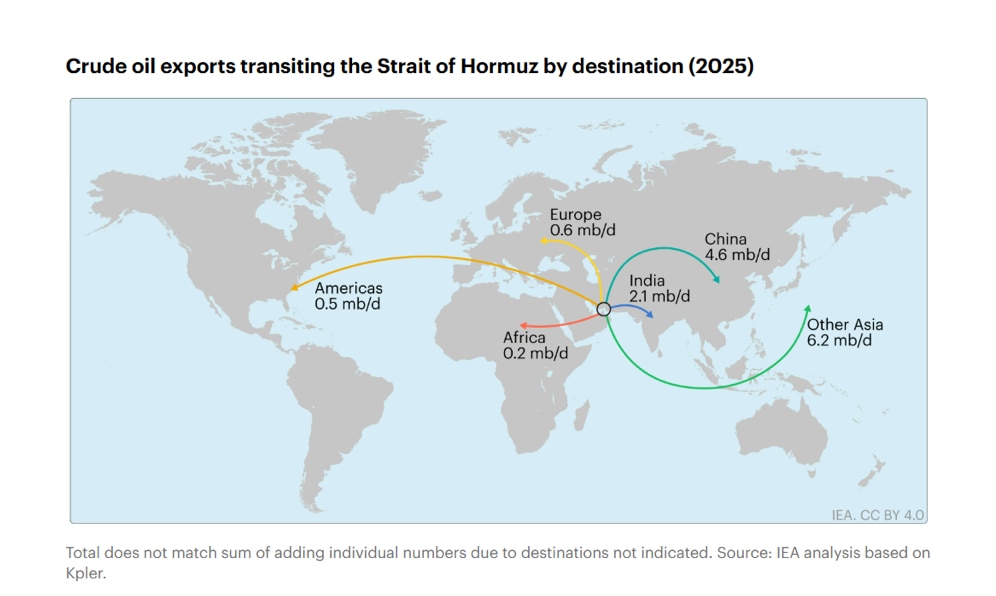
Bangladesh, Pakistan and India imported almost two-thirds of their LNG through the Strait in 2025, making them particularly vulnerable to any disruption in transit flows. Across ASEAN, around 17% of natural gas supply comes from the Middle East, translating to a 3% disruption in consumption, a figure that, while more contained than the oil shock, still carries significant consequences for power generation and industrial activity. In India, the exposure runs across both LNG – which powers grids and industry – and LPG, the bottled gas on which over 330 million households in India depend for cooking. With public-sector oil companies now racing to lock in 2.2 million tonnes of annual LPG supply from the United States, a crisis born in the Persian Gulf is quietly redrawing the map of India's long-term energy partnerships.

Are policymakers prioritizing short-term protection over long-term transition?

Geopolitical disruptions to fossil fuel supply chains produce a dual effect: reinforcing the strategic case for diversifying energy systems and accelerating domestic renewables, while, at the same time, increasing short-term reliance on fossil fuels. Rising political pressure to protect consumers is driving a resurgence in fossil fuel subsidies and reducing fiscal space for clean energy investment. Broad measures, such as fuel subsidies, tax reductions and price caps, can ease inflation temporarily, but they are fiscally costly, often regressive in distribution and difficult to phase out once implemented. Malaysia's monthly fuel subsidy bill, for example, has surged fivefold since the crisis began. The risk is not a short-term emissions bump, but the fact that emergency measures can become permanent fixtures, crowding out the very investments needed to prevent the next crisis.

Governments across Asia are combining price controls with supply-side interventions to manage the shock. In South Korea, authorities have imposed fuel price caps, extended fuel tax cuts and lifted restrictions on coal-fired generation. India has directed coal plants to operate at maximum capacity, leveraging domestic reserves to stabilize electricity supply. Bangladesh, Thailand and Viet Nam have also increased coal outputs as energy security concerns mount. Across the region, some countries have introduced four-day working weeks for civil servants and raised office temperature limits to curb electricity demand – measures that speak to the breadth and urgency of the supply squeeze.

The pattern is consistent: reach for what is available, affordable and controllable. Yet not all countries are equally exposed. Viet Nam's rapid expansion of solar generation in recent years has provided a meaningful buffer, illustrating that the countries that moved earliest on renewables are proving most resilient. Similarly, China appears to be somewhat shielded from Middle East conflict-driven price shocks by its significant energy reserves, diversified energy supply and rapidly expanding renewable energy sector, which together reduce its dependence on Middle Eastern oil. This lesson will not be lost on policymakers.

Across ASEAN, analysis suggests that replacing planned gas capacity with solar and storage solutions could save the region up to $4 billion by 2030 – a figure that takes on new significance when set against spiralling fossil fuel import bills.

How do recent disruptions in oil markets reinforce the case for clean fuels?

Clean fuels can enhance resilience to geopolitical shocks when they are produced from domestic resources, such as renewable electricity or local biogenetic feedstocks and residues. This is prompting governments across Asia and the EU to reassess biofuel blending mandates and broader clean-fuel strategies through an energy-security lens. In China, for instance, the top energy regulator has pledged to accelerate the development of its hydrogen industry and leverage cheaper inputs, such as homegrown wind and solar.

While infrastructure constraints remain, sustained volatility has historically accelerated structural shifts by mobilizing policy and investment. Continued instability could, therefore, reshape fuel economics and trade flows, strengthening the case for clean fuels, as explored in the World Economic Forum’s Future of Clean Fuels initiative. Analysis from the recently published Fuelling the Future Whitepaper shows that biofuels have already reduced transport fuel import dependence by 5–15% in several importing countries, illustrating their capacity to buffer external shocks.

The forces at play across Asia, including geopolitical exposure, fossil-fuel dependency and the pull of short-term fixes, are precisely what the forthcoming 2026 Energy Transition Index (ETI) captures in detail. The ETI offers a timely framework for understanding how countries are balancing security, affordability and sustainability and where the most ground remains to be covered.