

惯性聚合 高效追踪和阅读你感兴趣的博客、新闻、科技资讯
阅读原文 在惯性聚合中打开

推荐订阅源

AI
AI
Cloudbric
Cloudbric
Schneier on Security
V2EX - 技术
V2EX - 技术
N
News and Events Feed by Topic
Hacker News: Ask HN
Hacker News: Ask HN
L
LINUX DO - 最新话题
V
Visual Studio Blog
奇客Solidot–传递最新科技情报
奇客Solidot–传递最新科技情报
freeCodeCamp Programming Tutorials: Python, JavaScript, Git & More
W
WeLiveSecurity
博客园 - 司徒正美
Jina AI
Jina AI
S
Secure Thoughts
罗磊的独立博客
Hugging Face - Blog
Hugging Face - Blog
有赞技术团队
有赞技术团队
WordPress大学
WordPress大学
Security Archives - TechRepublic
博客园 - 三生石上(FineUI控件)
The Last Watchdog
The Last Watchdog
S
Security @ Cisco Blogs
S
SegmentFault 最新的问题
Attack and Defense Labs
Exploit-DB.com RSS Feed
钛媒体:引领未来商业与生活新知
钛媒体:引领未来商业与生活新知
SecWiki News
SecWiki News
Google DeepMind News
T
Troy Hunt's Blog
H
Heimdal Security Blog
C
CXSECURITY Database RSS Feed - CXSecurity.com
N
News and Events Feed by Topic
雷峰网
雷峰网
Last Week in AI
Last Week in AI
IT之家
IT之家
Project Zero
Project Zero
O
OpenAI News
腾讯CDC
The Hacker News
The Hacker News
L
Lohrmann on Cybersecurity
T
Tenable Blog
博客园_首页
C
Cisco Blogs
酷 壳 – CoolShell
酷 壳 – CoolShell
S
Schneier on Security
Scott Helme
Scott Helme
cs.CL updates on arXiv.org
人人都是产品经理
人人都是产品经理
P
Privacy International News Feed
OSCHINA 社区最新新闻
OSCHINA 社区最新新闻

World Economic Forum

How giving gorillas digital wallets can help finance nature Why is leadership a strategic investment for philanthropy? Counting the many costs of the global mental health burden What we learned from the 2026 World Bank Spring Meetings Crop protection is at risk. How innovation can help Here's a playbook for boards on how to govern agentic AI Why connected data makes AI decision-ready for sustainability 3 ways better data practices are reshaping financial supervision What technology convergence looks like in practice 7 reasons the old order broke — and how it might be repaired How governments can make agentic AI re  ? Current and future uses of RNA, including mRNA vaccines Real-time deepfakes are rewriting the rules of child safety Electrification trend ‘unmistakeable’ – and more energy stories From smallpox to the common cold: A brief history of vaccines Saudi Arabia's new AI-powered sustainability platform could unlock $20 billion by 2030 Here are 6 ways that climate change is affecting sports around the world This crisis could be an opportunity for the energy transition Middle East war: 6 ways countries are responding to the historic energy shock Nature can teach us about leadership and building resilience How did the Strait of Hormuz become so important, and will it stay that way? Yes/Cities: Helping global cities become more resilient, sustainable and prosperous Healthy ageing in APAC: The role of the influenza vaccine Risk management, renewables and a rocky road ahead: Spring Meetings takeaways Japan in a world of rising middle powers EU plans to offset Iran war's energy impact, and other climate and nature news 3 cities leading on green investment for economic growth The coffee industry is making the case for climate insurance The ocean is now a subprime asset, so we need a sustainable blue economy 5 leaders on today’s growth dilemmas and how to navigate them What helps purpose-driven, early-stage start-ups scale? Why trust is key to the EU's Empowering Consumers Directive The $3 trillion maintenance gap is burning money and the planet Surging AI needs and geopolitical supply shocks renew attention on nuclear energy 5 things to know before interacting with digital assets Frontiers Planet Prize: 25 solutions for planetary crises How the Iran war is disrupting India's steel production What's needed for growth in the new economy? Why we need a humanitarian truce is Sudan Freedom of expression under attack: How do we protect the media? Why companies – and nations – should create an AI culture Anthropic’s Mythos moment: how frontier AI is redefining cybersecurity Discover this week's must-read finance stories 'Godfather of AI' Yoshua Bengio on why AI can behave unpredictably (and what needs to change) Everyone talks about critical thinking. Here's how schools should actually teach it The top international trade stories to know this month The big chart: How oil prices have reacted to world events since the 1980s Why AI needs digital public infrastructure to deliver for citizens What AI in education needs next: Lessons from youth leaders across five countries How to scale clean hydrogen to meet energy security needs Meet the Young Global Leaders Class of 2026 Ventures with blue carbon solutions for coastal restoration How peer-led reskilling is helping bridge the skills gap in East Africa China's lessons on the energy sector’s nature-positive transition Here's how Japan's green materials sector is thriving The Strait of Hormuz crisis: Rewriting the future of AI Systemic risk is the hidden tax on growth. Here's how insurance can help build economic resilience Earth Day: What is it, when is it and why is it important? The Rayner plot: What it tells us about the future of jobs This is why we’ll feel the economic effects of this war for a while How energy and finance leaders are approaching climate investment in 2026 How quantum technologies are being tested to strengthen energy systems How to think about ‘safe’ withdrawal rates in a changing global economy Is collective cyber defence the future of port security? Learnings from a Dutch initiative Cyberattacks target US infrastructure, and other cybersecurity news Rethinking workplace energy: Why our assumptions can lead to burnout What could an international panel to tackle inequality achieve? Why climate action matters for healthy longevity Workforce health is the bedrock of global supply chains. Here's how to protect it Southeast Asia may be a distinct region but its risks affect each country differently 5 ways to grow a business mindset in international development How companies can finally cut Scope 3 emissions Here's how to get the $7 trillion AI hardware buildout right Leaders are moving from systems of record to systems of work G7 One Health Summit launches global diagnostics initiative, and other health stories What stopping war-risk insurance in the Strait of Hormuz tells us Why leaders must transform cyber resilience measurement AI can help create comparability and scale impact investing What's in store for the future of multilateralism? Why food waste is a $540 billion opportunity hiding in plain sight What Afghanistan can teach us about strategic foresight This is how we use generative AI on Forum Stories How cities are turning urban complexity into coherent climate plans How non-profits and governments use data to drive real system change How demographics, not AI, will redefine the labour market Three lessons on the energy transition in an age of crisis NFL players: Why financial literacy is a game-changer for student-athletes 3 ways Africa can maximize the value of its critical minerals and finance its future What leaders are saying about the new geopolitics of energy The financial system is rebooting. Stakeholders must adapt Cancer care innovation is reshaping resilience in Japan The hidden struggle of employed youth in Africa How markets and missions are becoming allies for impact What’s changing in frontier tech – from geopolitics to AI and energy Why stablecoins are quickly becoming a geopolitical issue How public-private collaboration can help close the global gender gap It’s time to start treating AI infrastructure as critical infrastructure 5 effective choices to turn workplace well-being into a competitive advantage How to strengthen collaboration to tackle infectious disease Why the AI economy can’t rely on a single digital Suez
How responsibly gathered and used data helps healthy ageing
Daniel Mahad · 2026-05-19 · via World Economic Forum
  • Wearable devices are not only personal health tools, they could become part of a broader digital infrastructure for healthy ageing.
  • Combined with traditional assessments, they can generate timely, real-world information about how people age, what puts them at risk of illness and where support is most needed.
  • Used responsibly, digital device data could support healthy ageing, reduce pressure on health systems and build resilience.

What if the device on your wrist could reveal more to you than how many steps you took today or how well you slept last night? What if it could also tell you how fast your body is ageing?

This is no longer science fiction. The same wearable devices people already use to track activity, heart rate and sleep can generate signals that may help estimate biological age – a measure of how the body is functioning. This matters because biological age may say more than birth date alone about a person’s resilience, risk of frailty and likelihood of remaining healthy and independent over time.

This does not mean a smartwatch can estimate a person’s “true age” with perfect precision. But it does suggest something important: Consumer wearables, used responsibly, could evolve from fitness gadgets into tools that support healthy longevity at scale.

From birth date to ‘body age’

Chronological age is a simple measure of the number of years since birth. Biological age is different. It aims to capture how much wear and tear the body has accumulated and how well its systems are functioning relative to what might be expected at a given age.

Traditionally, biological age has been estimated using blood tests, specialized laboratory methods or DNA-based measures. These approaches can be scientifically powerful, but they are also expensive, time-intensive and difficult to scale across whole populations.

Over the past decade, however, researchers have shown that ageing also leaves patterns in everyday behaviour and physiology – from how people move, how regularly they sleep and how variable their activity levels are, to how well they recover from physical stress. Using large datasets, scientists have built “ageing clocks” that estimate biological age from these kinds of signals.

In one study of US adults, a simple model based on age, maximum daily step count and variation in steps across a week predicted a widely used blood-based biological age score and was more strongly associated with mortality than that blood-based score itself. In older adults undergoing hospital rehabilitation, the same movement-based score was more closely linked to frailty, muscle strength and independence in daily activities than chronological age.

In other words, people with higher and more varied activity patterns tended to receive younger estimated biological age scores than more sedentary peers.

A broader body of research on the digital biomarkers of ageing points in the same direction. Signals such as sleep duration and regularity, daily step counts, gait speed, heart rate patterns, blood pressure and estimated cardiorespiratory fitness all appear to change with age and help predict later health outcomes. Many of these signals can already be captured by sensors inside consumer devices.

Why this matters now

Health systems are struggling to keep up with rising levels of chronic disease, disability and population ageing. But most health data is still collected only occasionally, for example at clinic visits or after illness has already progressed.

Wearables offer something different. They can collect information continuously, non-invasively and in real-world settings – often at low marginal cost. This means they could detect subtle day-to-day changes and early departures from a person’s usual baseline long before a single clinic measurement would.

This creates an opportunity to think about healthy longevity not simply as extending lifespan, but as preserving function, independence and quality of life for longer – optimizing healthspan. If ageing-related changes can be measured continuously and detected earlier, action can also happen earlier.
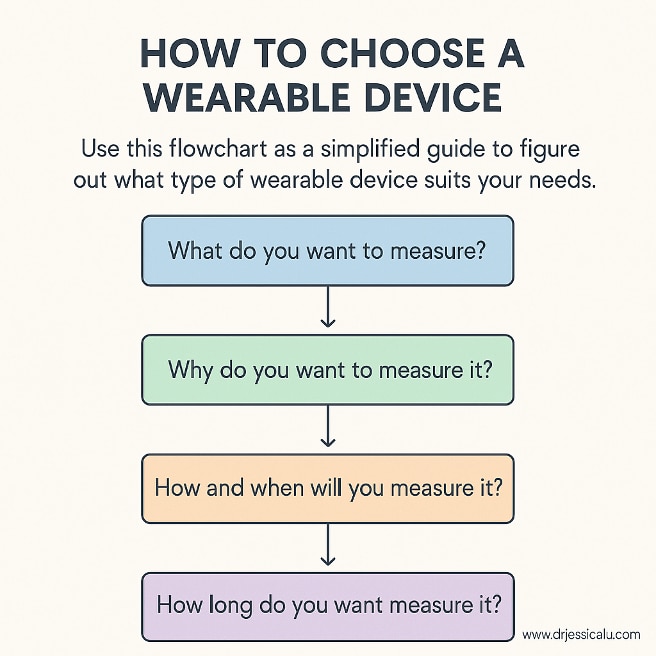
Flowchart with questions to ask when choosing a wearable device that supports healthy ageing.

Four key questions to ask yourself when you are choosing a wearable device. Image: Dr Jessica Lu

Consumer wearables are already widely used in many parts of the world. A practical guide for researchers and clinicians found that mainstream devices such as the Apple Watch, Fitbit, Garmin and Oura Ring can, when selected systematically for the intended use case, meet reasonable standards of accuracy, precision and usability for some cardiovascular and activity-related measures in relatively healthy adults.

The point is not that every commercial device is equally good at every measurement, but that, for some questions and under some conditions, consumer devices can already generate useful, scalable data.

From personal tracking to public value

And if wearable signals can help estimate biological age and detect changes in function, their value may extend beyond personal wellness.

In clinical care, digital measures could complement rather than replace traditional assessments. In geriatric rehabilitation, for example, combining blood-based ageing measures with activity data from wearables could help clinicians identify patients at higher risk of poor recovery and target rehabilitation resources more effectively.

At the population level, appropriately anonymized and governed wearable data could also help policy-makers understand how ageing trajectories differ across regions, occupations and social groups. If societies can observe in near real time how environments, working conditions and policies affect the pace of ageing, they may be better equipped to support longer, healthier working lives.

Guardrails for wearables data use

This potential is significant, but so are the risks. The size of the market is expanding, which means the user numbers are also increasing.
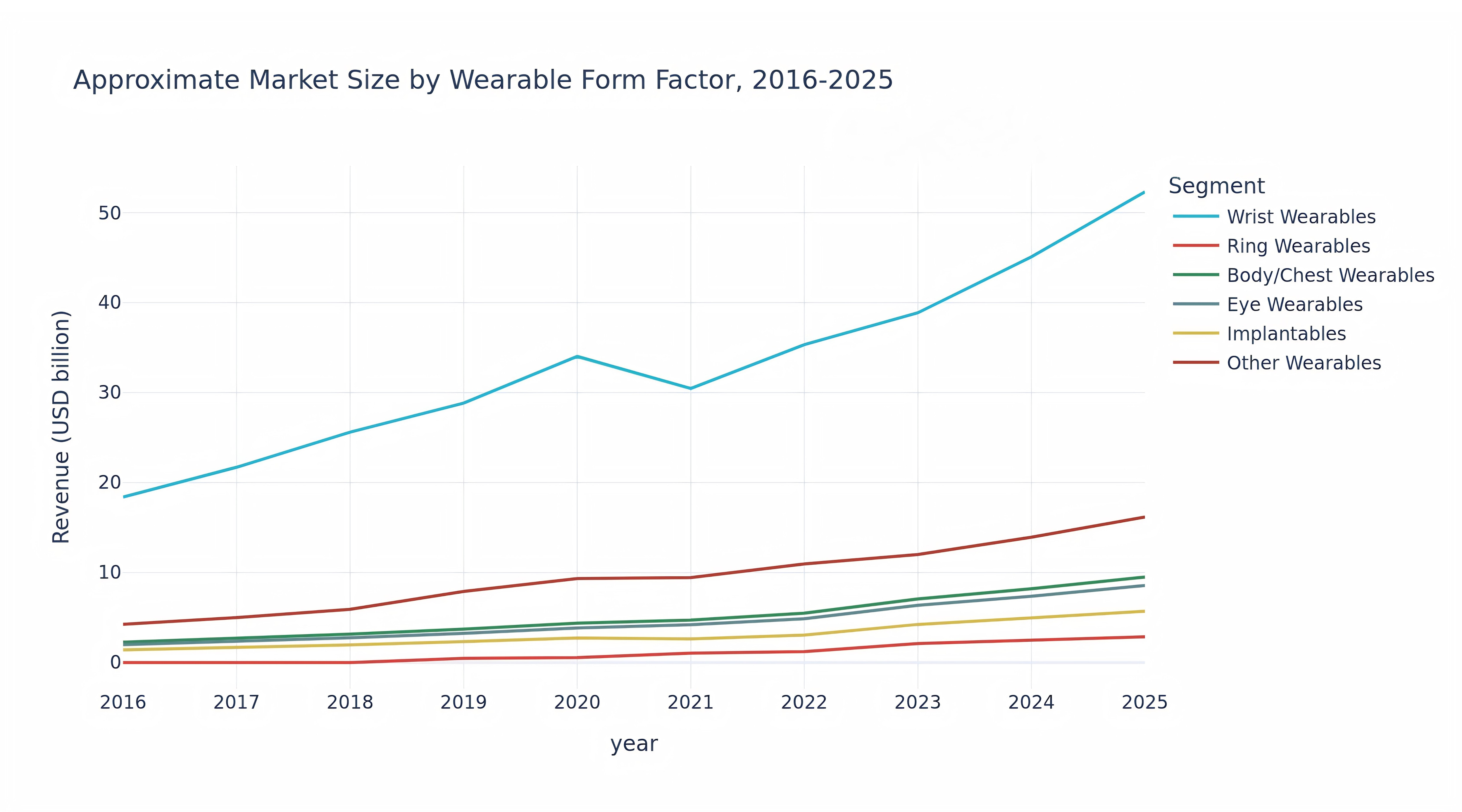
Wearable market trends globally.

The global wearables market is growing. Image: Data gathered and chart compiled by authors from Wissen Research, Grand View Research and Markets and Markets

And so, there are three main issues that policy-makers should consider when building guardrails for the responsible use of wearables data:

1. Validation

Many digital biomarkers of ageing have been developed in specific populations, often in high-income countries, and not all have been rigorously tested against meaningful clinical outcomes. Without validation across diverse populations, digital ageing estimates may be misleading or biased.

2. Equity

These tools will fall short if they are available only to those who can afford the latest devices or who already have high levels of digital literacy. Wearables and related systems must be affordable, durable and usable across different settings, including low-resource environments.

3. Governance

Biological age estimates derived from wearables involve sensitive health information. Clear rules around data ownership, consent, privacy and acceptable use are essential, as is transparency about how algorithms are built, evaluated and updated.

The more useful question, then, is not whether a smartwatch can determine a person’s biological age perfectly. It is whether societies can use the signals embedded in everyday digital devices responsibly to support healthier ageing, reduce pressure on health systems and build more resilient futures.