

惯性聚合 高效追踪和阅读你感兴趣的博客、新闻、科技资讯
阅读原文 在惯性聚合中打开

推荐订阅源

S
Secure Thoughts
Recent Commits to openclaw:main
H
Heimdal Security Blog
SecWiki News
SecWiki News
H
Hacker News: Front Page
N
News | PayPal Newsroom
L
LINUX DO - 最新话题
N
News and Events Feed by Topic
TaoSecurity Blog
TaoSecurity Blog
AI
AI
C
Cybersecurity and Infrastructure Security Agency CISA
Scott Helme
Scott Helme
PCI Perspectives
PCI Perspectives
S
Securelist
Exploit-DB.com RSS Feed
Cyberwarzone
Cyberwarzone
A
Arctic Wolf
Forbes - Security
Forbes - Security
T
Tor Project blog
Spread Privacy
Spread Privacy
WordPress大学
WordPress大学
I
Intezer
Martin Fowler
Martin Fowler
Help Net Security
Help Net Security
P
Proofpoint News Feed
让小产品的独立变现更简单 - ezindie.com
Cisco Talos Blog
Cisco Talos Blog
Latest news
Latest news
博客园 - 司徒正美
W
WeLiveSecurity
奇客Solidot–传递最新科技情报
奇客Solidot–传递最新科技情报
V
V2EX
P
Palo Alto Networks Blog
Google DeepMind News
IT之家
IT之家
阮一峰的网络日志
阮一峰的网络日志
V
Vulnerabilities – Threatpost
Jina AI
Jina AI
S
Security Affairs
Hacker News - Newest:
Hacker News - Newest: "LLM"
Simon Willison's Weblog
Project Zero
Project Zero
T
Threatpost
P
Privacy International News Feed
人人都是产品经理
人人都是产品经理
cs.CL updates on arXiv.org
Application and Cybersecurity Blog
博客园 - Franky
Hugging Face - Blog
Hugging Face - Blog
Apple Machine Learning Research

World Economic Forum

What happened at the MC14 WTO meeting in Yaoundé How giving gorillas digital wallets can help finance nature Why is leadership a strategic investment for philanthropy? Counting the many costs of the global mental health burden What we learned from the 2026 World Bank Spring Meetings Crop protection is at risk. How innovation can help Here's a playbook for boards on how to govern agentic AI Why connected data makes AI decision-ready for sustainability 3 ways better data practices are reshaping financial supervision What technology convergence looks like in practice 7 reasons the old order broke — and how it might be repaired How governments can make agentic AI re  ? Current and future uses of RNA, including mRNA vaccines Real-time deepfakes are rewriting the rules of child safety Electrification trend ‘unmistakeable’ – and more energy stories From smallpox to the common cold: A brief history of vaccines Saudi Arabia's new AI-powered sustainability platform could unlock $20 billion by 2030 Here are 6 ways that climate change is affecting sports around the world This crisis could be an opportunity for the energy transition Middle East war: 6 ways countries are responding to the historic energy shock Nature can teach us about leadership and building resilience How did the Strait of Hormuz become so important, and will it stay that way? Yes/Cities: Helping global cities become more resilient, sustainable and prosperous Healthy ageing in APAC: The role of the influenza vaccine Risk management, renewables and a rocky road ahead: Spring Meetings takeaways Japan in a world of rising middle powers EU plans to offset Iran war's energy impact, and other climate and nature news 3 cities leading on green investment for economic growth The coffee industry is making the case for climate insurance The ocean is now a subprime asset, so we need a sustainable blue economy 5 leaders on today’s growth dilemmas and how to navigate them What helps purpose-driven, early-stage start-ups scale? Why trust is key to the EU's Empowering Consumers Directive The $3 trillion maintenance gap is burning money and the planet Surging AI needs and geopolitical supply shocks renew attention on nuclear energy 5 things to know before interacting with digital assets Frontiers Planet Prize: 25 solutions for planetary crises How the Iran war is disrupting India's steel production What's needed for growth in the new economy? Why we need a humanitarian truce is Sudan Freedom of expression under attack: How do we protect the media? Why companies – and nations – should create an AI culture Anthropic’s Mythos moment: how frontier AI is redefining cybersecurity Discover this week's must-read finance stories 'Godfather of AI' Yoshua Bengio on why AI can behave unpredictably (and what needs to change) Everyone talks about critical thinking. Here's how schools should actually teach it The top international trade stories to know this month The big chart: How oil prices have reacted to world events since the 1980s Why AI needs digital public infrastructure to deliver for citizens What AI in education needs next: Lessons from youth leaders across five countries How to scale clean hydrogen to meet energy security needs Meet the Young Global Leaders Class of 2026 Ventures with blue carbon solutions for coastal restoration How peer-led reskilling is helping bridge the skills gap in East Africa China's lessons on the energy sector’s nature-positive transition Here's how Japan's green materials sector is thriving The Strait of Hormuz crisis: Rewriting the future of AI Systemic risk is the hidden tax on growth. Here's how insurance can help build economic resilience Earth Day: What is it, when is it and why is it important? The Rayner plot: What it tells us about the future of jobs This is why we’ll feel the economic effects of this war for a while How energy and finance leaders are approaching climate investment in 2026 How quantum technologies are being tested to strengthen energy systems How to think about ‘safe’ withdrawal rates in a changing global economy Is collective cyber defence the future of port security? Learnings from a Dutch initiative Cyberattacks target US infrastructure, and other cybersecurity news Rethinking workplace energy: Why our assumptions can lead to burnout What could an international panel to tackle inequality achieve? Why climate action matters for healthy longevity Workforce health is the bedrock of global supply chains. Here's how to protect it Southeast Asia may be a distinct region but its risks affect each country differently 5 ways to grow a business mindset in international development How companies can finally cut Scope 3 emissions Here's how to get the $7 trillion AI hardware buildout right Leaders are moving from systems of record to systems of work G7 One Health Summit launches global diagnostics initiative, and other health stories What stopping war-risk insurance in the Strait of Hormuz tells us AI can help create comparability and scale impact investing What's in store for the future of multilateralism? Why food waste is a $540 billion opportunity hiding in plain sight What Afghanistan can teach us about strategic foresight This is how we use generative AI on Forum Stories How cities are turning urban complexity into coherent climate plans How non-profits and governments use data to drive real system change How demographics, not AI, will redefine the labour market Three lessons on the energy transition in an age of crisis NFL players: Why financial literacy is a game-changer for student-athletes 3 ways Africa can maximize the value of its critical minerals and finance its future What leaders are saying about the new geopolitics of energy The financial system is rebooting. Stakeholders must adapt Cancer care innovation is reshaping resilience in Japan The hidden struggle of employed youth in Africa How markets and missions are becoming allies for impact What’s changing in frontier tech – from geopolitics to AI and energy Why stablecoins are quickly becoming a geopolitical issue How public-private collaboration can help close the global gender gap It’s time to start treating AI infrastructure as critical infrastructure 5 effective choices to turn workplace well-being into a competitive advantage How to strengthen collaboration to tackle infectious disease Why the AI economy can’t rely on a single digital Suez
Why leaders must transform cyber resilience measurement
Humberto Luiz Ribeiro da Silva · 2026-04-09 · via World Economic Forum
  • Recovery capabilities after an incident are no longer sufficient on their own to measure an organization’s cyber resilience.
  • Increasingly sophisticated cybercrime and inherited third-party risk are driving leaders to rethink how they govern cyber risk.
  • Cyber resilience should now be measured further upstream, in terms of preparedness and early mitigation, as well as recovery.

As cyber resilience gains greater prominence in board-level and C-level discussions worldwide, leaders increasingly recognize cyber risk as a core business, operational and governance issue.

However, cyber resilience has traditionally been measured mainly at the point of recovery: how quickly systems can be restored, how effectively crisis teams can respond, and how well organizations can contain damage after an incident.

While those capabilities matter, in a world of artificial intelligence (AI)-enabled attacks, expanding digital dependencies and rising third-party exposure, leaders need a broader approach.

Cyber resilience should now be measured further upstream: first as a capacity for risk mitigation and preparedness – the ability to reduce the probability, scale and business impact of disruption before damage occurs – and only then as a capacity for recovery when prevention falls short.

Cyber incidents a costly reality for organizations

That shift towards focusing on preparedness and risk mitigation is increasingly urgent because cyber incidents are now a daily reality for organizations of all sizes worldwide. The World Economic Forum’s Global Cybersecurity Outlook 2026 describes exactly this kind of fast-moving environment, shaped by AI-driven risk, geopolitical fragmentation and widening cyber inequity.
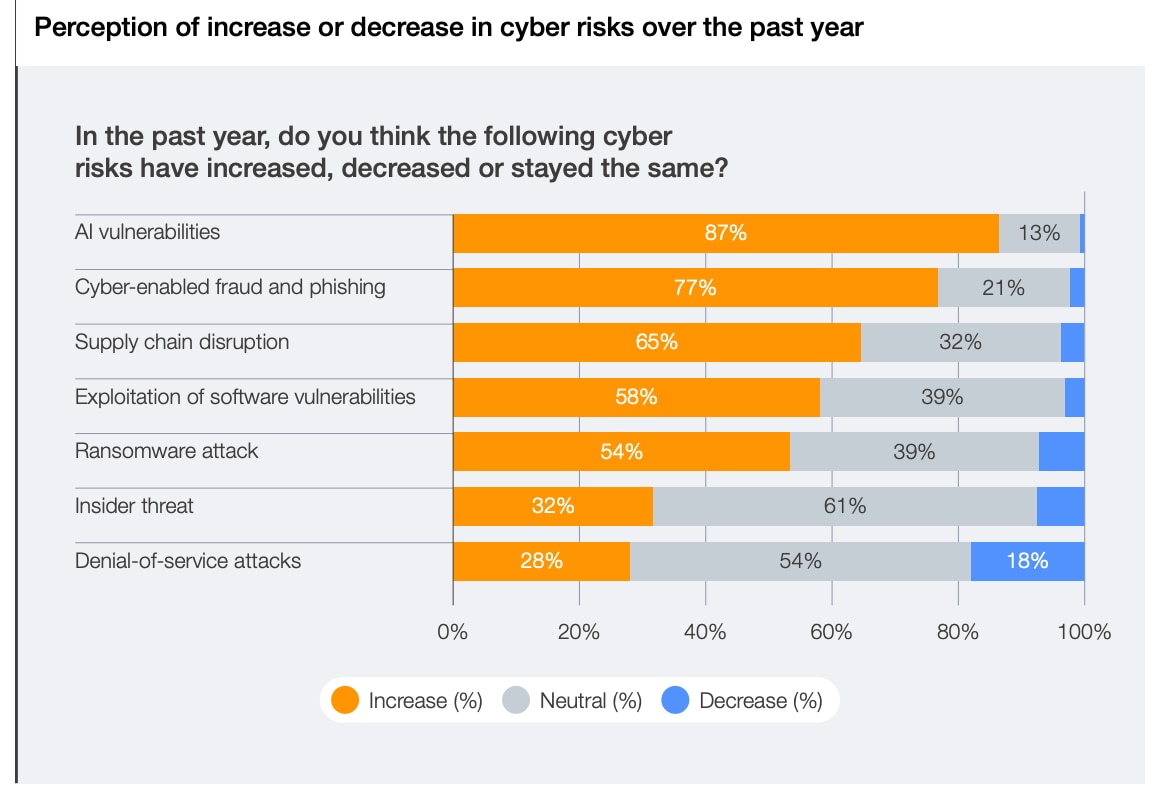
Perception of increase or decrease in cyber risks over the past year

Perception of increase or decrease in cyber risks over the past year Image: World Economic Forum

As recovery is usually far more costly than preparation, there’s also strong economic argument to changing this mindset. IBM’s 2025 Cost of a Data Breach Report found that the global average cost of a breach was $4.4 million, while faster identification and containment were key drivers of lower losses.

Organizations using AI and automation extensively shortened breach lifecycles by 80 days and reduced average breach costs by $1.9 million, the report added. Public cases make the asymmetry even clearer: Maersk estimated the NotPetya attack cost the company $200-300 million in business interruption and recovery.

How measurement of cyber resilience must evolve

The lesson for leaders is straightforward: resilience is not only about surviving shocks, but about reducing the need for costly recovery in the first place. That is why cyber measurement now needs to evolve through four interconnected shifts.

A shift from static to dynamic

Occasional questionnaires and point-in-time reviews are no longer enough for digital environments shaped daily by new architectures, suppliers, software updates, AI deployments and exposed identities.

Modern resilience measurement should function as a continuous monitoring discipline, not merely as a periodic audit. The UK’s National Cyber Security Centre offers a useful example through its Active Cyber Defence programme, which provides ongoing services and automated checks to reduce harm from commodity attacks at scale.

The broader principle is simple: measurement must keep pace, in real time, with the environment it is meant to protect.

A shift from declarative to observable

As cyber risk becomes more complex and fast-moving, cyber resilience cannot rely only on interviews, self-assessments or policy documents; it also needs observable evidence that systems, controls, processes and teams are working effectively in practice.

Leaders and cyber teams increasingly rely on external intelligence to strengthen preparedness before incidents unfold. That means externally assessing internet-facing vulnerabilities, unintended exposures and signs of emerging threats for earlier warning.

The timing advantage matters: obtaining outside-in risk intelligence before internal tools detect signs of compromise can give defenders a chance to act before a threat reaches the perimeter.

Observability is not about waiting for an internal alert to confirm damage, but about using external results – from vulnerability scanning to leak-site and dark web monitoring – to identify where the organization may already be vulnerable, exposed or being targeted, in order to act before compromise becomes disruption.

A shift from compliance to actionable

Compliance remains useful, especially in regulated sectors. But compliance scores alone do not protect the organization. Good measurement findings trigger better management decisions such as which vulnerabilities to fix first, which suppliers require escalation and which assets should be taken out of exposure.

Established incident-response guides and frameworks make this prioritization logic explicit: governing, identifying and protecting are not separate from response and recovery; they help prevent incidents, reduce their impact and improve incident management over time. Measurement has real value only when it informs prioritization, investment and remediation.

A shift from individual to systemic

Many organizations still assess cyber resilience as if risk stopped at their own perimeter, despite growing evidence that resilience depends on coordination, information-sharing and visibility across the wider ecosystem.

A 2025 Verizon report analysed 22,052 real-world security incidents and found third-party involvement in 30% of breaches, roughly double the previous year. That means resilience measurement must occur internally, but also extend across vendors, service providers, software dependencies, exposed credentials and leaked digital assets circulating outside formal boundaries.

SWIFT’s Customer Security Programme is a practical example, combining mandatory controls and attestation to strengthen trust in the financial ecosystem rather than leaving each participant to manage risk in isolation.

Information sharing and analysis centres, or ISACs, offer another practical model, enabling organizations in the same sector to share intelligence and strengthen collective cyber resilience. In interconnected economies, resilience must be measured and managed where disruption can propagate.

Frameworks to support consistent cyber measurement

Organizations can rely on mature frameworks and standards to support consistent measurement across all four shifts. For example, NIST CSF 2.0 provides a practical structure for governing, identifying, protecting, detecting, responding to and recovering from cyber risk. MITRE ATT&CK adds a knowledge base to help organizations map defenses against real-world adversary behavior. Together, these and other frameworks offer a common language across boards, security teams, suppliers and regulators.

Leading organizations are already shifting. Cyber resilience is no longer measured only by what happens after an incident, but by whether organizations are strengthening preparedness, reducing exposure, translating findings into action and addressing the systemic nature of digital risk.

In practice, four questions matter: Are we measuring dynamically? Are we observing operational effectiveness rather than declarations? Are our findings generating action? And does our monitoring extend beyond our perimeter to the broader ecosystem we depend on?

In 2026, organizations and governments that answer yes will be better positioned to prevent disruption, protect trust, reduce direct and indirect damage and accelerate digital innovation with greater confidence.

Discover

How the Forum helps leaders understand cyber risk and strengthen digital resilience