







Nature-related risk is now widely recognized but many organizations still struggle to identify where it will actually affect the business and therefore, where action will do most to reduce risk exposure.
A key reason is that the risk is often framed primarily in terms of state-of-nature metrics, including species abundance, ecosystem extent and condition. These measures are essential for conservation and remain central to regulation, permitting and social licence. They also provide an important evidence base for understanding and modelling ecosystem services.
However, they need to be complemented by information on ecosystem services and beneficiaries to show how ecological change translates into operational disruption, supply volatility or rising costs.
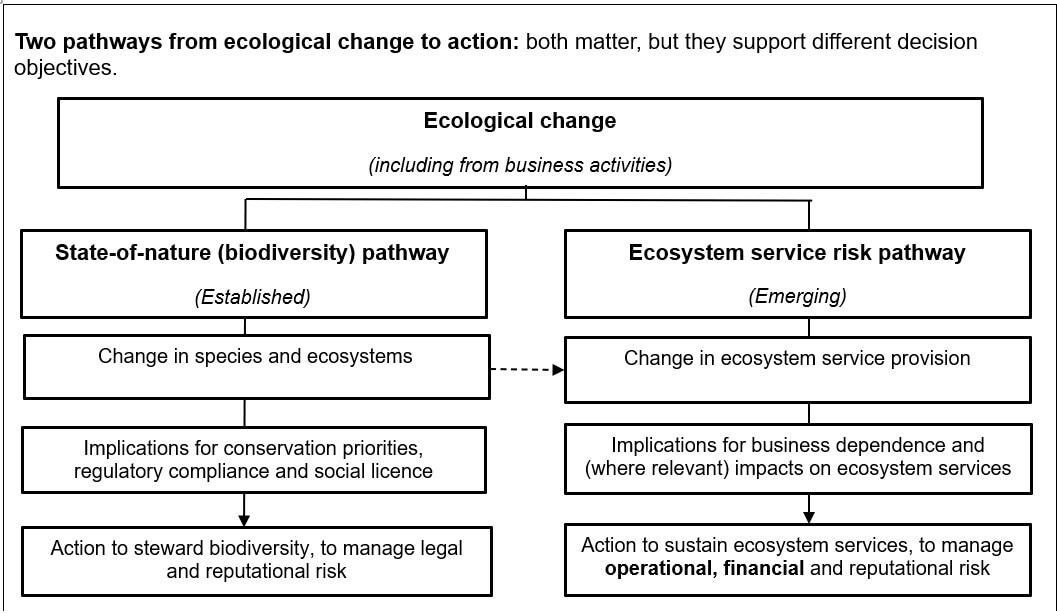
The ecosystem service pathway matters because this is one way nature-related risk becomes material: through water supply, soil stability, flood protection, climate regulation and other natural functions that support operations, supply chains and communities. When those services weaken, disruption follows.
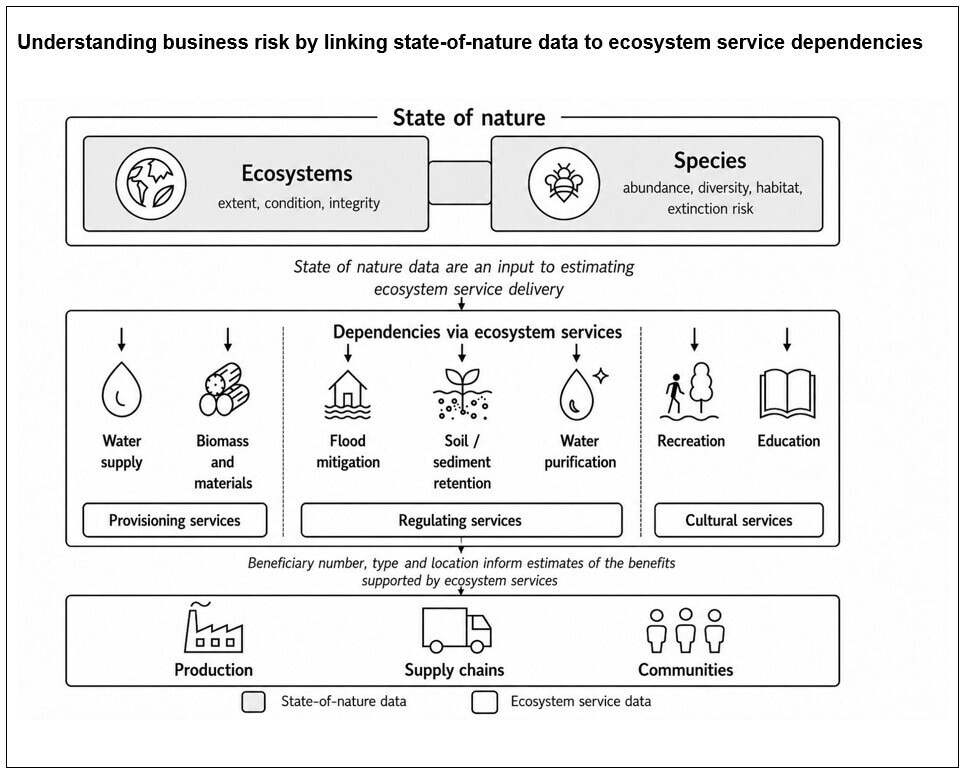
As important as state-of-nature metrics are, they are most decision-useful when linked to the ecosystem services they help sustain and the business activities and community values those services support.
Additional information on service provision and the number, type and location of beneficiaries is therefore also important to understanding business risk and opportunity.
Without visibility over these pathways, companies risk directing capital and effort toward nature-related actions that are valuable but do not materially reduce exposure.
Biodiversity and ecosystem condition underpin ecosystem productivity, resilience and the capacity to adapt to change. However, from a business perspective, state-of-nature indicators alone do not reveal where risk is building.
That risk may become material when changes in natural systems affect the services people and economies rely on. Declining vegetation cover can reduce water quality and reliability. Soil degradation can weaken productivity. The loss of coastal wetlands can increase physical damage from storms.
These are the pathways through which ecological change becomes business exposure – directly through physical risk and indirectly through impacts on communities, stakeholders and social licence.
That is why companies need to look beyond what nature is and understand what nature does.
Many organizations now accept that nature matters. Fewer know where it matters most to their business.
Without a clearer view of how risk arises, companies can focus on visible ecological changes while failing to address the natural processes most critical to business continuity and resilience. The result can be misallocation: investment where ecological importance is clear but not necessarily where business exposure is greatest.
The issue is not that state-of-nature information is unhelpful or that action for biodiversity is misplaced. Different objectives require different starting points. If the goal is conservation, then species, habitats and ecosystem status may be the right focus for prioritizing action.
If the goal is to reduce business risk exposure, companies need to understand which ecosystem services support their operations, supply chains and communities and how ecosystem change affects those services.
A mining example: when the risk sits upstream
Problem
A mine in a water-stressed catchment faces growing operational and community water risks due to declining water availability and quality.
Insight
A response framed around visible ecological impacts may focus on the asset boundary, for example, by protecting affected species or restoring habitat where impacts are most significant. That may be necessary, including for managing regulatory, permitting or broader nature-related transition risks but it may not address the main source of business exposure. If the objective is to reduce exposure to physical and transition risk more holistically, the key question becomes: what is shaping the water system on which the operation and downstream communities rely? The answer may lie upstream, in land-use change, vegetation loss, erosion or declining catchment condition beyond the site itself.
Decision change
That changes the response. Instead of concentrating only within the fence line, the company may need to work with landholders, water users, local authorities and other stakeholders to improve catchment condition, support coordinated stewardship and strengthen long-term water security. The decision is no longer based only on where ecological impacts are most significant or where biodiversity priorities are highest. It is based on where changes in ecosystem extent and condition are most likely to disrupt the services that support the operation and surrounding communities.
Nature-related risk is often spatially disconnected.
The ecological change that affects service supply may occur in one place, while its consequences are felt elsewhere. Water regulation depends on the upstream catchment condition. Coastal protection depends on ecosystems located between communities and the sea. Climate regulation depends on natural systems whose benefits extend far beyond the places where they occur.
This matters because companies often assess nature by what lies within their footprint. However, the services they depend on may be shaped by wider landscapes, shared resources and actors well beyond their direct operational control.
That is why effective responses often require broader forms of collaboration: with Indigenous Peoples, communities, suppliers, landholders, governments, financial institutions and other businesses. It also means prioritizing better spatial data and analysis to identify where service flows originate, who depends on them and where disruption could become material.
A services-based view of nature risk gives companies a clearer basis for action.
It changes how they manage risk, where they invest, who they partner with and what information they prioritize. It helps them see when action inside the fence line is enough and when resilience depends on working beyond it. Fundamentally, it should influence core business strategy.
Adopting a services-based approach does not replace biodiversity goals or negate the links between the state of nature, ecosystem service availability and business risk. It also does not remove the need for judgement.
Tracing ecosystem service pathways remains complex and context-specific and better data and analytical capability are still needed for companies to understand their nature-related dependencies, impacts, risks and opportunities. Public-private collaboration will often be essential, particularly where risks are shared across landscapes and communities.
Nevertheless, the direction is clear. Companies will make better decisions to reduce business risk when they understand how ecological change affects the natural functions that support social and economic activity and where those functions are becoming fragile.
Nature matters to business. What organizations must worry about now is how changing ecosystem conditions are affecting the services that support their operations, supply chains and surrounding communities. Determining that will make it clear where action can most effectively reduce risk exposure.
此内容由惯性聚合(RSS阅读器)自动聚合整理,仅供阅读参考。 原文来自 — 版权归原作者所有。