



惯性聚合 高效追踪和阅读你感兴趣的博客、新闻、科技资讯
阅读原文 在惯性聚合中打开

推荐订阅源

大猫的无限游戏
大猫的无限游戏
Webroot Blog
Webroot Blog
cs.AI updates on arXiv.org
T
Threat Research - Cisco Blogs
V2EX - 技术
V2EX - 技术
L
LINUX DO - 热门话题
Google DeepMind News
Recorded Future
Recorded Future
S
Schneier on Security
I
InfoQ
Cyber Security Advisories - MS-ISAC
cs.CV updates on arXiv.org
The GitHub Blog
The GitHub Blog
S
Security @ Cisco Blogs
O
OpenAI News
W
WeLiveSecurity
Vercel News
Vercel News
阮一峰的网络日志
阮一峰的网络日志
Simon Willison's Weblog
人人都是产品经理
人人都是产品经理
Cloudbric
Cloudbric
The Last Watchdog
The Last Watchdog
The Hacker News
The Hacker News
Google Online Security Blog
OSCHINA 社区最新新闻
OSCHINA 社区最新新闻
GbyAI
GbyAI
NISL@THU
NISL@THU
T
Tailwind CSS Blog
V
Visual Studio Blog
PCI Perspectives
PCI Perspectives
K
KPMG report finds enterprise disconnect between AI and its ROI | CIO
Jina AI
Jina AI
D
DataBreaches.Net
B
Blog RSS Feed
N
News and Events Feed by Topic
N
News and Events Feed by Topic
H
Heimdal Security Blog
cs.CL updates on arXiv.org
腾讯CDC
Latest news
Latest news
V
Vulnerabilities – Threatpost
Hacker News: Ask HN
Hacker News: Ask HN
WordPress大学
WordPress大学
V
V2EX
aimingoo的专栏
aimingoo的专栏
博客园 - 司徒正美
Apple Machine Learning Research
D
Darknet – Hacking Tools, Hacker News & Cyber Security
The Register - Security
Help Net Security
Help Net Security

World Economic Forum

How giving gorillas digital wallets can help finance nature Why is leadership a strategic investment for philanthropy? Counting the many costs of the global mental health burden What we learned from the 2026 World Bank Spring Meetings Crop protection is at risk. How innovation can help Here's a playbook for boards on how to govern agentic AI Why connected data makes AI decision-ready for sustainability 3 ways better data practices are reshaping financial supervision What technology convergence looks like in practice 7 reasons the old order broke — and how it might be repaired How governments can make agentic AI re  ? Current and future uses of RNA, including mRNA vaccines Real-time deepfakes are rewriting the rules of child safety Electrification trend ‘unmistakeable’ – and more energy stories From smallpox to the common cold: A brief history of vaccines Saudi Arabia's new AI-powered sustainability platform could unlock $20 billion by 2030 Here are 6 ways that climate change is affecting sports around the world This crisis could be an opportunity for the energy transition Middle East war: 6 ways countries are responding to the historic energy shock Nature can teach us about leadership and building resilience How did the Strait of Hormuz become so important, and will it stay that way? Yes/Cities: Helping global cities become more resilient, sustainable and prosperous Healthy ageing in APAC: The role of the influenza vaccine Risk management, renewables and a rocky road ahead: Spring Meetings takeaways Japan in a world of rising middle powers EU plans to offset Iran war's energy impact, and other climate and nature news 3 cities leading on green investment for economic growth The coffee industry is making the case for climate insurance The ocean is now a subprime asset, so we need a sustainable blue economy 5 leaders on today’s growth dilemmas and how to navigate them What helps purpose-driven, early-stage start-ups scale? Why trust is key to the EU's Empowering Consumers Directive The $3 trillion maintenance gap is burning money and the planet Surging AI needs and geopolitical supply shocks renew attention on nuclear energy 5 things to know before interacting with digital assets Frontiers Planet Prize: 25 solutions for planetary crises How the Iran war is disrupting India's steel production What's needed for growth in the new economy? Why we need a humanitarian truce is Sudan Freedom of expression under attack: How do we protect the media? Why companies – and nations – should create an AI culture Anthropic’s Mythos moment: how frontier AI is redefining cybersecurity Discover this week's must-read finance stories 'Godfather of AI' Yoshua Bengio on why AI can behave unpredictably (and what needs to change) Everyone talks about critical thinking. Here's how schools should actually teach it The top international trade stories to know this month The big chart: How oil prices have reacted to world events since the 1980s Why AI needs digital public infrastructure to deliver for citizens What AI in education needs next: Lessons from youth leaders across five countries How to scale clean hydrogen to meet energy security needs Meet the Young Global Leaders Class of 2026 Ventures with blue carbon solutions for coastal restoration How peer-led reskilling is helping bridge the skills gap in East Africa China's lessons on the energy sector’s nature-positive transition Here's how Japan's green materials sector is thriving The Strait of Hormuz crisis: Rewriting the future of AI Systemic risk is the hidden tax on growth. Here's how insurance can help build economic resilience Earth Day: What is it, when is it and why is it important? The Rayner plot: What it tells us about the future of jobs This is why we’ll feel the economic effects of this war for a while How energy and finance leaders are approaching climate investment in 2026 How quantum technologies are being tested to strengthen energy systems How to think about ‘safe’ withdrawal rates in a changing global economy Is collective cyber defence the future of port security? Learnings from a Dutch initiative Cyberattacks target US infrastructure, and other cybersecurity news Rethinking workplace energy: Why our assumptions can lead to burnout What could an international panel to tackle inequality achieve? Why climate action matters for healthy longevity Workforce health is the bedrock of global supply chains. Here's how to protect it Southeast Asia may be a distinct region but its risks affect each country differently 5 ways to grow a business mindset in international development How companies can finally cut Scope 3 emissions Here's how to get the $7 trillion AI hardware buildout right Leaders are moving from systems of record to systems of work G7 One Health Summit launches global diagnostics initiative, and other health stories What stopping war-risk insurance in the Strait of Hormuz tells us Why leaders must transform cyber resilience measurement AI can help create comparability and scale impact investing What's in store for the future of multilateralism? Why food waste is a $540 billion opportunity hiding in plain sight What Afghanistan can teach us about strategic foresight This is how we use generative AI on Forum Stories How cities are turning urban complexity into coherent climate plans How non-profits and governments use data to drive real system change How demographics, not AI, will redefine the labour market Three lessons on the energy transition in an age of crisis NFL players: Why financial literacy is a game-changer for student-athletes 3 ways Africa can maximize the value of its critical minerals and finance its future What leaders are saying about the new geopolitics of energy The financial system is rebooting. Stakeholders must adapt Cancer care innovation is reshaping resilience in Japan The hidden struggle of employed youth in Africa How markets and missions are becoming allies for impact What’s changing in frontier tech – from geopolitics to AI and energy Why stablecoins are quickly becoming a geopolitical issue How public-private collaboration can help close the global gender gap It’s time to start treating AI infrastructure as critical infrastructure 5 effective choices to turn workplace well-being into a competitive advantage How to strengthen collaboration to tackle infectious disease Why the AI economy can’t rely on a single digital Suez
The rise of cybersecurity as a strategic economic priority
Apisada Suwa · 2026-05-15 · via World Economic Forum
  • The cyber landscape is being reshaped by AI, geopolitical fragmentation and deepening interdependence, amplifying both opportunity and risk.
  • Cyber risks have become a systematic risk made visible by various converging forces.
  • Against this backdrop, leaders convened at the World Economic Forum’s Annual Meeting on Cybersecurity 2026 in Geneva last week to advance cooperation and shape a more resilient digital future.

Cybersecurity has become a systemic, economic and strategic imperative in an AI-driven, fragmented world. This was not a gradual evolution; it was a fundamental shift.

Nonetheless, this shift did not occur overnight, but accelerated over the past two decades. While the early 2000s saw the rise of the internet and initial cyber threats, a turning point emerged in the late 2000s and early 2010s, as attacks grew more organized and strategic, coinciding with deeper digitization of business and government systems. By the mid-2010s, large-scale incidents exposed the systemic nature of cyber risk, disrupting critical infrastructure and global supply chains.

In the 2020s, interconnected digital ecosystems, AI and mounting systemic pressures — including geopolitical tensions, natural disasters, and post-pandemic economic shifts — have profoundly redefined the landscape, making cyber risk pervasive, scalable and central to economic and societal stability.

Evidently, cyberattacks have been around for decades, so why are they now a central economic and national security priority?

Last week, at the World Economic Forum's Annual Meeting on Cybersecurity 2026, a flagship event during Geneva Cyber Week, global leaders convened to examine this transformation and what it means for the future of economies, societies and global cooperation. Here are some of the main takeaways from that event.

From technical to systemic economic threat

Cybersecurity is increasingly visible in economic outcomes. The ability to understand the strategic and economic impact of cyber incidents has validated it as a major systemic economic threat.

In 2025, a major cyberattack forced a prolonged shutdown of UK automotive production, disrupting operations across a wide supplier network. The incident was cited as a contributor to weaker national GDP growth, with an estimated economic impact of around £1.9 billion affecting thousands of organizations.

Cyber incidents are driving up insurance and compliance costs and recovery expenditures, while disrupting operations, eroding customer trust and, in some cases, threatening the solvency of businesses, particularly SMEs.

At the national level, weak cyber resilience can deter foreign investment, undermine innovation ecosystems and erode competitiveness in critical industries. As economies become more digital and interconnected, cybersecurity is emerging as a foundational pillar of economic security.

Crucially, leaders emphasized that cyber risk only becomes a sustained priority when its financial impact is clearly understood. This is driving demand for more robust risk quantification models and consolidated economic evidence to better inform decision-making and mobilize investment.
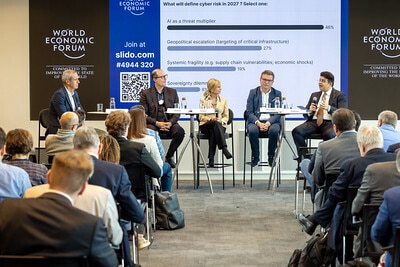
Experts and leaders gathered for the World Economic Forum's Annual Meeting on Cybersecurity 2026.akistan; Florian Schütz, Director, National Cyber Security Centre (NCSC) of Switzerland; Helmut Reisinger, CEO, Europe, Middle East and Africa, Palo Alto Networks, USA; Jeremy Jurgens, Managing Director, World Economic Forum; Nicole Eagan, Co-Founder and Strategic Advisor, Darktrace, United Kingdom; Rob Wainwright, Group Chief Information Security Officer, UBS, Switzerland; at the Annual Meeting on Cybersecurity 2026 in Geneva, Switzerland, on 6/5/2026 from 13:30 to 14:30 in the World Economic Forum Headquarters – Mont Blanc ABCD, Plenary. (Closing Plenary). ©2026 World Economic Forum/Kamal Kimaoui

Experts and leaders gathered for the World Economic Forum's Annual Meeting on Cybersecurity 2026. Image: World Economic Forum

From compliance to measurable resilience

In response, organizations are shifting away from compliance-driven approaches towards measurable resilience. The focus is moving to how quickly systems can recover, how much loss can be avoided, and how effectively operations can continue under stress.

This shift is reshaping investment priorities. Rather than expanding toolsets, leaders are concentrating on high-impact capabilities, improving visibility of critical assets and dependencies, strengthening incident response readiness, and enabling rapid recovery.

Cyber resilience is also being reframed as an enterprise-wide capability. It requires the integration of technology with governance, workforce readiness and trusted partnerships. Correspondingly, chief information security officers (CISOs) are playing a central role in driving this transformation, bridging technical execution with business strategy and board-level priorities.

From siloed to systemic defence

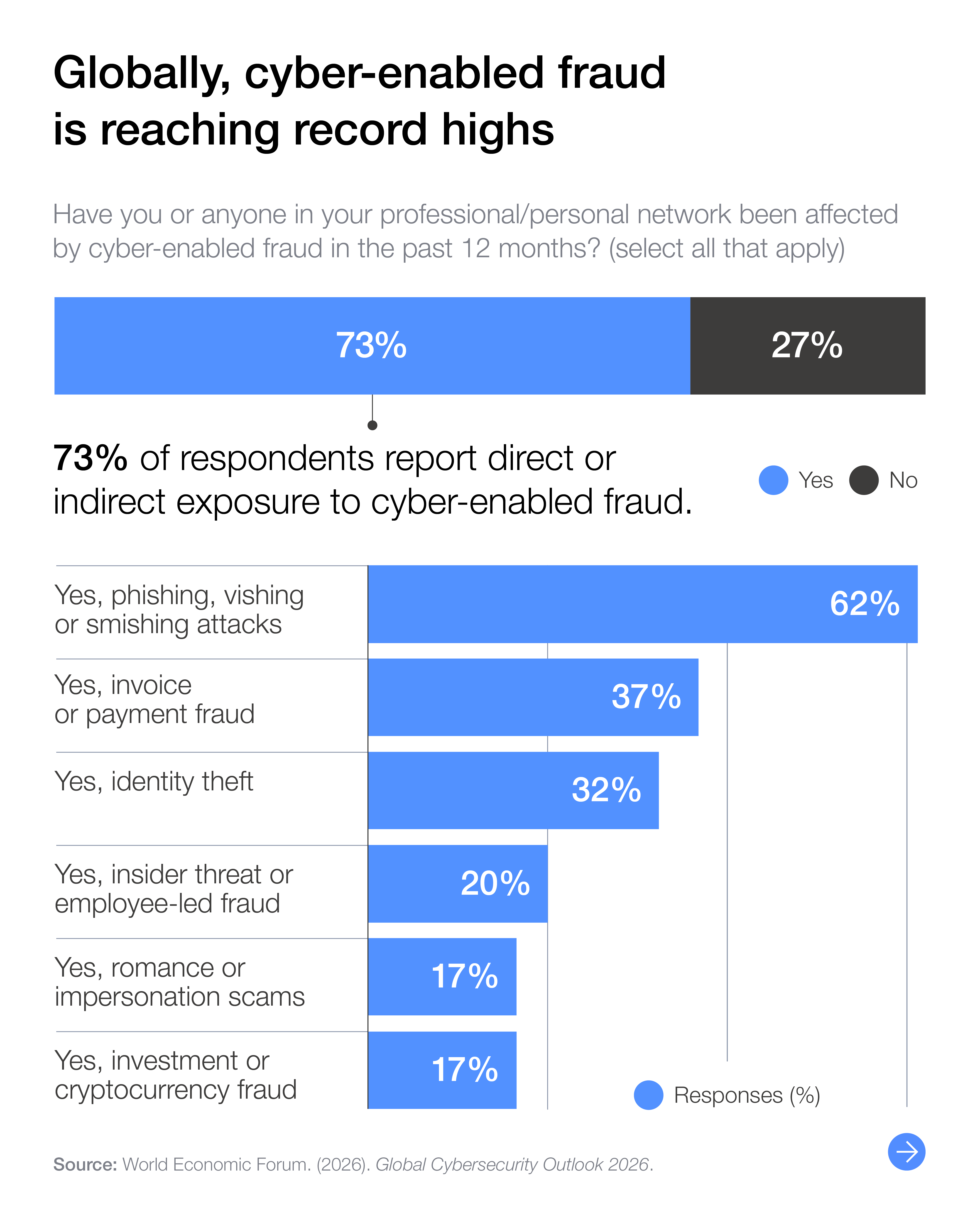
As digital supply chains grow more complex and concentrated, cyber risk is becoming increasingly systemic. A disruption at a single node can cascade across industries and borders, exposing the limits of isolated, organization-centric defences. At the same time, the rise of cyber-enabled fraud and scams (now among the most pervasive and underreported forms of cybercrime) underscores how threats are no longer confined to enterprises but directly affect individuals, communities and economies at scale. These attacks exploit gaps across platforms, jurisdictions and user awareness, highlighting the need for prevention, public awareness and victim support alongside traditional security measures.

Addressing this shift requires moving from reactive responses to a coordinated, system-wide approach that reduces risk at its source. Rather than relying on organizations or individuals to respond after attacks occur, leaders emphasized making it harder for criminals to establish and scale fraudulent operations in the first place. This must be complemented by stronger protections embedded into everyday digital services to detect and block threats earlier, alongside greater public awareness and improved digital literacy to reduce vulnerability.

For this reason, experts highlighted the need for stronger public-private collaboration and cross-sector coordination to operationalize these measures at scale. This includes joint exercises, improved information sharing, interoperable intelligence frameworks that enable rapid, collective response, and clearer mechanisms to define roles and responsibilities during crises.

However, scaling such coordination remains challenging in a fragmented regulatory landscape. While global operations such as trade rely on highly interconnected systems, regulation still operates in a multi-local rather than truly global environment. Instead of pursuing full harmonization, leaders pointed to more pragmatic approaches such as plurilateral agreements and mutual recognition between regulators to enable interoperability across jurisdictions. At the same time, there is growing recognition that regulation must go beyond rule-setting, using incentives, liability frameworks and transparency requirements to advance holistic cybersecurity outcomes at scale.
From reacting to anticipating AI-scale threats

Emerging technologies are accelerating the pace and sophistication of cyber threats. While 77% of organizations are already deploying AI for defence, attackers are using it almost universally, creating a widening asymmetry and enabling more autonomous, scalable attacks. Further intensifying this, advances in quantum computing and agentic AI systems are introducing new attack surfaces and governance challenges that current strategies are not fully equipped to address. Leaders stressed the need for sharper judgement to distinguish real risks from hype and to prioritize “no-regret” actions that strengthen resilience today.

Looking ahead, there was strong emphasis on embedding security-by-design, integrating safeguards early, ensuring accountability, and maintaining human oversight as technologies move from experimentation to real-world deployment. More broadly, leaders called for multi-horizon strategies that combine near-term risk mitigation with long-term capability building, recognizing that reactive approaches are no longer sufficient in an AI-driven threat landscape.

Towards a redefined cybersecurity imperative

Discussions at the Annual Meeting on Cybersecurity 2026 converged on a central message: the longstanding positioning of cybersecurity as a supporting function, which has led to the systematic underpricing of cyber risk, no longer reflects the realities of threats in the intelligence age.

As recognition grows that cybersecurity is a defining condition for economic stability, national security and strategic advantage in the digital age, there is increasing momentum to manage these risks more effectively. While this is an encouraging development, significant gaps remain. At the gathering, cybersecurity was therefore reframed as a domain where collaboration is not only necessary, but powerful.

The next phase of cybersecurity will depend on how effectively leaders can align incentives, quantify risk and build trust across interconnected systems. This will require deeper collaboration between business and government, stronger integration between technology and policy, and a sustained focus on measurable outcomes that keep pace with the speed of change.