




惯性聚合 高效追踪和阅读你感兴趣的博客、新闻、科技资讯
阅读原文 在惯性聚合中打开

推荐订阅源

T
Tailwind CSS Blog
Hacker News - Newest:
Hacker News - Newest: "LLM"
The Cloudflare Blog
J
Java Code Geeks
大猫的无限游戏
大猫的无限游戏
雷峰网
雷峰网
WordPress大学
WordPress大学
Jina AI
Jina AI
IT之家
IT之家
Hugging Face - Blog
Hugging Face - Blog
博客园 - 聂微东
有赞技术团队
有赞技术团队
V
Vulnerabilities – Threatpost
博客园 - 司徒正美
L
Lohrmann on Cybersecurity
P
Privacy International News Feed
S
SegmentFault 最新的问题
C
Cisco Blogs
V
V2EX
博客园 - 三生石上(FineUI控件)
Apple Machine Learning Research
I
Intezer
人人都是产品经理
人人都是产品经理
博客园_首页
D
Darknet – Hacking Tools, Hacker News & Cyber Security
Cyberwarzone
Cyberwarzone
Know Your Adversary
Know Your Adversary
酷 壳 – CoolShell
酷 壳 – CoolShell
Security Latest
Security Latest
V
Visual Studio Blog
S
Schneier on Security
宝玉的分享
宝玉的分享
博客园 - 【当耐特】
腾讯CDC
cs.CL updates on arXiv.org
博客园 - Franky
Last Week in AI
Last Week in AI
让小产品的独立变现更简单 - ezindie.com
奇客Solidot–传递最新科技情报
奇客Solidot–传递最新科技情报
K
Kaspersky official blog
T
The Exploit Database - CXSecurity.com
G
GRAHAM CLULEY
量子位
S
Securelist
小众软件
小众软件
OSCHINA 社区最新新闻
OSCHINA 社区最新新闻
T
Tenable Blog
阮一峰的网络日志
阮一峰的网络日志
博客园 - 叶小钗
T
Troy Hunt's Blog

World Economic Forum

What happened at the MC14 WTO meeting in Yaoundé How giving gorillas digital wallets can help finance nature Why is leadership a strategic investment for philanthropy? Counting the many costs of the global mental health burden What we learned from the 2026 World Bank Spring Meetings Crop protection is at risk. How innovation can help Here's a playbook for boards on how to govern agentic AI Why connected data makes AI decision-ready for sustainability 3 ways better data practices are reshaping financial supervision What technology convergence looks like in practice 7 reasons the old order broke — and how it might be repaired How governments can make agentic AI re  ? Current and future uses of RNA, including mRNA vaccines Real-time deepfakes are rewriting the rules of child safety Electrification trend ‘unmistakeable’ – and more energy stories From smallpox to the common cold: A brief history of vaccines Saudi Arabia's new AI-powered sustainability platform could unlock $20 billion by 2030 Here are 6 ways that climate change is affecting sports around the world This crisis could be an opportunity for the energy transition Middle East war: 6 ways countries are responding to the historic energy shock Nature can teach us about leadership and building resilience How did the Strait of Hormuz become so important, and will it stay that way? Yes/Cities: Helping global cities become more resilient, sustainable and prosperous Healthy ageing in APAC: The role of the influenza vaccine Risk management, renewables and a rocky road ahead: Spring Meetings takeaways Japan in a world of rising middle powers EU plans to offset Iran war's energy impact, and other climate and nature news 3 cities leading on green investment for economic growth The coffee industry is making the case for climate insurance The ocean is now a subprime asset, so we need a sustainable blue economy 5 leaders on today’s growth dilemmas and how to navigate them What helps purpose-driven, early-stage start-ups scale? Why trust is key to the EU's Empowering Consumers Directive The $3 trillion maintenance gap is burning money and the planet Surging AI needs and geopolitical supply shocks renew attention on nuclear energy 5 things to know before interacting with digital assets Frontiers Planet Prize: 25 solutions for planetary crises How the Iran war is disrupting India's steel production What's needed for growth in the new economy? Why we need a humanitarian truce is Sudan Freedom of expression under attack: How do we protect the media? Why companies – and nations – should create an AI culture Anthropic’s Mythos moment: how frontier AI is redefining cybersecurity Discover this week's must-read finance stories 'Godfather of AI' Yoshua Bengio on why AI can behave unpredictably (and what needs to change) Everyone talks about critical thinking. Here's how schools should actually teach it The top international trade stories to know this month The big chart: How oil prices have reacted to world events since the 1980s Why AI needs digital public infrastructure to deliver for citizens What AI in education needs next: Lessons from youth leaders across five countries How to scale clean hydrogen to meet energy security needs Meet the Young Global Leaders Class of 2026 Ventures with blue carbon solutions for coastal restoration How peer-led reskilling is helping bridge the skills gap in East Africa China's lessons on the energy sector’s nature-positive transition Here's how Japan's green materials sector is thriving The Strait of Hormuz crisis: Rewriting the future of AI Systemic risk is the hidden tax on growth. Here's how insurance can help build economic resilience Earth Day: What is it, when is it and why is it important? The Rayner plot: What it tells us about the future of jobs This is why we’ll feel the economic effects of this war for a while How energy and finance leaders are approaching climate investment in 2026 How quantum technologies are being tested to strengthen energy systems How to think about ‘safe’ withdrawal rates in a changing global economy Is collective cyber defence the future of port security? Learnings from a Dutch initiative Cyberattacks target US infrastructure, and other cybersecurity news Rethinking workplace energy: Why our assumptions can lead to burnout What could an international panel to tackle inequality achieve? Workforce health is the bedrock of global supply chains. Here's how to protect it Southeast Asia may be a distinct region but its risks affect each country differently 5 ways to grow a business mindset in international development How companies can finally cut Scope 3 emissions Here's how to get the $7 trillion AI hardware buildout right Leaders are moving from systems of record to systems of work G7 One Health Summit launches global diagnostics initiative, and other health stories What stopping war-risk insurance in the Strait of Hormuz tells us Why leaders must transform cyber resilience measurement AI can help create comparability and scale impact investing What's in store for the future of multilateralism? Why food waste is a $540 billion opportunity hiding in plain sight What Afghanistan can teach us about strategic foresight This is how we use generative AI on Forum Stories How cities are turning urban complexity into coherent climate plans How non-profits and governments use data to drive real system change How demographics, not AI, will redefine the labour market Three lessons on the energy transition in an age of crisis NFL players: Why financial literacy is a game-changer for student-athletes 3 ways Africa can maximize the value of its critical minerals and finance its future What leaders are saying about the new geopolitics of energy The financial system is rebooting. Stakeholders must adapt Cancer care innovation is reshaping resilience in Japan The hidden struggle of employed youth in Africa How markets and missions are becoming allies for impact What’s changing in frontier tech – from geopolitics to AI and energy Why stablecoins are quickly becoming a geopolitical issue How public-private collaboration can help close the global gender gap It’s time to start treating AI infrastructure as critical infrastructure 5 effective choices to turn workplace well-being into a competitive advantage How to strengthen collaboration to tackle infectious disease Why the AI economy can’t rely on a single digital Suez
Why climate action matters for healthy longevity
2026-04-14 · via World Economic Forum
  • Global life expectancy has more than doubled over the past century, as people seek longer, healthier lives amid the growing impacts of climate change.
  • Climate change interacts with existing pressures — from disease to food insecurity and unsafe housing — and could slow or even reverse recent gains in longevity in some regions.
  • Addressing these disparities requires rethinking how economies, cities and health systems support longer, healthier lives for all.

Global life expectancy has more than doubled in just over a century, from around 32 years in 1900 to about 73 years today. This is the result of cleaner water, better nutrition, vaccines and more resilient health systems.

Climate change has long been associated with risks such as sea-level rise and biodiversity loss. Now it raises deeper questions of whether future generations will live not only longer lives, but healthier ones – and whether these gains in longevity will be distributed fairly within and between countries.

The World Health Organization estimates that, between 2030 and 2050, climate change could cause about 250,000 additional deaths every year from undernutrition, malaria, diarrhoea and heat stress. This figure does not even fully capture deaths linked to disrupted health services, conflict, forced migration or worsening air quality.

The risks are uneven. Older adults are more vulnerable to heatwaves, air pollution and extreme weather, which increase heart attacks, strokes and respiratory disease. Children are more exposed to undernutrition, infectious diseases and the long-term impact of toxic air on lung and brain development. People in low-income and climate-vulnerable countries often face these threats with the weakest health and social protection systems.

Climate change acts as a risk multiplier on longevity, interacting with existing burdens such as non-communicable diseases, food insecurity and unsafe housing. It threatens to slow, and in some places reverse, the remarkable life expectancy gains of the last century.

A widening longevity gap

These pressures are opening a “longevity gap” both within and between countries.

Data has shown that residents of wealthier, greener neighbourhoods can expect to live close to a decade longer than those in hotter, more polluted or deprived areas. This gap is linked partly to climate and environmental stressors. Low- and middle-income countries, which have contributed least to historical emissions, are already experiencing crop failures, floods and shifting patterns of vector-borne disease that undermine health and nutrition, especially among children.

Rapidly ageing societies, from Southern Europe to East Asia, now face the double challenge of rising numbers of older people and rising climate risks, straining health and care systems. These disparities are moral failures, but they are also macroeconomic risks because climate-sensitive illnesses and productivity losses can erode growth and public finances.

Building ‘climate-resilient years of life’

Protecting longevity in a warming world means shifting from counting years of life to building climate-resilient years of life.

First, health systems must become climate resilient. Hospitals and clinics need to withstand heatwaves, floods and storms, with robust infrastructure, diversified energy sources and supply chains that can function under stress. Initiatives supported by the World Health Organization and partners are helping countries integrate climate risk into health planning, starting from risk assessments to climate-smart facility design.

Second, living environments must become healthier and lower carbon. The same actions that cut emissions can extend healthy life. Cleaner transport reduces air pollution and cardiovascular disease. Cooler, greener cities reduce heat stress and improve mental wellbeing. Sustainable food systems that enable more plant-based diets can lower greenhouse gas emissions while reducing obesity, diabetes and heart disease.

Third, ageing and climate policy need to sit under one roof. Most countries treat these as separate conversations, but both require long-term planning, intergenerational fairness and prevention-focused investment. Aligning national climate plans with healthy ageing strategies can help governments invest once and reap multiple benefits, from fewer hospitalisations during heatwaves to stronger community resilience during disasters.

How to boost longevity by creating more climate-resilient years of life.

Living longer in a warming world: How to boost climate-resilient years of life. Image: Daniel Mahadzir

What does this mean for business?

Heat, air pollution and climate-related disease already affect worker productivity, absenteeism and health costs. Ageing, climate-stressed populations will shape demand for housing, insurance, financial products, food and healthcare. The growing “longevity economy”, that is, goods and services for older adults, will depend on how well societies keep people healthy and active in harsher environments.

Investors are beginning to connect the dots. Health and climate are more visible in ESG frameworks but are still often assessed in isolation. Integrating climate–health–longevity metrics, including heat-related productivity loss, climate-linked health claims or resilience of health infrastructure, could become a new frontier in risk and opportunity assessment.
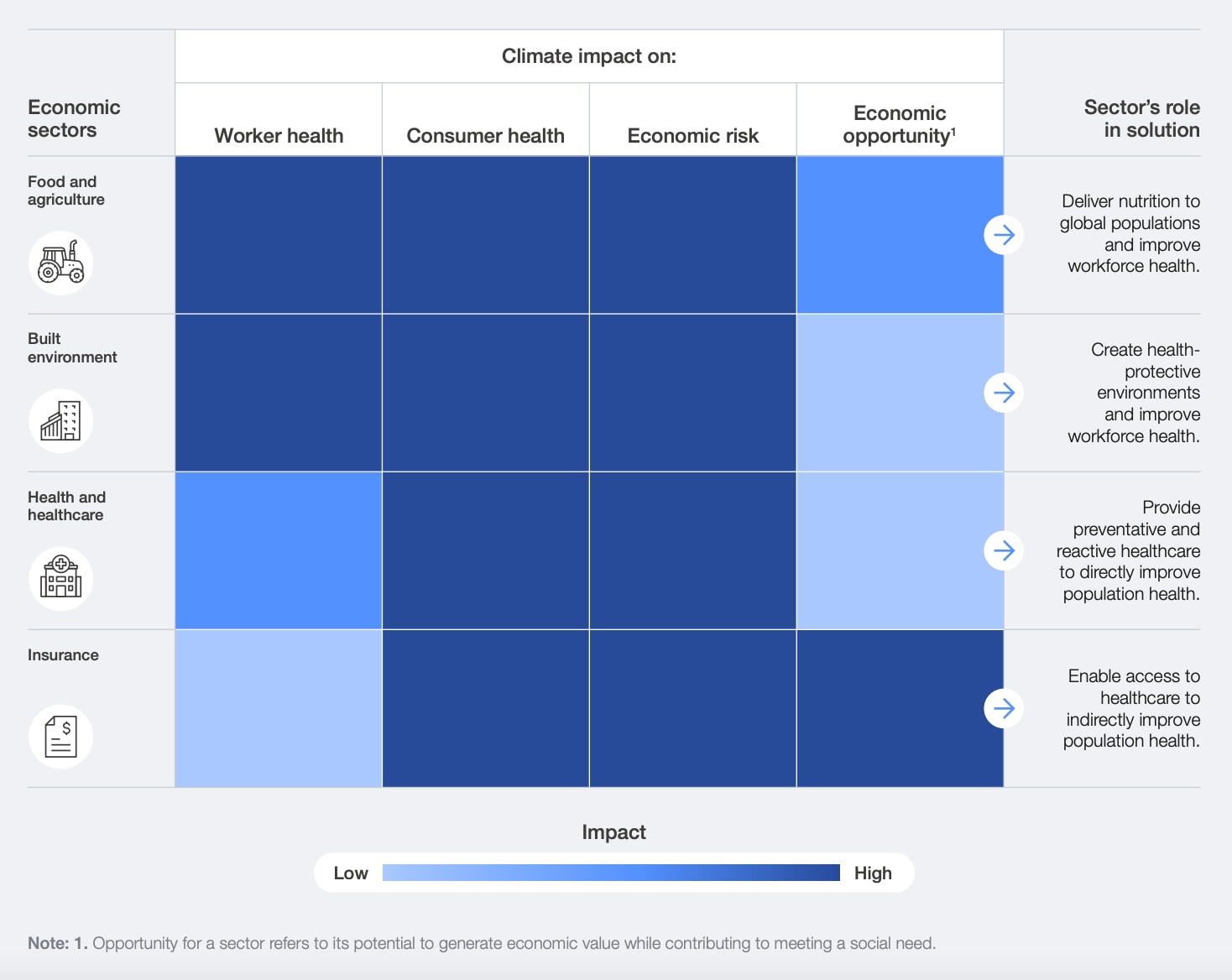
Food and agriculture, the built environment, health and healthcare, and insurance have especially high climate and health risks and opportunities. These specific health impacts, economic impacts and priority interventions could guide action.

How businesses in some sectors could help build resilience to climate and health risks, boosting Image: Building Economic Resilience to the Health Impacts of Climate Change. World Economic Forum, Boston Consulting Group

Living longer in a warming world

Promising solutions are already visible, the challenge is to scale and connect them.

Heat action plans are being integrated in municipalities such as Ahmedabad in India and Barcelona in Spain, with early warning systems, neighbourhood cooling centres and targeted outreach to older adults and people with chronic conditions.

Hospitals are installing solar panels, improving energy efficiency and redesigning buildings to stay functional during extreme weather, while also cutting their own emissions. Primary care systems are using community health workers and digital tools to support services during climate shocks such as floods or wildfires.

Several governments have also put forward policies covering malaria control in warming regions, as well as to address the mental health impacts of heat and displacement. Such policies are prototypes of a new social contract for longevity in the Anthropocene.

A child born now could expect to live into their 80s, but only if the foundations of their health are protected by a stable climate and functioning ecosystems. Every tonne of emissions avoided, every degree of avoided warming, every city redesigned for clean air and walkability is also an investment in human longevity.

This is where global frameworks converge. The Paris Agreement, the Sustainable Development Goals and the UN Decade of Healthy Ageing all aim, in different ways, to extend both the length and quality of human life. Rather than simply trying to live longer in a warming world, there is a growing need to rethink how economies, cities and health systems support longer, healthier lives for everyone.