

惯性聚合 高效追踪和阅读你感兴趣的博客、新闻、科技资讯
阅读原文 在惯性聚合中打开

推荐订阅源

S
Schneier on Security
Blog — PlanetScale
Blog — PlanetScale
L
LangChain Blog
P
Proofpoint News Feed
MongoDB | Blog
MongoDB | Blog
G
GRAHAM CLULEY
Simon Willison's Weblog
The Hacker News
The Hacker News
博客园_首页
W
WeLiveSecurity
Recorded Future
Recorded Future
S
Secure Thoughts
C
Check Point Blog
Y
Y Combinator Blog
Project Zero
Project Zero
量子位
www.infosecurity-magazine.com
S
Security Archives - TechRepublic
K
KPMG report finds enterprise disconnect between AI and its ROI | CIO
Scott Helme
Scott Helme
Spread Privacy
Spread Privacy
V
Vulnerabilities – Threatpost
AWS News Blog
AWS News Blog
S
Security @ Cisco Blogs
T
Threatpost
F
Full Disclosure
P
Proofpoint News Feed
T
The Exploit Database - CXSecurity.com
阮一峰的网络日志
阮一峰的网络日志
TaoSecurity Blog
TaoSecurity Blog
Last Week in AI
Last Week in AI
E
Exploit-DB.com RSS Feed
Microsoft Security Blog
N
News | PayPal Newsroom
C
Cybersecurity and Infrastructure Security Agency CISA
让小产品的独立变现更简单 - ezindie.com
C
Cisco Blogs
月光博客
月光博客
S
SegmentFault 最新的问题
B
Blog
GbyAI
GbyAI
J
Java Code Geeks
小众软件
小众软件
D
Docker
IT之家
IT之家
SecWiki News
SecWiki News
F
Fortinet All Blogs
Recent Commits to openclaw:main
Google Online Security Blog
NISL@THU
NISL@THU

World Economic Forum

How giving gorillas digital wallets can help finance nature Why is leadership a strategic investment for philanthropy? Counting the many costs of the global mental health burden What we learned from the 2026 World Bank Spring Meetings Crop protection is at risk. How innovation can help Here's a playbook for boards on how to govern agentic AI Why connected data makes AI decision-ready for sustainability 3 ways better data practices are reshaping financial supervision What technology convergence looks like in practice 7 reasons the old order broke — and how it might be repaired How governments can make agentic AI re  ? Current and future uses of RNA, including mRNA vaccines Real-time deepfakes are rewriting the rules of child safety Electrification trend ‘unmistakeable’ – and more energy stories From smallpox to the common cold: A brief history of vaccines Saudi Arabia's new AI-powered sustainability platform could unlock $20 billion by 2030 Here are 6 ways that climate change is affecting sports around the world This crisis could be an opportunity for the energy transition Middle East war: 6 ways countries are responding to the historic energy shock Nature can teach us about leadership and building resilience How did the Strait of Hormuz become so important, and will it stay that way? Yes/Cities: Helping global cities become more resilient, sustainable and prosperous Healthy ageing in APAC: The role of the influenza vaccine Risk management, renewables and a rocky road ahead: Spring Meetings takeaways Japan in a world of rising middle powers EU plans to offset Iran war's energy impact, and other climate and nature news 3 cities leading on green investment for economic growth The coffee industry is making the case for climate insurance The ocean is now a subprime asset, so we need a sustainable blue economy 5 leaders on today’s growth dilemmas and how to navigate them What helps purpose-driven, early-stage start-ups scale? Why trust is key to the EU's Empowering Consumers Directive The $3 trillion maintenance gap is burning money and the planet Surging AI needs and geopolitical supply shocks renew attention on nuclear energy 5 things to know before interacting with digital assets Frontiers Planet Prize: 25 solutions for planetary crises How the Iran war is disrupting India's steel production What's needed for growth in the new economy? Why we need a humanitarian truce is Sudan Freedom of expression under attack: How do we protect the media? Why companies – and nations – should create an AI culture Anthropic’s Mythos moment: how frontier AI is redefining cybersecurity Discover this week's must-read finance stories 'Godfather of AI' Yoshua Bengio on why AI can behave unpredictably (and what needs to change) Everyone talks about critical thinking. Here's how schools should actually teach it The top international trade stories to know this month The big chart: How oil prices have reacted to world events since the 1980s Why AI needs digital public infrastructure to deliver for citizens What AI in education needs next: Lessons from youth leaders across five countries How to scale clean hydrogen to meet energy security needs Meet the Young Global Leaders Class of 2026 Ventures with blue carbon solutions for coastal restoration How peer-led reskilling is helping bridge the skills gap in East Africa China's lessons on the energy sector’s nature-positive transition Here's how Japan's green materials sector is thriving The Strait of Hormuz crisis: Rewriting the future of AI Systemic risk is the hidden tax on growth. Here's how insurance can help build economic resilience Earth Day: What is it, when is it and why is it important? The Rayner plot: What it tells us about the future of jobs This is why we’ll feel the economic effects of this war for a while How energy and finance leaders are approaching climate investment in 2026 How quantum technologies are being tested to strengthen energy systems How to think about ‘safe’ withdrawal rates in a changing global economy Is collective cyber defence the future of port security? Learnings from a Dutch initiative Cyberattacks target US infrastructure, and other cybersecurity news Rethinking workplace energy: Why our assumptions can lead to burnout What could an international panel to tackle inequality achieve? Why climate action matters for healthy longevity Workforce health is the bedrock of global supply chains. Here's how to protect it Southeast Asia may be a distinct region but its risks affect each country differently 5 ways to grow a business mindset in international development How companies can finally cut Scope 3 emissions Here's how to get the $7 trillion AI hardware buildout right Leaders are moving from systems of record to systems of work G7 One Health Summit launches global diagnostics initiative, and other health stories What stopping war-risk insurance in the Strait of Hormuz tells us Why leaders must transform cyber resilience measurement AI can help create comparability and scale impact investing What's in store for the future of multilateralism? Why food waste is a $540 billion opportunity hiding in plain sight What Afghanistan can teach us about strategic foresight This is how we use generative AI on Forum Stories How cities are turning urban complexity into coherent climate plans How non-profits and governments use data to drive real system change How demographics, not AI, will redefine the labour market Three lessons on the energy transition in an age of crisis NFL players: Why financial literacy is a game-changer for student-athletes 3 ways Africa can maximize the value of its critical minerals and finance its future What leaders are saying about the new geopolitics of energy The financial system is rebooting. Stakeholders must adapt Cancer care innovation is reshaping resilience in Japan The hidden struggle of employed youth in Africa How markets and missions are becoming allies for impact What’s changing in frontier tech – from geopolitics to AI and energy Why stablecoins are quickly becoming a geopolitical issue How public-private collaboration can help close the global gender gap It’s time to start treating AI infrastructure as critical infrastructure 5 effective choices to turn workplace well-being into a competitive advantage How to strengthen collaboration to tackle infectious disease Why the AI economy can’t rely on a single digital Suez
Dexterity benchmarking could remove a barrier to automation
Junghee Ryu, · 2026-06-15 · via World Economic Forum
  • Global labour shortages are driving a humanoid robot boom, but inadequate hand dexterity remains the primary technological bottleneck.
  • DexBench provides a standardized framework to measure real-world robot manipulation skills across industrial environments.
  • How promising ideas become scalable impact is a key focus at the World Economic Forum’s Annual Meeting of the New Champions, also known as Summer Davos, in China from 23–25 June.

The world is running short of hands. Across Korea, Japan, much of Europe, and increasingly China’s manufacturing base, the working-age population is shrinking, even as demand for physical goods and services holds steady. This is the backdrop to the defining technology story of the past two years: the global boom in humanoids and physical AI, as capital, talent and public imagination converge on a single proposition: that general-purpose robots can step into the gap demographics are opening.
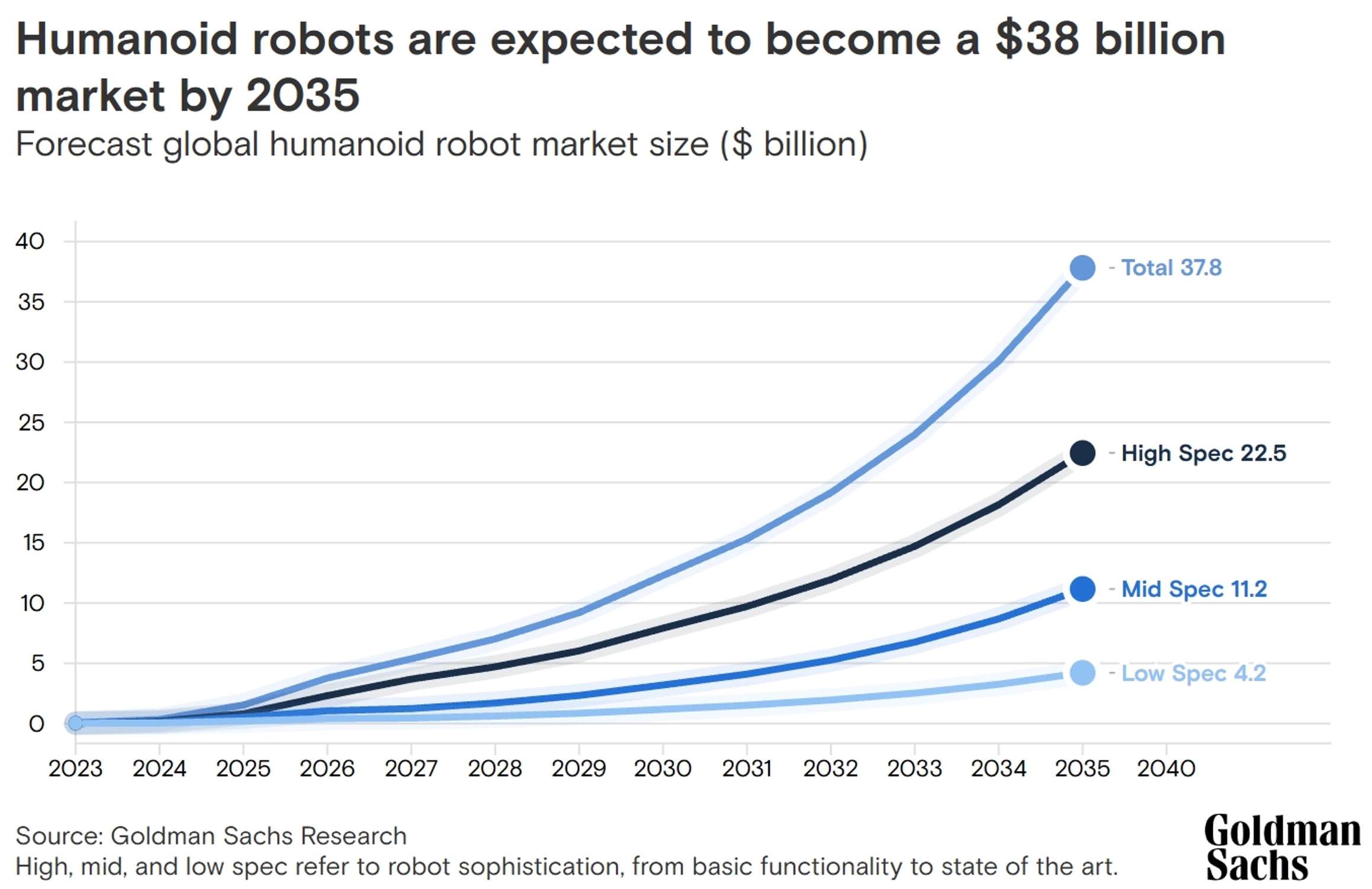
Humanoid robots are expected to become a $38 billion market by 2035.

The optimism is not unfounded. Locomotion is largely solved and navigation is maturing fast; robots can walk, balance and move through human spaces in ways that seemed out of reach a few years ago.

Solving the last mile of robotic automation

But anyone who has watched a robot try to fold a shirt, seat an electrical connector or pick a ripe strawberry knows where the difficulty lies. The bottleneck is not in the legs. It is in the hands. Dexterity – the fine, contact-rich manipulation people perform without conscious thought – is the part of physical work machines still struggle with most. It is, precisely, the last mile of automation. Close it, and physical AI becomes economically transformative; leave it open, and humanoids remain impressive demonstrations rather than dependable workers.

Why we need a shared standard for robotic dexterity

And here the field hits a quieter, structural problem: we have no shared way to measure dexterity. Robotics benchmarks today largely test simple actions: stacking blocks, pushing objects, picking from a bin in a controlled lab. These are useful for research but unrepresentative of the full spectrum of manipulation real industry demands. The result is a widening gap between what laboratories report and what factories can deploy, and no common instrument to even see it. The history of AI shows how such gaps close: progress follows measurement.

ImageNet catalyzed modern computer vision; MMLU and its successors shaped how we evaluate language models. A field can only improve what it can commonly measure, and without a shared standard for dexterity, the most consequential decisions in robotics are made in the dark.

Mapping robot manipulation: Object complexity and dexterity regimes

This is the gap DexBench is built to close, and it starts from the opposite end of most benchmarks. Rather than inventing tasks from a laboratory’s imagination, DexBench begins from the recurring needs of real customers across manufacturing, logistics and service operations, then works backward to the capabilities those needs demand. Two axes anchor the framework.

Object State Complexity captures how hard the manipulated object is to perceive and control: from rigid, well-defined parts at one end to deformable, variable or unpredictable materials at the other. What pushes a task towards the hard end is rarely one thing: tolerances tighten, success starts to hinge on force rather than position, contact keeps switching between gripping and slipping, the detail that matters slips out of the camera’s view, the material deforms, or events move too fast to react to. Few jobs stay fixed at one level; a single task can cross from easy to hard and back before it is finished.

Dexterity Regime captures the type and difficulty of the manipulation skill a task requires, from coarse pick-and-place to fine, force-modulated, contact-rich control. The framework distinguishes five, each defined as much by how robots fail in it as by what it demands: finding a grip that holds across varied shapes; placing contact accurately before it lands; acting at the right instant when things move or briefly vanish; sensing force to catch a slip or seat a part the camera never sees; and breaking a job into steps so a robot can recover when a first try fails.

Lifting a box off a shelf calls on one of these; seating a connector or folding clothes calls on all five. Dexterity, then, is less about how many fingers a hand has than about which of these failures it can absorb.

Together they form a coordinate system: any manipulation task can be placed as a point in shared, comparable terms, rather than described in the ad-hoc language each lab invents for itself.

Deconstructing physical work: The 18 atomic tasks of manipulation

From thousands of tasks observed across real work environments, a small and surprisingly stable structure emerges. The work decomposes into 18 key atomic tasks: the recurring primitives that appear again and again regardless of industry. Composed into roughly 80 representative cases, these cover the large majority of the manipulation performed across manufacturing, logistics, and service.

The finiteness is the point: a tractable, bounded battery of tests can stand in for an otherwise unbounded space of real-world jobs. A system’s result is not an abstract leaderboard rank but a readout of how much real work it can actually do.

That makes DexBench usable, in the same breath, by audiences that rarely speak the same language. A buyer can ask whether a given robot clears the atomic tasks their line actually depends on, before signing a purchase order. A developer can see exactly which regimes of object complexity and skill their model fails in, and target them directly. An investor can compare two companies on the same axes instead of two incomparable demo reels. The goal is not a leaderboard for its own sake, but a public yardstick that lets any builder, buyer or investor ask the same question and receive a comparable answer.

Driving industry-wide adoption for robotic standards

A benchmark’s value, in the end, comes less from being created than from being adopted. ImageNet did not matter because a single lab released it; it mattered because a community agreed to measure itself against it. DexBench will mean something only if industry players, researchers and customers take it up as a common language. Leading players across the field have begun to endorse it, including Lotte, SK Telecom, Hyosung, HL Mando, CJ Logistics, Fuji, ANA, Misui Chemicals. Also, it is designed to remain open to all.

The shortage of hands will not wait. If physical AI is to fill the gap demographics are creating, the field has to agree on what capable hands look like and how to measure them. DexBench is a starting point, not a finish line. The last mile of automation will be closed the same way it must be measured: together.

The Forum is spotlighting how innovation moves from breakthrough to scale to impact ahead of 'Summer Davos' in China, 23–25 June 2026. Follow the latest.