




惯性聚合 高效追踪和阅读你感兴趣的博客、新闻、科技资讯
阅读原文 在惯性聚合中打开

推荐订阅源

奇客Solidot–传递最新科技情报
奇客Solidot–传递最新科技情报
Stack Overflow Blog
Stack Overflow Blog
cs.AI updates on arXiv.org
钛媒体:引领未来商业与生活新知
钛媒体:引领未来商业与生活新知
T
The Exploit Database - CXSecurity.com
美团技术团队
P
Proofpoint News Feed
S
Schneier on Security
P
Privacy International News Feed
Last Week in AI
Last Week in AI
Scott Helme
Scott Helme
V
Vulnerabilities – Threatpost
freeCodeCamp Programming Tutorials: Python, JavaScript, Git & More
T
Tor Project blog
S
SegmentFault 最新的问题
Security Latest
Security Latest
月光博客
月光博客
A
About on SuperTechFans
Martin Fowler
Martin Fowler
A
Arctic Wolf
C
Cyber Attacks, Cyber Crime and Cyber Security
腾讯CDC
Schneier on Security
H
Hacker News: Front Page
TaoSecurity Blog
TaoSecurity Blog
NISL@THU
NISL@THU
B
Blog RSS Feed
C
Cybersecurity and Infrastructure Security Agency CISA
Cyberwarzone
Cyberwarzone
V2EX - 技术
V2EX - 技术
Hacker News - Newest:
Hacker News - Newest: "LLM"
OSCHINA 社区最新新闻
OSCHINA 社区最新新闻
W
WeLiveSecurity
Cisco Talos Blog
Cisco Talos Blog
MyScale Blog
MyScale Blog
M
MIT News - Artificial intelligence
K
KPMG report finds enterprise disconnect between AI and its ROI | CIO
P
Proofpoint News Feed
F
Fortinet All Blogs
aimingoo的专栏
aimingoo的专栏
N
News and Events Feed by Topic
The Last Watchdog
The Last Watchdog
Engineering at Meta
Engineering at Meta
博客园 - 叶小钗
T
Tenable Blog
H
Hackread – Cybersecurity News, Data Breaches, AI and More
L
LINUX DO - 热门话题
Help Net Security
Help Net Security
让小产品的独立变现更简单 - ezindie.com
G
Google Developers Blog

World Economic Forum

What happened at the MC14 WTO meeting in Yaoundé How giving gorillas digital wallets can help finance nature Why is leadership a strategic investment for philanthropy? Counting the many costs of the global mental health burden What we learned from the 2026 World Bank Spring Meetings Crop protection is at risk. How innovation can help Here's a playbook for boards on how to govern agentic AI Why connected data makes AI decision-ready for sustainability 3 ways better data practices are reshaping financial supervision What technology convergence looks like in practice 7 reasons the old order broke — and how it might be repaired How governments can make agentic AI re  ? Current and future uses of RNA, including mRNA vaccines Real-time deepfakes are rewriting the rules of child safety Electrification trend ‘unmistakeable’ – and more energy stories From smallpox to the common cold: A brief history of vaccines Saudi Arabia's new AI-powered sustainability platform could unlock $20 billion by 2030 Here are 6 ways that climate change is affecting sports around the world This crisis could be an opportunity for the energy transition Nature can teach us about leadership and building resilience How did the Strait of Hormuz become so important, and will it stay that way? Yes/Cities: Helping global cities become more resilient, sustainable and prosperous Healthy ageing in APAC: The role of the influenza vaccine Risk management, renewables and a rocky road ahead: Spring Meetings takeaways Japan in a world of rising middle powers EU plans to offset Iran war's energy impact, and other climate and nature news 3 cities leading on green investment for economic growth The coffee industry is making the case for climate insurance The ocean is now a subprime asset, so we need a sustainable blue economy 5 leaders on today’s growth dilemmas and how to navigate them What helps purpose-driven, early-stage start-ups scale? Why trust is key to the EU's Empowering Consumers Directive The $3 trillion maintenance gap is burning money and the planet Surging AI needs and geopolitical supply shocks renew attention on nuclear energy 5 things to know before interacting with digital assets Frontiers Planet Prize: 25 solutions for planetary crises How the Iran war is disrupting India's steel production What's needed for growth in the new economy? Why we need a humanitarian truce is Sudan Freedom of expression under attack: How do we protect the media? Why companies – and nations – should create an AI culture Anthropic’s Mythos moment: how frontier AI is redefining cybersecurity Discover this week's must-read finance stories 'Godfather of AI' Yoshua Bengio on why AI can behave unpredictably (and what needs to change) Everyone talks about critical thinking. Here's how schools should actually teach it The top international trade stories to know this month The big chart: How oil prices have reacted to world events since the 1980s Why AI needs digital public infrastructure to deliver for citizens What AI in education needs next: Lessons from youth leaders across five countries How to scale clean hydrogen to meet energy security needs Meet the Young Global Leaders Class of 2026 Ventures with blue carbon solutions for coastal restoration How peer-led reskilling is helping bridge the skills gap in East Africa China's lessons on the energy sector’s nature-positive transition Here's how Japan's green materials sector is thriving The Strait of Hormuz crisis: Rewriting the future of AI Systemic risk is the hidden tax on growth. Here's how insurance can help build economic resilience Earth Day: What is it, when is it and why is it important? The Rayner plot: What it tells us about the future of jobs This is why we’ll feel the economic effects of this war for a while How energy and finance leaders are approaching climate investment in 2026 How quantum technologies are being tested to strengthen energy systems How to think about ‘safe’ withdrawal rates in a changing global economy Is collective cyber defence the future of port security? Learnings from a Dutch initiative Cyberattacks target US infrastructure, and other cybersecurity news Rethinking workplace energy: Why our assumptions can lead to burnout What could an international panel to tackle inequality achieve? Why climate action matters for healthy longevity Workforce health is the bedrock of global supply chains. Here's how to protect it Southeast Asia may be a distinct region but its risks affect each country differently 5 ways to grow a business mindset in international development How companies can finally cut Scope 3 emissions Here's how to get the $7 trillion AI hardware buildout right Leaders are moving from systems of record to systems of work G7 One Health Summit launches global diagnostics initiative, and other health stories What stopping war-risk insurance in the Strait of Hormuz tells us Why leaders must transform cyber resilience measurement AI can help create comparability and scale impact investing What's in store for the future of multilateralism? Why food waste is a $540 billion opportunity hiding in plain sight What Afghanistan can teach us about strategic foresight This is how we use generative AI on Forum Stories How cities are turning urban complexity into coherent climate plans How non-profits and governments use data to drive real system change How demographics, not AI, will redefine the labour market Three lessons on the energy transition in an age of crisis NFL players: Why financial literacy is a game-changer for student-athletes 3 ways Africa can maximize the value of its critical minerals and finance its future What leaders are saying about the new geopolitics of energy The financial system is rebooting. Stakeholders must adapt Cancer care innovation is reshaping resilience in Japan The hidden struggle of employed youth in Africa How markets and missions are becoming allies for impact What’s changing in frontier tech – from geopolitics to AI and energy Why stablecoins are quickly becoming a geopolitical issue How public-private collaboration can help close the global gender gap It’s time to start treating AI infrastructure as critical infrastructure 5 effective choices to turn workplace well-being into a competitive advantage How to strengthen collaboration to tackle infectious disease Why the AI economy can’t rely on a single digital Suez
Middle East war: 6 ways countries are responding to the historic energy shock
Spencer Fein · 2026-04-24 · via World Economic Forum
  • The Middle East war has caused a historic disruption to global oil supply, triggering sharp price increases and a widespread energy crisis.
  • Governments around the world are implementing measures to reduce fuel demand and protect consumers.
  • The crisis highlights the growing impact of geoeconomic tensions on global energy systems and broader economic stability.

The war in the Middle East has triggered what the International Energy Agency (IEA) describes as the largest disruption in global oil supply in history, pushing governments worldwide to rapidly deploy emergency measures to curb demand and protect consumers.

At the centre of the crisis is the Strait of Hormuz, a critical chokepoint through which 20% of global oil supply normally flows. Following the outbreak of war, flows through the strait have been reduced to a fraction of normal levels, significantly limiting the global energy supply.

The impact has been immediate and severe. Global oil supply fell by more than 10 million barrels per day in March and the price of oil surged above $100 per barrel, while the price of refined fuels like diesel and jet fuel rose even faster, according to the IEA.

“The war in the Middle East is creating a major energy crisis, including the largest supply disruption in the history of the global oil market,” IEA Executive Director Fatih Birol said in a statement. “In the absence of a swift resolution, the impacts on energy markets and economies are set to become more and more severe.”

In response, governments are taking action to save energy and lower domestic demand. Drawing on an IEA energy crisis policy tracker, here are six of the most common ways countries are responding.

1. Work and study from home

Encouraging or mandating remote work and study has emerged as a primary way to reduce fuel demand as it lowers consumption by cutting both commuting and on-site facility use.

Indonesia, for instance, has imposed a work-from-home requirement for public-sector employees on Fridays while Myanmar mandates remote work on Wednesdays. Other countries such as Pakistan and the Philippines have imposed four-day working weeks for public officials.

Meanwhile, countries like Sri Lanka, Peru and Bangladesh have shortened school weeks or increased remote learning.

2. Limit cooling in buildings

Governments are eyeing the use of buildings and facilities to limit energy consumption.

Thailand, Bangladesh and Cambodia have imposed or encouraged temperature limits on the use of air conditioners in public offices. Jordan has banned the use of air conditioners in government offices entirely.

Cooling restrictions are particularly important in warmer climates, where electricity demand spikes can strain already tight energy systems.
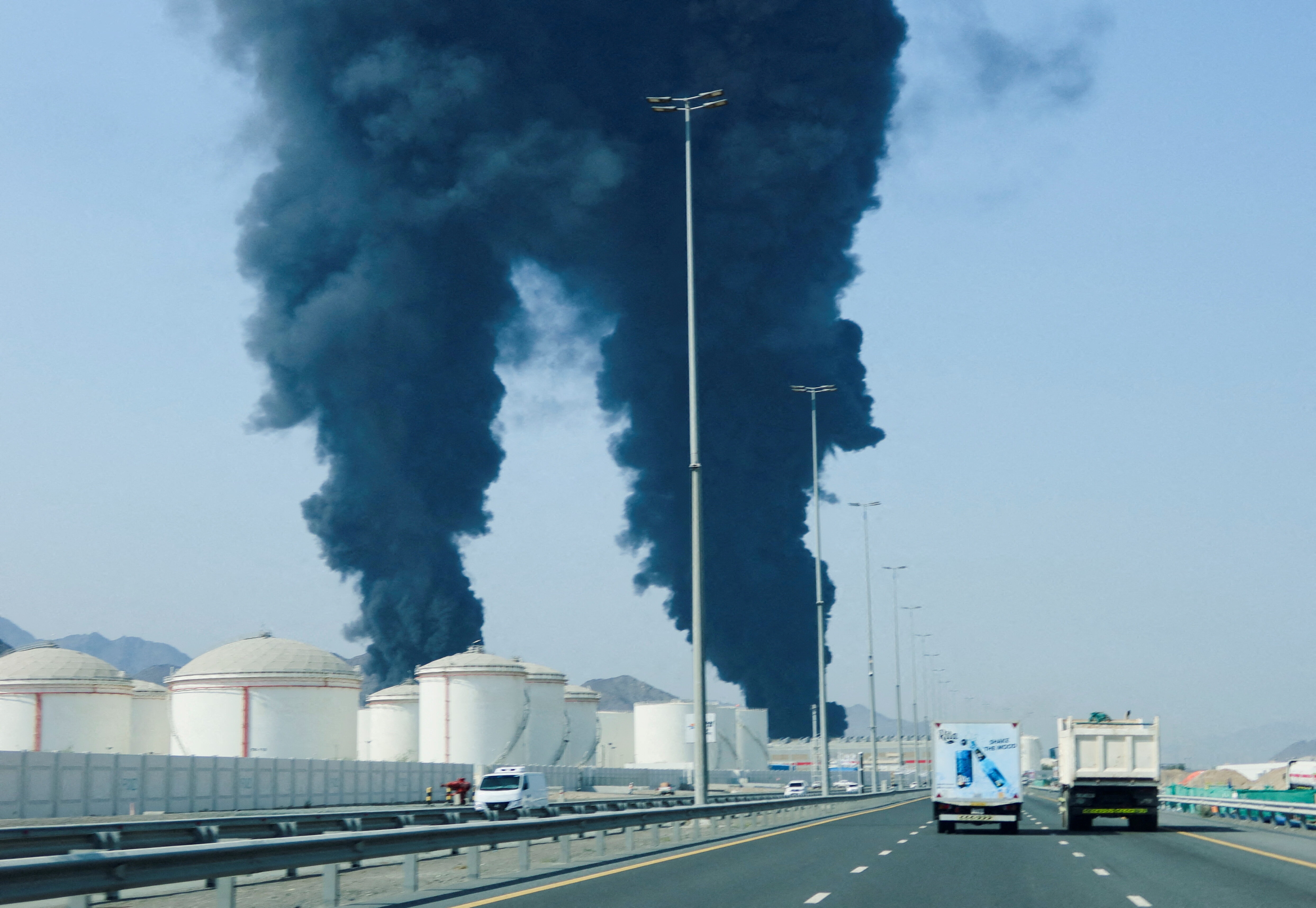
FILE PHOTO: Smoke rises in the Fujairah oil industry zone, caused by debris after interception of a drone by air defenses, according to the Fujairah media office, amid the U.S.-Israel conflict with Iran, in Fujairah, United Arab Emirates, March 14, 2026. REUTERS/Staff/File Photo

Smoke rises in the Fujairah oil industry zone in the United Arab Emirates in March. Image: REUTERS

Transport remains one of the largest levers for cutting oil demand, and governments are taking action to reduce private travel and increase the use of public transport.

Lithuania, for instance, has cut local train fares by 50% for two months while the Philippines has provided free bus rides for students and workers in selected cities. France, meanwhile, has renewed social leasing schemes for electric vehicles for low-income individuals reliant on private cars for work. Chile has also offered financial assistance to taxi drivers buying electric vehicles.

Other countries such as Thailand and Argentina have changed regulations to allow higher bioethanol content in gasoline blends.

4. Restrict government travel

Public-sector travel is being scaled back to reduce fuel consumption and set an example.

South Korea has mandated driving restrictions for public-sector workers while Jordan and Pakistan have banned international travel for public officials. Jordan has curbed the hosting of foreign delegations, too.

Sri Lanka has also limited travel for government officials, encouraging them to take public transportation.

5. Mandate price caps and provide subsidies

Some governments are intervening directly in fuel markets to shield households and businesses from rising costs.

Croatia and Hungary, for example, have imposed fuel price caps, while Czechia has limited retailers’ profit margins. China has capped domestic refined oil prices, and Japan has introduced a subsidy-backed fuel price ceiling.

Although these measures provide immediate relief, they carry fiscal trade-offs and may weaken incentives to reduce consumption.

6. Launch nationwide energy-saving campaigns

Alongside policy mandates, governments are appealing directly to citizens to change behaviour.

Australia has encouraged voluntary reductions in fuel use and energy consumption through its “Every Little Bit Helps” campaign, while Egypt has asked the public to limit private and commercial lighting and reduce shop hours on weekends.

Several other countries including Mozambique, Lao PDR, Ethiopia and Viet Nam have urged the public to take energy-saving actions.

Geoeconomic confrontation and global risks

The global energy-saving measures mark one of the most widespread demand-reduction efforts in decades. Moreover, they underscore the significant impact that geopolitical and geoeconomic conflicts are increasingly having on the global economy.

In January, the World Economic Forum’s Global Risks Report 2026 ranked geoeconomic confrontation as the foremost concern for risk professionals in the short term, with survey respondents identifying it as the risk most likely to trigger a material global crisis in 2026. State-based armed conflict followed in second place.

“Geoeconomic confrontation threatens the core of the interconnected global economy,” the report stated, noting that such confrontations are both a cause and a consequence of the diminished multilateral system. “With fewer multilateral constraints on unilateral action, rising national barriers and clashing interests could have negative economic and social repercussions across the globe.”