


惯性聚合 高效追踪和阅读你感兴趣的博客、新闻、科技资讯
阅读原文 在惯性聚合中打开

推荐订阅源

Y
Y Combinator Blog
Security Archives - TechRepublic
钛媒体:引领未来商业与生活新知
钛媒体:引领未来商业与生活新知
Apple Machine Learning Research
Blog — PlanetScale
Blog — PlanetScale
OSCHINA 社区最新新闻
OSCHINA 社区最新新闻
G
Google Developers Blog
F
Full Disclosure
大猫的无限游戏
大猫的无限游戏
酷 壳 – CoolShell
酷 壳 – CoolShell
T
Threat Research - Cisco Blogs
A
Arctic Wolf
Threat Intelligence Blog | Flashpoint
The Cloudflare Blog
博客园 - 【当耐特】
AWS News Blog
AWS News Blog
U
Unit 42
V
Vulnerabilities – Threatpost
P
Privacy International News Feed
T
Tor Project blog
Microsoft Security Blog
宝玉的分享
宝玉的分享
Google DeepMind News
爱范儿
爱范儿
cs.CL updates on arXiv.org
Recorded Future
Recorded Future
freeCodeCamp Programming Tutorials: Python, JavaScript, Git & More
奇客Solidot–传递最新科技情报
奇客Solidot–传递最新科技情报
C
CXSECURITY Database RSS Feed - CXSecurity.com
T
Threatpost
Latest news
Latest news
GbyAI
GbyAI
S
SegmentFault 最新的问题
MongoDB | Blog
MongoDB | Blog
N
Netflix TechBlog - Medium
Hacker News: Ask HN
Hacker News: Ask HN
美团技术团队
N
News | PayPal Newsroom
J
Java Code Geeks
Exploit-DB.com RSS Feed
Microsoft Azure Blog
K
KPMG report finds enterprise disconnect between AI and its ROI | CIO
The Hacker News
The Hacker News
The GitHub Blog
The GitHub Blog
V
V2EX
N
News and Events Feed by Topic
T
Troy Hunt's Blog
Security Latest
Security Latest
博客园 - 叶小钗
P
Palo Alto Networks Blog

World Economic Forum

What happened at the MC14 WTO meeting in Yaoundé How giving gorillas digital wallets can help finance nature Why is leadership a strategic investment for philanthropy? Counting the many costs of the global mental health burden What we learned from the 2026 World Bank Spring Meetings Crop protection is at risk. How innovation can help Here's a playbook for boards on how to govern agentic AI Why connected data makes AI decision-ready for sustainability 3 ways better data practices are reshaping financial supervision What technology convergence looks like in practice 7 reasons the old order broke — and how it might be repaired How governments can make agentic AI re  ? Current and future uses of RNA, including mRNA vaccines Real-time deepfakes are rewriting the rules of child safety Electrification trend ‘unmistakeable’ – and more energy stories From smallpox to the common cold: A brief history of vaccines Saudi Arabia's new AI-powered sustainability platform could unlock $20 billion by 2030 Here are 6 ways that climate change is affecting sports around the world This crisis could be an opportunity for the energy transition Middle East war: 6 ways countries are responding to the historic energy shock Nature can teach us about leadership and building resilience How did the Strait of Hormuz become so important, and will it stay that way? Yes/Cities: Helping global cities become more resilient, sustainable and prosperous Healthy ageing in APAC: The role of the influenza vaccine Risk management, renewables and a rocky road ahead: Spring Meetings takeaways Japan in a world of rising middle powers EU plans to offset Iran war's energy impact, and other climate and nature news 3 cities leading on green investment for economic growth The coffee industry is making the case for climate insurance The ocean is now a subprime asset, so we need a sustainable blue economy 5 leaders on today’s growth dilemmas and how to navigate them What helps purpose-driven, early-stage start-ups scale? Why trust is key to the EU's Empowering Consumers Directive The $3 trillion maintenance gap is burning money and the planet Surging AI needs and geopolitical supply shocks renew attention on nuclear energy 5 things to know before interacting with digital assets Frontiers Planet Prize: 25 solutions for planetary crises How the Iran war is disrupting India's steel production What's needed for growth in the new economy? Why we need a humanitarian truce is Sudan Freedom of expression under attack: How do we protect the media? Why companies – and nations – should create an AI culture Anthropic’s Mythos moment: how frontier AI is redefining cybersecurity Discover this week's must-read finance stories 'Godfather of AI' Yoshua Bengio on why AI can behave unpredictably (and what needs to change) Everyone talks about critical thinking. Here's how schools should actually teach it The top international trade stories to know this month The big chart: How oil prices have reacted to world events since the 1980s Why AI needs digital public infrastructure to deliver for citizens What AI in education needs next: Lessons from youth leaders across five countries How to scale clean hydrogen to meet energy security needs Meet the Young Global Leaders Class of 2026 Ventures with blue carbon solutions for coastal restoration How peer-led reskilling is helping bridge the skills gap in East Africa China's lessons on the energy sector’s nature-positive transition Here's how Japan's green materials sector is thriving The Strait of Hormuz crisis: Rewriting the future of AI Systemic risk is the hidden tax on growth. Here's how insurance can help build economic resilience Earth Day: What is it, when is it and why is it important? The Rayner plot: What it tells us about the future of jobs This is why we’ll feel the economic effects of this war for a while How energy and finance leaders are approaching climate investment in 2026 How quantum technologies are being tested to strengthen energy systems How to think about ‘safe’ withdrawal rates in a changing global economy Is collective cyber defence the future of port security? Learnings from a Dutch initiative Cyberattacks target US infrastructure, and other cybersecurity news Rethinking workplace energy: Why our assumptions can lead to burnout What could an international panel to tackle inequality achieve? Why climate action matters for healthy longevity Workforce health is the bedrock of global supply chains. Here's how to protect it Southeast Asia may be a distinct region but its risks affect each country differently 5 ways to grow a business mindset in international development How companies can finally cut Scope 3 emissions Here's how to get the $7 trillion AI hardware buildout right Leaders are moving from systems of record to systems of work G7 One Health Summit launches global diagnostics initiative, and other health stories What stopping war-risk insurance in the Strait of Hormuz tells us Why leaders must transform cyber resilience measurement AI can help create comparability and scale impact investing What's in store for the future of multilateralism? Why food waste is a $540 billion opportunity hiding in plain sight What Afghanistan can teach us about strategic foresight This is how we use generative AI on Forum Stories How cities are turning urban complexity into coherent climate plans How non-profits and governments use data to drive real system change How demographics, not AI, will redefine the labour market Three lessons on the energy transition in an age of crisis NFL players: Why financial literacy is a game-changer for student-athletes What leaders are saying about the new geopolitics of energy The financial system is rebooting. Stakeholders must adapt Cancer care innovation is reshaping resilience in Japan The hidden struggle of employed youth in Africa How markets and missions are becoming allies for impact What’s changing in frontier tech – from geopolitics to AI and energy Why stablecoins are quickly becoming a geopolitical issue How public-private collaboration can help close the global gender gap It’s time to start treating AI infrastructure as critical infrastructure 5 effective choices to turn workplace well-being into a competitive advantage How to strengthen collaboration to tackle infectious disease Why the AI economy can’t rely on a single digital Suez
3 ways Africa can maximize the value of its critical minerals and finance its future
Ifeanyi Chukwudi · 2026-04-03 · via World Economic Forum
  • Africa does not sufficiently monetize its abundant critical mineral resources, exacerbating its development financing gap.
  • With growing demand for critical minerals for the energy transition, the continent has a key window for transforming its industrial strategies.
  • Increasing local processing, addressing the fiscal revenue gap, and building regional integration would help recapture African mineral wealth.

Africa faces a development financing gap of $1.6 trillion, consistently failing to meet its needs across health, education, energy and infrastructure. Traditional responses through foreign aid and debt relief have failed to close this gap, with official development assistance to Africa declining by 9% in 2024 and borrowing costs continuing to rise. But critical mineral assets offer an immediate alternative financing pathway.

The continent holds an estimated 30% of the world's critical minerals, contributing about 75% of global cobalt production, 62% of manganese, while holding significant deposits of lithium, copper and rare earth elements. As demand driven by the global energy transition keeps rising, revenues from just four key minerals (copper, nickel, cobalt and lithium) are projected to reach $16 trillion over the next 25 years, with sub-Saharan Africa positioned to capture over 10% of that total. Yet African countries currently collect only about 40% of potential revenues from these resources. Three strategies can change this.

1. Increasing local processing and beneficiation

Africa’s critical mineral wealth can directly finance its development by strategically moving up the value chain. Every stage of value addition that happens on African soil, from refining raw ore to producing battery-grade materials, will generate tax revenue, create employment and retain foreign exchange that would otherwise leave with the unprocessed export. For decades, the continent has exported the raw materials of global industrialization while importing finished products at a premium, capturing less than 1% of the total economic value of the green technologies its minerals make possible.

The gap between what Africa mines and what it processes is particularly wide for cobalt: Despite the DRC accounting for two-thirds of global mined cobalt in 2024, nearly all output is exported with minimal processing. The chart below shows this pattern across key minerals, with Africa's share collapsing at every stage beyond extraction.
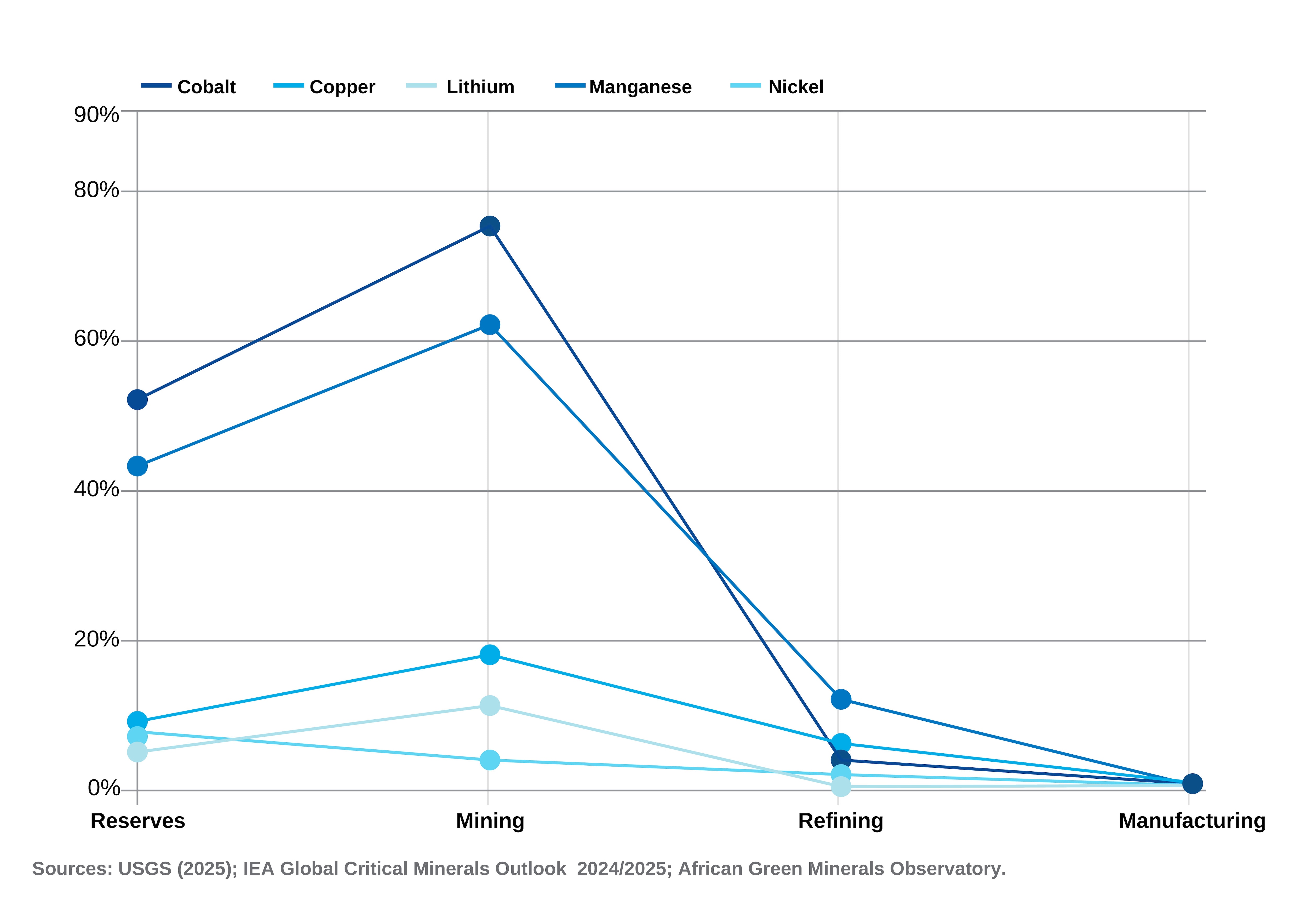
Minerals value flows out of Africa following extraction.

Minerals value flows out of Africa following extraction. Image: USGS; IEA; African Green Minerals Observatory

Refining these critical minerals can add a further 15-30% premium at each processing stage; value that currently leaves Africa.
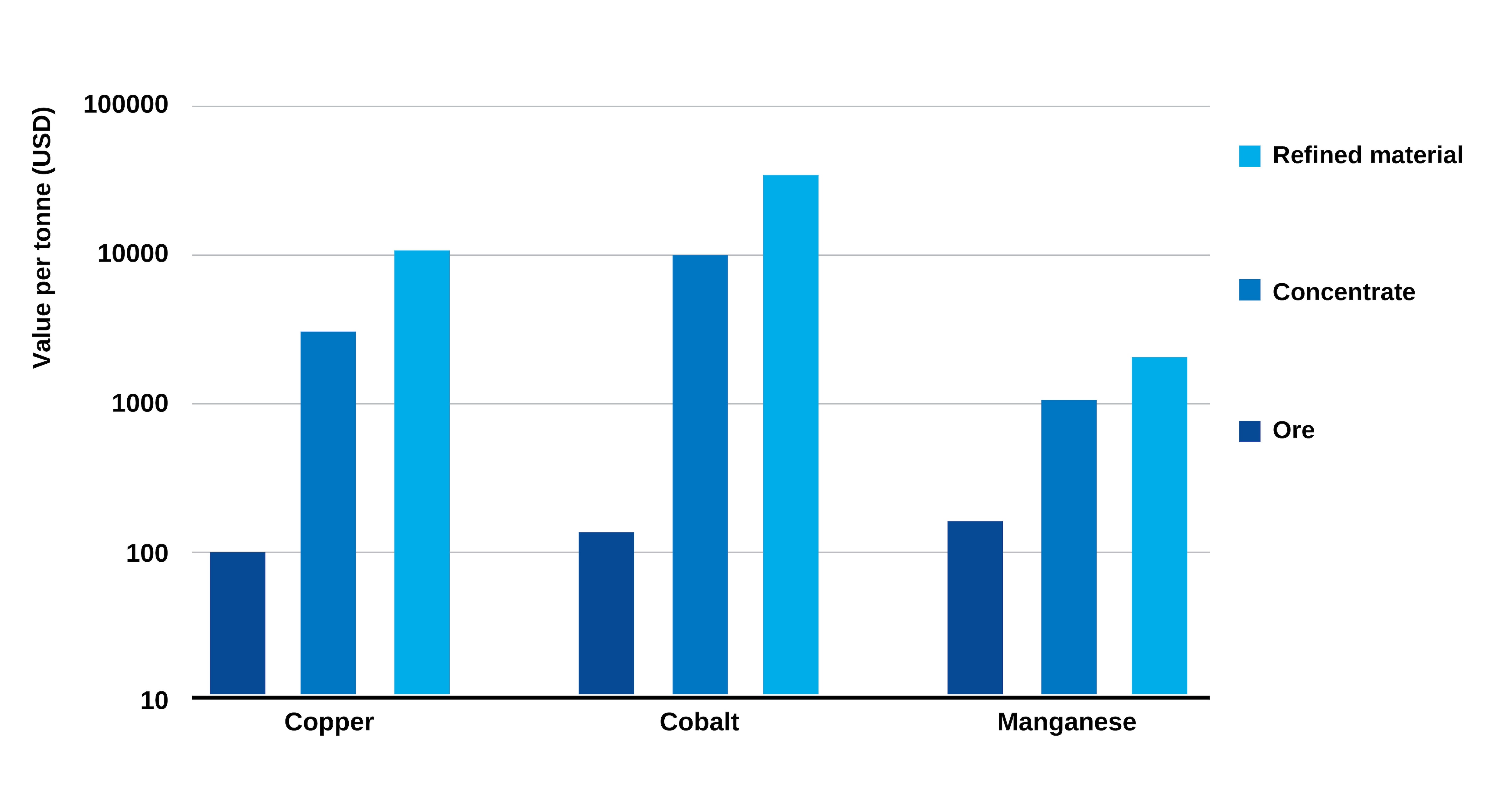
Value per tonne of material at different processing stages (2024)

Value per tonne of material at different processing stages (2024) Image: IEA

The IEA projects that the total market value of Africa's key refined minerals could rise from roughly $70 billion today to $120 billion by 2040, driven by moving a greater share of production through domestic processing. If done at scale, pursuing beneficiation (the treatment of raw materials) could indeed raise the continent's GDP by 12% and create approximately 2.3 million high-quality industrial jobs.

Therefore, the strategic imperative must be to provide the conditions that make processing investment viable and fiscally productive. This means designing investment frameworks that link capital entry to genuine value addition commitments, rather than allowing processing promises to remain unenforceable aspirations. It means directing finance toward the energy infrastructure and industrial corridors that processing facilities require. And ultimately building the institutional capacity to monitor, enforce and progressively deepen those commitments over time.

2. Closing the fiscal revenue gap

While beneficiation captures the long-term prize, reforming the fiscal architecture of extraction could generate significant development revenue in the near term. Tax incentives have a legitimate role in attracting capital to high-risk projects, but their current prevalence in Africa may be reaching a point of diminishing returns. Between 2014 and 2016, corporate income tax holidays granted to just two firms cost Sierra Leone $131 million, which was roughly equal to the country's entire 2024 budget deficit. In Guinea, mining-related tax expenditures, such as corporate income tax holidays, reduced mineral royalties and import duty exemptions on mining equipment, represented 24.4% of total national tax expenditure in 2019; IMF simulations suggest that modest reforms could generate revenue four times the size of the country's entire agriculture budget.

Thinking further ahead, Africa must rethink its incentive strategy and put greater emphasis on incentivizing value creation rather than extractive presence alone. These could be in the form of performance-linked incentives that are time-bound and tied to outcomes such as local value addition, technology transfer and infrastructure development.

Closing the revenue gap will also mean fixing the revenue leakage problem. Africa loses about $89 billion annually to illicit financial flows, with the extractives sector significantly exposed. The IMF estimates that sub-Saharan Africa loses $450-730 million annually in corporate income tax alone from profit-shifting by multinational mining companies. To address this, African governments must build state capacity for revenue management and close the loopholes that allow transfer pricing abuse (where companies manipulate prices charged between their own subsidiaries across jurisdictions to shift profits away from the country where the mineral is extracted, reducing their tax liability there). Every dollar protected from leakage is a dollar that does not need to be borrowed and can directly flow into the development finance pool Africa urgently needs.

3. Leveraging regional integration

However, both strategies must be supported by regional integration to achieve scale. Africa's mineral endowment is geographically distributed, and no single country holds the full mineral basket required to anchor an integrated clean-energy value chain. This makes regional coordination an economic necessity.

The DRC-Zambia transboundary battery and electric vehicle special economic zone is the most concrete example. Collectively, Zambia and DRC hold 70% of the minerals needed for battery and EV production. A BloombergNEF study confirmed a joint precursor plant is financially viable and building it in the DRC would cost three times less than an equivalent facility in the United States, demonstrating that Africa's processing proposition is commercially competitive.

The AfCFTA creates the architecture to scale this model. By aggregating demand, harmonizing investment standards and enabling shared infrastructure along mineral corridors, the AfCFTA can transform isolated national deposits into a regionally integrated industrial hub. With better coordination, revenues generated at each processing stage will be multiplied across economies.

Africa faces its largest development financing gap at precisely the moment when the global value of its mineral wealth has never been higher. Three forces make this moment particularly critical. The external financing model Africa has depended on for decades is breaking down, but simultaneously the global energy transition has created long-term demand for Africa's minerals that is written into the industrial strategies of major economies. Hence, policy decisions made now will determine the architecture of the clean energy economy for decades, with first movers capturing the dividends. But these conditions will not persist indefinitely, hence the need for urgency.

Increased local processing will raise revenues for Africa by capturing more value; fiscal reform will unlock the revenues already owed from ongoing extraction; and regional integration scales both by creating the market depth and investment attractiveness that individual countries cannot generate alone. On this path, Africa will move from a development financing model anchored in external dependency toward one built on the productive use of its resources.