



惯性聚合 高效追踪和阅读你感兴趣的博客、新闻、科技资讯
阅读原文 在惯性聚合中打开

推荐订阅源

Cyberwarzone
Cyberwarzone
F
Full Disclosure
V
Visual Studio Blog
freeCodeCamp Programming Tutorials: Python, JavaScript, Git & More
有赞技术团队
有赞技术团队
J
Java Code Geeks
博客园 - 【当耐特】
OSCHINA 社区最新新闻
OSCHINA 社区最新新闻
博客园 - 叶小钗
L
LINUX DO - 最新话题
T
Threatpost
S
SegmentFault 最新的问题
Vercel News
Vercel News
云风的 BLOG
云风的 BLOG
C
Cyber Attacks, Cyber Crime and Cyber Security
Google DeepMind News
Know Your Adversary
Know Your Adversary
S
Schneier on Security
V
Vulnerabilities – Threatpost
D
DataBreaches.Net
G
GRAHAM CLULEY
Latest news
Latest news
P
Privacy International News Feed
D
Darknet – Hacking Tools, Hacker News & Cyber Security
C
CXSECURITY Database RSS Feed - CXSecurity.com
Scott Helme
Scott Helme
L
Lohrmann on Cybersecurity
T
The Exploit Database - CXSecurity.com
Security Latest
Security Latest
G
Google Developers Blog
L
LangChain Blog
MyScale Blog
MyScale Blog
Project Zero
Project Zero
N
News and Events Feed by Topic
Hacker News - Newest:
Hacker News - Newest: "LLM"
大猫的无限游戏
大猫的无限游戏
P
Proofpoint News Feed
Blog — PlanetScale
Blog — PlanetScale
阮一峰的网络日志
阮一峰的网络日志
N
News | PayPal Newsroom
www.infosecurity-magazine.com
cs.AI updates on arXiv.org
SecWiki News
SecWiki News
T
Tor Project blog
C
Check Point Blog
Google Online Security Blog
GbyAI
GbyAI
The Last Watchdog
The Last Watchdog
cs.CL updates on arXiv.org
WordPress大学
WordPress大学

World Economic Forum

What happened at the MC14 WTO meeting in Yaoundé How giving gorillas digital wallets can help finance nature Why is leadership a strategic investment for philanthropy? Counting the many costs of the global mental health burden What we learned from the 2026 World Bank Spring Meetings Crop protection is at risk. How innovation can help Here's a playbook for boards on how to govern agentic AI Why connected data makes AI decision-ready for sustainability 3 ways better data practices are reshaping financial supervision What technology convergence looks like in practice 7 reasons the old order broke — and how it might be repaired How governments can make agentic AI re  ? Current and future uses of RNA, including mRNA vaccines Real-time deepfakes are rewriting the rules of child safety Electrification trend ‘unmistakeable’ – and more energy stories From smallpox to the common cold: A brief history of vaccines Saudi Arabia's new AI-powered sustainability platform could unlock $20 billion by 2030 Here are 6 ways that climate change is affecting sports around the world This crisis could be an opportunity for the energy transition Middle East war: 6 ways countries are responding to the historic energy shock Nature can teach us about leadership and building resilience How did the Strait of Hormuz become so important, and will it stay that way? Yes/Cities: Helping global cities become more resilient, sustainable and prosperous Healthy ageing in APAC: The role of the influenza vaccine Risk management, renewables and a rocky road ahead: Spring Meetings takeaways Japan in a world of rising middle powers EU plans to offset Iran war's energy impact, and other climate and nature news 3 cities leading on green investment for economic growth The coffee industry is making the case for climate insurance The ocean is now a subprime asset, so we need a sustainable blue economy 5 leaders on today’s growth dilemmas and how to navigate them What helps purpose-driven, early-stage start-ups scale? Why trust is key to the EU's Empowering Consumers Directive The $3 trillion maintenance gap is burning money and the planet Surging AI needs and geopolitical supply shocks renew attention on nuclear energy 5 things to know before interacting with digital assets Frontiers Planet Prize: 25 solutions for planetary crises How the Iran war is disrupting India's steel production What's needed for growth in the new economy? Freedom of expression under attack: How do we protect the media? Why companies – and nations – should create an AI culture Anthropic’s Mythos moment: how frontier AI is redefining cybersecurity Discover this week's must-read finance stories 'Godfather of AI' Yoshua Bengio on why AI can behave unpredictably (and what needs to change) Everyone talks about critical thinking. Here's how schools should actually teach it The top international trade stories to know this month The big chart: How oil prices have reacted to world events since the 1980s Why AI needs digital public infrastructure to deliver for citizens What AI in education needs next: Lessons from youth leaders across five countries How to scale clean hydrogen to meet energy security needs Meet the Young Global Leaders Class of 2026 Ventures with blue carbon solutions for coastal restoration How peer-led reskilling is helping bridge the skills gap in East Africa China's lessons on the energy sector’s nature-positive transition Here's how Japan's green materials sector is thriving The Strait of Hormuz crisis: Rewriting the future of AI Systemic risk is the hidden tax on growth. Here's how insurance can help build economic resilience Earth Day: What is it, when is it and why is it important? The Rayner plot: What it tells us about the future of jobs This is why we’ll feel the economic effects of this war for a while How energy and finance leaders are approaching climate investment in 2026 How quantum technologies are being tested to strengthen energy systems How to think about ‘safe’ withdrawal rates in a changing global economy Is collective cyber defence the future of port security? Learnings from a Dutch initiative Cyberattacks target US infrastructure, and other cybersecurity news Rethinking workplace energy: Why our assumptions can lead to burnout What could an international panel to tackle inequality achieve? Why climate action matters for healthy longevity Workforce health is the bedrock of global supply chains. Here's how to protect it Southeast Asia may be a distinct region but its risks affect each country differently 5 ways to grow a business mindset in international development How companies can finally cut Scope 3 emissions Here's how to get the $7 trillion AI hardware buildout right Leaders are moving from systems of record to systems of work G7 One Health Summit launches global diagnostics initiative, and other health stories What stopping war-risk insurance in the Strait of Hormuz tells us Why leaders must transform cyber resilience measurement AI can help create comparability and scale impact investing What's in store for the future of multilateralism? Why food waste is a $540 billion opportunity hiding in plain sight What Afghanistan can teach us about strategic foresight This is how we use generative AI on Forum Stories How cities are turning urban complexity into coherent climate plans How non-profits and governments use data to drive real system change How demographics, not AI, will redefine the labour market Three lessons on the energy transition in an age of crisis NFL players: Why financial literacy is a game-changer for student-athletes 3 ways Africa can maximize the value of its critical minerals and finance its future What leaders are saying about the new geopolitics of energy The financial system is rebooting. Stakeholders must adapt Cancer care innovation is reshaping resilience in Japan The hidden struggle of employed youth in Africa How markets and missions are becoming allies for impact What’s changing in frontier tech – from geopolitics to AI and energy Why stablecoins are quickly becoming a geopolitical issue How public-private collaboration can help close the global gender gap It’s time to start treating AI infrastructure as critical infrastructure 5 effective choices to turn workplace well-being into a competitive advantage How to strengthen collaboration to tackle infectious disease Why the AI economy can’t rely on a single digital Suez
Why we need a humanitarian truce is Sudan
Mohamed Elsh · 2026-04-21 · via World Economic Forum
  • As the Sudan war enters its fourth year, international mediators waver on securing a humanitarian truce.
  • The 2026 international conference on Sudan’s crisis distinguished itself from earlier meetings by including Sudanese civil society throughout the process, signifying its growing voice in calls for peace and relief.
  • Sudan’s civil society has already proven it can mobilize towards peace in a militarized context; a humanitarian truce would create greater space for them to operate.

Marking the third complete year of war in Sudan, an international conference took place in Berlin in April this year that followed earlier, inconclusive convenings.

This year, the meeting underscored a familiar reality: the international community can spotlight Sudan’s crisis, but that cannot substitute for practical steps to reduce civilian harm and create space for a credible political process.

In a statement, conference co-hosts – Germany, France, the United Kingdom, the United States, the African Union, and the European Union – urged joint efforts to end Sudan’s war, address the humanitarian crisis and include Sudanese voices in political solutions.

The final statement also acknowledged the role of the Quad – one of the mediator groups, comprised of the US, Egypt, Saudi Arabia and the United Arab Emirates – in ceasefire efforts.

However, despite a humanitarian truce being the foundation of the Quad’s roadmap to peace and a key demand of Sudanese civil society, the statement dismissed it as fundamental to securing humanitarian access.

While it is true that humanitarian access should be protected as a matter of principle and not be conditional, sidelining the need for a time-bound, monitored and structured truce risks leaving civilians trapped between legal, theoretical commitments on paper and violence on the ground.

A humanitarian truce can serve as the practical bridge between humanitarian imperatives and a political track.

How the voice of Sudan’s civil society is growing

What set the 2026 Berlin meeting apart from those in Paris in 2025 and London in 2024 was the visible participation of members of Sudanese civil society advocating for peace.

They engaged not only in the formal sessions but also in preparatory meetings and side events, signalling a widening civilian accord pushing for outcomes and not just statements.

In the days leading up to the Berlin meeting, a wave of diverse civil society groups mobilized to advocate for the end of the war. These included the Democratic Civil Society Platform, the Sudan Civic Convergence Tracks, the “Barridouha – Cool it Down” campaign, the Sudanese Group for Refugee Advocacy, and the Sudanese Women’s Groups and Leaders.

The different campaigns and advocacy messages are part of a growing repertoire of civil resistance actions aimed at spotlighting the war’s devastating impact on civilians, pressing for an end to hostilities and urging regional and international actors to prioritize Sudan in peace efforts.

In particular, the Democratic Civil Society Platform stands out for its structured, policy-oriented vision. Its advocacy centres on clear, pragmatic demands encapsulated in the “Life First” campaign.

Strengthening grassroots networks and organizing around everyday needs such as safety, services, livelihoods and education can make peace efforts relevant to daily life.

The argument is simple: establish a credible humanitarian truce anchored in a political process with meaningful civilian participation, while restoring essential services such as health and education and safeguarding agricultural cycles and local economies.

A humanitarian truce is not only a logistical pause in fighting; it is life-centred protection designed to preserve the social and economic foundations required for enduring peace.

This momentum is not limited to traditional peace advocacy. It also extends into sectoral initiatives that, while seemingly technical, are politically consequential. A striking example is the National Initiative to Save the Future of Sudanese Certificate Students, launched in mid-March.

Emerging from what organizers described as a defining moment in Sudanese education, the initiative seeks to address the plight of approximately 280,000 students, many in Darfur and Kordofan, who have been unable to sit for secondary school examinations for three consecutive years due to the war.

The initiative’s statement declares that girls make up about 65% of those affected, making the crisis as much about gendered exclusion as it is about systemic collapse.

By framing education as “the last anchor” of national unity, the initiative warns that denying a generation access to schooling risks perpetuating the very grievances that fuel conflict.

Sudan’s expanding civil society movement seeks to end widespread violence, protect civilians and revive a democratic transition consistent with the aims of the Sudan December Revolution – the popular uprising that led to the removal of President Omar al-Bashir and the end of his 30-year rule.

Since the current war began, civil actors have operated in an increasingly militarized environment shaped by remnants of the previous regime and violent networks of war profiteers – conditions that restrict their work, shrink civic space and make peaceful community engagement harder.

A humanitarian truce, supported by credible coordination, monitoring and clear obligations, would create practical space for civil society and pro-peace movements to operate.

It would make it safer to organize, communicate and represent affected communities; it would also help stabilize conditions for humanitarian delivery and the restoration of basic services.
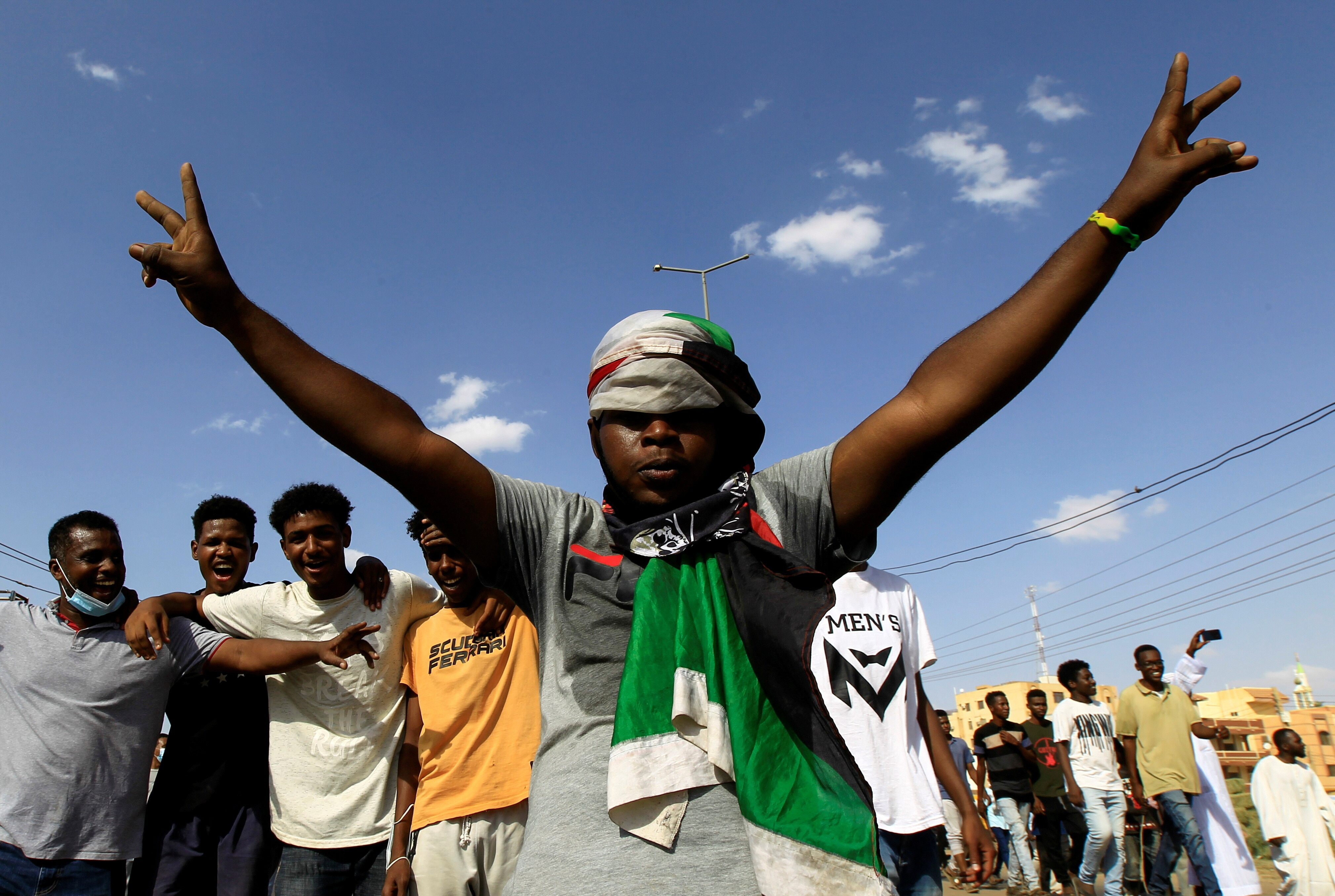
A protester gestures as people demonstrate against the Sudanese military's recent seizure of power and ousting of the civilian government, in the capital Khartoum, Sudan October 30, 2021

A protester gestures as people demonstrate against the Sudanese military's recent seizure of power and ousting of the civilian government, in the capital Khartoum, Sudan October 30, 2021 Image: REUTERS/Mohamed Nureldin

Sudanese civil society has already shown its ability to mobilize around rights and protection in an increasingly militarized context; a truce would allow that capacity to contribute more directly to de-escalation and to a viable peace process.

Pro-peace campaigns could help rebalance the “correlation of forces” within Sudan and beyond, amplifying constituencies that favour peace negotiation while constraining those that oppose it.

In practice, similar dynamics are beginning to emerge. For instance, campaigns such as the initiative on secondary school examinations have already gained acknowledgement from both sides of the conflict and opened space for negotiation.

This shows that civil resistance can, under certain conditions, push the parties to make concessions by shifting the moral and political terrain.

Eventually, the humanitarian truce would grant the space needed for pro-peace civil society to be effective. This includes influencing public opinion, marginalizing those opposing their efforts, and empowering citizens to demand inclusion in decisions about Sudan’s future.

Collective action is essential

Despite major obstacles, Sudanese civil society has shown creativity and resilience at local, national and international levels. By acting, they have built stronger connections, enabled communities, fostered collaboration and creativity, and confronted misleading stories about the conflict.

The potential for these efforts to contribute to peace depends on their ability to scale up, coordinate across platforms and bridge the gap between elite-driven advocacy and grassroots engagement, so that calls for peace translate into tangible local benefits.

The path forward is demanding but practical. Elite advocacy remains vital for engaging international actors and shaping policy debates; at the same time, deeper community engagement is required to sustain legitimacy and pressure.

Strengthening grassroots networks and organizing around everyday needs such as safety, services, livelihoods and education can make peace efforts relevant to daily life. Only by bridging these divides can civil society generate enough leverage to influence belligerents and underpin a credible peace process.

The Berlin conference is over but Sudanese civil society’s message remains clear: peace will not arrive on its own or at a “ripe” moment – it must be built persistently and collectively.

International partners should back Sudanese civilian initiatives such as Life First and the National Initiative to Save the Future of Sudanese Certificate Students, and prioritize a credible, monitored humanitarian truce as a first, life-saving step that can widen civic space and make an inclusive political process possible.