
惯性聚合 高效追踪和阅读你感兴趣的博客、新闻、科技资讯
阅读原文 在惯性聚合中打开

推荐订阅源

Hacker News: Ask HN
Hacker News: Ask HN
C
Cisco Blogs
The Hacker News
The Hacker News
T
Tor Project blog
Cyber Security Advisories - MS-ISAC
The GitHub Blog
The GitHub Blog
A
Arctic Wolf
CTFtime.org: upcoming CTF events
The Register - Security
云风的 BLOG
云风的 BLOG
Simon Willison's Weblog
P
Palo Alto Networks Blog
Vercel News
Vercel News
C
CERT Recently Published Vulnerability Notes
I
InfoQ
freeCodeCamp Programming Tutorials: Python, JavaScript, Git & More
M
MIT News - Artificial intelligence
I
Intezer
aimingoo的专栏
aimingoo的专栏
U
Unit 42
C
Cyber Attacks, Cyber Crime and Cyber Security
L
LINUX DO - 热门话题
Microsoft Security Blog
酷 壳 – CoolShell
酷 壳 – CoolShell
Cyberwarzone
Cyberwarzone
P
Proofpoint News Feed
P
Proofpoint News Feed
B
Blog
T
Threat Research - Cisco Blogs
博客园 - 叶小钗
Recorded Future
Recorded Future
Last Week in AI
Last Week in AI
N
News and Events Feed by Topic
cs.AI updates on arXiv.org
Know Your Adversary
Know Your Adversary
Engineering at Meta
Engineering at Meta
G
Google Developers Blog
PCI Perspectives
PCI Perspectives
Google DeepMind News
WordPress大学
WordPress大学
Application and Cybersecurity Blog
MyScale Blog
MyScale Blog
Security Archives - TechRepublic
Schneier on Security
N
News | PayPal Newsroom
C
Cybersecurity and Infrastructure Security Agency CISA
H
Help Net Security
博客园 - 聂微东
H
Hackread – Cybersecurity News, Data Breaches, AI and More
G
GRAHAM CLULEY

World Economic Forum

What happened at the MC14 WTO meeting in Yaoundé How giving gorillas digital wallets can help finance nature Why is leadership a strategic investment for philanthropy? Counting the many costs of the global mental health burden What we learned from the 2026 World Bank Spring Meetings Crop protection is at risk. How innovation can help Here's a playbook for boards on how to govern agentic AI Why connected data makes AI decision-ready for sustainability 3 ways better data practices are reshaping financial supervision What technology convergence looks like in practice 7 reasons the old order broke — and how it might be repaired How governments can make agentic AI re  ? Current and future uses of RNA, including mRNA vaccines Real-time deepfakes are rewriting the rules of child safety Electrification trend ‘unmistakeable’ – and more energy stories From smallpox to the common cold: A brief history of vaccines Saudi Arabia's new AI-powered sustainability platform could unlock $20 billion by 2030 Here are 6 ways that climate change is affecting sports around the world This crisis could be an opportunity for the energy transition Middle East war: 6 ways countries are responding to the historic energy shock Nature can teach us about leadership and building resilience How did the Strait of Hormuz become so important, and will it stay that way? Yes/Cities: Helping global cities become more resilient, sustainable and prosperous Healthy ageing in APAC: The role of the influenza vaccine Risk management, renewables and a rocky road ahead: Spring Meetings takeaways Japan in a world of rising middle powers EU plans to offset Iran war's energy impact, and other climate and nature news 3 cities leading on green investment for economic growth The coffee industry is making the case for climate insurance The ocean is now a subprime asset, so we need a sustainable blue economy 5 leaders on today’s growth dilemmas and how to navigate them What helps purpose-driven, early-stage start-ups scale? Why trust is key to the EU's Empowering Consumers Directive The $3 trillion maintenance gap is burning money and the planet Surging AI needs and geopolitical supply shocks renew attention on nuclear energy 5 things to know before interacting with digital assets Frontiers Planet Prize: 25 solutions for planetary crises How the Iran war is disrupting India's steel production What's needed for growth in the new economy? Why we need a humanitarian truce is Sudan Freedom of expression under attack: How do we protect the media? Why companies – and nations – should create an AI culture Anthropic’s Mythos moment: how frontier AI is redefining cybersecurity Discover this week's must-read finance stories 'Godfather of AI' Yoshua Bengio on why AI can behave unpredictably (and what needs to change) Everyone talks about critical thinking. Here's how schools should actually teach it The top international trade stories to know this month The big chart: How oil prices have reacted to world events since the 1980s Why AI needs digital public infrastructure to deliver for citizens What AI in education needs next: Lessons from youth leaders across five countries How to scale clean hydrogen to meet energy security needs Meet the Young Global Leaders Class of 2026 Ventures with blue carbon solutions for coastal restoration How peer-led reskilling is helping bridge the skills gap in East Africa China's lessons on the energy sector’s nature-positive transition Here's how Japan's green materials sector is thriving The Strait of Hormuz crisis: Rewriting the future of AI Systemic risk is the hidden tax on growth. Here's how insurance can help build economic resilience Earth Day: What is it, when is it and why is it important? The Rayner plot: What it tells us about the future of jobs This is why we’ll feel the economic effects of this war for a while How energy and finance leaders are approaching climate investment in 2026 How quantum technologies are being tested to strengthen energy systems How to think about ‘safe’ withdrawal rates in a changing global economy Cyberattacks target US infrastructure, and other cybersecurity news Rethinking workplace energy: Why our assumptions can lead to burnout What could an international panel to tackle inequality achieve? Why climate action matters for healthy longevity Workforce health is the bedrock of global supply chains. Here's how to protect it Southeast Asia may be a distinct region but its risks affect each country differently 5 ways to grow a business mindset in international development How companies can finally cut Scope 3 emissions Here's how to get the $7 trillion AI hardware buildout right Leaders are moving from systems of record to systems of work G7 One Health Summit launches global diagnostics initiative, and other health stories What stopping war-risk insurance in the Strait of Hormuz tells us Why leaders must transform cyber resilience measurement AI can help create comparability and scale impact investing What's in store for the future of multilateralism? Why food waste is a $540 billion opportunity hiding in plain sight What Afghanistan can teach us about strategic foresight This is how we use generative AI on Forum Stories How cities are turning urban complexity into coherent climate plans How non-profits and governments use data to drive real system change How demographics, not AI, will redefine the labour market Three lessons on the energy transition in an age of crisis NFL players: Why financial literacy is a game-changer for student-athletes 3 ways Africa can maximize the value of its critical minerals and finance its future What leaders are saying about the new geopolitics of energy The financial system is rebooting. Stakeholders must adapt Cancer care innovation is reshaping resilience in Japan The hidden struggle of employed youth in Africa How markets and missions are becoming allies for impact What’s changing in frontier tech – from geopolitics to AI and energy Why stablecoins are quickly becoming a geopolitical issue How public-private collaboration can help close the global gender gap It’s time to start treating AI infrastructure as critical infrastructure 5 effective choices to turn workplace well-being into a competitive advantage How to strengthen collaboration to tackle infectious disease Why the AI economy can’t rely on a single digital Suez
Is collective cyber defence the future of port security? Learnings from a Dutch initiative
Marijn van S · 2026-04-14 · via World Economic Forum
  • Ports – highly interconnected ecosystems of logistics, industry, energy and infrastructure – are among the most critical economic and logistical gateways globally.
  • For ports and port-anchored industrial clusters, cybersecurity is fundamentally an ecosystem and governance challenge, not just a technical one.
  • Ferm Seaports is a collaboration among the five major Dutch ports and more than 1,000 companies operating within them, aiming to work together rather than compete on cybersecurity.

Ports handle approximately 80% of international trade by volume, sustaining the global economy. Far more than transit hubs, they are complex industrial clusters that connect maritime transport with vast industrial ecosystems and deeply interconnected supply chains.

At the same time, port ecosystems are becoming increasingly digitised and interconnected, and thus vulnerable to cyberattacks. However, many of them still lack the collective cyber resilience needed, given their interdependent nature. A Dutch initiative attempted to tackle this through collaboration.

Why collective cyber resilience is critical for port ecosystems

Automated terminals, smart infrastructure and real-time data platforms are transforming not only how goods move through ports but also how the wider industrial ecosystem coordinates operations, manages energy and uses shared infrastructure, making ports more efficient and interconnected.

At the Port of Rotterdam, for example, advanced port-call optimization and shared data platforms have enabled more predictive and coordinated operations.

This allows more accurate vessel arrival forecasts, reducing waiting times up to 20% and enabling optimization of berths, equipment deployment and hinterland connections before congestion occurs.

Yet this growing digital interdependence also expands the cyber-attack surface. A disruption to one system can rapidly propagate across port operations, industrial partners and inland transport networks.

Simultaneously, cyber threats are becoming more targeted and sophisticated and can be geopolitically motivated. Maritime cyber incidents reportedly increased by 103% in 2025, with vulnerabilities in port operating systems exploited, denial-of-service attacks targeting infrastructure and ransomware hitting major terminals.

For example, when a ransomware encrypts terminal operating systems during a cyberattack, container handling can come to a standstill, triggering costly delays and ripple effects across global supply chains.

Tackling cybersecurity in this environment requires collective resilience across the entire port ecosystem.

The Netherlands’ response provides a solid case study for increasing port resilience to protect national and European prosperity.

Ferm Seaports was established under the Joint Cyber Strategy for Dutch Seaports, developed by the ports themselves, in collaboration with the Branche Organisatie Zeehavens (BOZ, Dutch Port Association), the Ministry of Infrastructure and Water Management, and the National Coordinator for Security and Counterterrorism (NCTV).

The premise for this initiative is that while ports may compete commercially, they must cooperate on cybersecurity and resilience. Cyber threats do not respect organizational structures, operational boundaries or market competition and neither can the response.

Addressing the governance challenge

Port-based industrial clusters bring together various actors – port authorities, terminal operators, logistics providers and industrial companies – each with different regulatory obligations, risk appetites and levels of cybersecurity maturity. Yet they rely on shared infrastructure and tightly interconnected supply chains.

This interdependence blurs accountability. For example, is the port authority, a major operator or a neutral coordinating body ultimately responsible for cyber resilience across the cluster? In the absence of clear leadership and enforceable coordination mechanisms, cybersecurity efforts often lack a common “way of working” and efforts remain fragmented rather than ecosystem-wide.

Collaboration is further complicated by trust barriers. Concerns over commercially sensitive information, competitive positioning and reputational exposure can limit willingness to share incident data or lessons learned. Organizations, therefore, frequently silo cyber risk management, without fully accounting for the systemic impact of their decisions or inaction.
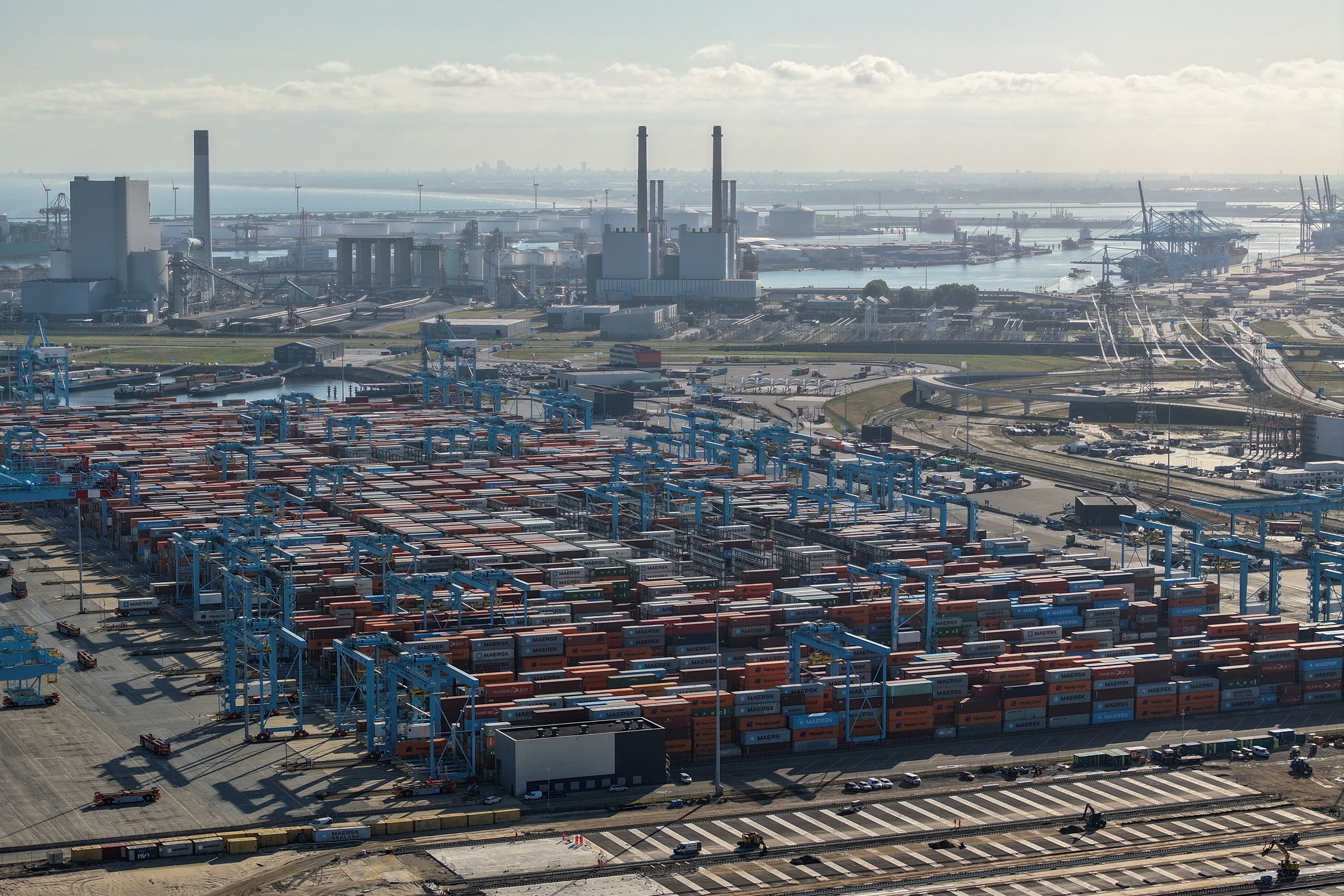
A drone view shows the port of Rotterdam in Rotterdam, Netherlands, July 9, 2025

A drone view shows the port of Rotterdam in Rotterdam, Netherlands, July 9, 2025 Image: REUTERS/Bart Biesemans

To address these structural challenges, the Ferm initiative operates through three complementary roles:

  • Orchestrator: Conducting joint threat analysis, scenario planning, cyber stress testing and ecosystem-wide incident response planning across supply chains so ports and companies understand shared risks and prepare for cascading failure scenarios they would be unable to manage singularly.
  • Facilitator: Enabling trusted information sharing, community building and peer collaboration – including its threat intelligence service, which collects and analyses information from sources such as the Dutch National Cyber Security Centre and maritime sector signals. Technical alerts and complex security advisories are translated into clear, actionable guidance tailored to port operations, describing potential business impact and practical mitigation measures.
  • Representative: Engaging with governments, regulators and international port networks to address cross-border threats and enable early warnings.

Ferm’s strength lies in its cross-sectoral approach, its close connection to operations, and its facilitation of cooperation on issues relevant to all stakeholders, while keeping participation voluntary.

A layered defence model for port cyber resilience

Ferm focuses on three primary organization groups, supported and facilitated by relevant public partners and stakeholders.

The first group comprises those organizations that are foundational to the safe handling of maritime traffic, such as Vessel Traffic Services operators and mooring service providers. This is the most critical process within the port chain, enabling the flow of goods, logistics and industrial production, with consequences that extend across the port ecosystem and beyond.

The second group are organizations that form critical chains for the continuity of the Dutch economy and the European hinterland, such as terminal operators and chemical companies. Ferm has mapped these critical chains to identify where disruptions would have the greatest economic and societal impact.

The third group includes all port-related organizations that may not be formally designated as critical but play an important supporting role in daily port operations. These include shipping companies, ship builders, nautical service providers and non-maritime organizations within the port.

How Europe can adapt the Ferm Seaports example

The Ferm initiative shows how ecosystem-level collaboration strengthens cyber resilience in ports and in the interconnected industrial systems that depend on them.

Since Rotterdam, the initiative has expanded to four additional Dutch seaports. While more than 1,000 companies operate across these ports, Ferm directly connects around 80 organizations through structured coordination and information-sharing.

It identifies an average of 15 vulnerable systems and issues approximately two urgent security advisories per week. This illustrates both the scale of exposure and the value of coordinated monitoring and response.

Its success lies in a clear, shared vision, strong top-management commitment and sustainable, long-term funding partnerships, with the initiative supported and financed by the five Dutch seaport authorities.

The lessons extend beyond ports: as industrial clusters become more digitized, collective cyber resilience becomes a structural necessity. Initiatives such as Ferm demonstrate how collaboration, rather than competition, can become a strategic asset for safeguarding the continuity of critical economic lifelines.