

惯性聚合 高效追踪和阅读你感兴趣的博客、新闻、科技资讯
阅读原文 在惯性聚合中打开

推荐订阅源

cs.AI updates on arXiv.org
Schneier on Security
cs.CV updates on arXiv.org
Attack and Defense Labs
H
Hacker News: Front Page
Google DeepMind News
雷峰网
雷峰网
C
CXSECURITY Database RSS Feed - CXSecurity.com
Cisco Talos Blog
Cisco Talos Blog
T
Tenable Blog
G
Google Developers Blog
A
About on SuperTechFans
The Cloudflare Blog
S
Securelist
OSCHINA 社区最新新闻
OSCHINA 社区最新新闻
C
Cisco Blogs
H
Hackread – Cybersecurity News, Data Breaches, AI and More
aimingoo的专栏
aimingoo的专栏
云风的 BLOG
云风的 BLOG
Forbes - Security
Forbes - Security
腾讯CDC
Application and Cybersecurity Blog
V
Vulnerabilities – Threatpost
IT之家
IT之家
博客园_首页
P
Proofpoint News Feed
P
Privacy & Cybersecurity Law Blog
C
Cyber Attacks, Cyber Crime and Cyber Security
Project Zero
Project Zero
月光博客
月光博客
NISL@THU
NISL@THU
爱范儿
爱范儿
S
Secure Thoughts
K
Kaspersky official blog
Security Latest
Security Latest
T
Tailwind CSS Blog
博客园 - Franky
D
Darknet – Hacking Tools, Hacker News & Cyber Security
TaoSecurity Blog
TaoSecurity Blog
The GitHub Blog
The GitHub Blog
Microsoft Azure Blog
B
Blog RSS Feed
S
SegmentFault 最新的问题
H
Help Net Security
T
Tor Project blog
L
LINUX DO - 热门话题
S
Security @ Cisco Blogs
N
News and Events Feed by Topic
O
OpenAI News
S
Schneier on Security

World Economic Forum

What happened at the MC14 WTO meeting in Yaoundé How giving gorillas digital wallets can help finance nature Why is leadership a strategic investment for philanthropy? Counting the many costs of the global mental health burden What we learned from the 2026 World Bank Spring Meetings Crop protection is at risk. How innovation can help Here's a playbook for boards on how to govern agentic AI Why connected data makes AI decision-ready for sustainability 3 ways better data practices are reshaping financial supervision What technology convergence looks like in practice 7 reasons the old order broke — and how it might be repaired How governments can make agentic AI re  ? Current and future uses of RNA, including mRNA vaccines Real-time deepfakes are rewriting the rules of child safety Electrification trend ‘unmistakeable’ – and more energy stories From smallpox to the common cold: A brief history of vaccines Saudi Arabia's new AI-powered sustainability platform could unlock $20 billion by 2030 Here are 6 ways that climate change is affecting sports around the world This crisis could be an opportunity for the energy transition Middle East war: 6 ways countries are responding to the historic energy shock Nature can teach us about leadership and building resilience How did the Strait of Hormuz become so important, and will it stay that way? Yes/Cities: Helping global cities become more resilient, sustainable and prosperous Healthy ageing in APAC: The role of the influenza vaccine Risk management, renewables and a rocky road ahead: Spring Meetings takeaways Japan in a world of rising middle powers EU plans to offset Iran war's energy impact, and other climate and nature news 3 cities leading on green investment for economic growth The coffee industry is making the case for climate insurance The ocean is now a subprime asset, so we need a sustainable blue economy 5 leaders on today’s growth dilemmas and how to navigate them What helps purpose-driven, early-stage start-ups scale? Why trust is key to the EU's Empowering Consumers Directive The $3 trillion maintenance gap is burning money and the planet Surging AI needs and geopolitical supply shocks renew attention on nuclear energy 5 things to know before interacting with digital assets Frontiers Planet Prize: 25 solutions for planetary crises How the Iran war is disrupting India's steel production What's needed for growth in the new economy? Why we need a humanitarian truce is Sudan Freedom of expression under attack: How do we protect the media? Why companies – and nations – should create an AI culture Anthropic’s Mythos moment: how frontier AI is redefining cybersecurity Discover this week's must-read finance stories 'Godfather of AI' Yoshua Bengio on why AI can behave unpredictably (and what needs to change) Everyone talks about critical thinking. Here's how schools should actually teach it The top international trade stories to know this month The big chart: How oil prices have reacted to world events since the 1980s Why AI needs digital public infrastructure to deliver for citizens What AI in education needs next: Lessons from youth leaders across five countries How to scale clean hydrogen to meet energy security needs Meet the Young Global Leaders Class of 2026 Ventures with blue carbon solutions for coastal restoration How peer-led reskilling is helping bridge the skills gap in East Africa China's lessons on the energy sector’s nature-positive transition Here's how Japan's green materials sector is thriving The Strait of Hormuz crisis: Rewriting the future of AI Systemic risk is the hidden tax on growth. Here's how insurance can help build economic resilience Earth Day: What is it, when is it and why is it important? The Rayner plot: What it tells us about the future of jobs This is why we’ll feel the economic effects of this war for a while How energy and finance leaders are approaching climate investment in 2026 How quantum technologies are being tested to strengthen energy systems How to think about ‘safe’ withdrawal rates in a changing global economy Is collective cyber defence the future of port security? Learnings from a Dutch initiative Cyberattacks target US infrastructure, and other cybersecurity news Rethinking workplace energy: Why our assumptions can lead to burnout What could an international panel to tackle inequality achieve? Why climate action matters for healthy longevity Workforce health is the bedrock of global supply chains. Here's how to protect it Southeast Asia may be a distinct region but its risks affect each country differently 5 ways to grow a business mindset in international development How companies can finally cut Scope 3 emissions Here's how to get the $7 trillion AI hardware buildout right Leaders are moving from systems of record to systems of work G7 One Health Summit launches global diagnostics initiative, and other health stories What stopping war-risk insurance in the Strait of Hormuz tells us Why leaders must transform cyber resilience measurement AI can help create comparability and scale impact investing What's in store for the future of multilateralism? Why food waste is a $540 billion opportunity hiding in plain sight What Afghanistan can teach us about strategic foresight This is how we use generative AI on Forum Stories How cities are turning urban complexity into coherent climate plans How non-profits and governments use data to drive real system change How demographics, not AI, will redefine the labour market Three lessons on the energy transition in an age of crisis NFL players: Why financial literacy is a game-changer for student-athletes 3 ways Africa can maximize the value of its critical minerals and finance its future What leaders are saying about the new geopolitics of energy The financial system is rebooting. Stakeholders must adapt Cancer care innovation is reshaping resilience in Japan The hidden struggle of employed youth in Africa How markets and missions are becoming allies for impact What’s changing in frontier tech – from geopolitics to AI and energy Why stablecoins are quickly becoming a geopolitical issue How public-private collaboration can help close the global gender gap It’s time to start treating AI infrastructure as critical infrastructure 5 effective choices to turn workplace well-being into a competitive advantage Why the AI economy can’t rely on a single digital Suez
How to strengthen collaboration to tackle infectious disease
Saia Ma’u Piukala · 2026-04-01 · via World Economic Forum
  • No single discipline, sector or country can manage the threat of infectious disease alone in a highly interconnected world.
  • This idea is the basis of the One Health initiative, created by international bodies to strengthen global cooperation on health.
  • More can be done to tackle the effects of emerging zoonotic diseases (those originating in animals), antimicrobial resistance and climate change.

“Between animal and human medicine, there are no dividing lines – nor should there be.”

Rudolf Virchow, the German physician widely regarded as the father of modern pathology, made that declaration in 1856 against a backdrop of multiple global and regional health crises.

The third cholera pandemic (1846-1860), had originated in India and was engulfing swathes of Asia, Europe, Africa and North America, eventually killing well over 1 million people. An outbreak of trichinosis, a parasitic infection caused by eating raw or undercooked meat, sickened thousands in Europe, causing hundreds of deaths. And typhus, an often-fatal bacterial disease transmitted via infected fleas, lice or mites, had ravaged areas with poor hygiene, poverty and overcrowding in 1848.

These events convinced Virchow that diseases were just as much social and environmental issues as they were biological.

In the mid-19th century, the nexus between animal, human and ecosystem health was clear to Virchow. But it wasn’t until some 150 years later that the modern-day “One Health” concept took shape. It was articulated by the Manhattan Principles of 2004 following the 2003 global SARS outbreak, which was triggered by a novel coronavirus harboured by horseshoe bats.

The core message of the principles was that no single discipline or sector can properly manage the threat of disease in a globalized world. A trans-disciplinary, multisectoral approach that includes environmental health as a key component of human and animal health is essential.

Building on the Manhattan Principles, international organizations began formalizing the One Health collaboration. This led to the One Health Quadripartite of today, comprising the World Health Organization, the UN Food and Agriculture Organization, the UN Environment Programme and the World Organization for Animal Health.

The growing threat of infectious disease

The advocacy platform of the quadripartite has never been more urgent. Over 60% of known infectious diseases and up to 75% of emerging diseases originate in animals. Each year, on average, these so-called zoonotic diseases affect more than 2 billion people and claim over 2 million lives. And 600 million people fall ill from foodborne diseases each year, incurring an estimated $110 billion in medical expenses annually and huge productivity losses in low- and middle-income countries.

Antimicrobial resistance (AMR – when drugs stop being effective in treating a range of diseases) could cause 10 million deaths annually by 2050, with global economic costs reaching $100 trillion. In the Western Pacific, a projected 5.2 million deaths will be caused by drug-resistant infections between 2020 and 2030. AMR is expected to cost the region $148 billion in economic losses during this time, along with 172 million additional hospital days by 2030, taxing the region’s already-stretched health systems.

As one of the most climate-vulnerable regions globally, 3.5 million deaths occur in the Western Pacific each year from preventable environmental causes such as air pollution, unsafe water and extreme weather. Outdoor air pollution alone causes one death every 14 seconds.
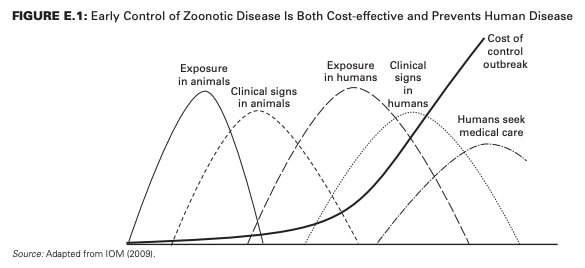
The cost difference of controlling an infectious disease outbreak as exposure builds in humans and animals.

If controlled early, it is much less costly to tackle an infectious disease outbreak. Image: People, Pathogens and our Planet, Volume 2: The Economics of One Health, World Bank

The One Health investment case

Countries in the Western Pacific region realize they need to act, both individually and collectively, to address infectious diseases.

Indonesia is working to reduce risks from certain zoonotic diseases. Heightened surveillance of avian influenza is being carried out at traditional poultry markets, for example. Efforts to control a climate-sensitive disease called leptospirosis are being strengthened in coastal and low-lying areas. Rabies, endemic in 26 of the country’s 38 provinces, is being addressed through accelerated animal vaccination, advanced surveillance and case management of rabid animals, and amplified risk communication at the community level.

Hit last year by a five-month dengue outbreak with 900 cases and three deaths, the island country of Tonga convened the Pacific’s first National Bridging Workshop, bringing together government and civil society organizations representing the human, animal and environmental health sectors to break silos and collaborate on preparing for, and responding to, vector-borne and other diseases.

Malaysia has been strengthening its AMR outbreak response in hospitals by training staff and updating national guidelines. It is boosting AMR surveillance capacity and drumming up political support across ministries beyond health.

Loading...

But the painful lessons of COVID-19 have underscored that a piecemeal approach to One Health simply doesn’t work. Working to prevent pandemics through a comprehensive One Health approach would cost $10-11 billion per year globally, according to the World Bank. By comparison, managing and responding to pandemics would cost around $30 billion – three times as much as prevention.

The return on investment is even more compelling. Investing wisely in broader One Health prevention can deliver returns of up to 86%, and 3.4 billion dollars in annual investments could generate up to $30 billion in benefits.

Despite this mounting body of evidence, it’s been a challenge to secure consistent government funding for One Health initiatives. Policy-makers and budget holders, facing competing demands, are under pressure to demonstrate a quick fix. But the return on One Health investment is manifested in the longer term.

One Health as a political unifier

There is a potential game-changer for tackling infectious disease, however. The landmark Pandemic Agreement reached by WHO Member States in 2025 formally codifies One Health as key to avoiding pandemics. Once a country ratifies the Pandemic Agreement, it becomes legally binding, making it incumbent on that government to fully support One Health.

Still, will all of this really happen at a time when health budgets are shrinking and being diverted to other areas such as militarization and defence?

As a former parliamentarian and Health Minister of my homeland Tonga, I know full well that all health is ultimately political. For One Health to succeed and be sustained, political leaders and policy-makers at the very highest levels must recognize how essential it is for health and national security – and act.

From 5-7 April 2026, the French government is hosting a One Health Summit in Lyon. It will convene WHO Member States, several represented by presidents and prime ministers, alongside ministers of health, finance and other portfolios. At a time of fraying multilateralism, this gathering symbolizes that where there’s political will there’s usually a way.

The Lyon One Health Summit could be a unifier. It could facilitate regional and global collaboration between countries, as well as multisectoral collaboration within countries. This could lead to sustainable financing to implement One Health-related programmes to tackle infectious disease.

This is a very real opportunity to prove that One World, One Health – the vision with its roots in the work of Rudolf Virchow a century ago – can be more than a slogan. It can represent a shared reality we can, and should, commit to for once and for all.