



惯性聚合 高效追踪和阅读你感兴趣的博客、新闻、科技资讯
阅读原文 在惯性聚合中打开

推荐订阅源

N
News and Events Feed by Topic
V
Visual Studio Blog
Jina AI
Jina AI
云风的 BLOG
云风的 BLOG
C
Check Point Blog
M
MIT News - Artificial intelligence
罗磊的独立博客
月光博客
月光博客
阮一峰的网络日志
阮一峰的网络日志
V
V2EX
S
Secure Thoughts
酷 壳 – CoolShell
酷 壳 – CoolShell
Application and Cybersecurity Blog
B
Blog
N
News | PayPal Newsroom
爱范儿
爱范儿
cs.CV updates on arXiv.org
P
Privacy International News Feed
H
Hackread – Cybersecurity News, Data Breaches, AI and More
Security Archives - TechRepublic
Scott Helme
Scott Helme
V2EX - 技术
V2EX - 技术
OSCHINA 社区最新新闻
OSCHINA 社区最新新闻
Simon Willison's Weblog
H
Help Net Security
大猫的无限游戏
大猫的无限游戏
K
Kaspersky official blog
雷峰网
雷峰网
IT之家
IT之家
Vercel News
Vercel News
S
Schneier on Security
C
CERT Recently Published Vulnerability Notes
博客园_首页
T
Tailwind CSS Blog
T
The Exploit Database - CXSecurity.com
F
Full Disclosure
博客园 - 司徒正美
The Cloudflare Blog
D
Darknet – Hacking Tools, Hacker News & Cyber Security
C
Cisco Blogs
K
KPMG report finds enterprise disconnect between AI and its ROI | CIO
奇客Solidot–传递最新科技情报
奇客Solidot–传递最新科技情报
N
News and Events Feed by Topic
Cyberwarzone
Cyberwarzone
P
Proofpoint News Feed
F
Fortinet All Blogs
有赞技术团队
有赞技术团队
S
Security Affairs
Latest news
Latest news

World Economic Forum

What happened at the MC14 WTO meeting in Yaoundé How giving gorillas digital wallets can help finance nature Why is leadership a strategic investment for philanthropy? Counting the many costs of the global mental health burden What we learned from the 2026 World Bank Spring Meetings Crop protection is at risk. How innovation can help Here's a playbook for boards on how to govern agentic AI Why connected data makes AI decision-ready for sustainability 3 ways better data practices are reshaping financial supervision What technology convergence looks like in practice 7 reasons the old order broke — and how it might be repaired How governments can make agentic AI re  ? Current and future uses of RNA, including mRNA vaccines Real-time deepfakes are rewriting the rules of child safety Electrification trend ‘unmistakeable’ – and more energy stories From smallpox to the common cold: A brief history of vaccines Saudi Arabia's new AI-powered sustainability platform could unlock $20 billion by 2030 Here are 6 ways that climate change is affecting sports around the world This crisis could be an opportunity for the energy transition Middle East war: 6 ways countries are responding to the historic energy shock Nature can teach us about leadership and building resilience How did the Strait of Hormuz become so important, and will it stay that way? Yes/Cities: Helping global cities become more resilient, sustainable and prosperous Healthy ageing in APAC: The role of the influenza vaccine Risk management, renewables and a rocky road ahead: Spring Meetings takeaways Japan in a world of rising middle powers 3 cities leading on green investment for economic growth The coffee industry is making the case for climate insurance The ocean is now a subprime asset, so we need a sustainable blue economy 5 leaders on today’s growth dilemmas and how to navigate them What helps purpose-driven, early-stage start-ups scale? Why trust is key to the EU's Empowering Consumers Directive The $3 trillion maintenance gap is burning money and the planet Surging AI needs and geopolitical supply shocks renew attention on nuclear energy 5 things to know before interacting with digital assets Frontiers Planet Prize: 25 solutions for planetary crises How the Iran war is disrupting India's steel production What's needed for growth in the new economy? Why we need a humanitarian truce is Sudan Freedom of expression under attack: How do we protect the media? Why companies – and nations – should create an AI culture Anthropic’s Mythos moment: how frontier AI is redefining cybersecurity Discover this week's must-read finance stories 'Godfather of AI' Yoshua Bengio on why AI can behave unpredictably (and what needs to change) Everyone talks about critical thinking. Here's how schools should actually teach it The top international trade stories to know this month The big chart: How oil prices have reacted to world events since the 1980s Why AI needs digital public infrastructure to deliver for citizens What AI in education needs next: Lessons from youth leaders across five countries How to scale clean hydrogen to meet energy security needs Meet the Young Global Leaders Class of 2026 Ventures with blue carbon solutions for coastal restoration How peer-led reskilling is helping bridge the skills gap in East Africa China's lessons on the energy sector’s nature-positive transition Here's how Japan's green materials sector is thriving The Strait of Hormuz crisis: Rewriting the future of AI Systemic risk is the hidden tax on growth. Here's how insurance can help build economic resilience Earth Day: What is it, when is it and why is it important? The Rayner plot: What it tells us about the future of jobs This is why we’ll feel the economic effects of this war for a while How energy and finance leaders are approaching climate investment in 2026 How quantum technologies are being tested to strengthen energy systems How to think about ‘safe’ withdrawal rates in a changing global economy Is collective cyber defence the future of port security? Learnings from a Dutch initiative Cyberattacks target US infrastructure, and other cybersecurity news Rethinking workplace energy: Why our assumptions can lead to burnout What could an international panel to tackle inequality achieve? Why climate action matters for healthy longevity Workforce health is the bedrock of global supply chains. Here's how to protect it Southeast Asia may be a distinct region but its risks affect each country differently 5 ways to grow a business mindset in international development How companies can finally cut Scope 3 emissions Here's how to get the $7 trillion AI hardware buildout right Leaders are moving from systems of record to systems of work G7 One Health Summit launches global diagnostics initiative, and other health stories What stopping war-risk insurance in the Strait of Hormuz tells us Why leaders must transform cyber resilience measurement AI can help create comparability and scale impact investing What's in store for the future of multilateralism? Why food waste is a $540 billion opportunity hiding in plain sight What Afghanistan can teach us about strategic foresight This is how we use generative AI on Forum Stories How cities are turning urban complexity into coherent climate plans How non-profits and governments use data to drive real system change How demographics, not AI, will redefine the labour market Three lessons on the energy transition in an age of crisis NFL players: Why financial literacy is a game-changer for student-athletes 3 ways Africa can maximize the value of its critical minerals and finance its future What leaders are saying about the new geopolitics of energy The financial system is rebooting. Stakeholders must adapt Cancer care innovation is reshaping resilience in Japan The hidden struggle of employed youth in Africa How markets and missions are becoming allies for impact What’s changing in frontier tech – from geopolitics to AI and energy Why stablecoins are quickly becoming a geopolitical issue How public-private collaboration can help close the global gender gap It’s time to start treating AI infrastructure as critical infrastructure 5 effective choices to turn workplace well-being into a competitive advantage How to strengthen collaboration to tackle infectious disease Why the AI economy can’t rely on a single digital Suez
EU plans to offset Iran war's energy impact, and other climate and nature news
Tom Crowfoot · 2026-04-23 · via World Economic Forum
  • This round-up contains the key nature and climate news from the past month.
  • Top news: EU drafts plan to offset Iran war's energy impact; Corporate emissions targets surged in 2025; Tuvalu takes on pre-COP31 negotiations.

1. EU unveils plan to offset Iran war's energy impact

The European Union (EU) has drafted plans to cut electricity taxes and accelerate clean energy deployment, aiming to shield consumers from volatile oil and gas prices.

The proposal is in response to recent geopolitical shocks, including disruptions around the Strait of Hormuz, which exposed Europe’s heavy dependence on imported fossil fuels.

The EU's proposed rules would ensure electricity is taxed less than fossil fuels and allow governments to reduce levies for energy-intensive industries, helping lower costs and support electrification.

The plan also promotes faster adoption of low-carbon technologies, smart grids and energy efficiency, alongside coordinated gas storage measures to avoid price spikes during supply crunches.

"The benefits of this transition clearly outweigh its ​costs. Europe cannot afford to remain exposed to increasingly frequent energy shocks," the plans state. "Every delayed investment in the energy transition risks greater cost for society at a later stage."

2. Corporate emission targets surged in 2025

Corporate climate action is accelerating, with a 40% rise in companies setting science-based targets in 2025 and nearly 10,000 firms globally now aligned with emissions reduction pathways.

Data from the Science Based Targets initiative (SBTi) shows an even faster growth in net-zero commitments, increasing 61% year-on-year as climate strategy becomes embedded in core business planning.

"There is clear evidence about the business benefits of science-based target-setting. This is a key lever for companies to manage transition risk and strengthen business resilience, remaining competitive now and in the future," said David Kennedy, Chief Executive Officer, SBTi.
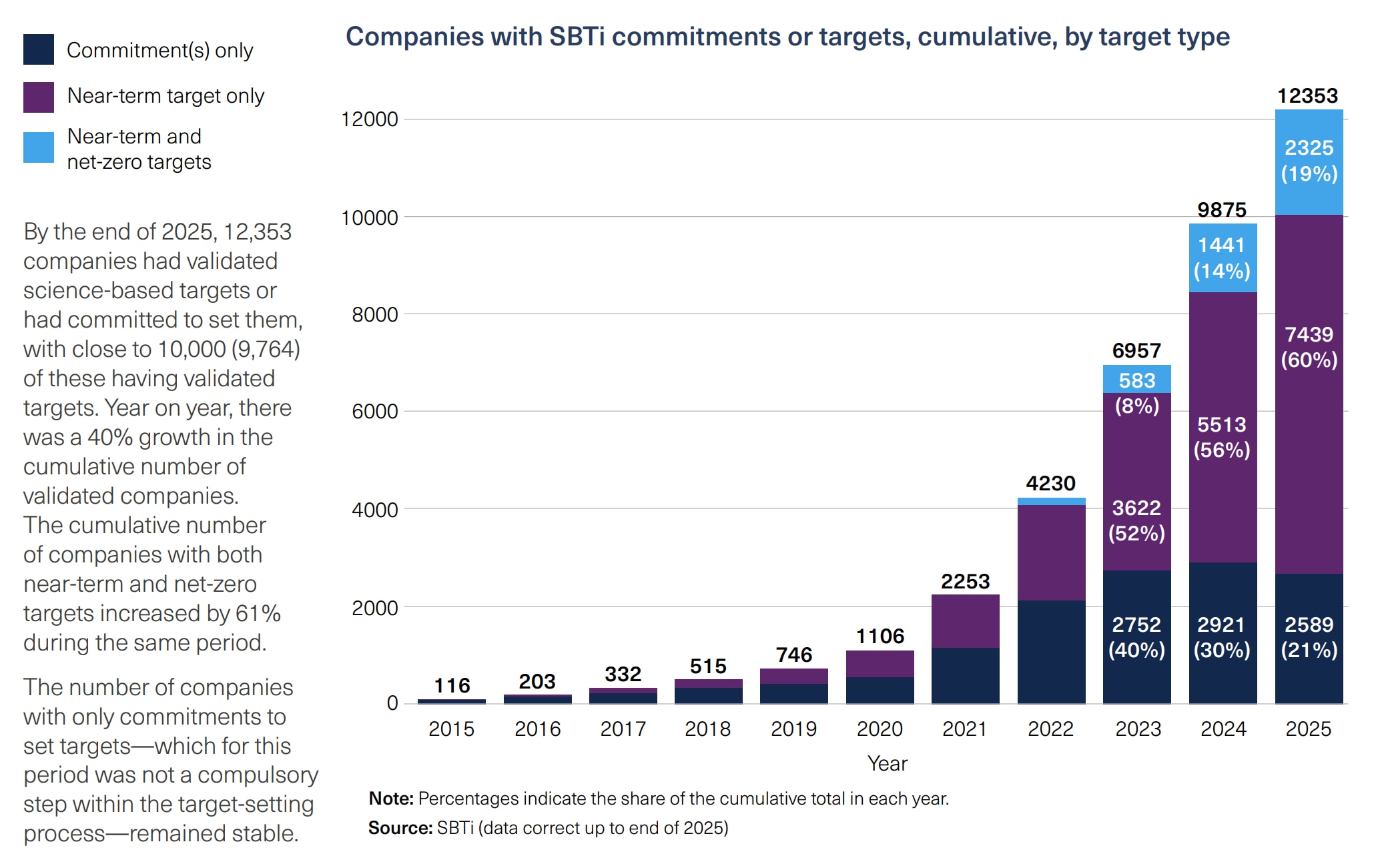
Companies with SBTi commitments or targets, cumulative, by target type.

The number of companies with both near-term and net-zero targets has increased 61% year-on-year. Image: SBTi

Asia is emerging as a major hub for climate ambition, with a 53% increase in target-setting companies, matching Europe’s growth and expanding rapidly across both developed and emerging markets.

Europe still leads overall, accounting for nearly half of all companies with validated targets, while countries like Japan, the UK and the US rank highest individually.

Momentum is spreading across sectors, particularly healthcare, IT and materials, signalling that climate targets are becoming mainstream despite political and economic headwinds.

3. News in brief: Other top nature and climate stories

Funafuti, Tuvalu's most populous island.

Tuvalu is hosting a pre-COP31 meeting. Image: REUTERS/Kirsty Needham


Tuvalu to set the stage for COP31 negotiations:
The Pacific nation will host a special pre-COP31 leaders’ meeting ahead of the Antalya summit, as Australia’s Chris Bowen prepares to lead negotiations amid expectations of tougher global emissions talks.

EU cracks down on greenwashing: The Empowering Consumers Directive (EmpCo) will prohibit companies from using generic sustainability claims in marketing. Member states transposed this into law in late March and takes effect this September.

Canada to double its protected land size by 2030:

Prime Minister Mark Carney unveiled plans to nearly double protected land and ocean areas by the end of the decade under a $2.78bn strategy, expanding national parks, marine reserves and urban green spaces across the country.

Over half of the US faces drought: More than 60% of the US is in drought after near-record March heat and low rainfall, with snowpack - accumulated snow that acts as a crucial water reserve - collapsing and raising risks of water shortages, wildfires and agricultural losses across key farming regions.

Heatwaves are creating "non-survivable" conditions: Multiple recent heatwaves have already reached critical conditions for older people when temperature and humidity are combined, with thousands of deaths likely undercounted globally.

World Bank launches global water security push: The World Bank and partners have launched 'Water Forward', to improve water access for up to one billion people, focusing on investment in infrastructure, irrigation, reuse and water management. The initiative commits to deliver water security to 400 million ​people by 2030.

Water is foundational to how economies function. When water systems work, farmers produce, businesses operate, and cities attract investment.

Ajay Banga, President of the World Bank Group

4. More on the nature and climate crisis from Forum Stories

Earth Day 2026: What is it, when is it and why is it important?

Each year on 22 April, around one billion people around the world take action to raise awareness of the climate crisis and bring about behavioural change to protect the environment. This year’s returning theme, ‘Our Power, Our Planet’, puts human agency front and centre. What was a push for clean energy in 2025 has evolved into a bold reminder: even as policies waver, communities hold the power to innovate and solve problems where they live. Discover the history of Earth Day and its achievements in this explainer from the Forum's Akanksha Khatri below.

These ventures have scalable coastal restoration solutions.

Blue carbon ecosystems such as mangroves, seagrasses and tidal wetlands are some of the most powerful natural climate solutions in the world. However, despite their essential environmental, social and economic value, these ecosystems remain vastly underfunded thanks to a blue finance gap. To help close this gap, the Blue Carbon Action Partnership (BCAP) is working with public, private and civil society partners to support a cohort of ventures at a critical stage of development. Discover how six promising ventures are being supported by the BCAP to translate national priorities into investable coastal solutions in this article.

A new EU directive will require companies to prove their green credentials. Here's how

The EU's Empowering Consumers for the Green Transition Directive means companies have to reassess how they communicate sustainability. The legislation aims to help consumers to make more informed choices, but many companies are being cautious amid concerns about greater scrutiny. This article breaks down what it is and what will take effect this fall.

Why climate action matters for healthy longevity.

Climate change is not just an environmental issue. It is increasingly shaping how long and how well people live. From heat and air pollution to food insecurity and disease, climate risks are interacting with existing pressures on health systems and widening longevity gaps across regions. The World Health Organization estimates that, between 2030 and 2050, climate change could cause about 250,000 additional deaths every year. As societies age, there is a growing focus on how climate action, from resilient health systems to cleaner cities, can support healthier, longer lives. Learn more about why climate and longevity need to be part of the same conversation in this article.