





A major shift is under way in how technological innovation happens.
In healthcare, the integration of robotics, artificial intelligence (AI) and advanced sensing technologies is redefining surgery, by improving precision, reducing infrastructure constraints and enabling greater throughput and focus on post-op care. Meanwhile, in drug discovery, the combination of AI with robotics and data systems is compressing timelines that used to take years, accelerating everything from molecule identification to clinical trial design.
In manufacturing, the convergence of digital twins, AI and robotics is transforming production into a hybrid physical-digital system, enabling real-time simulation of new product ideas, reducing waste and allowing for rapid iteration at scale.
And in energy, intelligent grid systems have been transformed by breakthroughs in advanced materials, next-generation energy systems, omni computing, AI and spatial intelligence, enabling them to help optimize charge, discharge and power flows.
Technologies matter not in isolation, but in how they reshape processes, remove bottlenecks and create new forms of value when they converge.
Across each example, a consistent pattern emerges. This stage of convergence does not eliminate constraints; it moves them into a physical-digital plane. Understanding where those constraints shift is essential for capturing value.
For more than two years, the World Economic Forum’s Technology Convergence Initiative has been exploring this shift. What began as an emerging signal is now gaining real momentum, with growing demand from leaders trying to understand how these systems are taking shape.
Much of today’s discourse still treats technologies in isolation, asking which will replace which. But history shows us that paradigm shifts come from convergence not substitution. The smartphone, for example, successfully combined technologies from industries that had never coordinated before – such as computing, communication, navigation and media.
Artificial intelligence dominates headlines and boardroom agendas. But AI is not the story on its own. It is the connective tissue across a broader system of technologies, including spatial intelligence, advanced materials, robotics, quantum, next-generation energy systems, omni-computing and engineering biology.
When these domains intersect, they unlock capabilities that cannot be understood through any single lens. It is now necessary to revisit the concept of convergence – to understand how multiple technologies come together to create entirely new systems.
So, how do we do this? Part of the answer lies in moving beyond high-level labels.
Technology domains are often treated as monoliths but that can hide where real progress is happening. Looking at their smaller components, and how advanced each one is, gives a much clearer picture.
For example, large language models are already widely adopted and approaching commoditization. At the same time, newer developments such as world models are still emerging, particularly in their ability to simulate physical environments and interact with robotics systems. Treating both simply as “AI” masks critical differences in readiness and application.
The World Economic Forum’s Tech Maturity Index breaks down eight advanced technology domains into 246 (and growing) subcomponent parts, developed to help organizations define and track maturity arcs.
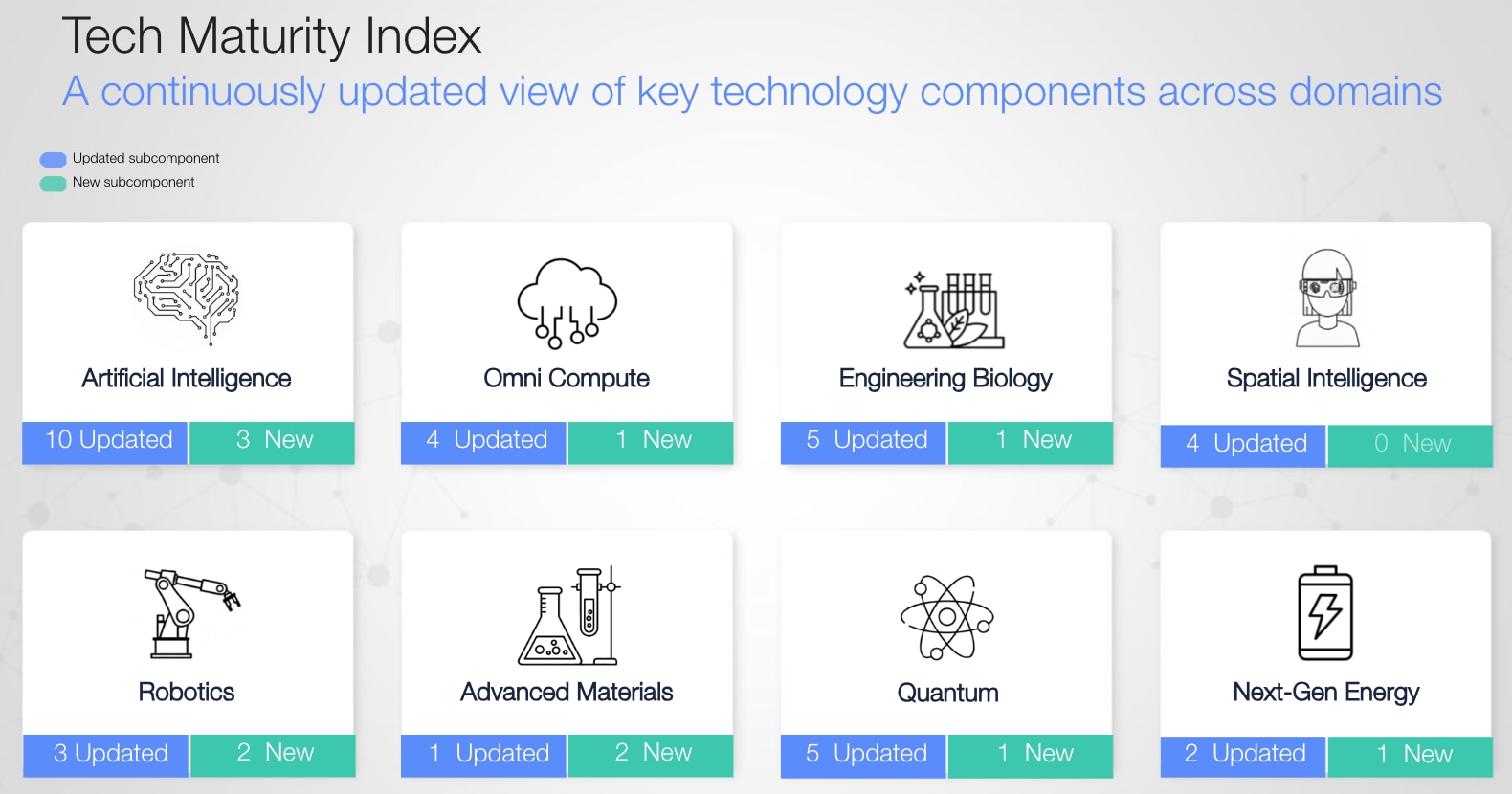
This structured lens enables organizations to distinguish between emerging, scaling and established components. This is essential for understanding when a technology is viable, where it can create value and how it can be combined with others.
Innovation rarely comes from the newest technology alone. It often emerges from combining mature, scalable systems with newer, differentiating capabilities.
Capturing that value requires less technological infrastructure and more organizational rethinking. Success increasingly depends, not on the full stack of capabilities required in the new landscape, but on the ability to orchestrate across ecosystems.
This means forming new types of partnerships, engaging with unfamiliar sectors and building internal capabilities that bridge disciplines. It also requires a shift from controlling value chains to participating in them.
Organizations that succeed are those that leverage existing strengths, connect into broader networks, and scale through coordination rather than ownership.
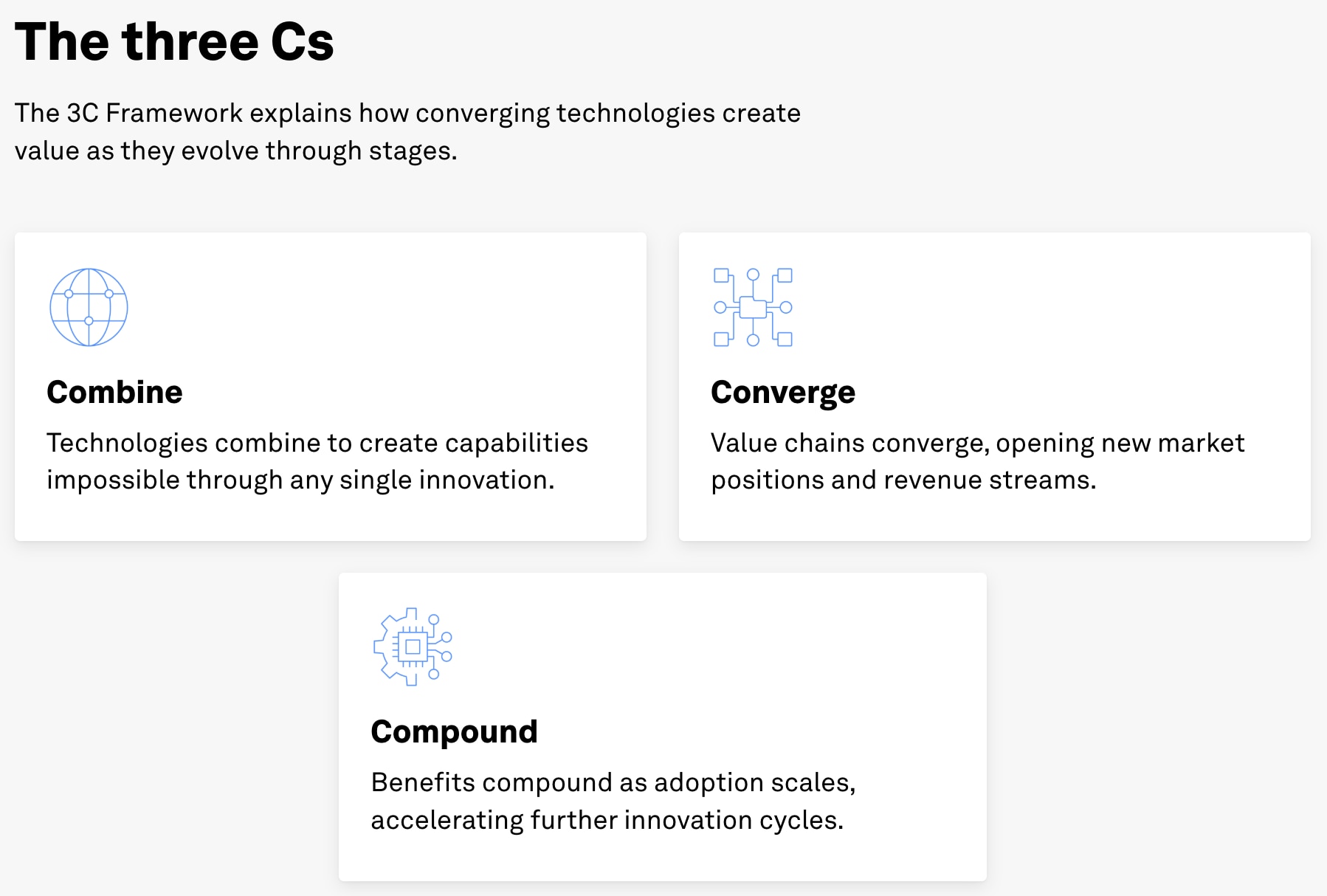
These dynamics point to a repeatable cycle – combine, converge, compound. The 3C framework maps how organizations bring technologies together, integrate them into systems that scale, and interconnect them to unlock compounding value over time. Markets mature, new combinations emerge, the cycle restarts.
The Forum’s first Technology Convergence Report established the technical foundation, mapping how technologies combine and how maturity shapes their trajectory. The second, Technology Convergence: The New Logic for Competitive Advantage, moves from theory to application. It examines how these combinations are already reshaping industries, redefining value chains and creating new forms of competitive advantage.
This growing momentum is also increasingly visible in the external environment. The Technology Convergence Initiative and its work were recently presented at SXSW, leading a slew of thought leaders articulating this message: technology is at an intersection, and convergence is no longer a future concept.
Conversations are shifting from AI as a standalone force to AI as one element within a broader system – how it connects with robotics, with advanced materials, with energy infrastructure. It is an evolving landscape, setting the stage for the next phase of this work.
What is still emerging in some contexts is already being operationalized in others. The question now is not whether technology convergence is happening. It is where it matters most and how to act on it.
此内容由惯性聚合(RSS阅读器)自动聚合整理,仅供阅读参考。 原文来自 — 版权归原作者所有。