



惯性聚合 高效追踪和阅读你感兴趣的博客、新闻、科技资讯
阅读原文 在惯性聚合中打开

推荐订阅源

Stack Overflow Blog
Stack Overflow Blog
T
Tor Project blog
Hacker News - Newest:
Hacker News - Newest: "LLM"
cs.CL updates on arXiv.org
Threat Intelligence Blog | Flashpoint
P
Palo Alto Networks Blog
T
The Exploit Database - CXSecurity.com
P
Privacy International News Feed
C
Cybersecurity and Infrastructure Security Agency CISA
MyScale Blog
MyScale Blog
D
DataBreaches.Net
I
Intezer
GbyAI
GbyAI
Jina AI
Jina AI
The GitHub Blog
The GitHub Blog
S
Security @ Cisco Blogs
C
Cyber Attacks, Cyber Crime and Cyber Security
NISL@THU
NISL@THU
Project Zero
Project Zero
博客园_首页
Martin Fowler
Martin Fowler
A
About on SuperTechFans
J
Java Code Geeks
AI
AI
WordPress大学
WordPress大学
cs.AI updates on arXiv.org
L
LINUX DO - 热门话题
云风的 BLOG
云风的 BLOG
腾讯CDC
酷 壳 – CoolShell
酷 壳 – CoolShell
C
Cisco Blogs
L
LangChain Blog
Google Online Security Blog
AWS News Blog
AWS News Blog
Help Net Security
Help Net Security
Application and Cybersecurity Blog
D
Docker
N
Netflix TechBlog - Medium
Know Your Adversary
Know Your Adversary
D
Darknet – Hacking Tools, Hacker News & Cyber Security
S
Secure Thoughts
H
Heimdal Security Blog
Recent Commits to openclaw:main
O
OpenAI News
S
Security Affairs
freeCodeCamp Programming Tutorials: Python, JavaScript, Git & More
博客园 - 【当耐特】
雷峰网
雷峰网
V
Visual Studio Blog
T
Threat Research - Cisco Blogs

World Economic Forum

How giving gorillas digital wallets can help finance nature Why is leadership a strategic investment for philanthropy? Counting the many costs of the global mental health burden What we learned from the 2026 World Bank Spring Meetings Crop protection is at risk. How innovation can help Here's a playbook for boards on how to govern agentic AI Why connected data makes AI decision-ready for sustainability 3 ways better data practices are reshaping financial supervision What technology convergence looks like in practice 7 reasons the old order broke — and how it might be repaired How governments can make agentic AI re  ? Current and future uses of RNA, including mRNA vaccines Real-time deepfakes are rewriting the rules of child safety Electrification trend ‘unmistakeable’ – and more energy stories From smallpox to the common cold: A brief history of vaccines Saudi Arabia's new AI-powered sustainability platform could unlock $20 billion by 2030 Here are 6 ways that climate change is affecting sports around the world This crisis could be an opportunity for the energy transition Middle East war: 6 ways countries are responding to the historic energy shock Nature can teach us about leadership and building resilience How did the Strait of Hormuz become so important, and will it stay that way? Yes/Cities: Helping global cities become more resilient, sustainable and prosperous Healthy ageing in APAC: The role of the influenza vaccine Risk management, renewables and a rocky road ahead: Spring Meetings takeaways Japan in a world of rising middle powers EU plans to offset Iran war's energy impact, and other climate and nature news 3 cities leading on green investment for economic growth The coffee industry is making the case for climate insurance The ocean is now a subprime asset, so we need a sustainable blue economy 5 leaders on today’s growth dilemmas and how to navigate them What helps purpose-driven, early-stage start-ups scale? Why trust is key to the EU's Empowering Consumers Directive The $3 trillion maintenance gap is burning money and the planet Surging AI needs and geopolitical supply shocks renew attention on nuclear energy 5 things to know before interacting with digital assets Frontiers Planet Prize: 25 solutions for planetary crises How the Iran war is disrupting India's steel production What's needed for growth in the new economy? Why we need a humanitarian truce is Sudan Freedom of expression under attack: How do we protect the media? Why companies – and nations – should create an AI culture Anthropic’s Mythos moment: how frontier AI is redefining cybersecurity Discover this week's must-read finance stories 'Godfather of AI' Yoshua Bengio on why AI can behave unpredictably (and what needs to change) Everyone talks about critical thinking. Here's how schools should actually teach it The top international trade stories to know this month The big chart: How oil prices have reacted to world events since the 1980s Why AI needs digital public infrastructure to deliver for citizens What AI in education needs next: Lessons from youth leaders across five countries How to scale clean hydrogen to meet energy security needs Meet the Young Global Leaders Class of 2026 Ventures with blue carbon solutions for coastal restoration How peer-led reskilling is helping bridge the skills gap in East Africa China's lessons on the energy sector’s nature-positive transition Here's how Japan's green materials sector is thriving The Strait of Hormuz crisis: Rewriting the future of AI Systemic risk is the hidden tax on growth. Here's how insurance can help build economic resilience Earth Day: What is it, when is it and why is it important? The Rayner plot: What it tells us about the future of jobs This is why we’ll feel the economic effects of this war for a while How energy and finance leaders are approaching climate investment in 2026 How quantum technologies are being tested to strengthen energy systems How to think about ‘safe’ withdrawal rates in a changing global economy Is collective cyber defence the future of port security? Learnings from a Dutch initiative Cyberattacks target US infrastructure, and other cybersecurity news Rethinking workplace energy: Why our assumptions can lead to burnout What could an international panel to tackle inequality achieve? Why climate action matters for healthy longevity Workforce health is the bedrock of global supply chains. Here's how to protect it Southeast Asia may be a distinct region but its risks affect each country differently 5 ways to grow a business mindset in international development How companies can finally cut Scope 3 emissions Here's how to get the $7 trillion AI hardware buildout right Leaders are moving from systems of record to systems of work G7 One Health Summit launches global diagnostics initiative, and other health stories What stopping war-risk insurance in the Strait of Hormuz tells us Why leaders must transform cyber resilience measurement AI can help create comparability and scale impact investing What's in store for the future of multilateralism? Why food waste is a $540 billion opportunity hiding in plain sight What Afghanistan can teach us about strategic foresight This is how we use generative AI on Forum Stories How cities are turning urban complexity into coherent climate plans How non-profits and governments use data to drive real system change How demographics, not AI, will redefine the labour market Three lessons on the energy transition in an age of crisis NFL players: Why financial literacy is a game-changer for student-athletes 3 ways Africa can maximize the value of its critical minerals and finance its future What leaders are saying about the new geopolitics of energy The financial system is rebooting. Stakeholders must adapt Cancer care innovation is reshaping resilience in Japan The hidden struggle of employed youth in Africa How markets and missions are becoming allies for impact What’s changing in frontier tech – from geopolitics to AI and energy Why stablecoins are quickly becoming a geopolitical issue How public-private collaboration can help close the global gender gap It’s time to start treating AI infrastructure as critical infrastructure 5 effective choices to turn workplace well-being into a competitive advantage How to strengthen collaboration to tackle infectious disease Why the AI economy can’t rely on a single digital Suez
Critical minerals need more than capital. They need targeted de-risking to become investable
Tom Moerenho · 2026-05-03 · via World Economic Forum
  • Demand for critical minerals is rising, but investment is still not scaling where risks, timelines and revenues remain hard to underwrite.
  • Because different minerals face distinct barriers, a one-size-fits-all approach often fails.
  • Building more resilient and diversified supply will require targeted de-risking tools that can crowd in private capital where it is most needed.

Critical minerals sit at the intersection of energy technology delivery, industrial competitiveness and economic resilience. From copper and lithium for electrification to rare earths for semiconductors, these materials increasingly shape how quickly countries can deploy clean energy, expand digital infrastructure and strengthen security. Demand is expected to rise significantly in the coming years, even as efforts to improve material efficiency, scale circularity and accelerate substitution continue.

Yet the real constraint is often misunderstood. The problem is not simply one of geological scarcity or even capital. It is whether projects are investable in the first place. Many still struggle to attract mainstream private finance because their risk profiles do not align with investor requirements. Long development timelines, high upfront capital needs, permitting complexity, policy uncertainty and weak revenue visibility make projects difficult to underwrite. Copper shows the scale of the challenge: despite a projected supply shortfall of 30% by 2035, investment projections indicate a $250 billion gap by 2030.

This is why the debate needs to move beyond calls for “more capital” and focus instead on what makes projects financeable. In a new report by the World Economic Forum in collaboration with the Center on Global Energy Policy at Columbia University's School of International and Public Affairs (SIPA), we outline a practical framework for closing the bankability gap: one that matches de-risking tools to the specific constraints facing different minerals, jurisdictions and stages of project development.

Start with the real constraint, not a generic funding gap

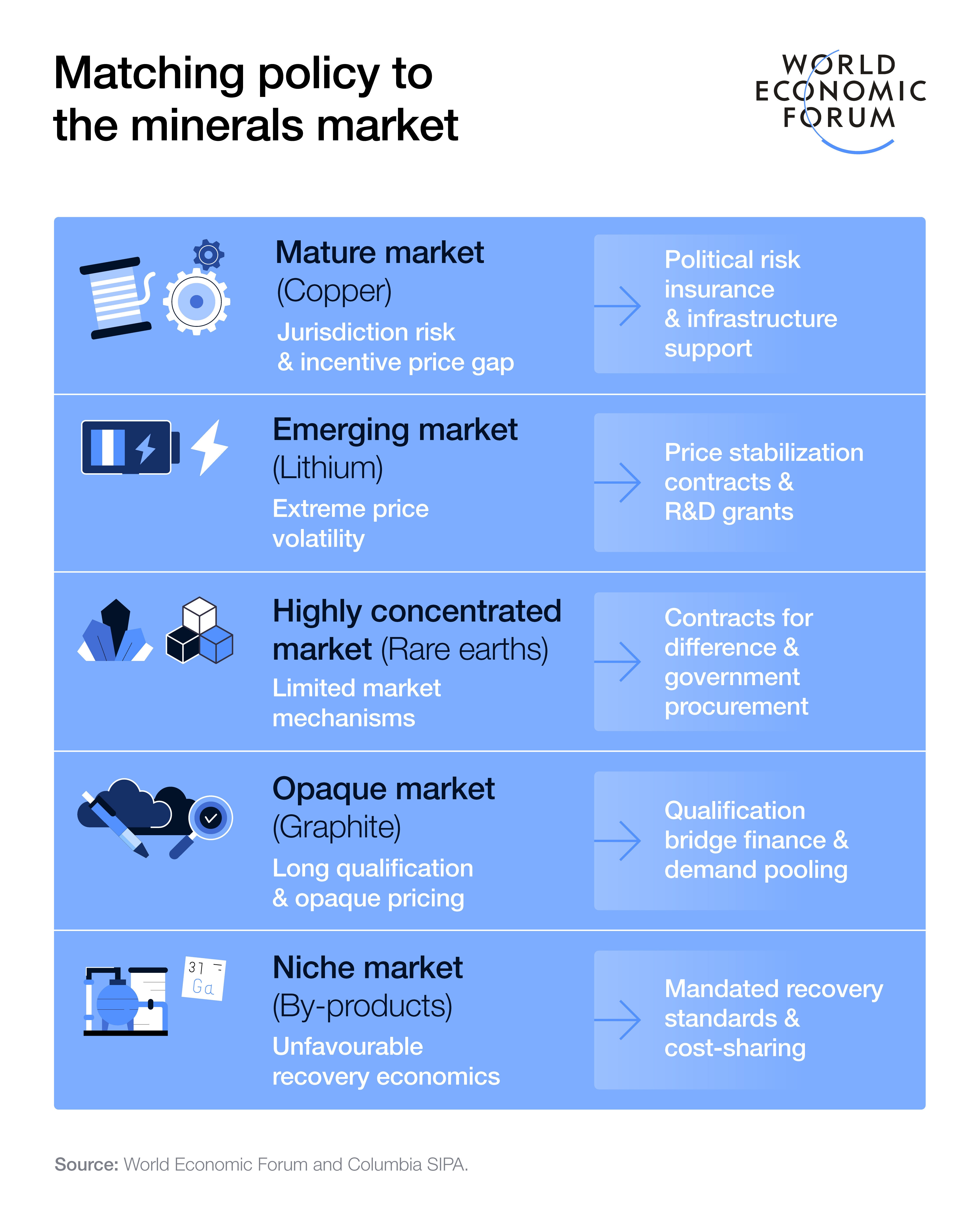
Critical minerals are often treated as a single policy category. In practice, each mineral has its own market structure, pricing dynamics, end uses and risk profile, and those differences matter for bankability. A copper project does not face the same financing barriers as a graphite, rare earths or by-product minerals project.

In mature markets such as copper, the challenge often lies less in price discovery and more in permitting, infrastructure and delivery risk. In emerging markets such as lithium, volatility and limited hedging options can make revenues harder to underwrite over the long term. In highly concentrated markets such as rare earths, new entrants may need stronger demand anchors and revenue support to compete with incumbent suppliers. In opaque markets such as graphite, long qualification cycles, weak benchmarks and uncertain offtake can delay projects even when demand is growing. By-product minerals present yet another challenge: they may be strategically important, but their economics are rarely strong enough on their own to justify dedicated investment.

The lesson is simple: if the constraint differs by mineral, then the policy response has to differ too.

Match the de-risking tool to the bottleneck

This is where policy often misses the mark. Too many interventions are broad, familiar and politically attractive, but not necessarily well matched to the actual barrier holding back investment. When that happens, public support can be expensive without being especially effective; in some cases, it can displace private capital rather than crowd it in.

A more effective approach is to identify what is actually holding a project back and then match the intervention to that problem. If the main issue is early-stage capital expenditure, then upfront capital support may be the right tool. If the problem is weak offtake or poor revenue visibility, then demand anchors or revenue-stabilization mechanisms may matter more. If political or jurisdictional uncertainty is the key deterrent, then risk mitigation instruments may be decisive. And where timelines, infrastructure gaps, or permitting delays are the real issue, structural reforms may matter more than direct financial support.

What matters is not deploying every instrument available. It is to use the minimum fit-for-purpose set of tools needed to close the bankability gap and unlock broader pools of capital.
Sequence support so that public capital unlocks private finance

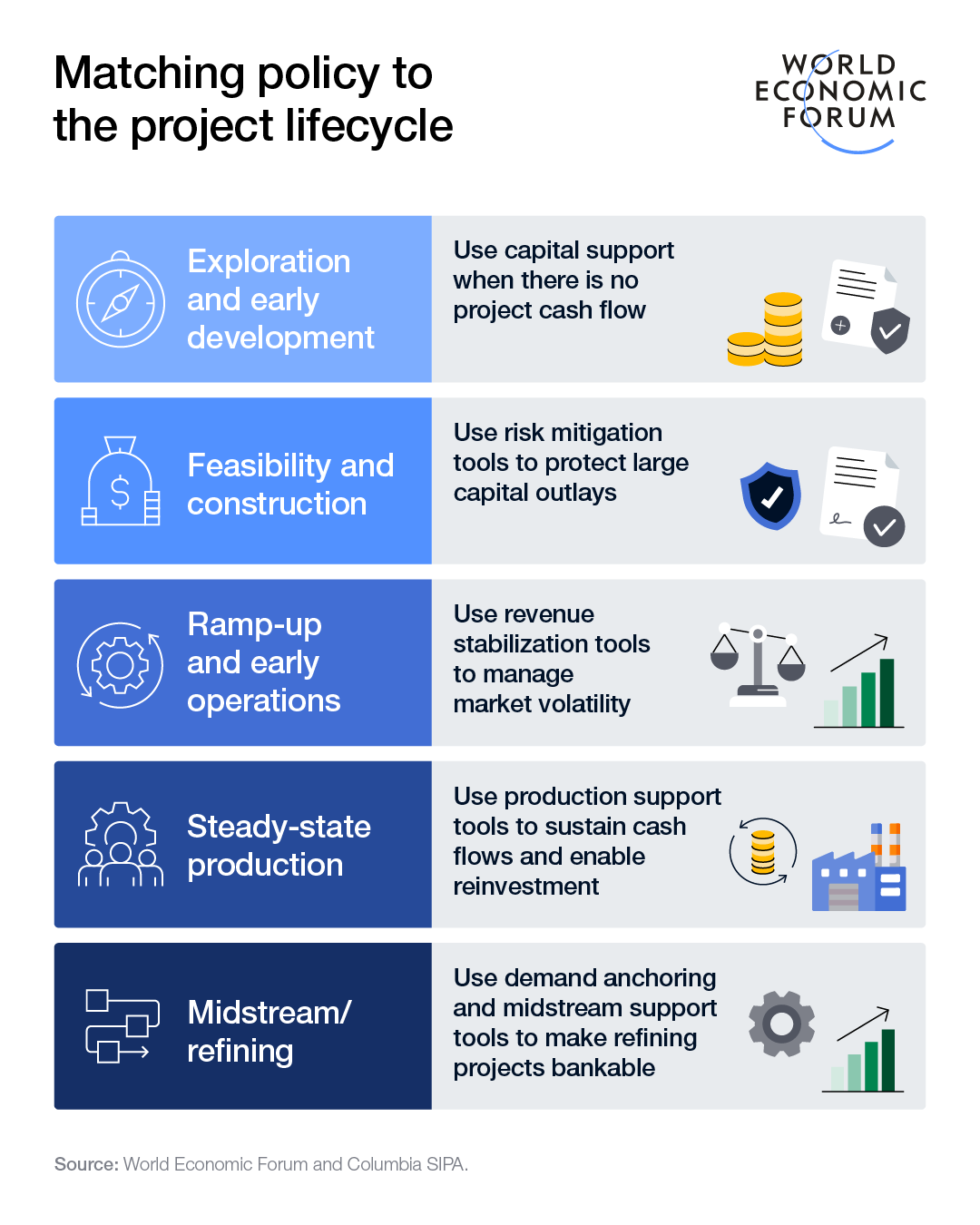
Projects face different barriers at different stages of development. Exploration and feasibility often require capital support because uncertainty is high and there is no project cash flow. Construction may need completion guarantees or other forms of risk sharing. Ramp-up may require revenue stabilization where price volatility or weak benchmarks undermine debt capacity. Midstream refining may need stronger offtake support, while steady-state production may depend more on production tax credits, floor-price mechanisms or strategic procurement in higher-cost markets.

This sequencing is crucial because the goal is to deploy public tools where they are most catalytic and then step-down support as risks decline and projects mature. That is how public finance can strengthen pipelines without undermining commercial discipline.

The same logic applies across jurisdictions. In low-risk, high-governance settings, the binding constraint may be permitting and infrastructure. In medium-risk settings, fiscal stability, foreign exchange tools and political risk cover may become more important. In fragile or highly strategic environments, a combination of guarantees, concessional finance and long-term offtake may be needed before private investors can participate at all.
Matching policy to the minerals lifecyle

Allocate risk strategically for resilient supply

The objective is not only to increase supply, but to diversify it. Today, concentration at key stages of critical mineral value chains creates exposure to disruption, with implications for industrial competitiveness, technology deployment and energy security. A more resilient supply base will require clearer risk allocation, more credible policy frameworks and stronger coordination across governments, industry, financial institutions and development finance partners.

If governments want more resilient mineral supply chains, and investors want financeable projects, the answer is not just more subsidies or more generic ambition. It is smarter de-risking: targeted interventions that match the right instruments to the right minerals, in the right jurisdictions, at the right stages. Critical minerals do need capital. But before that, they need a more practical pathway to becoming investable.