







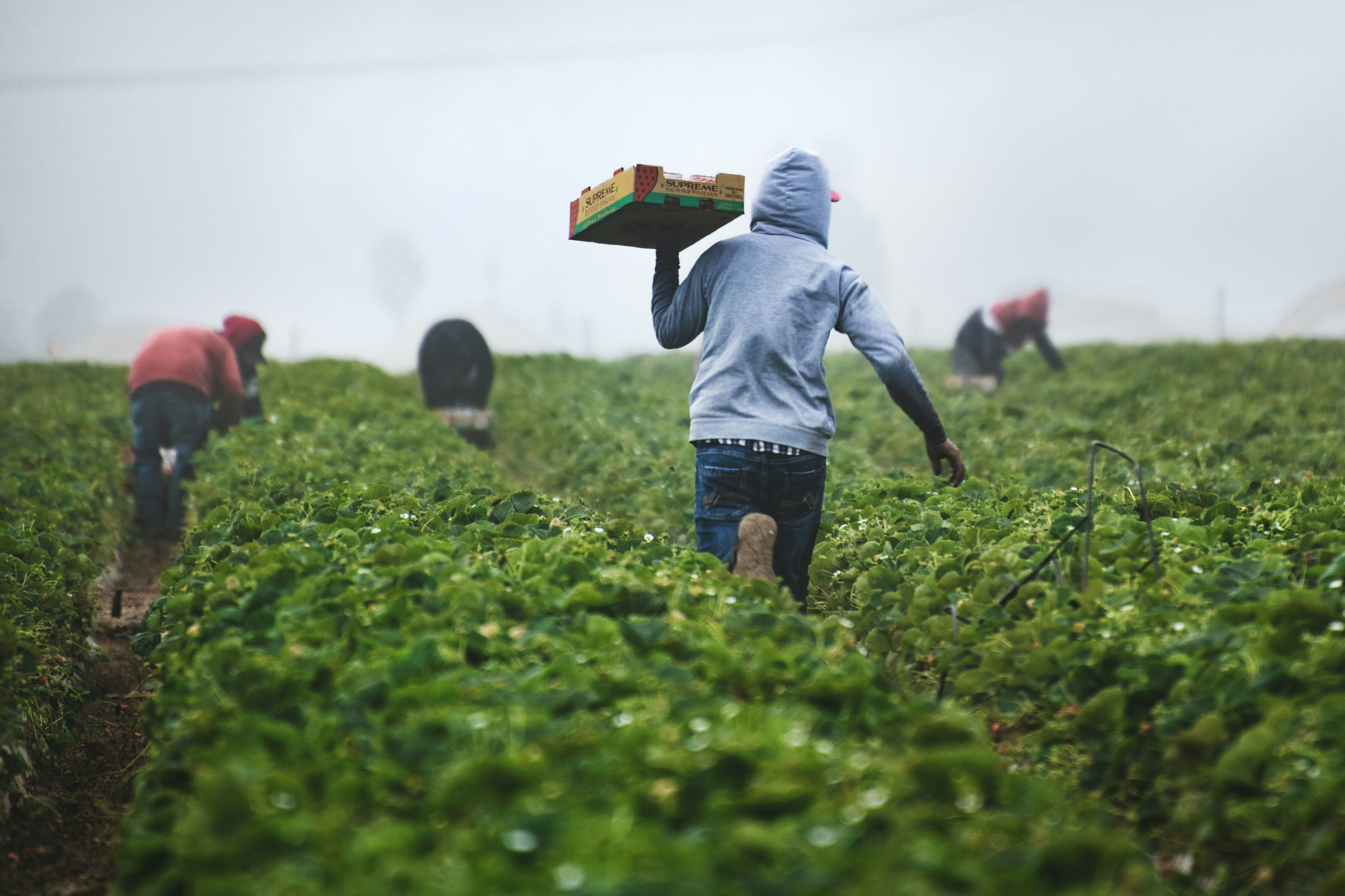
Agricultural risks are often poorly understood, highly correlated and concentrated at farm level. Image: Tim Mossholder/Unsplash
- Agriculture remains a substantially underinsured sector; as a result, volatile cash flows and high credit risk constrain the deployment of capital into sustainable food systems.
- As climate and market risks intensify, insurance must be embedded into financing structures as a risk-sharing layer.
- Scaling insurance uptake requires tackling affordability, data and product-fit gaps, as well as collaboration between financial institutions, data providers and on-the-ground experts.
Financing the transformation of our food systems has become a strategic necessity for the stability and durability of global supply chains. Food systems account for roughly 30% of global greenhouse gas emissions, yet receive less than 7% of annual climate finance. At the same time, climate and production shocks are already driving food price volatility and supply instability, with direct implications for global food security. The financing gap is widely acknowledged, but commercial capital still isn’t flowing into sustainable food systems.
The constraint is increasingly clear: it is not a lack of capital, but a lack of risk mitigation for providers of financing. Agricultural risks are often poorly understood, highly correlated and concentrated at farm level. Climate volatility, yield variability and supply chain disruptions create uncertainty that lenders and investors struggle to price and absorb. In the absence of effective risk-sharing mechanisms, capital pulls back.
Insurance could be a structural enabler of food systems financing. By protecting against risks such as climate-driven yield losses, supply chain disruptions and farmer default, insurance helps stabilize cash flows and reduce uncertainty across the value chain. This would give lenders and investors greater confidence to deploy capital at scale and over longer time horizons.
Have you read?
Yet agriculture remains substantially underinsured globally. Around 55% of the world’s insurable crop value is still uninsured, and protection gaps in climate-sensitive sectors continue to widen. Expanding insurance uptake represents one of the most immediate levers to reduce credit risk, stabilize cash flows and crowd in commercial capital. By embedding risk-sharing mechanisms more systematically into financing structures, insurance can help unlock broader food systems investment at the scale required for transformation, while strengthening the resilience of food systems and supporting more stable and reliable food supply.
Insurance as an enabling layer, not a standalone solution
Insurance, when embedded across financing structures, helps share risk across the food system, in three main ways.
First, it protects farmer income. Weather volatility, such as droughts or floods, and yield variability when adopting regenerative practices undermine farmers’ loan repayment capacity. Well-designed insurance products – including parametric and index-based solutions – can cushion these shocks, helping farmers service loans and continue investing in improved practices.
Second, it protects value chain stability. Corporations and aggregators rely on predictable delivery from upstream suppliers. Climate shocks and crop failures disrupt contracts and cashflows. By covering delivery and performance risk, insurance reinforces corporate offtake commitments and strengthens demand-led financing models.
And third, it protects investors at portfolio level. Credit-linked insurance, guarantees and reinsurance structures reduce the probability and impact of correlated losses across regions and commodities. This enables more conservative capital – including institutional investors with lower risk appetite – to participate.
What are the barriers to scale?
Despite its potential, agricultural insurance uptake remains limited, particularly among smallholder farmers. The challenge is not a single constraint, but a combination of structural barriers that reinforce one another:
- Affordability remains a core challenge. Without cost-sharing mechanisms or catalytic support, insurance is often perceived as an added burden rather than a risk-management investment.
- Data gaps complicate underwriting. Limited farm-level data, especially in emerging markets, constrains accurate risk assessment and pricing. Partnerships with traders, input suppliers and other local actors with “boots on the ground” insight are essential to reduce uncertainty and build confidence.
- Product–need mismatches undermine trust. If payout timing does not align with farmers’ cash flow cycles, or if index triggers fail to reflect real losses, uptake suffers. Insurance must be designed around real income volatility, not theoretical risk events.
- Transaction and distribution costs are high. Serving fragmented smallholders individually is expensive. Aggregation through cooperatives, financial institutions and value-chain platforms is critical to achieving viable scale.
- Regulatory fragmentation and uneven market maturity further complicate scaling, requiring structures that can operate across both developed insurance markets and low-penetration countries.
From pilots to scale: Lessons from successful models
There is no shortage of pilot projects to de-risk agricultural finance. What remains scarce are models that scale. Successful models showcase some common characteristics:
- They embed insurance into existing financial structures or value chain programmes. Standalone insurance products struggle with low uptake and high distribution costs. But when protection is bundled with loans, input finance or sourcing programmes, and when it is built into the financing stack, uptake rises, lender risk falls, and transaction costs decrease.
- They rely on strong local partnerships. Traders, ag-input firms, cooperatives and aggregators provide the “boots on the ground” insight that insurers and lenders often lack. This local intelligence improves underwriting, reduces adverse selection and builds farmer trust. Without these partnerships, products struggle to reflect real risk.
- They leverage digital data and remote sensing to reduce friction and volatility. Index-based and parametric solutions – triggered by weather data or satellite monitoring – reduce claims assessment costs and enable faster payouts. They also make it possible to serve dispersed smallholders at scale.
- They use structured capital stacks. Blended finance facilities that combine first-loss capital with insured senior tranches can attract commercial investors with lower risk appetite. In these structures, catalytic capital absorbs initial losses, insurance wraps the senior layer, and institutional capital can enter at scale with improved pricing.
These characteristics are being operationalized across diverse geographies to transform food systems from the ground up. Detailed case studies and a wider range of successful models can be found in the World Economic Forum’s Playbook of Financing Solutions. Taken together, these models demonstrate that scaling food systems transformation requires moving from isolated insurance products to integrated risk architectures.
Next steps to embed insurance in food systems financing
Integrating insurance into food systems financing stacks requires greater collaboration across key actors. There are clear benefits to such collaboration, for all actors involved.
- For financial institutions, integrating insurance into lending structures lowers credit risk, improves portfolio resilience and enables lending at larger scale, longer tenors and to new borrower segments.
- For insurers, collaboration opens access to new customer pools and premium volumes, while improving risk selection and pricing through better data and closer alignment with value-chain realities.
- For corporations and value-chain coordinators, embedding insurance within sourcing and supplier transition programmes stabilizes supply, reduces performance risk and strengthens the credibility of demand signals.
In combination, these shifts move insurance from a standalone product to a shared risk infrastructure – one that enhances predictability, strengthens incentives and makes food systems financing more scalable and commercially viable.
With thanks to Christian Graf, Partner, EMEA Practice Lead Sustainability & Responsibility in Financial Services at Bain & Company, Carlo Farina, Partner, core member of the Sustainability & Responsibility Practice at Bain & Company and Celine Unneberg, Senior Manager at Bain & Company who also contributed to this work.
Don't miss any update on this topic
Create a free account and access your personalized content collection with our latest publications and analyses.
License and Republishing
World Economic Forum articles may be republished in accordance with the Creative Commons Attribution-NonCommercial-NoDerivatives 4.0 International Public License, and in accordance with our Terms of Use.
The views expressed in this article are those of the author alone and not the World Economic Forum.
Stay up to date:
Food Security
Share:

Forum Stories newsletter
Bringing you weekly curated insights and analysis on the global issues that matter.