



惯性聚合 高效追踪和阅读你感兴趣的博客、新闻、科技资讯
阅读原文 在惯性聚合中打开

推荐订阅源

美团技术团队
W
WeLiveSecurity
Stack Overflow Blog
Stack Overflow Blog
L
LangChain Blog
S
SegmentFault 最新的问题
Apple Machine Learning Research
Google DeepMind News
F
Full Disclosure
奇客Solidot–传递最新科技情报
奇客Solidot–传递最新科技情报
The Register - Security
G
Google Developers Blog
C
Check Point Blog
GbyAI
GbyAI
A
About on SuperTechFans
V
Vulnerabilities – Threatpost
T
The Blog of Author Tim Ferriss
T
Tor Project blog
AWS News Blog
AWS News Blog
Cyberwarzone
Cyberwarzone
C
CERT Recently Published Vulnerability Notes
MongoDB | Blog
MongoDB | Blog
Latest news
Latest news
aimingoo的专栏
aimingoo的专栏
U
Unit 42
Y
Y Combinator Blog
P
Privacy International News Feed
Cisco Talos Blog
Cisco Talos Blog
S
Securelist
S
Schneier on Security
雷峰网
雷峰网
cs.CV updates on arXiv.org
Attack and Defense Labs
P
Proofpoint News Feed
C
Cisco Blogs
Webroot Blog
Webroot Blog
T
Troy Hunt's Blog
Google Online Security Blog
月光博客
月光博客
P
Privacy & Cybersecurity Law Blog
Security Archives - TechRepublic
罗磊的独立博客
Cloudbric
Cloudbric
钛媒体:引领未来商业与生活新知
钛媒体:引领未来商业与生活新知
Recent Commits to openclaw:main
Application and Cybersecurity Blog
Hacker News: Ask HN
Hacker News: Ask HN
H
Hackread – Cybersecurity News, Data Breaches, AI and More
博客园 - 司徒正美
freeCodeCamp Programming Tutorials: Python, JavaScript, Git & More
Microsoft Security Blog

World Economic Forum

What happened at the MC14 WTO meeting in Yaoundé How giving gorillas digital wallets can help finance nature Why is leadership a strategic investment for philanthropy? Counting the many costs of the global mental health burden What we learned from the 2026 World Bank Spring Meetings Crop protection is at risk. How innovation can help Here's a playbook for boards on how to govern agentic AI Why connected data makes AI decision-ready for sustainability 3 ways better data practices are reshaping financial supervision What technology convergence looks like in practice 7 reasons the old order broke — and how it might be repaired How governments can make agentic AI re  ? Current and future uses of RNA, including mRNA vaccines Real-time deepfakes are rewriting the rules of child safety Electrification trend ‘unmistakeable’ – and more energy stories From smallpox to the common cold: A brief history of vaccines Saudi Arabia's new AI-powered sustainability platform could unlock $20 billion by 2030 Here are 6 ways that climate change is affecting sports around the world This crisis could be an opportunity for the energy transition Middle East war: 6 ways countries are responding to the historic energy shock Nature can teach us about leadership and building resilience How did the Strait of Hormuz become so important, and will it stay that way? Yes/Cities: Helping global cities become more resilient, sustainable and prosperous Healthy ageing in APAC: The role of the influenza vaccine Risk management, renewables and a rocky road ahead: Spring Meetings takeaways Japan in a world of rising middle powers EU plans to offset Iran war's energy impact, and other climate and nature news 3 cities leading on green investment for economic growth The coffee industry is making the case for climate insurance The ocean is now a subprime asset, so we need a sustainable blue economy 5 leaders on today’s growth dilemmas and how to navigate them What helps purpose-driven, early-stage start-ups scale? Why trust is key to the EU's Empowering Consumers Directive The $3 trillion maintenance gap is burning money and the planet Surging AI needs and geopolitical supply shocks renew attention on nuclear energy 5 things to know before interacting with digital assets Frontiers Planet Prize: 25 solutions for planetary crises How the Iran war is disrupting India's steel production Why we need a humanitarian truce is Sudan Freedom of expression under attack: How do we protect the media? Why companies – and nations – should create an AI culture Anthropic’s Mythos moment: how frontier AI is redefining cybersecurity Discover this week's must-read finance stories 'Godfather of AI' Yoshua Bengio on why AI can behave unpredictably (and what needs to change) Everyone talks about critical thinking. Here's how schools should actually teach it The top international trade stories to know this month The big chart: How oil prices have reacted to world events since the 1980s Why AI needs digital public infrastructure to deliver for citizens What AI in education needs next: Lessons from youth leaders across five countries How to scale clean hydrogen to meet energy security needs Meet the Young Global Leaders Class of 2026 Ventures with blue carbon solutions for coastal restoration How peer-led reskilling is helping bridge the skills gap in East Africa China's lessons on the energy sector’s nature-positive transition Here's how Japan's green materials sector is thriving The Strait of Hormuz crisis: Rewriting the future of AI Systemic risk is the hidden tax on growth. Here's how insurance can help build economic resilience Earth Day: What is it, when is it and why is it important? The Rayner plot: What it tells us about the future of jobs This is why we’ll feel the economic effects of this war for a while How energy and finance leaders are approaching climate investment in 2026 How quantum technologies are being tested to strengthen energy systems How to think about ‘safe’ withdrawal rates in a changing global economy Is collective cyber defence the future of port security? Learnings from a Dutch initiative Cyberattacks target US infrastructure, and other cybersecurity news Rethinking workplace energy: Why our assumptions can lead to burnout What could an international panel to tackle inequality achieve? Why climate action matters for healthy longevity Workforce health is the bedrock of global supply chains. Here's how to protect it Southeast Asia may be a distinct region but its risks affect each country differently 5 ways to grow a business mindset in international development How companies can finally cut Scope 3 emissions Here's how to get the $7 trillion AI hardware buildout right Leaders are moving from systems of record to systems of work G7 One Health Summit launches global diagnostics initiative, and other health stories What stopping war-risk insurance in the Strait of Hormuz tells us Why leaders must transform cyber resilience measurement AI can help create comparability and scale impact investing What's in store for the future of multilateralism? Why food waste is a $540 billion opportunity hiding in plain sight What Afghanistan can teach us about strategic foresight This is how we use generative AI on Forum Stories How cities are turning urban complexity into coherent climate plans How non-profits and governments use data to drive real system change How demographics, not AI, will redefine the labour market Three lessons on the energy transition in an age of crisis NFL players: Why financial literacy is a game-changer for student-athletes 3 ways Africa can maximize the value of its critical minerals and finance its future What leaders are saying about the new geopolitics of energy The financial system is rebooting. Stakeholders must adapt Cancer care innovation is reshaping resilience in Japan The hidden struggle of employed youth in Africa How markets and missions are becoming allies for impact What’s changing in frontier tech – from geopolitics to AI and energy Why stablecoins are quickly becoming a geopolitical issue How public-private collaboration can help close the global gender gap It’s time to start treating AI infrastructure as critical infrastructure 5 effective choices to turn workplace well-being into a competitive advantage How to strengthen collaboration to tackle infectious disease Why the AI economy can’t rely on a single digital Suez
What's needed for growth in the new economy?
Majda Eddaif · 2026-04-21 · via World Economic Forum
  • A new World Economic Forum report, Growth in the New Economy: Towards a Blueprint, outlines trends, 'no-regret' strategies and dilemmas shaping long-term growth.
  • AI adoption, geostrategic competition, rising debt, and environmental and demographic challenges are poised to shape the new economy, and demand new growth strategies.
  • On the sidelines of the IMF and World Bank Spring Meetings 2026, the Centre for the New Economy and Society convened a series of leadership dialogues on the global economic outlook, the implications of the energy and commodities shock, and the future of jobs and inequality in the new economy.
  • Here are the key findings from the report, alongside takeaways from the IMF and World Bank Spring Meetings 2026.

The world can change a lot in just three months. Back in January, Kristalina Georgieva, the head of the International Monetary Fund (IMF), was cautiously optimistic about the state of the global economy when she spoke at Davos. Momentum was building.

Now the IMF has confirmed that the context has deteriorated. The global growth forecast for the year has been revised down by 0.2 percentage points - from 3.3% in January, to 3.1% in the latest IMF World Economic Outlook, published to coincide with its annual Spring Meetings with the World Bank in Washington. This drop in projected growth "largely reflects the disruptions from the conflict in the Middle East".

Had the war not started in February, the IMF was on track to upgrade its growth projection for 2026 to 3.4%. But with the Strait of Hormuz chokepoint shut, the daily flow of oil has fallen by 13%, says the IMF, while Brent crude surged from $72 before hostilities started to a peak of $120 per barrel.

Georgieva described the shock as "large, global, and asymmetric". Even under the most optimistic scenario, she warned, there will be "no neat and clean return to the status quo ante". Some estimates suggest that it might take up to 12 weeks to rebalance global tanker fleet and loading operations after reopening of the Strait of Hormuz, with lasting damage to production capacity and molecules.

In the meantime, a set of structural transformations – from AI adoption and geostrategic competition to record levels of debt and demographic and climate pressures – is reshaping the global economy.

The World Economic Forum's new report, Growth in the New Economy: Towards a Blueprint, argues that the strategies which generated returns in the old economy will no longer do so - and may actively erode the gains already made.

"The current context demands bold choices and trade-offs," says Attilio Di Battista, the Forum's Head of Economic Growth and Transformation. "Investing in productivity, talent and reinforcing the fundamentals of economic policy are clear winning strategies that hold across every country and income level."

Building on two years of dialogues with nearly 200 global business leaders held as part of the Forum’s Future of Growth Initiative, policy-makers and experts, and a survey of more than 11,000 executives worldwide, the report outlines the frontier of the new economy as well as key trends, “no-regret” strategies and dilemmas shaping economic growth in the long-term.

Discover

How the Forum helps leaders make sense of AI and collaborate on responsible innovation

'Bold choices and trade-offs'

So what should leaders actually do in the face of so much uncertainty? The report identifies "no-regret" moves and open dilemmas that will define four major areas of economic policy in the coming decade:
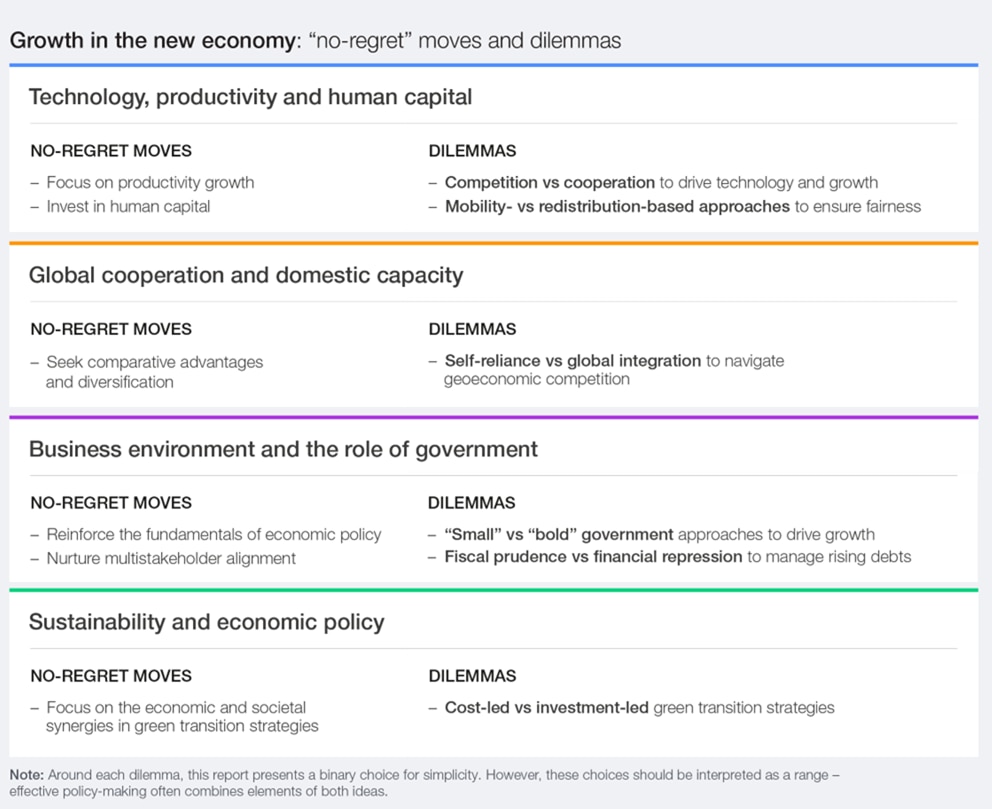
Image: World Economic Forum
  • Technology, productivity and human capital. Sustained growth in the new economy will depend on strengthening productivity and human capital as technology and knowledge become central to value creation. Governments and businesses must navigate between different approaches to translating innovation into new sources of growth and ensuring its benefits are widely shared, pursuing coordinated or competition-led approaches to harness technology and prioritize redistribution or mobility-based strategies for economic inclusion.
  • Global cooperation and domestic capacity. Leveraging comparative advantage and diversification remain “no-regret” strategies that may enable expansion of economic opportunity and resilience. But governments and businesses will need to balance global engagement with stronger domestic capacity, navigating between self-reliance and global integration strategies.
  • Business environment and the role of government. In the new economy, reinforcing the fundamentals of economic policy – including credible institutions, high-quality infrastructure and macroeconomic stability – and strengthening multistakeholder alignment continue to be winning strategies. The role of government in economic transformation can range from minimal to more expansive, while policy-makers face hard choices to manage debt levels, shifting between greater fiscal prudence and forms of financial repression.
  • Sustainability and economic policy. Focusing on the economic and societal benefits of green transition strategies is essential to unlocking long-term prosperity and resilience. Critical dilemmas around how to manage the costs and trade-offs of greener growth persist, with decision-makers navigating a range of investment-led and cost-led strategies.

Where growth will come from

Amid the tremors brought by the conflict in the Middle East, the report points to long-term shifts in the engines and composition of economic growth.

A small number of economies will drive a large share of global expansion, shaping demand, investment flows and economic influence over the rest of the decade. Asia alone is projected to account for more than 50% of cumulative global growth through 2030, while middle-income economies are expected to drive 65% of global GDP over the same period. Despite growing the fastest, low-income economies are still projected to account for only 1% of new output, a reminder that growth rate and growth weight are entirely different things.

At the industry level, business leaders expect growth opportunities over the next five years in IT services, advanced manufacturing, healthcare and accommodation and leisure. Foreign demand and domestic corporate investment are seen as the primary growth drivers across most industries, while domestic consumer spending or public expenditure are likely to constrained by the pressure of high public debt and stagnant real incomes.
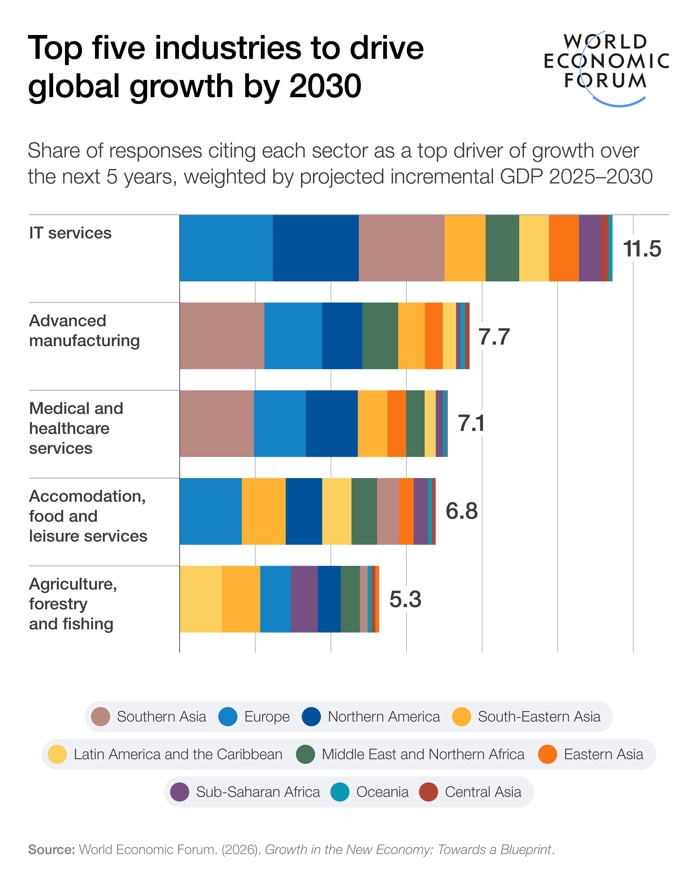
IT is seen as a key driver of growth over the next five years. Image: World Economic Forum

Pathways to growth in the new economy

According to the latest survey of more than 11,000 executives globally, high energy costs and policy instability stand out as the most common barriers to growth across regions and income levels. Skills shortages and regulatory constraints are also among the key concerns in high-income economies, while access to finance and infrastructure weigh on growth in low-income economies.

However, there might be new opportunities too.

Looking at the next five years, executives expect frontier technologies and green and energy transition to drive growth across most countries.

Demographic shifts are likely to create divergent growth trajectories. Ageing and declining populations are expected to weigh on growth in Europe and East Asia, while younger populations in South Asia, Sub-Saharan Africa and parts of the Middle East could support growth if matched with jobs and economic opportunities.

Geoeconomic fragmentation is expected to drive divergence too. While it is mostly seen as a drag on growth, executives expect some geographies, like South-East Asia, to benefit from shifting supply chains and trade patterns.
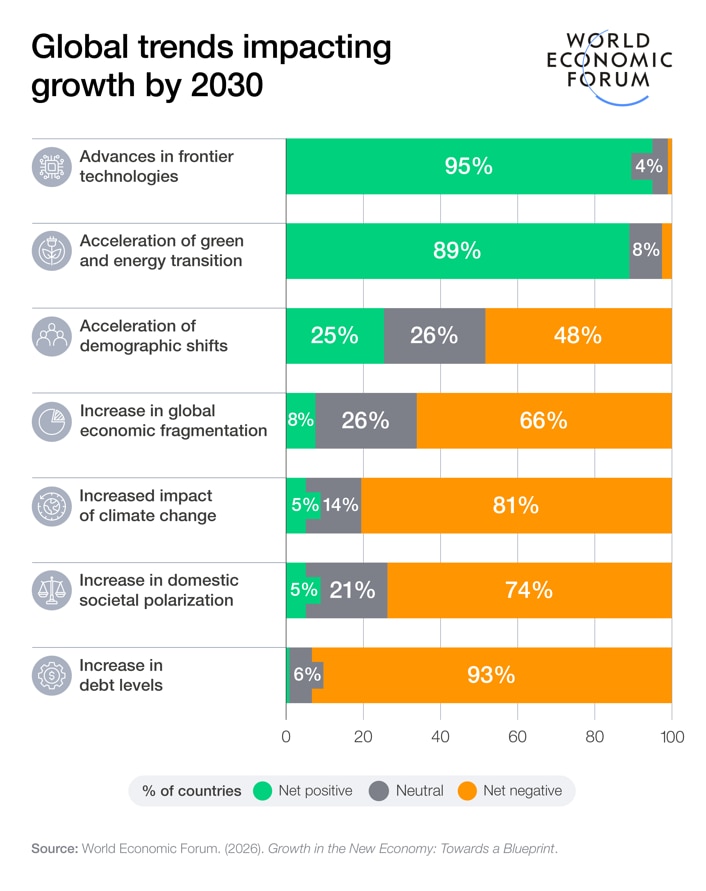
Acceleration in AI and other frontier technologies is redefining industries and the economy. Image: World Economic Forum

The new economy is not a future scenario. It is here, being stress-tested in real time. Both the Forum's report and the Spring Meetings carry the same message: resilience is built in calm water, not crisis alone.

Growth will come from pairing proactive risk management with long-term thinking, investing in the fundamentals, ensuring the benefits of the ongoing transformations are widely shared, and resisting the pull of knee-jerk reactions that leave people worse off. As Georgieva put it: "war takes away everything we work for". So does the failure to prepare and adapt swiftly and smartly.

Find out more about the World Economic Forum's Future of Growth initiative here.