


惯性聚合 高效追踪和阅读你感兴趣的博客、新闻、科技资讯
阅读原文 在惯性聚合中打开

推荐订阅源

H
Heimdal Security Blog
A
Arctic Wolf
K
Kaspersky official blog
V
Vulnerabilities – Threatpost
Threat Intelligence Blog | Flashpoint
Simon Willison's Weblog
L
LINUX DO - 热门话题
MongoDB | Blog
MongoDB | Blog
T
Threat Research - Cisco Blogs
D
Docker
爱范儿
爱范儿
T
Tenable Blog
C
Check Point Blog
B
Blog
C
Cisco Blogs
Vercel News
Vercel News
The Cloudflare Blog
T
Threatpost
NISL@THU
NISL@THU
T
Tor Project blog
V2EX - 技术
V2EX - 技术
P
Palo Alto Networks Blog
Application and Cybersecurity Blog
T
Tailwind CSS Blog
G
GRAHAM CLULEY
P
Privacy & Cybersecurity Law Blog
SecWiki News
SecWiki News
博客园 - 司徒正美
S
Security @ Cisco Blogs
GbyAI
GbyAI
S
Secure Thoughts
Microsoft Security Blog
The Register - Security
Recorded Future
Recorded Future
Cloudbric
Cloudbric
Webroot Blog
Webroot Blog
N
News and Events Feed by Topic
Y
Y Combinator Blog
博客园_首页
T
Troy Hunt's Blog
The Hacker News
The Hacker News
雷峰网
雷峰网
Google DeepMind News
U
Unit 42
AWS News Blog
AWS News Blog
PCI Perspectives
PCI Perspectives
V
Visual Studio Blog
博客园 - 聂微东
有赞技术团队
有赞技术团队
酷 壳 – CoolShell
酷 壳 – CoolShell

World Economic Forum

How giving gorillas digital wallets can help finance nature Why is leadership a strategic investment for philanthropy? Counting the many costs of the global mental health burden What we learned from the 2026 World Bank Spring Meetings Crop protection is at risk. How innovation can help Here's a playbook for boards on how to govern agentic AI Why connected data makes AI decision-ready for sustainability 3 ways better data practices are reshaping financial supervision What technology convergence looks like in practice 7 reasons the old order broke — and how it might be repaired How governments can make agentic AI re  ? Current and future uses of RNA, including mRNA vaccines Real-time deepfakes are rewriting the rules of child safety Electrification trend ‘unmistakeable’ – and more energy stories From smallpox to the common cold: A brief history of vaccines Saudi Arabia's new AI-powered sustainability platform could unlock $20 billion by 2030 Here are 6 ways that climate change is affecting sports around the world This crisis could be an opportunity for the energy transition Middle East war: 6 ways countries are responding to the historic energy shock Nature can teach us about leadership and building resilience How did the Strait of Hormuz become so important, and will it stay that way? Yes/Cities: Helping global cities become more resilient, sustainable and prosperous Healthy ageing in APAC: The role of the influenza vaccine Risk management, renewables and a rocky road ahead: Spring Meetings takeaways Japan in a world of rising middle powers EU plans to offset Iran war's energy impact, and other climate and nature news 3 cities leading on green investment for economic growth The coffee industry is making the case for climate insurance The ocean is now a subprime asset, so we need a sustainable blue economy 5 leaders on today’s growth dilemmas and how to navigate them What helps purpose-driven, early-stage start-ups scale? Why trust is key to the EU's Empowering Consumers Directive The $3 trillion maintenance gap is burning money and the planet Surging AI needs and geopolitical supply shocks renew attention on nuclear energy 5 things to know before interacting with digital assets Frontiers Planet Prize: 25 solutions for planetary crises How the Iran war is disrupting India's steel production What's needed for growth in the new economy? Why we need a humanitarian truce is Sudan Freedom of expression under attack: How do we protect the media? Why companies – and nations – should create an AI culture Anthropic’s Mythos moment: how frontier AI is redefining cybersecurity Discover this week's must-read finance stories 'Godfather of AI' Yoshua Bengio on why AI can behave unpredictably (and what needs to change) Everyone talks about critical thinking. Here's how schools should actually teach it The top international trade stories to know this month The big chart: How oil prices have reacted to world events since the 1980s Why AI needs digital public infrastructure to deliver for citizens What AI in education needs next: Lessons from youth leaders across five countries How to scale clean hydrogen to meet energy security needs Meet the Young Global Leaders Class of 2026 Ventures with blue carbon solutions for coastal restoration How peer-led reskilling is helping bridge the skills gap in East Africa China's lessons on the energy sector’s nature-positive transition Here's how Japan's green materials sector is thriving The Strait of Hormuz crisis: Rewriting the future of AI Systemic risk is the hidden tax on growth. Here's how insurance can help build economic resilience Earth Day: What is it, when is it and why is it important? The Rayner plot: What it tells us about the future of jobs This is why we’ll feel the economic effects of this war for a while How energy and finance leaders are approaching climate investment in 2026 How quantum technologies are being tested to strengthen energy systems How to think about ‘safe’ withdrawal rates in a changing global economy Is collective cyber defence the future of port security? Learnings from a Dutch initiative Cyberattacks target US infrastructure, and other cybersecurity news Rethinking workplace energy: Why our assumptions can lead to burnout What could an international panel to tackle inequality achieve? Why climate action matters for healthy longevity Workforce health is the bedrock of global supply chains. Here's how to protect it Southeast Asia may be a distinct region but its risks affect each country differently 5 ways to grow a business mindset in international development How companies can finally cut Scope 3 emissions Here's how to get the $7 trillion AI hardware buildout right Leaders are moving from systems of record to systems of work G7 One Health Summit launches global diagnostics initiative, and other health stories What stopping war-risk insurance in the Strait of Hormuz tells us Why leaders must transform cyber resilience measurement AI can help create comparability and scale impact investing What's in store for the future of multilateralism? Why food waste is a $540 billion opportunity hiding in plain sight What Afghanistan can teach us about strategic foresight This is how we use generative AI on Forum Stories How cities are turning urban complexity into coherent climate plans How non-profits and governments use data to drive real system change How demographics, not AI, will redefine the labour market Three lessons on the energy transition in an age of crisis NFL players: Why financial literacy is a game-changer for student-athletes 3 ways Africa can maximize the value of its critical minerals and finance its future What leaders are saying about the new geopolitics of energy The financial system is rebooting. Stakeholders must adapt Cancer care innovation is reshaping resilience in Japan The hidden struggle of employed youth in Africa How markets and missions are becoming allies for impact What’s changing in frontier tech – from geopolitics to AI and energy Why stablecoins are quickly becoming a geopolitical issue How public-private collaboration can help close the global gender gap It’s time to start treating AI infrastructure as critical infrastructure 5 effective choices to turn workplace well-being into a competitive advantage How to strengthen collaboration to tackle infectious disease Why the AI economy can’t rely on a single digital Suez
This month in AI: How convergent technologies can be scaled
Cathy Li · 2026-05-04 · via World Economic Forum
  • This month in AI: The Forum's latest Technology Convergence report explores how innovations like AI can be brought together to scale effectively.
  • Leading AI CEOs appear together at NVIDA GTC 2026 to back open-proprietary models.
  • The EU's code of practice on AI-generated content has been simplified and streamlined ahead of implementation this summer.

1. Big picture: Scaling convergent technologies

Last year, the report introduced the 3C Framework. The first C, Combination, considers how complementary capabilities can be brought together to solve problems or create new solutions. The second, Convergence, looks at the functional merging of overlapping capabilities within value chains. The third C, Compounding, considers how new capabilities emerge, creating exponential impact.

This year's edition recognizes how the 3Cs operate as an interconnected system, rather than a linear sequence, where compounding of capabilities leads back to technologies combining. "Convergent innovation does not unfold on a predictable schedule," the report states. "It rewards those who stay the course."
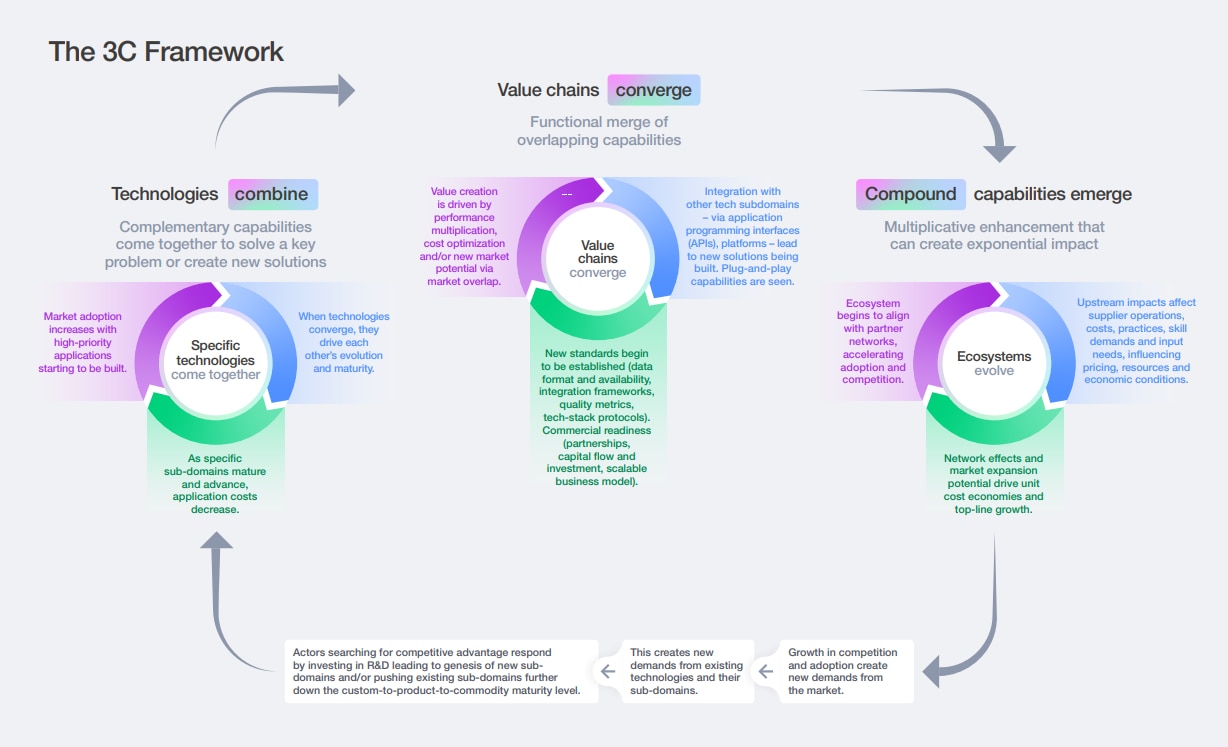
The 3C Framework shows how complementary technology systems can be combined, converge to create value chains and compound to advance capabilities.

The 3C Framework operates as an interconnected system. Image: World Economic Forum

In addition, deep dives from key industries show how AI and other technologies are being brought together to advance promising solutions and ensure they have a durable impact. In healthcare, for example, cognitive robotic systems are being propelled to maturity as AI systems, such as object detection, small/efficient models and multimodal models, combine with other sectors, including advanced alloys in advanced materials and adaptive and intelligent controls in robotics.

And in intelligent energy grid systems, predictive modelling and reinforcement learning are being utilized alongside solid-state battery advancements and real-time 3D syncing.

You can read the full report here to find out more about how technologies can be effectively converged to create lasting value and unlock new capabilities.

2. Market moves: AI power consumption, ecosystem models and new EU guidance

Power use in the US will hit record highs in 2026 and 2027, with AI and cryptocurrency data centres playing a large role in surging demand, the Energy Information Administration has said. Projections in the latest Short-Term Energy Outlook indicate demand will rise from a record 4,195 billion kilowatt-hours (kWh) in 2025 to 4,244 billion kWh in 2026 and 4,381 billion kWh the following year. The data follows calls from experts to improve energy system flexibility and utilization to support AI growth. Writing for the Forum, Amit Narayan and Shaneez Mohinani, respectively the CEO and Head of Strategy & Operations at GridCARE, suggest that a 1% improvement in system flexibility could unlock 100 GW in the US alone, equivalent to $500 billion in avoided infrastructure costs.

CEOs from some of the world’s leading AI organizations have backed an open-proprietary ecosystem model. The leaders of Mistral, Perplexity, Cursor, Reflection AI and other businesses joined NVIDIA CEO Jensen Huang at the company’s GTC 2026 event in San Jose, California, to announce the Nemotron Coalition. The collaboration hopes "to advance open, frontier-level foundation models through shared expertise, data and compute". Participants are seeking to advance systems of models, where individual specialized systems work together to solve business problems. “What you want is a multimodal, multi-model and multi-cloud orchestra," said Perplexity CEO Aravind Srinivas. "All you’ve got to do is delegate your task. You don’t have to worry about which model is good at what - it’s for the orchestration system to figure it out."

The European Commission has released a second draft of its Code of Practice on Marking and Labelling of AI-generated Content. The code intends to support providers and deployers of generative AI systems in demonstrating compliance of obligations in the EU AI Act. Following feedback from participants and observers from industry, academia, civil society and beyond, the Commission says that the latest version is simplified and streamlined, providing more flexibility and reducing compliance burdens. The final code is expected to publish in early June, with rules taking effect on 2 August, 2026.

3. AI insight in a chart

4. More AI news on Forum Stories

While AI has offered many positives, it has also brought challenges. New figures from INTERPOL suggest AI-enhanced fraud is 4.5 times more profitable than traditional cybercrime methods. Tal Goldstein, Head of Strategy and Growth, and Giulia Moschetta, Initiatives Lead, Centre for Cybersecurity, at the Forum, have considered how private-public collaboration can bring new solutions and deploy new safeguards. Read the article here.

When considering adoption of new technology, conversations in businesses often centre around ‘winners and losers’, ‘disrupt or be disrupted’. But is this the right way to think about things? In this piece, Nezar Banabeela, CEO of Etihad Etisalat Company (Mobily) discusses why AI must instead be considered a cultural discussion, building a shared understanding of what different tools can and should achieve.

Yoshua Bengio, Professor of Computer Science at the University of Montreal, is widely considered one of the ‘Godfathers of AI’. Earlier this year at the Forum's Annual Meeting, he spoke to Radio Davos to discuss solutions to correct unwanted AI behaviours. You can read more about his conversation here or listen to it below.