


惯性聚合 高效追踪和阅读你感兴趣的博客、新闻、科技资讯
阅读原文 在惯性聚合中打开

推荐订阅源

博客园 - 聂微东
S
Secure Thoughts
P
Palo Alto Networks Blog
Google DeepMind News
AI
AI
H
Hacker News: Front Page
Schneier on Security
C
CXSECURITY Database RSS Feed - CXSecurity.com
Cloudbric
Cloudbric
TaoSecurity Blog
TaoSecurity Blog
T
Tor Project blog
L
LINUX DO - 热门话题
Cyberwarzone
Cyberwarzone
V2EX - 技术
V2EX - 技术
Google DeepMind News
GbyAI
GbyAI
S
Security @ Cisco Blogs
S
Security Affairs
P
Privacy International News Feed
I
Intezer
S
SegmentFault 最新的问题
F
Full Disclosure
H
Heimdal Security Blog
www.infosecurity-magazine.com
S
Securelist
V
Vulnerabilities – Threatpost
C
CERT Recently Published Vulnerability Notes
cs.CV updates on arXiv.org
Google Online Security Blog
Security Latest
Security Latest
C
Cybersecurity and Infrastructure Security Agency CISA
Attack and Defense Labs
Forbes - Security
Forbes - Security
Cyber Security Advisories - MS-ISAC
freeCodeCamp Programming Tutorials: Python, JavaScript, Git & More
I
InfoQ
WordPress大学
WordPress大学
Vercel News
Vercel News
小众软件
小众软件
大猫的无限游戏
大猫的无限游戏
美团技术团队
IT之家
IT之家
Threat Intelligence Blog | Flashpoint
aimingoo的专栏
aimingoo的专栏
Y
Y Combinator Blog
Last Week in AI
Last Week in AI
博客园 - 【当耐特】
D
Docker
D
Darknet – Hacking Tools, Hacker News & Cyber Security
Hugging Face - Blog
Hugging Face - Blog

World Economic Forum

How giving gorillas digital wallets can help finance nature Why is leadership a strategic investment for philanthropy? Counting the many costs of the global mental health burden What we learned from the 2026 World Bank Spring Meetings Crop protection is at risk. How innovation can help Here's a playbook for boards on how to govern agentic AI Why connected data makes AI decision-ready for sustainability 3 ways better data practices are reshaping financial supervision What technology convergence looks like in practice 7 reasons the old order broke — and how it might be repaired How governments can make agentic AI re  ? Current and future uses of RNA, including mRNA vaccines Real-time deepfakes are rewriting the rules of child safety Electrification trend ‘unmistakeable’ – and more energy stories From smallpox to the common cold: A brief history of vaccines Saudi Arabia's new AI-powered sustainability platform could unlock $20 billion by 2030 Here are 6 ways that climate change is affecting sports around the world This crisis could be an opportunity for the energy transition Middle East war: 6 ways countries are responding to the historic energy shock Nature can teach us about leadership and building resilience How did the Strait of Hormuz become so important, and will it stay that way? Yes/Cities: Helping global cities become more resilient, sustainable and prosperous Healthy ageing in APAC: The role of the influenza vaccine Risk management, renewables and a rocky road ahead: Spring Meetings takeaways Japan in a world of rising middle powers EU plans to offset Iran war's energy impact, and other climate and nature news 3 cities leading on green investment for economic growth The coffee industry is making the case for climate insurance The ocean is now a subprime asset, so we need a sustainable blue economy 5 leaders on today’s growth dilemmas and how to navigate them What helps purpose-driven, early-stage start-ups scale? Why trust is key to the EU's Empowering Consumers Directive The $3 trillion maintenance gap is burning money and the planet Surging AI needs and geopolitical supply shocks renew attention on nuclear energy 5 things to know before interacting with digital assets Frontiers Planet Prize: 25 solutions for planetary crises How the Iran war is disrupting India's steel production What's needed for growth in the new economy? Why we need a humanitarian truce is Sudan Freedom of expression under attack: How do we protect the media? Why companies – and nations – should create an AI culture Anthropic’s Mythos moment: how frontier AI is redefining cybersecurity Discover this week's must-read finance stories 'Godfather of AI' Yoshua Bengio on why AI can behave unpredictably (and what needs to change) Everyone talks about critical thinking. Here's how schools should actually teach it The top international trade stories to know this month The big chart: How oil prices have reacted to world events since the 1980s Why AI needs digital public infrastructure to deliver for citizens What AI in education needs next: Lessons from youth leaders across five countries How to scale clean hydrogen to meet energy security needs Meet the Young Global Leaders Class of 2026 Ventures with blue carbon solutions for coastal restoration How peer-led reskilling is helping bridge the skills gap in East Africa China's lessons on the energy sector’s nature-positive transition Here's how Japan's green materials sector is thriving The Strait of Hormuz crisis: Rewriting the future of AI Systemic risk is the hidden tax on growth. Here's how insurance can help build economic resilience Earth Day: What is it, when is it and why is it important? The Rayner plot: What it tells us about the future of jobs This is why we’ll feel the economic effects of this war for a while How energy and finance leaders are approaching climate investment in 2026 How quantum technologies are being tested to strengthen energy systems How to think about ‘safe’ withdrawal rates in a changing global economy Is collective cyber defence the future of port security? Learnings from a Dutch initiative Cyberattacks target US infrastructure, and other cybersecurity news Rethinking workplace energy: Why our assumptions can lead to burnout What could an international panel to tackle inequality achieve? Why climate action matters for healthy longevity Workforce health is the bedrock of global supply chains. Here's how to protect it Southeast Asia may be a distinct region but its risks affect each country differently 5 ways to grow a business mindset in international development How companies can finally cut Scope 3 emissions Here's how to get the $7 trillion AI hardware buildout right Leaders are moving from systems of record to systems of work G7 One Health Summit launches global diagnostics initiative, and other health stories What stopping war-risk insurance in the Strait of Hormuz tells us Why leaders must transform cyber resilience measurement AI can help create comparability and scale impact investing What's in store for the future of multilateralism? Why food waste is a $540 billion opportunity hiding in plain sight What Afghanistan can teach us about strategic foresight This is how we use generative AI on Forum Stories How cities are turning urban complexity into coherent climate plans How non-profits and governments use data to drive real system change How demographics, not AI, will redefine the labour market Three lessons on the energy transition in an age of crisis NFL players: Why financial literacy is a game-changer for student-athletes 3 ways Africa can maximize the value of its critical minerals and finance its future What leaders are saying about the new geopolitics of energy The financial system is rebooting. Stakeholders must adapt Cancer care innovation is reshaping resilience in Japan The hidden struggle of employed youth in Africa How markets and missions are becoming allies for impact What’s changing in frontier tech – from geopolitics to AI and energy Why stablecoins are quickly becoming a geopolitical issue How public-private collaboration can help close the global gender gap It’s time to start treating AI infrastructure as critical infrastructure 5 effective choices to turn workplace well-being into a competitive advantage How to strengthen collaboration to tackle infectious disease Why the AI economy can’t rely on a single digital Suez
The hardware that can break AI's memory wall
Kaushik Roy · 2026-05-26 · via World Economic Forum
  • Artificial intelligence (AI) is hitting a “memory wall” that slows performance and drives up costs, ultimately limiting progress.
  • Standard computer architecture, in which memory and processing are separate, is becoming inefficient in the face of AI's rapid growth.
  • Alternative models to combat the AI bottleneck could include compute-in-memory systems, brain-inspired spiking neural networks, event-based sensors or using lower-precision or approximate computing.

Artificial intelligence (AI) is running into a physical bottleneck. As models grow larger and more complex, an increasing share of time and energy is spent moving data between memory, where information is stored, and processors, where calculations are performed.

That burden, often called the “memory wall,” is becoming a serious constraint. The pressure is rising quickly: language-processing models grew 5,000-fold in size over four years.

The memory wall problem matters for two reasons.

First, the energy demand of large-scale AI systems is increasing rapidly, driving up costs and the infrastructure needed to train and run them.

Second, many valuable uses of AI depend on fast decisions made locally on edge devices rather than in the cloud, in settings where power, size, connectivity and delay all matter.

Medical devices, autonomous vehicles or rescue drones cannot always rely on sending information to a distant data centre for processing and waiting for a response; instead, they often need hardware that makes on-device AI more practical.

As we described in Frontiers in Science, there are three main ways to ease this bottleneck: move computation closer to the data, draw on the brain’s event-driven information-processing method and use lower-precision or stochastic computing where exact arithmetic is unnecessary.

Together, these approaches could support a new generation of AI hardware that is faster, more efficient and better suited to large-scale infrastructure and edge applications.

3 new approaches to break the AI memory wall

1. Bring computation to memory

Most computers still use the long-established von Neumann architecture, in which memory and processing are physically separate. To perform even a simple operation, data must be fetched from memory, processed in a separate computing unit, and written back again.

That repeated traffic becomes expensive for AI, which depends on enormous numbers of parameters and intermediate values that must be accessed repeatedly.

One response is compute-in-memory, which performs operations within or very near the memory array rather than moving data to a separate processing unit each time a calculation is needed. The reduction in data traffic could help cut latency and energy use as AI systems scale.

There is no single hardware recipe for compute-in-memory. A range of approaches exists, each with trade-offs in speed, precision, density and energy efficiency. The broader point is that future AI hardware will need tighter integration between storage and computation than conventional systems are designed to provide.

2. Learn from the brain’s timing

A second route involves changing how information is processed. Many AI systems rely on artificial neural networks that process inputs continuously, performing large numbers of calculations at every step, whether the incoming signal has changed or not.

Biological brains work differently – neurons are usually quiet and fire mainly when there is something to report.

The brain’s timing-based strategy has inspired spiking neural networks in which information is represented through discrete “spikes” or events. This means computation can be driven by changes in the input and when little changes, little may need to be processed.

These neural networks can be especially useful when paired with event-based sensors. A conventional camera captures image frames at regular intervals, resulting in a great deal of repeated visual information.

In contrast, an event-based camera records only pixel-level changes, such as motion or brightness shifts, resulting in a much leaner data stream. These devices require hardware and algorithms that can process changes as they occur, rather than repeatedly analyzing full images.

For edge AI, this combination is attractive. A search-and-rescue drone navigating through smoke, debris or unstable terrain may need to detect motion, avoid obstacles and adjust its path in real time with limited battery power.

Sending that information to the cloud can slow responses, especially when connectivity is unreliable. In such settings, brain-inspired processing can reduce unnecessary computation and keep sensing and decision-making local.
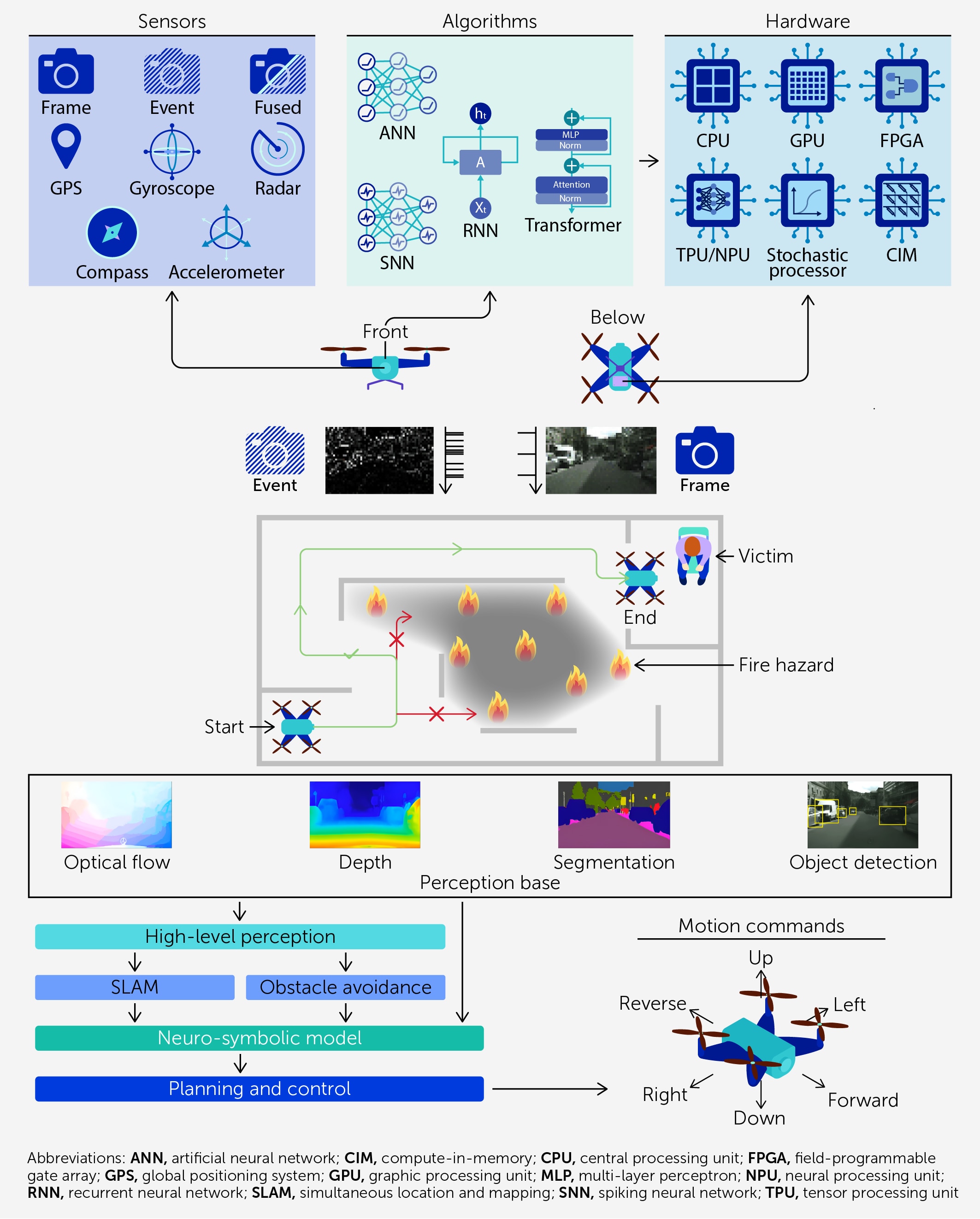
An unmanned aerial vehicle (UAV) carrying out a search-and-rescue mission using multiple sensors and efficient AI running on brain-inspired hardware. This enables real-time perception, planning and navigation in unfamiliar environments while avoiding obstacles and hazards.

An unmanned aerial vehicle (UAV) carrying out a search-and-rescue mission using multiple sensors and efficient AI running on brain-inspired hardware. This enables real-time perception, planning and navigation in unfamiliar environments while avoiding obstacles and hazards. Image: Frontiers in Science

3. Use precision where it matters most

A third strategy is to recognize that not every AI computation requires the same level of precision. Many models can tolerate small numerical errors, approximate values or a degree of hardware noise without a meaningful drop in overall performance.

Tolerance for small errors creates room for stochastic or approximate hardware. In practice, this can mean using lower numerical precision, allowing controlled variability in certain operations or designing circuits that trade exact arithmetic for lower power consumption.

The aim is to match precision to need. When that balance is chosen carefully, hardware can use less power and fewer chip resources while still meeting the application's accuracy requirements.

Stochastic and approximate approaches are especially relevant for adaptive and real-time systems, such as autonomous vehicles, mobile robots or wearable devices, where fast responses and efficient operation may matter more than maximum numerical precision at every stage.

Co-designing the full system

These three routes are most powerful when treated as parts of a single design problem. Future AI hardware cannot be developed by designing a chip in isolation and then trying to fit algorithms onto it afterwards. The architecture, memory, precision strategy, sensors and learning model all shape one another.

That is why hardware-algorithm co-design is becoming so important. Some workloads may benefit most from compute-in-memory; others may benefit from spiking networks and event-based sensing; and still others may rely on mixed-precision or stochastic methods. In many cases, the best solution may combine these approaches on the same platform.

The larger implication is that the future of AI depends as much on hardware design as on model design. More efficient AI hardware could help contain the growing resource demands of large-scale systems while improving the safety and reliability of devices in the field.

This has implications for cost, infrastructure, resilience and access across sectors from healthcare and transportation to emergency response and industrial automation.

If AI is to keep spreading across the global economy without a parallel rise in energy and hardware burdens, breaking the memory wall will be essential. The next leap forward may come less from building ever-larger models and more from building better machines to run them.