



惯性聚合 高效追踪和阅读你感兴趣的博客、新闻、科技资讯
阅读原文 在惯性聚合中打开

推荐订阅源

W
WeLiveSecurity
cs.AI updates on arXiv.org
Hacker News - Newest:
Hacker News - Newest: "LLM"
Cloudbric
Cloudbric
V
Visual Studio Blog
L
LangChain Blog
A
About on SuperTechFans
B
Blog
T
Tenable Blog
罗磊的独立博客
Hacker News: Ask HN
Hacker News: Ask HN
Blog — PlanetScale
Blog — PlanetScale
博客园 - 三生石上(FineUI控件)
The Register - Security
OSCHINA 社区最新新闻
OSCHINA 社区最新新闻
P
Palo Alto Networks Blog
U
Unit 42
WordPress大学
WordPress大学
D
Darknet – Hacking Tools, Hacker News & Cyber Security
N
News and Events Feed by Topic
T
Threat Research - Cisco Blogs
C
Check Point Blog
Security Latest
Security Latest
M
MIT News - Artificial intelligence
Application and Cybersecurity Blog
宝玉的分享
宝玉的分享
P
Proofpoint News Feed
NISL@THU
NISL@THU
Forbes - Security
Forbes - Security
S
Securelist
Security Archives - TechRepublic
Hugging Face - Blog
Hugging Face - Blog
aimingoo的专栏
aimingoo的专栏
Latest news
Latest news
GbyAI
GbyAI
T
Troy Hunt's Blog
钛媒体:引领未来商业与生活新知
钛媒体:引领未来商业与生活新知
L
LINUX DO - 热门话题
V2EX - 技术
V2EX - 技术
小众软件
小众软件
Google DeepMind News
K
Kaspersky official blog
C
CXSECURITY Database RSS Feed - CXSecurity.com
O
OpenAI News
H
Hackread – Cybersecurity News, Data Breaches, AI and More
Threat Intelligence Blog | Flashpoint
N
Netflix TechBlog - Medium
www.infosecurity-magazine.com
Google DeepMind News
P
Proofpoint News Feed

World Economic Forum

How giving gorillas digital wallets can help finance nature Why is leadership a strategic investment for philanthropy? Counting the many costs of the global mental health burden What we learned from the 2026 World Bank Spring Meetings Crop protection is at risk. How innovation can help Here's a playbook for boards on how to govern agentic AI Why connected data makes AI decision-ready for sustainability 3 ways better data practices are reshaping financial supervision What technology convergence looks like in practice 7 reasons the old order broke — and how it might be repaired How governments can make agentic AI re  ? Current and future uses of RNA, including mRNA vaccines Real-time deepfakes are rewriting the rules of child safety Electrification trend ‘unmistakeable’ – and more energy stories From smallpox to the common cold: A brief history of vaccines Saudi Arabia's new AI-powered sustainability platform could unlock $20 billion by 2030 Here are 6 ways that climate change is affecting sports around the world This crisis could be an opportunity for the energy transition Middle East war: 6 ways countries are responding to the historic energy shock Nature can teach us about leadership and building resilience How did the Strait of Hormuz become so important, and will it stay that way? Yes/Cities: Helping global cities become more resilient, sustainable and prosperous Healthy ageing in APAC: The role of the influenza vaccine Risk management, renewables and a rocky road ahead: Spring Meetings takeaways Japan in a world of rising middle powers EU plans to offset Iran war's energy impact, and other climate and nature news 3 cities leading on green investment for economic growth The coffee industry is making the case for climate insurance The ocean is now a subprime asset, so we need a sustainable blue economy 5 leaders on today’s growth dilemmas and how to navigate them What helps purpose-driven, early-stage start-ups scale? Why trust is key to the EU's Empowering Consumers Directive The $3 trillion maintenance gap is burning money and the planet Surging AI needs and geopolitical supply shocks renew attention on nuclear energy 5 things to know before interacting with digital assets Frontiers Planet Prize: 25 solutions for planetary crises How the Iran war is disrupting India's steel production What's needed for growth in the new economy? Why we need a humanitarian truce is Sudan Freedom of expression under attack: How do we protect the media? Why companies – and nations – should create an AI culture Anthropic’s Mythos moment: how frontier AI is redefining cybersecurity Discover this week's must-read finance stories 'Godfather of AI' Yoshua Bengio on why AI can behave unpredictably (and what needs to change) Everyone talks about critical thinking. Here's how schools should actually teach it The top international trade stories to know this month The big chart: How oil prices have reacted to world events since the 1980s Why AI needs digital public infrastructure to deliver for citizens What AI in education needs next: Lessons from youth leaders across five countries How to scale clean hydrogen to meet energy security needs Meet the Young Global Leaders Class of 2026 Ventures with blue carbon solutions for coastal restoration How peer-led reskilling is helping bridge the skills gap in East Africa China's lessons on the energy sector’s nature-positive transition Here's how Japan's green materials sector is thriving The Strait of Hormuz crisis: Rewriting the future of AI Systemic risk is the hidden tax on growth. Here's how insurance can help build economic resilience Earth Day: What is it, when is it and why is it important? The Rayner plot: What it tells us about the future of jobs This is why we’ll feel the economic effects of this war for a while How energy and finance leaders are approaching climate investment in 2026 How quantum technologies are being tested to strengthen energy systems How to think about ‘safe’ withdrawal rates in a changing global economy Is collective cyber defence the future of port security? Learnings from a Dutch initiative Cyberattacks target US infrastructure, and other cybersecurity news Rethinking workplace energy: Why our assumptions can lead to burnout What could an international panel to tackle inequality achieve? Why climate action matters for healthy longevity Workforce health is the bedrock of global supply chains. Here's how to protect it Southeast Asia may be a distinct region but its risks affect each country differently 5 ways to grow a business mindset in international development How companies can finally cut Scope 3 emissions Here's how to get the $7 trillion AI hardware buildout right Leaders are moving from systems of record to systems of work G7 One Health Summit launches global diagnostics initiative, and other health stories What stopping war-risk insurance in the Strait of Hormuz tells us Why leaders must transform cyber resilience measurement AI can help create comparability and scale impact investing What's in store for the future of multilateralism? Why food waste is a $540 billion opportunity hiding in plain sight What Afghanistan can teach us about strategic foresight This is how we use generative AI on Forum Stories How cities are turning urban complexity into coherent climate plans How non-profits and governments use data to drive real system change How demographics, not AI, will redefine the labour market Three lessons on the energy transition in an age of crisis NFL players: Why financial literacy is a game-changer for student-athletes 3 ways Africa can maximize the value of its critical minerals and finance its future What leaders are saying about the new geopolitics of energy The financial system is rebooting. Stakeholders must adapt Cancer care innovation is reshaping resilience in Japan The hidden struggle of employed youth in Africa How markets and missions are becoming allies for impact What’s changing in frontier tech – from geopolitics to AI and energy Why stablecoins are quickly becoming a geopolitical issue How public-private collaboration can help close the global gender gap It’s time to start treating AI infrastructure as critical infrastructure 5 effective choices to turn workplace well-being into a competitive advantage How to strengthen collaboration to tackle infectious disease Why the AI economy can’t rely on a single digital Suez
Counting the everyday costs of geoeconomic confrontation
Mitali Chatt · 2026-05-08 · via World Economic Forum
  • As conflict spreads around the world at an unprecedented rate, the knock-on effects hit food, jobs, healthcare, the environment and much more.
  • Geoeconomics exacerbates this, as nations increasingly use economic tools, such as tariffs or sanctions, to further their interests.
  • Safeguarding trade flows and stabilizing critical supply chains will ensure geopolitical shifts do not create the highest costs for the most vulnerable.

We are living in a world where pensioners might have to choose between heating and medicine, students often need to rethink studying abroad, workers must navigate industrial transitions, parents stretch their grocery budgets and small businesses must absorb frequent supply shocks.

At the same time, conflict is spreading at an unprecedented scale. Around 60 active state-based conflicts and more than 2.3 million related deaths were recorded in 2024 alone, according to the latest figures from the Uppsala Conflict Data Program. And as advances in technology reshape the economics of war, conflicts are becoming cheaper, more accessible and more difficult to end.

The underlying reason for many of these pain points is geoeconomic, which means using economic tools and policies, including tariffs and sanctions, to advance geopolitical objectives and power.

Indeed, geoeconomic confrontation was ranked the top immediate and short-term risk in the World Economic Forum’s Global Risks Report 2026, followed closely by state-based armed conflict. This implies that one in three of the more than 1,300 expert respondents to the Forum's Global Risks Perception Survey believe geopolitical risks are the most critical risks currently facing the world.
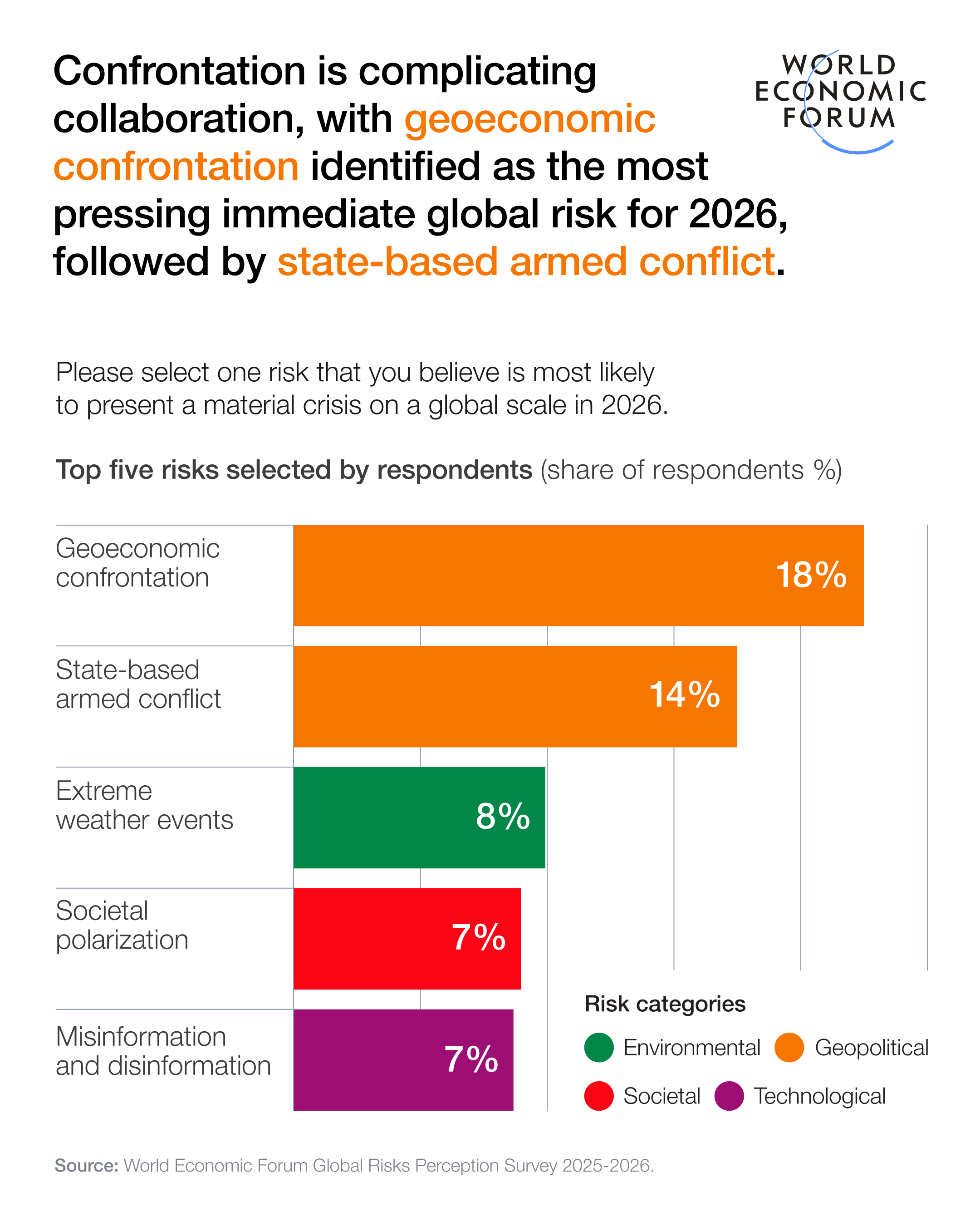
While these rankings are global in nature, geoeconomic confrontation is making waves locally as well.

Southeast Asian economies find themselves at the sharp end of global realignments, for instance. And at the World Economic Forum’s Annual Meeting 2026 in Davos, geoeconomic confrontation and its implications were a major topic, including that localization is gaining ground over globalization. The consensus was that increasing fragmentation is increasing fragility in many regions of the world.

What does geopolitical conflict cost people?

So what does this mean at the country, household or individual level? Families don’t debate tariff codes. They notice that bread costs more, cooking oil prices fluctuate and construction materials are more expensive and difficult to get.

When energy and other supply chains fragment along geopolitical lines – through supply cutoffs, reshoring, sanctions or strategic competition – the result is price volatility. Households experience this as higher electricity bills and fuel costs, a drop in medicine availability and pressure on food prices, among other effects.

Even if current hostilities in the Middle East ease, recovery will be slow. Damaged infrastructure, high insurance premiums and lingering security risks mean shipping could take months to normalize.

The massive disruption to global shipping in the Red Sea in late 2023, for example, forced major carriers to reroute around Africa's Cape of Good Hope. This cut Suez Canal traffic by up to 57%, adding 10-14 days to journeys. It took months for average daily transit trading volume to recover. A recent survey of oil and gas executives by the Federal Reserve Bank of Dallas in the US shows 80% expect the current Strait of Hormuz disruption to last months, with higher shipping and insurance costs becoming sticky.

In addition to energy, the Strait of Hormuz is a critical chokepoint for a wide network of global commodity flows that deliver a wealth of everyday necessities to people around the world.

Feeding through to food

The current Gulf conflict is sending shockwaves through global agriculture. The region normally supplies about one-third of seaborne fertiliser exports, most of which have been halted. Prices have surged, with the World Bank reporting at the end of April 2026 that the war has caused a 60% jump in urea, which is widely used in fertilisers – just as planting season begins across major markets.

The impact on agriculture is likely to be particularly severe in parts of Africa that obtain over a third of their nitrogen fertilizer from the Gulf, as well as smallholders in South Asia who depend on it to maximise output from limited land. With fertilizer typically bought just before use and rarely stockpiled, the disruption has left markets exposed and scrambling for supply. The World Food Programme warns that if traffic through the Strait remains disrupted, the number of people facing acute hunger could increase to 363 million globally this year.

The crisis is also spilling into other industries. More than half of Qatar’s exports of sulphur – an essential element of battery production – transits through the Strait of Hormuz. Petrochemical bottlenecks are also pushing up the cost of plastics such as bags, wraps and films. These materials are heavily used in the consumer goods and packaging industries, and so higher prices could be transmitted to consumers.

The effect on jobs and workplaces

Geoeconomic confrontation can also strain labour markets as businesses scale back or shut down. According to the International Labour Organization, slower global growth, driven partly by geopolitical instability, is expected to reduce employment growth and worsen job prospects. A recent academic analysis suggests that tariff increases alone could result in cumulative global job declines exceeding 23 million.

Small firms are particularly exposed because they often have limited capacity to absorb shocks. Rising inflation resulting from supply chain disruption erodes real wages and dampens hiring. Over time, if this persists, labour markets are likely to become more unequal, more insecure and slower to recover.

Workplaces are also subject to massive disruptions due to ongoing geopolitical crises. Energy supply disruption is forcing some countries to encourage partial remote work and learning to conserve energy consumption, while others are limiting the use of air conditioners in offices.

Health, education and the environment

Elderly people face heightened risks of illness, hunger and death as health systems collapse and displacement limits care during geopolitical conflict. There is evidence that large-scale displacement and rising food insecurity due to the ongoing conflict in the Middle East are affecting vulnerable populations and straining social support systems.

For students, the effects are both immediate and long-lasting: At least 52 million children in the Middle East and surrounding regions have experienced disrupted education due to school closures, displacement and insecurity. Attacks on infrastructure and the use of schools as shelters also severely limits access to learning.

And geoeconomic confrontation can act as a catalyst for environmental risks too. Conflicts accelerate environmental degradation, for example, as heavy metals from infrastructure destruction or weaponry pollute waterways. This creates long-tail risks for insurers, investors and firms operating in or sourcing from conflict-affected regions, not to mention the people living in affected areas. Environmental damage is both a cause and a consequence of instability, locking regions – and the supply chains that depend on them – into cycles of fragility.

Mitigating the cost of geoeconomic confrontation

Geoeconomic confrontation defines the global landscape today. The consequences are not confined to balance sheets and policy debates, they are embedded in trade, output, inflation trajectories, labour market inequalities and the erosion of social mobility and human dignity.

Current public policy trajectories suggest a continued shift toward localization, protectionism, strategic competition and a focus on short-term resilience gains – sometimes at the expense of long-term stability.

Cross-border cooperation can and will continue to deliver tangible gains for businesses and people, however. But this requires deliberate efforts to safeguard trade flows, stabilize critical supply chains and ensure that geopolitical shifts do not create the highest costs for the most vulnerable sections of our populations.