

惯性聚合 高效追踪和阅读你感兴趣的博客、新闻、科技资讯
阅读原文 在惯性聚合中打开

推荐订阅源

T
Threatpost
Forbes - Security
Forbes - Security
P
Palo Alto Networks Blog
Scott Helme
Scott Helme
S
Securelist
OSCHINA 社区最新新闻
OSCHINA 社区最新新闻
V
Visual Studio Blog
P
Proofpoint News Feed
大猫的无限游戏
大猫的无限游戏
博客园 - 三生石上(FineUI控件)
cs.CL updates on arXiv.org
AWS News Blog
AWS News Blog
P
Privacy & Cybersecurity Law Blog
L
LINUX DO - 热门话题
L
Lohrmann on Cybersecurity
Last Week in AI
Last Week in AI
Engineering at Meta
Engineering at Meta
Spread Privacy
Spread Privacy
博客园_首页
T
Tor Project blog
The Cloudflare Blog
博客园 - 聂微东
罗磊的独立博客
Cyberwarzone
Cyberwarzone
腾讯CDC
T
The Exploit Database - CXSecurity.com
Google DeepMind News
CTFtime.org: upcoming CTF events
P
Privacy International News Feed
D
Darknet – Hacking Tools, Hacker News & Cyber Security
U
Unit 42
A
Arctic Wolf
C
Cybersecurity and Infrastructure Security Agency CISA
A
About on SuperTechFans
G
GRAHAM CLULEY
K
Kaspersky official blog
月光博客
月光博客
Microsoft Security Blog
T
Tenable Blog
L
LINUX DO - 最新话题
酷 壳 – CoolShell
酷 壳 – CoolShell
IT之家
IT之家
TaoSecurity Blog
TaoSecurity Blog
Security Archives - TechRepublic
MongoDB | Blog
MongoDB | Blog
T
The Blog of Author Tim Ferriss
C
Cyber Attacks, Cyber Crime and Cyber Security
博客园 - 司徒正美
O
OpenAI News
Recent Announcements

World Economic Forum

What happened at the MC14 WTO meeting in Yaoundé How giving gorillas digital wallets can help finance nature Why is leadership a strategic investment for philanthropy? Counting the many costs of the global mental health burden What we learned from the 2026 World Bank Spring Meetings Crop protection is at risk. How innovation can help Here's a playbook for boards on how to govern agentic AI Why connected data makes AI decision-ready for sustainability 3 ways better data practices are reshaping financial supervision What technology convergence looks like in practice 7 reasons the old order broke — and how it might be repaired How governments can make agentic AI re  ? Current and future uses of RNA, including mRNA vaccines Real-time deepfakes are rewriting the rules of child safety Electrification trend ‘unmistakeable’ – and more energy stories From smallpox to the common cold: A brief history of vaccines Saudi Arabia's new AI-powered sustainability platform could unlock $20 billion by 2030 Here are 6 ways that climate change is affecting sports around the world This crisis could be an opportunity for the energy transition Middle East war: 6 ways countries are responding to the historic energy shock Nature can teach us about leadership and building resilience How did the Strait of Hormuz become so important, and will it stay that way? Yes/Cities: Helping global cities become more resilient, sustainable and prosperous Healthy ageing in APAC: The role of the influenza vaccine Risk management, renewables and a rocky road ahead: Spring Meetings takeaways Japan in a world of rising middle powers EU plans to offset Iran war's energy impact, and other climate and nature news 3 cities leading on green investment for economic growth The coffee industry is making the case for climate insurance The ocean is now a subprime asset, so we need a sustainable blue economy 5 leaders on today’s growth dilemmas and how to navigate them What helps purpose-driven, early-stage start-ups scale? Why trust is key to the EU's Empowering Consumers Directive The $3 trillion maintenance gap is burning money and the planet Surging AI needs and geopolitical supply shocks renew attention on nuclear energy 5 things to know before interacting with digital assets Frontiers Planet Prize: 25 solutions for planetary crises How the Iran war is disrupting India's steel production What's needed for growth in the new economy? Why we need a humanitarian truce is Sudan Freedom of expression under attack: How do we protect the media? Why companies – and nations – should create an AI culture Anthropic’s Mythos moment: how frontier AI is redefining cybersecurity Discover this week's must-read finance stories 'Godfather of AI' Yoshua Bengio on why AI can behave unpredictably (and what needs to change) Everyone talks about critical thinking. Here's how schools should actually teach it The big chart: How oil prices have reacted to world events since the 1980s Why AI needs digital public infrastructure to deliver for citizens What AI in education needs next: Lessons from youth leaders across five countries How to scale clean hydrogen to meet energy security needs Meet the Young Global Leaders Class of 2026 Ventures with blue carbon solutions for coastal restoration How peer-led reskilling is helping bridge the skills gap in East Africa China's lessons on the energy sector’s nature-positive transition Here's how Japan's green materials sector is thriving The Strait of Hormuz crisis: Rewriting the future of AI Systemic risk is the hidden tax on growth. Here's how insurance can help build economic resilience Earth Day: What is it, when is it and why is it important? The Rayner plot: What it tells us about the future of jobs This is why we’ll feel the economic effects of this war for a while How energy and finance leaders are approaching climate investment in 2026 How quantum technologies are being tested to strengthen energy systems How to think about ‘safe’ withdrawal rates in a changing global economy Is collective cyber defence the future of port security? Learnings from a Dutch initiative Cyberattacks target US infrastructure, and other cybersecurity news Rethinking workplace energy: Why our assumptions can lead to burnout What could an international panel to tackle inequality achieve? Why climate action matters for healthy longevity Workforce health is the bedrock of global supply chains. Here's how to protect it Southeast Asia may be a distinct region but its risks affect each country differently 5 ways to grow a business mindset in international development How companies can finally cut Scope 3 emissions Here's how to get the $7 trillion AI hardware buildout right Leaders are moving from systems of record to systems of work G7 One Health Summit launches global diagnostics initiative, and other health stories What stopping war-risk insurance in the Strait of Hormuz tells us Why leaders must transform cyber resilience measurement AI can help create comparability and scale impact investing What's in store for the future of multilateralism? Why food waste is a $540 billion opportunity hiding in plain sight What Afghanistan can teach us about strategic foresight This is how we use generative AI on Forum Stories How cities are turning urban complexity into coherent climate plans How non-profits and governments use data to drive real system change How demographics, not AI, will redefine the labour market Three lessons on the energy transition in an age of crisis NFL players: Why financial literacy is a game-changer for student-athletes 3 ways Africa can maximize the value of its critical minerals and finance its future What leaders are saying about the new geopolitics of energy The financial system is rebooting. Stakeholders must adapt Cancer care innovation is reshaping resilience in Japan The hidden struggle of employed youth in Africa How markets and missions are becoming allies for impact What’s changing in frontier tech – from geopolitics to AI and energy Why stablecoins are quickly becoming a geopolitical issue How public-private collaboration can help close the global gender gap It’s time to start treating AI infrastructure as critical infrastructure 5 effective choices to turn workplace well-being into a competitive advantage How to strengthen collaboration to tackle infectious disease Why the AI economy can’t rely on a single digital Suez
The top international trade stories to know this month
Angela Minyi · 2026-04-17 · via World Economic Forum
  • This monthly round-up brings you a selection of the latest news and updates on global trade.
  • Top international trade stories: Middle East ceasefire impacts oil and shipping; EU-US trade deal a step closer; UNCTAD says global trade hit a record $35tn in 2025.

1. Middle East ceasefire shifts oil prices, but not ships

International trade and markets reacted swiftly to the two-week ceasefire agreed by the US and Iran on 7 April.

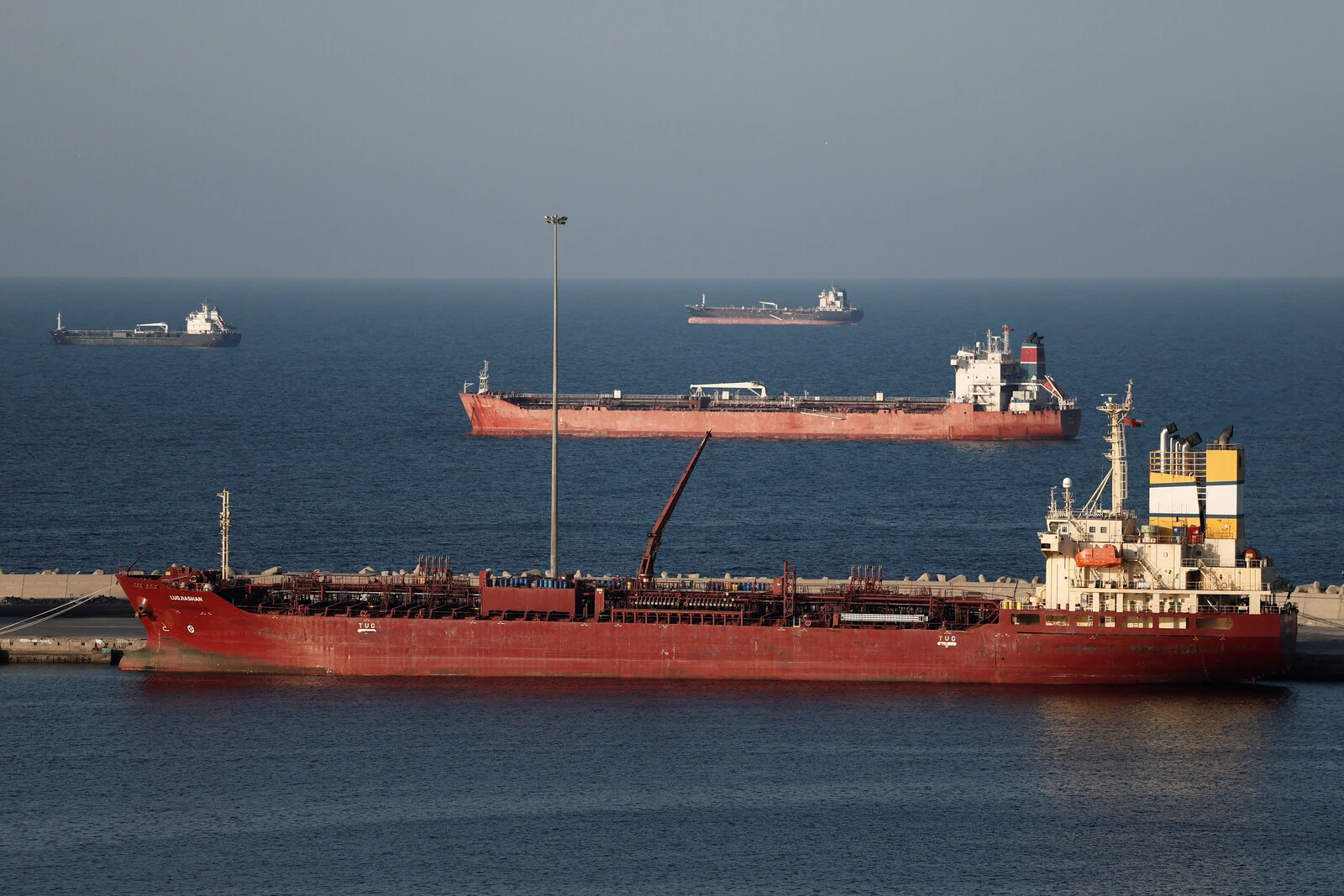
In anticipation of the Strait of Hormuz reopening and energy supplies being able to pass through the shipping route once more, oil fell below $100 a barrel and backlogged ships carrying oil and other essential exports prepared to depart. But only a small number of ships have so far passed through and with the ceasefire already undermined with further attacks the strait remains essentially shut.

"Overall, the market is hopeful more oil ​is going to reach the market... but it is still concerned that it is a very fragile ceasefire and it may not last," Andrew Lipow, founder of Lipow Oil Associates, told Reuters.

Following the ceasefire announcement, negotiations for lasting peace between the US and Iran broke down. In response, the US imposed a naval blockade of Iranian ports.

Slower global growth is expected as a result of the war in the Middle East, according to Kristalina Georgieva, Managing Director of the International Monetary Fund. The conflict has already shrunk global oil supply by 13%, she told Reuters, and impacted related supply chains like helium and fertilizers. “Even if the war is to stop today, there would be a lingering negative impact to the rest of the ​world," she said.

2. EU-US trade deal gets a conditional green light

The European Parliament moved the EU one step closer to a trade deal with the US at the end of March.

A majority voted in favour of legislation that protects EU interests in the face of continued tariff threats and uncertainty.

The framework agreement was made in July 2025, but the parliament voted to only accept zero tariffs on US goods if steel and aluminium goods from the EU are excluded from the 50% tariff the US had previously said it would impose.

Lawmakers also agreed to suspend the deal if the US imposes additional tariffs above 15%, or introduces new duties on EU goods, reports the BBC.

The EU’s 27 member states will now need to sign off on the legislation, with a final vote expected by May.

In the meantime, US carmakers have accused the EU of breaching the spirit of the trade deal with its plans to change safety rules that would prevent certain US vehicles from being sold in Europe, reports the Financial Times. The vehicles in question are large pick-up trucks that have “far lower safety and air pollution standards,” according to an energy advocacy group. But the American Automotive Policy Council, representing General Motors, Ford and Stellantis, points out that the deal made in summer 2025 included “mutual recognition of vehicle standards”.

3. Global trade hits a record $35tn, but fragility is rising

Global trade grew to a record $35 trillion in 2025, but UNCTAD warns that the outlook is becoming more fragile for 2026.

Trade expanded by about $2.5 trillion last year, or roughly 7.5%, showing that global commerce remained resilient despite ongoing geopolitical pressures. Trade in goods drove most of the expansion, according to UNCTAD’s latest update, adding around $1.8 trillion to global growth. Notably, South-South trade in regions like East Asia and Africa outpaced the global average, “underscoring the growing weight of developing economies on world trade,” it said.
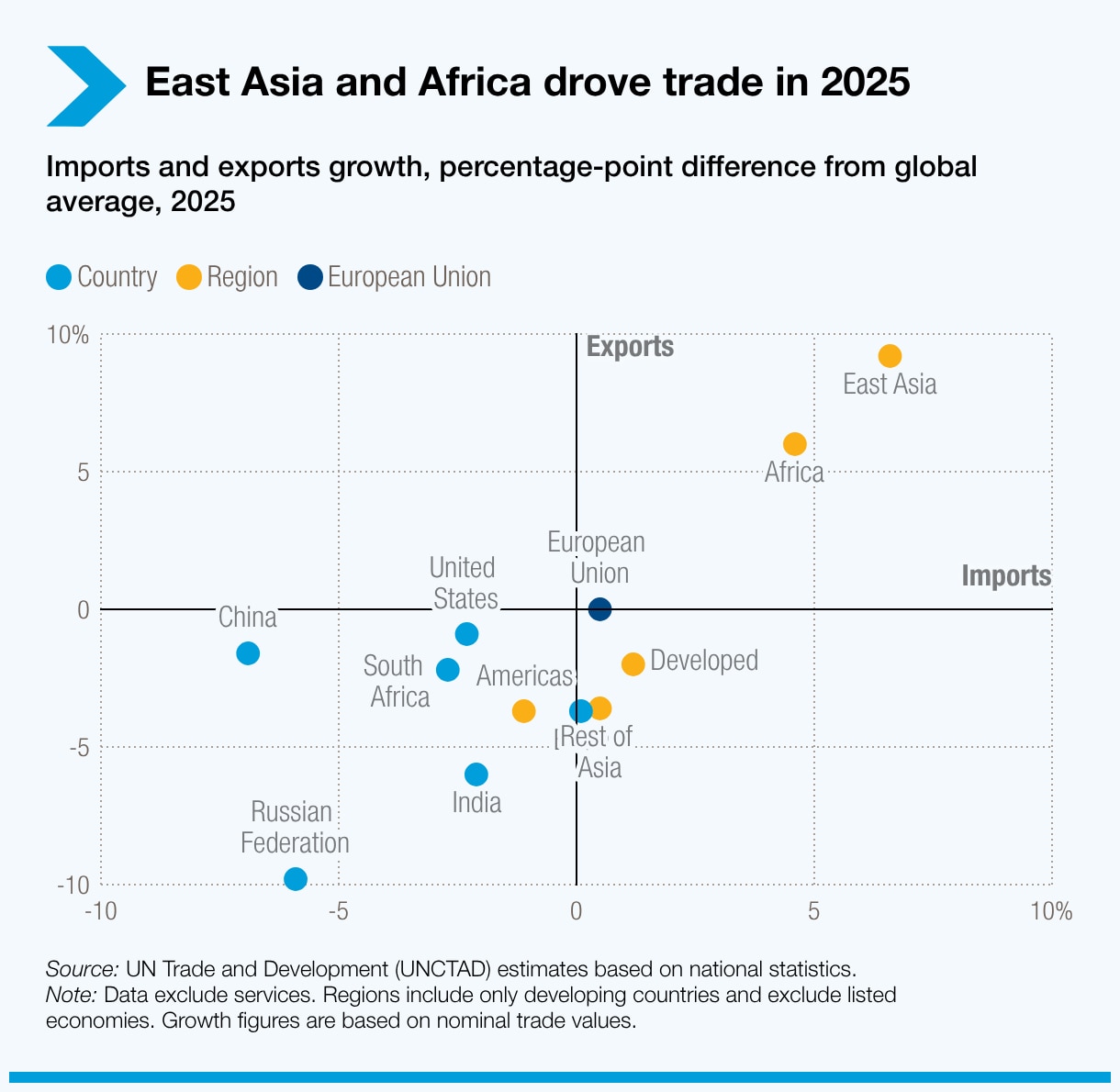
Graph showing how East Asia and Africa drove trade in 2025.

South-South trade expanded by around 9% last year. Image: UNCTAD

But “persistent trade tensions” and the ongoing conflict in the Middle East are expected to slow growth later in the year. “Rising energy prices, together with higher trade costs linked to tariffs, regulatory changes and the erosion of trade rules, further cloud the outlook,” says UNCTAD.

4. News in brief: Trade stories from around the world

Certain patented medicines will face a 100% tariff to enter the US, the White House announced at the beginning of April. It is a long-anticipated move by the US administration, but is seen as "largely symbolic", according to the BBC, because it does not apply to the most commonly used medicines in the US. What's more, many of the biggest drug-makers have already struck agreements to avoid the tariffs.

Australia and the EU have agreed to a free trade deal following eight years of negotiations. Described as a mutual "win-win" by Australia's Prime Minister, Anthony Albanese, and European Commission President, Ursula von der Leyen, the deal is worth around $7 billion. While European carmakers were said to have welcomed the deal, farmers in both Australia and Europe were opposed to the agreed export quotas.

The Federation of European Business in India, whose members include Pernod Ricard, Heineken and Carlsberg, has asked the government for an exemption from a 10% ‌import duty on glass bottles and aluminium cans, amid shortage fears caused by the Middle East crisis, Reuters reports.

British food and drink exports to the US slumped in the second half of 2025, according to the UK's Food and Drink Federation. The value of products like whisky and infant formula fell 8.6% from the previous year, largely as a result of the tariffs imposed by the US administration, reports Bloomberg.

Discover

How the Forum helps leaders make sense of regional, trade and geopolitical shifts

5. More on trade on Forum Stories

The shipping crisis in the Strait of Hormuz is now "the largest supply disruption in the history of the global oil market", according to the International Energy Agency. But it is not just oil that's being affected. From fertilizers to aluminium, this article outlines nine other commodities that are facing shortages as a result of the Middle East conflict.

The situation in Iran has also highlighted how modern power still runs through a surprisingly small number of vulnerable trade routes, or as Robert Muggah, Founder of Igarape Institute puts it, choke points. Muggah charts the history of these contested trade passages and explains how rare minerals, big data and the climate crisis are creating new global choke points.

Managing global supply chains amid geopolitical tensions and nature risks is further explored in this article, which suggests that new forms of international cooperation are needed to help build resilience. A poll of business leaders showed that 80% are willing to deepen engagement in international partnerships to shore up supply chains and protect materials trade.