








The multilateral system currently faces its most sustained legitimacy crisis in decades. Institutions underpinning international cooperation are being systematically undermined, as shared challenges and crises intensify.
What once appeared as fringe hostility has moved into the political mainstream, exploiting fears about identity, insecurity and economic precarity through coordinated disinformation and misleading narratives. It is working.
Across regions, political extremism is on the rise and democracy is on the backfoot. The narratives around global cooperation are reframed as weakness, solidarity as naivety or conspiracy, and collective international action as ideological capture rather than public good, providing political cover for deep cuts to the United Nations and other international organizations.
Migration often lies at the centre of today’s disinformation-driven political narratives. Migrants become proxies for fears about loss of control, cultural change and sovereignty, even in countries shaped by migration now facing ageing populations, declining fertility and labour shortages.
These distortions carry policy consequences. During negotiations on the 2018 Global Compact for Safe, Orderly and Regular Migration (a non-binding framework reaffirming state sovereignty), coordinated disinformation cast the compact as imposed global governance, fuelling backlash and prompting some governments to withdraw. This episode is just one example of how fear-based disinformation is derailing international cooperation before implementation even begins.
Most troubling is the growing sense of inevitability surrounding this trajectory. Resignation has taken hold among political leaders, practitioners and civil society that the rules-based multilateral system is finished, giving way to raw power.
Budget cuts to international cooperation are treated as permanent while power politics push states toward rising military spending as the only “safe” investment, fuelling a security economy where conflict becomes an economic logic.
Yet there is little discussion of what is really at stake: the hard-won progress achieved since the Second World War – not only the avoidance of large-scale conflict, but advances in shared science, health, human rights, gender equality, education and economic development.
If this system unravels, we risk sliding back to the rivalry and instability it was built to prevent, reversing decades of progress – something which we will all pay for.
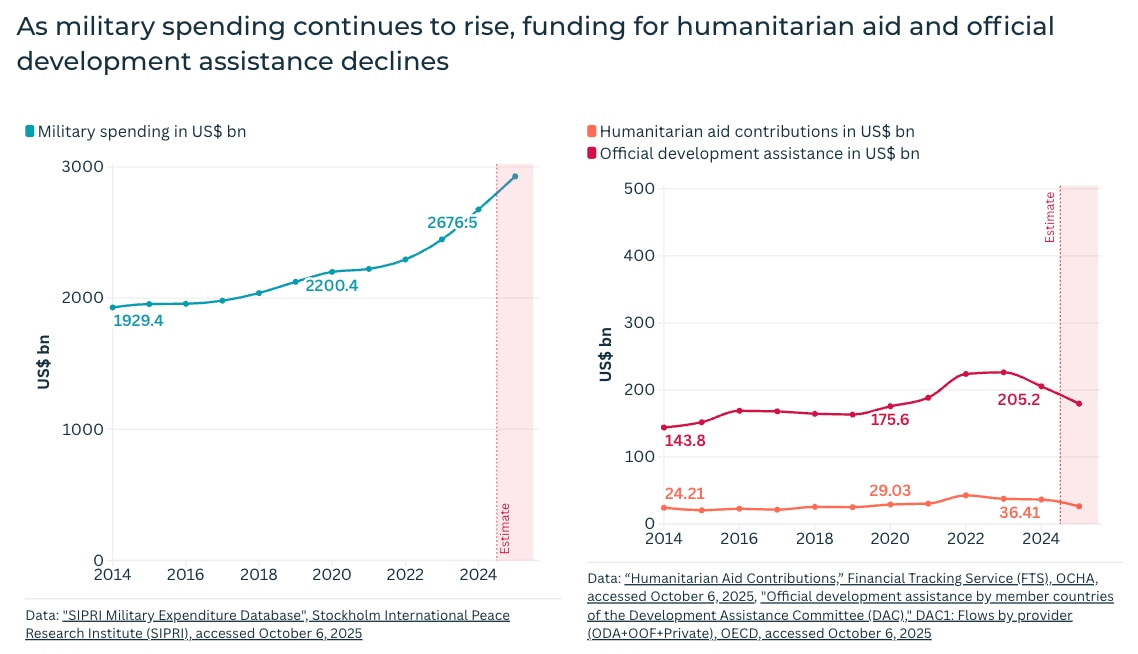
The result? Trust in the institutions and rule of law underpinning international cooperation is eroding as protectionism and conflicts proliferate.
A Rockefeller Foundation 2025 survey illustrates that across 34 countries, only 55% backed international cooperation if it compromises national interests, and just 43% believed it served their personal interests. Support fell to 34% in Japan, 41% in Argentina, 49% in France, 50% in New Zealand, and 52% in Canada.
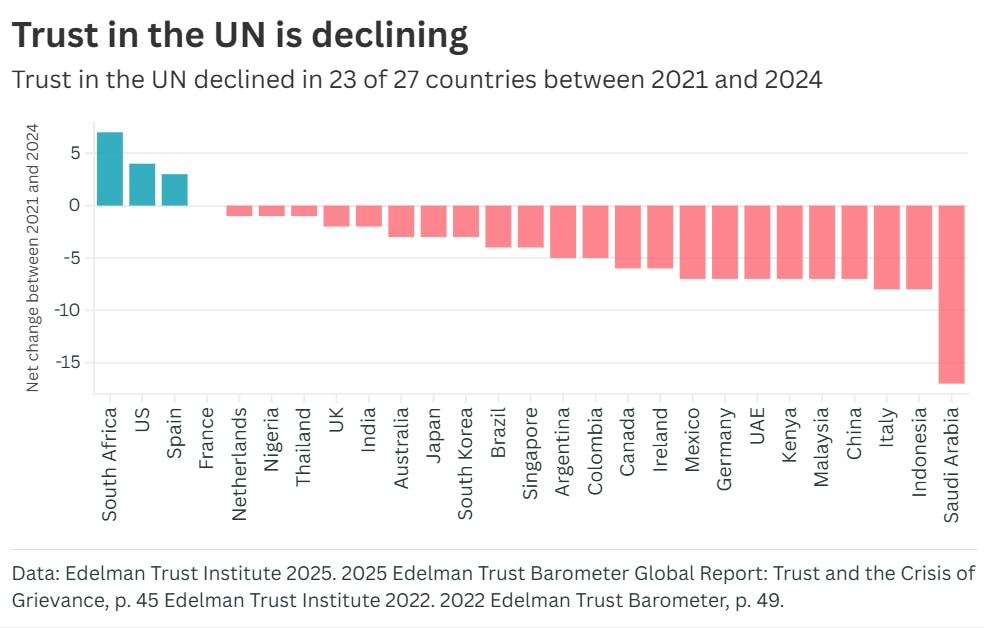
While majorities support cooperation in principle, particularly on jobs, trade, food and other global goods, confidence in multilateral institutions remains weak. Edelman’s Trust Barometer also shows trust in the UN declining in 23 of 27 countries between 2021 and 2024.
The message is clear: support for international cooperation is conditional and fragile, and without visible results and clearer public engagement on its tangible benefits, it will continue to erode.
Disinformation succeeds not only through what is said, but in how messages travel in today’s information environment – built on emotion, repetition, and simplified frames that resonate with real anxieties, even when false.
Media and algorithmic systems structurally advantage sensational and polarizing content over accuracy. As technology platforms are promised deregulation, tax cuts and market access, many retreat from content moderation and fact-checking in favour of engagement and reach – a system privileging disinformation at scale.
Amid economic and social strain, simple explanations and clear targets for blame, however false, become emotionally compelling. Canadian Prime Minister Mark Carney warned at the World Economic Forum’s Annual Meeting in Davos that harmful dynamics endure when actors quietly disagree but fail to act.
Loading...
Yet, the deeper risk is twofold: political, technology and high-net-worth actors often benefit from acquiescence, while these narratives gain traction by tapping into fears of insecurity and loss.
Alongside this, public and private solidarity, particularly through philanthropy and aid, is being actively delegitimized. Influential donors are stepping back from humanitarian and development financing while recasting established aid efforts as ideological projects rather than mechanisms to meet basic human needs.
This shift weakens aid’s moral and political legitimacy, with tangible impacts: declining philanthropy, reduced political support, and rising public scepticism toward humanitarian and development action.
The erosion of these dynamics are undermining key foundations of international stability:
Without clear explanations of why these systems matter in everyday life, their erosion becomes predictable, especially amid coordinated disinformation designed to delegitimize them. Yet, this future is not inevitable.
There is an antidote to fear-based politics rooted in disinformation: rebuilding public trust in international cooperation by reconnecting people with what collective action makes possible and acknowledging public fears while offering clear evidence of how cooperation addresses shared challenges. It must also show what is at stake: the fragmentation, economic disruption, conflict and human suffering that follow when it collapses.
For decades, public outreach has been dismissed as “spin” rather than recognized as a pillar of legitimacy, trust, and accountability – leaving a vacuum others have exploited. Many norms and standards underpinning cooperation are so embedded in everyday systems that their benefits go largely unnoticed.
Yet they quietly sustain daily life: aviation standards prevent collisions; regulatory cooperation keeps medicines safe; global telecoms standards allow phones to function; humanitarian law enables aid to reach civilians; and democratic norms reinforce peaceful elections and accountability.
These systems become visible when they fail – when flights are grounded, supply chains collapse, conflicts escalate, or democratic norms erode.
The challenge is less about the principles guiding cooperation than about how they are administered and implemented. Administrative complexity, fragmented mandates, and limited visibility of results can erode confidence even where cooperation works, leaving space for narratives portraying it as unnecessary, ineffective or harmful.
Rebuilding trust is therefore essential not only to defend cooperation but to enable meaningful reform. Without public confidence in the value of international standards, reform risks being driven by budget cuts rather than tangible improvement. Sustainable reform requires renewed belief in these principles so governments invest in strengthening how standards are implemented, making them more effective, transparent and responsive.
International cooperation must also be reclaimed for what its founders intended: a space where actors confront differences around a table rather than on the battlefield.
To remain relevant in polarized societies, international cooperation must be a credible space where opposing actors engage in genuine dialogue – to debate constructively and peacefully, implement agreements, and forge new ones. This is not idealism. In an interconnected world, it is the only peaceful path and firmly in the national interest of all.
Large-scale public engagement has worked before, albeit briefly. In 2020, the UN75 initiative mobilized UN country information centres and civil society networks to engage more than 1.5 million people worldwide in dialogue on shared priorities and the UN’s future, demonstrating public appetite and institutional capacity to deliver at scale. The effort was not sustained, yet the infrastructure still exists while being under-resourced, disconnected and underutilized.
Strategic engagement also delivers results. In the United States, the Better World Campaign recently helped secure congressional funding for the US’s UN dues by demonstrating the national benefits of strong UN engagement.
Actors, such as the Center for Countering Digital Hate, also address parts of the disinformation ecosystem. Importantly, many companies and innovators remain committed to responsible technology, ethical standards and public-interest partnerships – essential allies for rebuilding trust through evidence-based engagement. What is missing is coordinated connective tissue linking these efforts internationally.
Hubs of international cooperation like Geneva, New York and Vienna have the expertise, credibility and worldwide networks to help close this gap – by listening more closely to public concerns, engaging honestly about failures and where reform is needed, and making visible what cooperation achieves and what is at stake if it unravels.
Anchored in Geneva, Stronger Together brings together actors across sectors and regions to pool evidence and translate it into meaningful public engagement and advocacy.
At a moment when fear, division and conflict are being amplified worldwide, the case for cooperation must be made clearly and confidently. It must show not only that international cooperation works and is needed today, but that it remains essential to peace, rights, prosperity, and our shared future.
Now is the moment for international organizations, civil society, business, scientists, academics, creators, foundations and responsible technology to act together to rebuild trust through evidence, dialogue and shared understanding. Because in an interconnected world, we are stronger together.
此内容由惯性聚合(RSS阅读器)自动聚合整理,仅供阅读参考。 原文来自 — 版权归原作者所有。