
惯性聚合 高效追踪和阅读你感兴趣的博客、新闻、科技资讯
阅读原文 在惯性聚合中打开

推荐订阅源

T
Threatpost
aimingoo的专栏
aimingoo的专栏
OSCHINA 社区最新新闻
OSCHINA 社区最新新闻
T
Tailwind CSS Blog
J
Java Code Geeks
博客园_首页
Google Online Security Blog
Hugging Face - Blog
Hugging Face - Blog
C
CXSECURITY Database RSS Feed - CXSecurity.com
I
Intezer
P
Palo Alto Networks Blog
V
Vulnerabilities – Threatpost
雷峰网
雷峰网
O
OpenAI News
SecWiki News
SecWiki News
小众软件
小众软件
酷 壳 – CoolShell
酷 壳 – CoolShell
美团技术团队
N
News | PayPal Newsroom
Project Zero
Project Zero
Forbes - Security
Forbes - Security
IT之家
IT之家
A
Arctic Wolf
WordPress大学
WordPress大学
Jina AI
Jina AI
T
Tor Project blog
博客园 - 三生石上(FineUI控件)
S
Secure Thoughts
Google DeepMind News
Attack and Defense Labs
博客园 - 聂微东
Exploit-DB.com RSS Feed
P
Privacy International News Feed
Cloudbric
Cloudbric
G
GRAHAM CLULEY
博客园 - 叶小钗
H
Hacker News: Front Page
腾讯CDC
量子位
Help Net Security
Help Net Security
人人都是产品经理
人人都是产品经理
C
Cyber Attacks, Cyber Crime and Cyber Security
月光博客
月光博客
奇客Solidot–传递最新科技情报
奇客Solidot–传递最新科技情报
宝玉的分享
宝玉的分享
爱范儿
爱范儿
L
Lohrmann on Cybersecurity
Hacker News - Newest:
Hacker News - Newest: "LLM"
Recorded Future
Recorded Future
C
CERT Recently Published Vulnerability Notes

World Economic Forum

How giving gorillas digital wallets can help finance nature Why is leadership a strategic investment for philanthropy? Counting the many costs of the global mental health burden What we learned from the 2026 World Bank Spring Meetings Crop protection is at risk. How innovation can help Here's a playbook for boards on how to govern agentic AI Why connected data makes AI decision-ready for sustainability 3 ways better data practices are reshaping financial supervision What technology convergence looks like in practice 7 reasons the old order broke — and how it might be repaired How governments can make agentic AI re  ? Current and future uses of RNA, including mRNA vaccines Real-time deepfakes are rewriting the rules of child safety Electrification trend ‘unmistakeable’ – and more energy stories From smallpox to the common cold: A brief history of vaccines Saudi Arabia's new AI-powered sustainability platform could unlock $20 billion by 2030 Here are 6 ways that climate change is affecting sports around the world This crisis could be an opportunity for the energy transition Middle East war: 6 ways countries are responding to the historic energy shock Nature can teach us about leadership and building resilience How did the Strait of Hormuz become so important, and will it stay that way? Yes/Cities: Helping global cities become more resilient, sustainable and prosperous Healthy ageing in APAC: The role of the influenza vaccine Risk management, renewables and a rocky road ahead: Spring Meetings takeaways Japan in a world of rising middle powers EU plans to offset Iran war's energy impact, and other climate and nature news 3 cities leading on green investment for economic growth The coffee industry is making the case for climate insurance The ocean is now a subprime asset, so we need a sustainable blue economy 5 leaders on today’s growth dilemmas and how to navigate them What helps purpose-driven, early-stage start-ups scale? Why trust is key to the EU's Empowering Consumers Directive The $3 trillion maintenance gap is burning money and the planet Surging AI needs and geopolitical supply shocks renew attention on nuclear energy 5 things to know before interacting with digital assets Frontiers Planet Prize: 25 solutions for planetary crises How the Iran war is disrupting India's steel production What's needed for growth in the new economy? Why we need a humanitarian truce is Sudan Freedom of expression under attack: How do we protect the media? Why companies – and nations – should create an AI culture Anthropic’s Mythos moment: how frontier AI is redefining cybersecurity Discover this week's must-read finance stories 'Godfather of AI' Yoshua Bengio on why AI can behave unpredictably (and what needs to change) Everyone talks about critical thinking. Here's how schools should actually teach it The top international trade stories to know this month The big chart: How oil prices have reacted to world events since the 1980s Why AI needs digital public infrastructure to deliver for citizens What AI in education needs next: Lessons from youth leaders across five countries How to scale clean hydrogen to meet energy security needs Meet the Young Global Leaders Class of 2026 Ventures with blue carbon solutions for coastal restoration How peer-led reskilling is helping bridge the skills gap in East Africa China's lessons on the energy sector’s nature-positive transition Here's how Japan's green materials sector is thriving The Strait of Hormuz crisis: Rewriting the future of AI Systemic risk is the hidden tax on growth. Here's how insurance can help build economic resilience Earth Day: What is it, when is it and why is it important? The Rayner plot: What it tells us about the future of jobs This is why we’ll feel the economic effects of this war for a while How energy and finance leaders are approaching climate investment in 2026 How quantum technologies are being tested to strengthen energy systems How to think about ‘safe’ withdrawal rates in a changing global economy Is collective cyber defence the future of port security? Learnings from a Dutch initiative Cyberattacks target US infrastructure, and other cybersecurity news Rethinking workplace energy: Why our assumptions can lead to burnout What could an international panel to tackle inequality achieve? Why climate action matters for healthy longevity Workforce health is the bedrock of global supply chains. Here's how to protect it Southeast Asia may be a distinct region but its risks affect each country differently 5 ways to grow a business mindset in international development How companies can finally cut Scope 3 emissions Here's how to get the $7 trillion AI hardware buildout right Leaders are moving from systems of record to systems of work G7 One Health Summit launches global diagnostics initiative, and other health stories What stopping war-risk insurance in the Strait of Hormuz tells us Why leaders must transform cyber resilience measurement AI can help create comparability and scale impact investing What's in store for the future of multilateralism? Why food waste is a $540 billion opportunity hiding in plain sight What Afghanistan can teach us about strategic foresight This is how we use generative AI on Forum Stories How cities are turning urban complexity into coherent climate plans How non-profits and governments use data to drive real system change How demographics, not AI, will redefine the labour market Three lessons on the energy transition in an age of crisis NFL players: Why financial literacy is a game-changer for student-athletes 3 ways Africa can maximize the value of its critical minerals and finance its future What leaders are saying about the new geopolitics of energy The financial system is rebooting. Stakeholders must adapt Cancer care innovation is reshaping resilience in Japan The hidden struggle of employed youth in Africa How markets and missions are becoming allies for impact What’s changing in frontier tech – from geopolitics to AI and energy Why stablecoins are quickly becoming a geopolitical issue How public-private collaboration can help close the global gender gap It’s time to start treating AI infrastructure as critical infrastructure 5 effective choices to turn workplace well-being into a competitive advantage How to strengthen collaboration to tackle infectious disease Why the AI economy can’t rely on a single digital Suez
Is power grid connectivity the strategic bottleneck for AI?
Ditlev Engel · 2026-05-19 · via World Economic Forum
  • Artificial intelligence (AI) is advancing faster than ever before, but the global energy system needs to keep pace for this progress to continue.
  • Investment in AI data centres is growing faster than power grids can keep up, making grid connectivity a constraint.
  • Strong leadership and a new mindset is needed to align clean energy investments, power grid build-out and AI growth for the benefit of all.

Artificial intelligence (AI) technology is advancing at an extraordinary pace. At the same time, the computing power used to train frontier AI models has been doubling every five to six months. Unlike the semiconductor scaling that defined previous technological eras, this growth is driven not by shrinking transistors but by deploying ever-larger chip clusters.

Combined with the scale of investment in data and computing infrastructure, this progress is already transforming entire industries. But the energy system must keep pace for progress to continue. This shift from silicon efficiency to physical scale is precisely why grid connectivity has become the binding constraint. Strong leadership is needed to align clean energy investments, grid build-out and AI growth.

AI and data centre demand due to rise sharply

According to DNV’s Global 2025 Energy Transition Outlook, electricity demand from AI and data centres will rise sharply up to 2030, with North America consuming half of the total demand by then.

From 2035, AI training and inference (the moment where a trained model is applied to real-world data to generate answers) will become the dominant driver of data centre electricity use. By 2060, DNV estimates ~80% of data centre electricity demand will come from AI, and the sector reaches 11% (6,400 TWh) of final electricity demand, slightly less than for global space cooling demand.
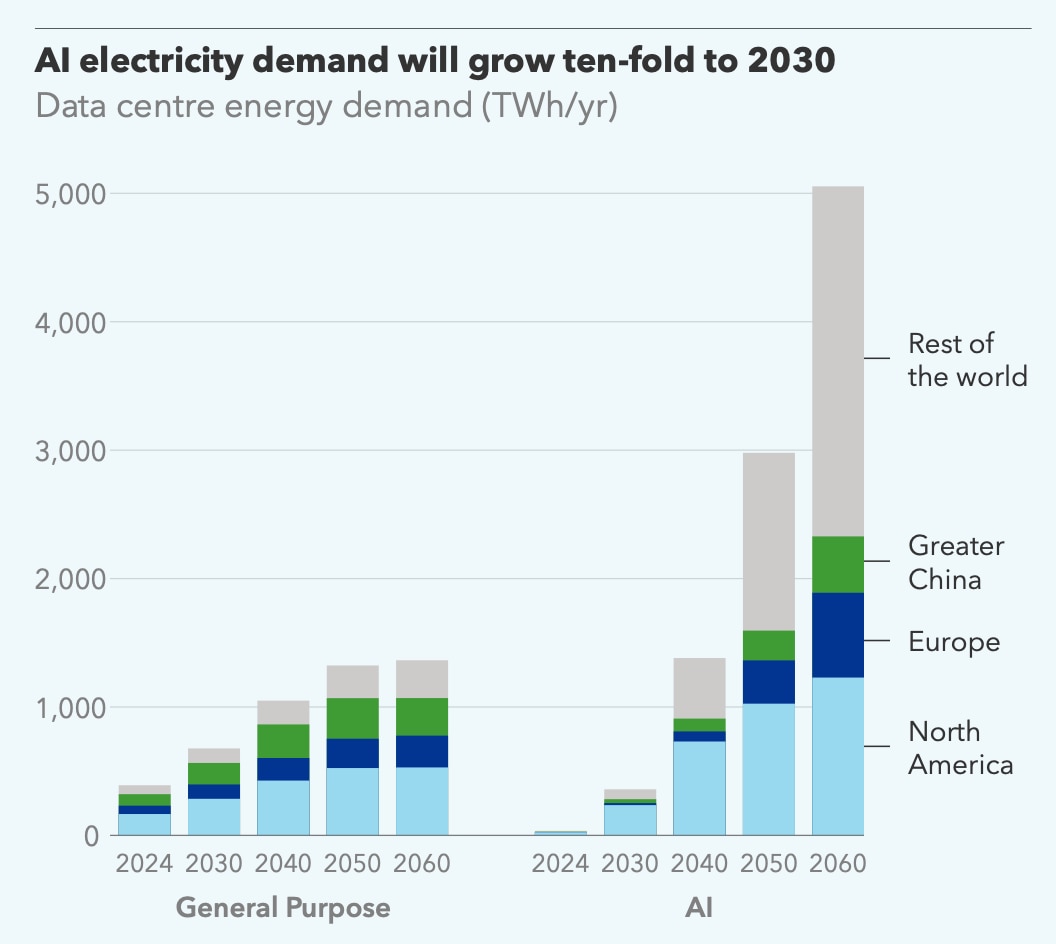
Forecast AI Electricity Demand Growth to 2060

Forecast AI Electricity Demand Growth to 2060 Image: DNV

Most of this additional load will connect through transmission grids. Approximately 10% of new transmission line connection requests in 2030, and 12% in 2040, will be for data centres, globally.

According to the International Energy Agency (IEA), permitting reform, grid-code harmonization, new financing models, and public-engagement efforts are moving, but not fast enough to match current AI investment. Efficiency helps, but it cannot remove the need for physical capacity, firm connections, and predictable operating envelopes.

The risk profile has shifted: access to the grid – rather than chips, capital, or algorithms – is increasingly the binding constraint. For developers, grid-connection uncertainty now rivals technology risk. For operators and policy-makers, the challenge is integrating a new demand class without compromising reliability.

Grid connectivity challenges for AI data centres

Until recently, most data-centre electricity demand fell into two categories: hyperscale cloud sites (predictable, suited to long-term planning) and cryptocurrency mining (volatile but often interruptible). AI data centres sit between these extremes.

They combine very high-power density with fast, uncertain ramping and a low tolerance for interruptibility – making them the most challenging load for today’s grid planning and interconnection frameworks.

This makes AI data centres something of a stress test for grid connectivity as they turn it into a system‑level challenge. Grid operators must assess not just individual projects, but also how clusters of AI data centres interact with existing assets and each other − often with limited data and under significant time pressure.

Near term, the aim is to reduce risk and deploy systems assurance, rather than bypassing the grid. Practical measures include:

  • Choosing the right location from the start. Before committing land or capital, developers should assess where grid capacity is actually available, how long connection queues are and what technical limits apply locally. Sites near retired power plants or underused grid infrastructure can connect significantly faster than greenfield locations in congested areas.
  • Behind‑the‑meter assets: Assets such as batteries, limited on‑site generation, power‑quality equipment, plus capacity procurement, like off‑site power purchase agreements or own generation, enable operations within grid limits and reduce short‑term stress.
  • Interruptible ‘emergency lane’ connections: Power grids hold spare capacity in reserve for emergencies. Under managed contracts, this reserve can be made available to data centres willing to accept occasional, planned interruptions. A recent DNV study of the Dutch transmission network[1] suggests this approach could unlock 5–15% of additional capacity in congested areas without compromising system security, so long as clear rules govern when and how connections are curtailed. Regulators recognizing this as a standard option for data centres would meaningfully shorten connection queues.
  • Demand flexibility: Data centres can ease grid pressure not just by using less power, but by using it more flexibly. Deferring non-urgent computing tasks, redirecting workloads to less congested locations, and prioritizing operations by criticality all reduce strain on local networks without cutting total output.

An AI campus, for example, secures capital and hardware but faces a multi‑year grid queue. By combining phased connections with on‑site storage and operational load controls, the project can begin operations earlier − while grid reinforcements are still under way − without compromising system security.

Leadership priorities for the next phase of AI

AI is already supporting grid planning and operations, such as accelerating power‑flow studies, congestion analysis, AI-enhanced digital twins. But it cannot remove the regulatory, institutional and physical risk constraints, and it will not be able to offset AI‑driven load growth within the timeframes that matter.

Leadership is needed from three stakeholder groups:

  • Utilities and regulators should treat AI data centres as a distinct load class and adapt interconnection, queue management, and grid‑code practices accordingly.
  • Developers and hyperscalers need to price grid realities into early investment decisions, treating connection timelines, operational limits and compliance risks as core, not an afterthought.
  • Policy-makers and investors must accelerate grid build-out while enabling interim flexibility mechanisms that protect reliability and maintain public trust.

The future electrification of our societies requires a new mindset toward digitalization and systems thinking: data centres can act as an important enabler for faster scaling, thanks to their strong business case, just as we are seeing with batteries for EVs, making storage another important enabler for the energy transition. Aligning AI growth with grid connectivity is now a central leadership responsibility.