








Tensions in the Gulf region have escalated amid fresh strikes from the US, Israel and Iran and uncertainty over peace talks.
Israel and Iran exchanged missile strikes, with US President Donald Trump urging both sides to "immediately stop shooting". Iran later said it would stop strikes before Israel followed suit saying attacks would end "for now". US President Donald Trump said that Israel would have "no choice" but to accept any deal the US makes with Iran.
Last week, Iranian attacks on Kuwait damaged its airport and killed one person, injuring more than 60 others, Kuwaiti authorities said. Iran also claimed it had hit a US Navy HQ in Bahrain and a US airbase. The US military said it had carried out defensive strikes in southern Iran.
The escalation comes despite a temporary ceasefire between the US and Iran that has been in place since early April, raising fears that full-scale fighting could resume, according to reports from Al Jazeera and Reuters.
At the time of writing, Iran’s foreign minister said “no tangible progress” had been made in talks to end the conflict. He said lines of communication with the US remained open, but warned that any attack on Lebanon’s capital, Beirut, as part of Israel's campaign against Hezbollah, could lead to a resumption of the US-Iran conflict.
Oil industry executives recently warned the US administration that disruption in the Strait of Hormuz caused by the conflict is draining inventories to levels that could send global energy prices surging in the coming weeks. Gulf countries that export oil via the Strait, meanwhile, are in talks over pipelines that would allow them to bypass the waterway.
Maritime traffic through the Strait of Hormuz has come to a near standstill since the Iran war broke out in late February. Usually, a fifth of the world’s oil and liquefied natural gas supplies travel through the passage. And while more vessels have been able to travel through the Strait in recent weeks, the numbers are still much lower than pre-war levels.
Experts say the effects of shortages of fuel and fertilizer – another commodity hit hard by the disruption – could be compounded by an “exceptional” El Niño.
The naturally occurring climate pattern, characterized by warming of ocean surface temperatures in areas of the Pacific, happens every two to seven years and lasts around nine to 12 months. Even a moderate event makes some weather and climate extremes more likely, the UN agency says.
The WMO has said a new phase of El Niño could begin in a matter of weeks and strengthen throughout the rest of the year – and some weather agencies think it could be one of the strongest ever recorded.
This would layer increased risk of drought, heat and regional crop losses in parts of the world on top of a food system already more fragile due to availability and cost of fuel and fertilizer, one expert told the World Resources Institute.
More widely, this underscores how extreme weather events – the number one long-term risk in the Forum's Global Risks Report – do not exist in a vacuum but exacerbate existing inequalities, supply chain disruptions and geopolitical tensions.
Experts say governments, companies and aid agencies should prepare for what could prove to be a major systemic shock in order to mitigate any potential impact.
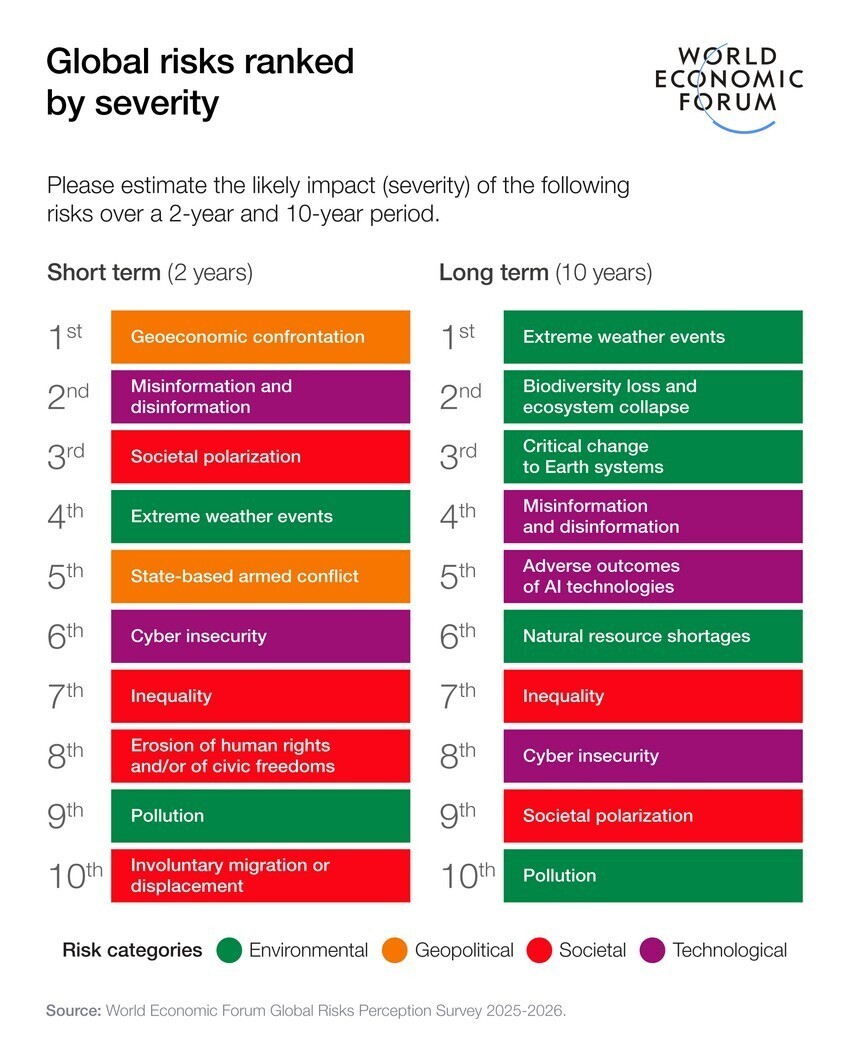
Over the past month, geopolitics has been shaped as much by summitry as by conflict. Donald Trump’s meeting with Xi Jinping sought to steady US-China relations, even as fears of a “Thucydides trap” continued to frame their relationship, while Vladimir Putin’s talks with Xi underscored the durability of the China-Russia alignment and its push for a more multipolar order. At the Shangri-La Dialogue in Singapore, Indo-Pacific debates centred on deterrence and maritime competition. In St Petersburg, Russia used its economic forum, with Saudi Arabia as a key guest partner, to signal that despite sanctions and war, Moscow still has non-Western options.
The UK and Poland, meanwhile, have signed a new defence and security treaty that Britain said will improve border security, tackle organized crime and deepen defence cooperation with the European Union. The UK described the determination of the NATO military alliance to defend its territory as “unshakeable”. But after the US demanded Europe do more to protect itself, both Britain and Poland have looked to seal defence deals with other nations, including France and Germany.
Discover
How the Forum helps leaders make sense of regional, trade and geopolitical shifts
China’s economic story is increasingly about sweeping self-sufficiency. In amongst this is the soybean – and a reliance on imports to support changing diets that has become a vulnerability. What does this say about the trade-offs between food security and natural resource use many countries face? Discover more in this article.
Against a tense global backdrop, the Trump-Xi summit last month aimed to restabilize US-China relations. The leaders shared a vision of building “a constructive relationship of strategic stability” to bring enhanced certainty and predictability for the global economy. But the outcome offers just limited clarity regarding the future direction and stability of a bilateral relationship that affects the entire world. What comes next for China’s trade policy? There are four trends likely to emerge.
In an interconnected world, what happens in one region can send shockwaves across the entire global economy. Supply disruptions, such as the recent effective closure of the Strait of Hormuz, for example, have far-reaching trade impacts. Yet the global trade system often relies on just-in-time logistics and concentrated supply routes. Read why a fragmented world needs more diversified trade hubs in this article.
此内容由惯性聚合(RSS阅读器)自动聚合整理,仅供阅读参考。 原文来自 — 版权归原作者所有。