
惯性聚合 高效追踪和阅读你感兴趣的博客、新闻、科技资讯
阅读原文 在惯性聚合中打开

推荐订阅源

F
Fortinet All Blogs
宝玉的分享
宝玉的分享
酷 壳 – CoolShell
酷 壳 – CoolShell
T
The Exploit Database - CXSecurity.com
Help Net Security
Help Net Security
腾讯CDC
Project Zero
Project Zero
C
CXSECURITY Database RSS Feed - CXSecurity.com
IT之家
IT之家
C
Cyber Attacks, Cyber Crime and Cyber Security
T
Tailwind CSS Blog
Threat Intelligence Blog | Flashpoint
D
Darknet – Hacking Tools, Hacker News & Cyber Security
L
LINUX DO - 最新话题
K
KPMG report finds enterprise disconnect between AI and its ROI | CIO
T
Threatpost
N
News | PayPal Newsroom
C
Cybersecurity and Infrastructure Security Agency CISA
Hacker News - Newest:
Hacker News - Newest: "LLM"
S
SegmentFault 最新的问题
cs.AI updates on arXiv.org
P
Proofpoint News Feed
A
Arctic Wolf
B
Blog RSS Feed
Forbes - Security
Forbes - Security
P
Privacy & Cybersecurity Law Blog
Attack and Defense Labs
V2EX - 技术
V2EX - 技术
P
Proofpoint News Feed
I
Intezer
Application and Cybersecurity Blog
阮一峰的网络日志
阮一峰的网络日志
aimingoo的专栏
aimingoo的专栏
T
Tenable Blog
MyScale Blog
MyScale Blog
U
Unit 42
Cyber Security Advisories - MS-ISAC
WordPress大学
WordPress大学
W
WeLiveSecurity
D
DataBreaches.Net
奇客Solidot–传递最新科技情报
奇客Solidot–传递最新科技情报
G
GRAHAM CLULEY
有赞技术团队
有赞技术团队
Martin Fowler
Martin Fowler
罗磊的独立博客
The Last Watchdog
The Last Watchdog
让小产品的独立变现更简单 - ezindie.com
V
Vulnerabilities – Threatpost
美团技术团队
Microsoft Security Blog

World Economic Forum

What happened at the MC14 WTO meeting in Yaoundé How giving gorillas digital wallets can help finance nature Why is leadership a strategic investment for philanthropy? Counting the many costs of the global mental health burden What we learned from the 2026 World Bank Spring Meetings Crop protection is at risk. How innovation can help Here's a playbook for boards on how to govern agentic AI Why connected data makes AI decision-ready for sustainability 3 ways better data practices are reshaping financial supervision What technology convergence looks like in practice 7 reasons the old order broke — and how it might be repaired How governments can make agentic AI re  ? Current and future uses of RNA, including mRNA vaccines Real-time deepfakes are rewriting the rules of child safety Electrification trend ‘unmistakeable’ – and more energy stories From smallpox to the common cold: A brief history of vaccines Saudi Arabia's new AI-powered sustainability platform could unlock $20 billion by 2030 This crisis could be an opportunity for the energy transition Middle East war: 6 ways countries are responding to the historic energy shock Nature can teach us about leadership and building resilience How did the Strait of Hormuz become so important, and will it stay that way? Yes/Cities: Helping global cities become more resilient, sustainable and prosperous Healthy ageing in APAC: The role of the influenza vaccine Risk management, renewables and a rocky road ahead: Spring Meetings takeaways Japan in a world of rising middle powers EU plans to offset Iran war's energy impact, and other climate and nature news 3 cities leading on green investment for economic growth The coffee industry is making the case for climate insurance The ocean is now a subprime asset, so we need a sustainable blue economy 5 leaders on today’s growth dilemmas and how to navigate them What helps purpose-driven, early-stage start-ups scale? Why trust is key to the EU's Empowering Consumers Directive The $3 trillion maintenance gap is burning money and the planet Surging AI needs and geopolitical supply shocks renew attention on nuclear energy 5 things to know before interacting with digital assets Frontiers Planet Prize: 25 solutions for planetary crises How the Iran war is disrupting India's steel production What's needed for growth in the new economy? Why we need a humanitarian truce is Sudan Freedom of expression under attack: How do we protect the media? Why companies – and nations – should create an AI culture Anthropic’s Mythos moment: how frontier AI is redefining cybersecurity Discover this week's must-read finance stories 'Godfather of AI' Yoshua Bengio on why AI can behave unpredictably (and what needs to change) Everyone talks about critical thinking. Here's how schools should actually teach it The top international trade stories to know this month The big chart: How oil prices have reacted to world events since the 1980s Why AI needs digital public infrastructure to deliver for citizens What AI in education needs next: Lessons from youth leaders across five countries How to scale clean hydrogen to meet energy security needs Meet the Young Global Leaders Class of 2026 Ventures with blue carbon solutions for coastal restoration How peer-led reskilling is helping bridge the skills gap in East Africa China's lessons on the energy sector’s nature-positive transition Here's how Japan's green materials sector is thriving The Strait of Hormuz crisis: Rewriting the future of AI Systemic risk is the hidden tax on growth. Here's how insurance can help build economic resilience Earth Day: What is it, when is it and why is it important? The Rayner plot: What it tells us about the future of jobs This is why we’ll feel the economic effects of this war for a while How energy and finance leaders are approaching climate investment in 2026 How quantum technologies are being tested to strengthen energy systems How to think about ‘safe’ withdrawal rates in a changing global economy Is collective cyber defence the future of port security? Learnings from a Dutch initiative Cyberattacks target US infrastructure, and other cybersecurity news Rethinking workplace energy: Why our assumptions can lead to burnout What could an international panel to tackle inequality achieve? Why climate action matters for healthy longevity Workforce health is the bedrock of global supply chains. Here's how to protect it Southeast Asia may be a distinct region but its risks affect each country differently 5 ways to grow a business mindset in international development How companies can finally cut Scope 3 emissions Here's how to get the $7 trillion AI hardware buildout right Leaders are moving from systems of record to systems of work G7 One Health Summit launches global diagnostics initiative, and other health stories What stopping war-risk insurance in the Strait of Hormuz tells us Why leaders must transform cyber resilience measurement AI can help create comparability and scale impact investing What's in store for the future of multilateralism? Why food waste is a $540 billion opportunity hiding in plain sight What Afghanistan can teach us about strategic foresight This is how we use generative AI on Forum Stories How cities are turning urban complexity into coherent climate plans How non-profits and governments use data to drive real system change How demographics, not AI, will redefine the labour market Three lessons on the energy transition in an age of crisis NFL players: Why financial literacy is a game-changer for student-athletes 3 ways Africa can maximize the value of its critical minerals and finance its future What leaders are saying about the new geopolitics of energy The financial system is rebooting. Stakeholders must adapt Cancer care innovation is reshaping resilience in Japan The hidden struggle of employed youth in Africa How markets and missions are becoming allies for impact What’s changing in frontier tech – from geopolitics to AI and energy Why stablecoins are quickly becoming a geopolitical issue How public-private collaboration can help close the global gender gap It’s time to start treating AI infrastructure as critical infrastructure 5 effective choices to turn workplace well-being into a competitive advantage How to strengthen collaboration to tackle infectious disease Why the AI economy can’t rely on a single digital Suez
Here are 6 ways that climate change is affecting sports around the world
Meg Jones · 2026-04-27 · via World Economic Forum

This article has been updated.

  • As extreme weather events escalate, they are likely to dramatically impact sporting events around the world.
  • The sports economy is worth $2.3 trillion a year, but faces challenges from our changing climate. A new World Economic Forum report outlines pathways to ensure resilience.
  • From running marathons at night to moving annual events to different seasons, sporting organizations are racing to stay ahead of the impacts of climate change.

As runners at the 2026 Los Angeles Marathon were told they could ‘finish’ at mile 18 because of dangerous heat, skiers at the Winter Olympics in northern Italy were competing on increasingly artificial snow.

Climate change is no longer a distant challenger for the sporting world; it is shaping how, when and where competitions take place.

Released at the start of the year, a World Economic Forum report, Sports for People and Planet, warns that a dwindling number of countries will be able to host the Olympic Games due to the climate crisis. In fact, the data suggests that just 10 countries will be able to host the Winter Olympics and Paralympics as of 2040 due to reduced snowfall.
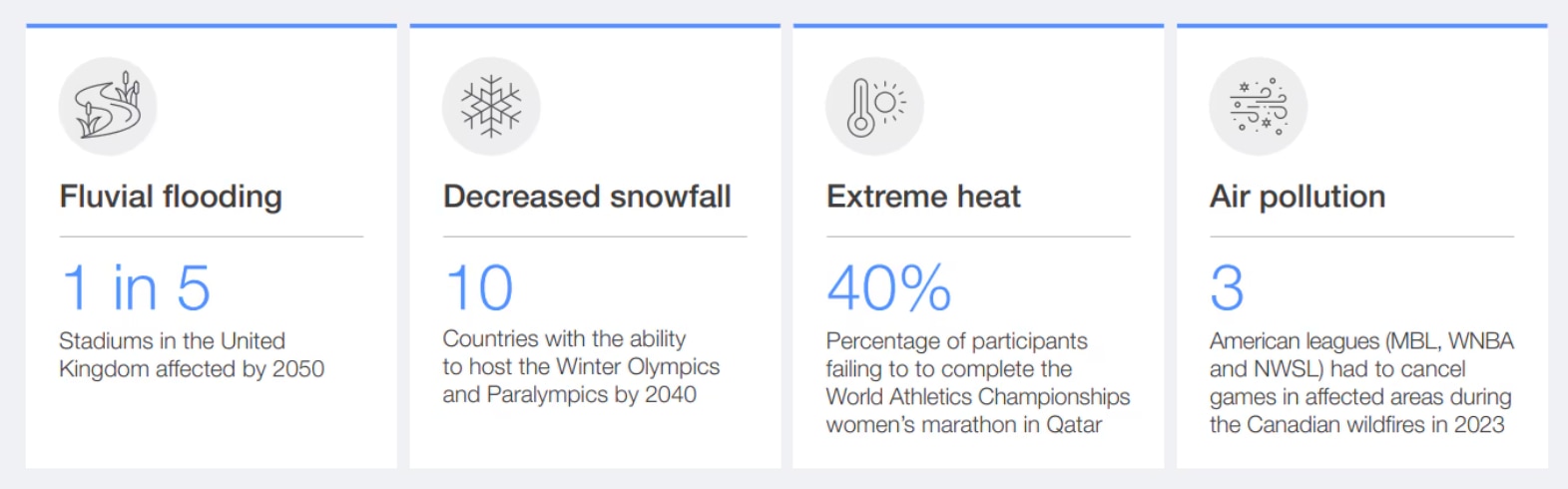
Infographic showing impact of the climate crisis on sports.

Analysis shows the impact of the climate crisis on the Winter Olympics and Paralympics. Image: World Economic Forum

From running marathons at night to moving annual events to different seasons, here are some ways that sports are racing to stay ahead of climate change impacts.

The Olympics

When Paris hosted the Olympic Games in 2024, the world’s greatest athletes were going for gold as the planet was breaking records of its own. The year 2024 has since been confirmed as the warmest year on record, with global average temperatures around 1.5°C above pre‑industrial levels.

Two years later, the Winter Olympics in northern Italy faced similar climate pressures. With unpredictable and inconsistent weather patterns, organizers had to rely more heavily on artificial snow and spreading events over a wider area. According to the IOC, this was the "most widespread games in Olympic history", spanning some 22,000 square kilometres.
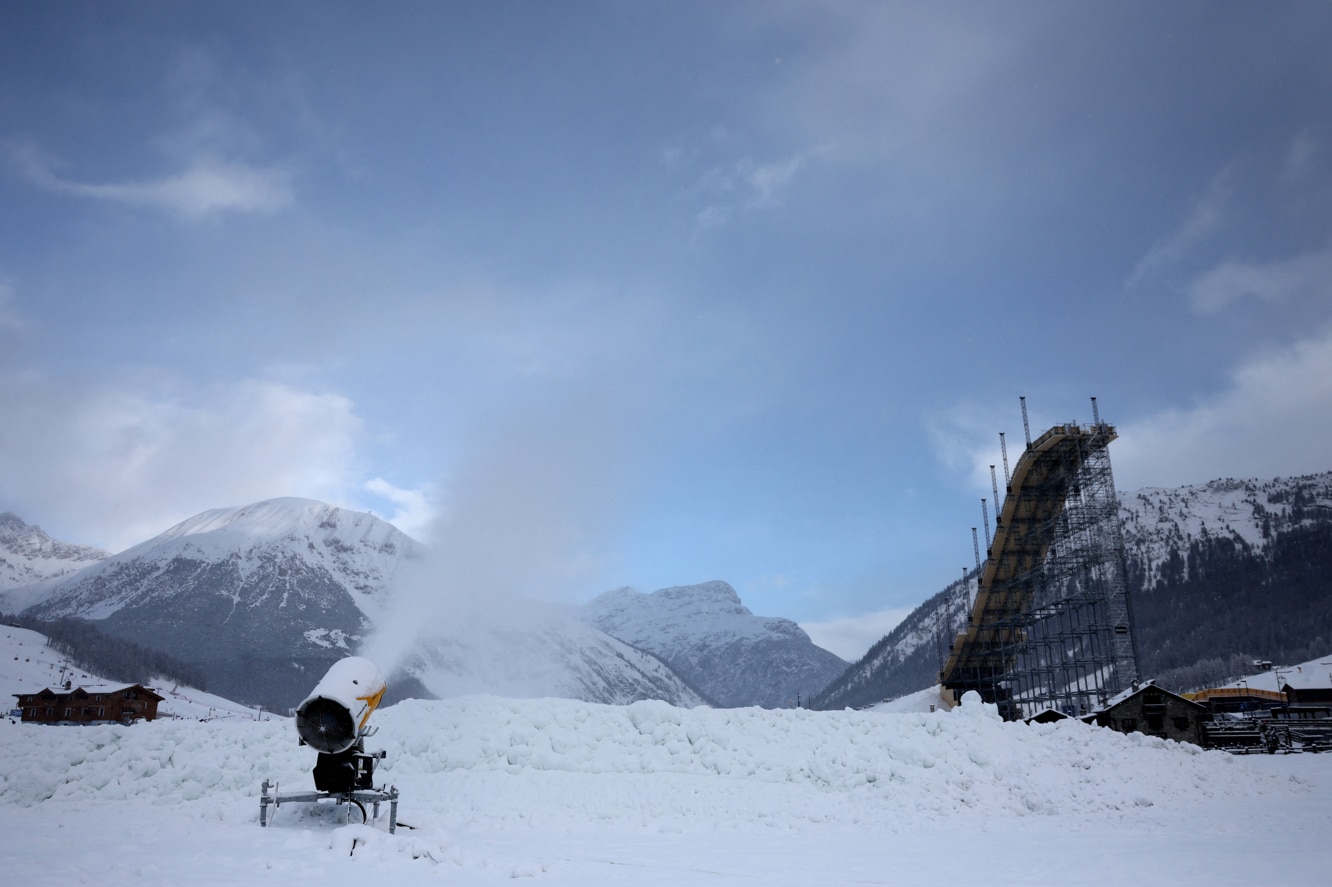
A snow cannon fires artificial snow infront of the big ski jump in the snow park in Livigno as part of the Milano Cortina Winter Olympic games in Italy, January 9, 2026.

Winter Olympics organizers had to rely more heavily on artificial snow this year. Image: Reuters/Yara Nardi

Grand slam for tennis

At the 2026 Australian Open, temperatures nearing 40°C triggered the tournament’s extreme‑heat policy, suspending play on outside courts and moving matches into roofed arenas to protect players and fans.
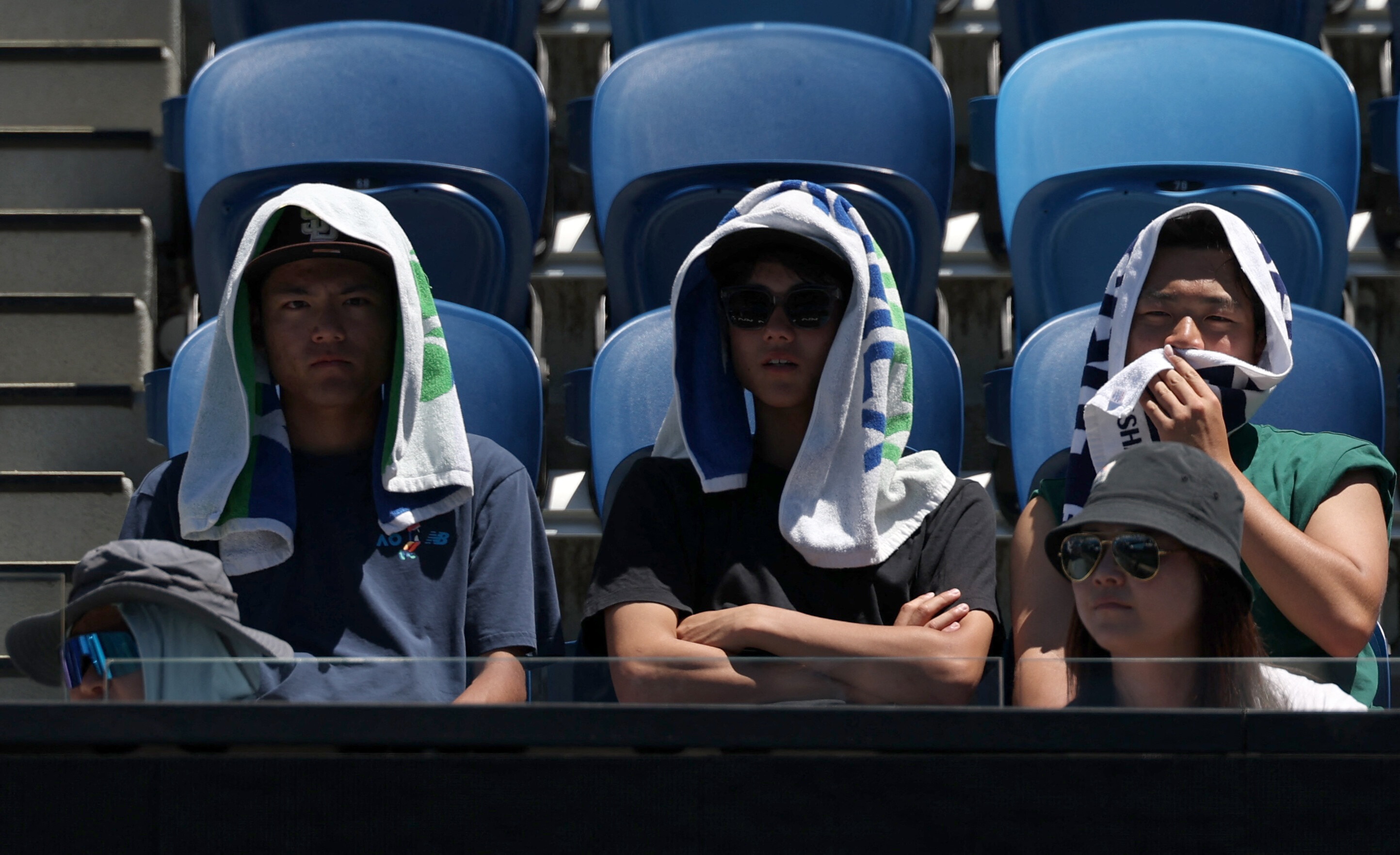
Tennis - Australian Open - Melbourne Park, Melbourne, Australia - January 24, 2026 Spectators in the stands use towels to cover from the heat during the third round match between Russia's Karen Khachanov and Italy's Luciano Darderi REUTERS/Hollie Adams

Temperatures soared towards 40°C at this years' Australian Open. Image: Reuters/Hollie Adams

At tournaments in China last year, Denmark’s Holger Rune famously asked an official “Do you want a player to die on court?” as he struggled in temperatures above 30°C and humidity over 80% at the Shanghai Masters, while players at the nearby Wuhan Open also retired with dizziness and heat‑related illness.

As of 2026, the ATP Tour allows men’s singles players to take a 10‑minute cooling break during best‑of‑three‑set matches when conditions are extremely hot, to reduce the risk of heat stress.

The women’s WTA Tour has offered this kind of heat‑break protection for players since the early 1990s.

Heat‑stress scales, cooling breaks and schedule changes are becoming as integral to major tennis events as seedings and draws.

New route for the Tour de France

Since the first race in 1903, the bulk of the Tour de France has been ridden through 23 days of July. However, as temperatures continue to rise, this tradition may have to shift gears and reroute out of July into a cooler month.

A recent study has found that the risk of heat stress for cyclists has increased steadily over the years, with the highest number of extreme heat episodes having happened in the last decade.

As France shut down schools at the start of July last year due to extreme heatwave warnings, participants were heading out to start the world's most prestigious cycling competition. Extreme sports in extreme weather puts huge pressure on the human body to remain regulated – many cyclists experience heat-related illnesses as a result.

Infographic illustrating the overview of heat waves impact on health outcome.

Prolonged exposure to extreme heat can cause a cascade of heat-related illnesses. Image: World Economic Forum

As temperatures continue to rise, larger structural changes will need to happen – such as moving the race from July – to ensure the riders' safety and the event's future.

Skiing towards a warming world

From the Swiss Alps to the Rocky Mountains, ski resorts across the globe are grappling with the impacts of climate change. As temperatures continue to rise, snowfall is melting at an alarming pace – according to one study, one in eight ski resorts worldwide could have no snow by 2100.

But this isn’t a concept of the future; resorts are suffering now.

Europe had its warmest year on record in 2024, and average snow thickness across the continent has been shrinking by about 12% per decade, while the length of the snow season falls by roughly 0.44 days each year.

View of the Alpine resort of Gaschurn, Austria.

Skiers pass on a small layer of artificial snow amid warmer temperatures in Austria. Image: Reuters/Arnd Wiegmann

These snow-less slopes don’t just impact individual resorts – the effects are felt across whole towns whose economies depend on ski tourism.

From investing more in bike trails, climbing routes and walking paths to using artificial snow, the tourism sector in these areas is having to shift and adapt to mounting climate threats.

Moving marathons

As extreme weather conditions escalate, marathons and long-distance races across the globe are being postponed, cancelled or altered to reduce the risks to human life.

In Los Angeles, where race‑day temperatures were forecast to climb above 30°C, organizers offered a one‑time “mile 18 option” at this year’s marathon: runners who were struggling could turn off the course roughly 8 miles before the official finish and still receive a finisher’s medal.

In Europe, Berlin Marathon runners also contended with record-breaking temperatures in 2025, just as new research warned that climate change will leave marathoners with fewer opportunities to race in optimal conditions.

After analyzing 221 global races, the research found that 86% are expected to have worse conditions for marathon running for most runners by 2045, with all seven Abbott World Marathon Majors on the list.

One increasingly common response is to start races earlier in the day to avoid peak heat.

The 2019 World Athletics Championships in Qatar saw the women’s marathon start time shift to 11:59 pm local time due to the daytime heat in Doha.

Wildfire haze

US baseball, basketball and soccer teams are increasingly united over a common opposition: wildfires.

In January 2025, wildfires around Los Angeles forced evacuation orders for roughly 180,000 people and pushed air‑quality levels into the “unhealthy” range, with readings around 185 on the local index. The NBA rescheduled nine games as a result of this.

In June 2023, around 75 million people were under air quality alerts as wildfire smoke from Canada covered major US cities. The intensity of the smoke saw Major League Baseball, the Women’s National Basketball Association and the National Women’s Soccer League cancel games over concerns about dangerous air quality.

More frequent wildfires across the globe are increasing pollution levels, which can exacerbate respiratory ailments as well as cardiovascular diseases. These risks could lead to as many as 9 million premature deaths per year by 2060, the Forum’s report suggests.

Infographic illustrating the overview of climate hazard impact on health outcomes

Health outcomes involve direct and indirect consequences of extreme weather events. Image: World Economic Forum

For some baseball teams, climate change is having a different impact. Researchers have found that climate change caused more than 500 home runs since 2010, with higher air temperatures reducing air resistance for the ball to travel through.

That’s an average of 58 more home runs each season due to climate-induced warming.

The future of sporting events is under threat from our changing climate. Adaptation measures are increasingly vital to protect the athletes, supporters and sport itself as extreme weather events become increasingly common.

Many are already adapting to a new normal to preserve their sport and what it means for community and sportsmanship for generations of fans to come.