



惯性聚合 高效追踪和阅读你感兴趣的博客、新闻、科技资讯
阅读原文 在惯性聚合中打开

推荐订阅源

S
Schneier on Security
A
Arctic Wolf
S
Security Affairs
O
OpenAI News
SecWiki News
SecWiki News
TaoSecurity Blog
TaoSecurity Blog
H
Heimdal Security Blog
T
Threat Research - Cisco Blogs
Hacker News: Ask HN
Hacker News: Ask HN
N
News | PayPal Newsroom
Google Online Security Blog
C
Cisco Blogs
The Hacker News
The Hacker News
cs.AI updates on arXiv.org
C
CXSECURITY Database RSS Feed - CXSecurity.com
P
Privacy International News Feed
V
Vulnerabilities – Threatpost
cs.CV updates on arXiv.org
酷 壳 – CoolShell
酷 壳 – CoolShell
H
Hacker News: Front Page
T
Tenable Blog
T
The Exploit Database - CXSecurity.com
Recent Commits to openclaw:main
Spread Privacy
Spread Privacy
人人都是产品经理
人人都是产品经理
www.infosecurity-magazine.com
V2EX - 技术
V2EX - 技术
L
LINUX DO - 最新话题
The GitHub Blog
The GitHub Blog
博客园 - 三生石上(FineUI控件)
T
The Blog of Author Tim Ferriss
OSCHINA 社区最新新闻
OSCHINA 社区最新新闻
V
Visual Studio Blog
The Cloudflare Blog
N
News and Events Feed by Topic
量子位
Google DeepMind News
Application and Cybersecurity Blog
L
LINUX DO - 热门话题
P
Palo Alto Networks Blog
Stack Overflow Blog
Stack Overflow Blog
K
KPMG report finds enterprise disconnect between AI and its ROI | CIO
Attack and Defense Labs
Cyber Security Advisories - MS-ISAC
Hacker News - Newest:
Hacker News - Newest: "LLM"
Apple Machine Learning Research
The Register - Security
Microsoft Security Blog
Know Your Adversary
Know Your Adversary
Webroot Blog
Webroot Blog

World Economic Forum

How giving gorillas digital wallets can help finance nature Why is leadership a strategic investment for philanthropy? Counting the many costs of the global mental health burden What we learned from the 2026 World Bank Spring Meetings Crop protection is at risk. How innovation can help Here's a playbook for boards on how to govern agentic AI Why connected data makes AI decision-ready for sustainability 3 ways better data practices are reshaping financial supervision What technology convergence looks like in practice 7 reasons the old order broke — and how it might be repaired How governments can make agentic AI re  ? Current and future uses of RNA, including mRNA vaccines Real-time deepfakes are rewriting the rules of child safety Electrification trend ‘unmistakeable’ – and more energy stories From smallpox to the common cold: A brief history of vaccines Saudi Arabia's new AI-powered sustainability platform could unlock $20 billion by 2030 Here are 6 ways that climate change is affecting sports around the world This crisis could be an opportunity for the energy transition Middle East war: 6 ways countries are responding to the historic energy shock Nature can teach us about leadership and building resilience How did the Strait of Hormuz become so important, and will it stay that way? Yes/Cities: Helping global cities become more resilient, sustainable and prosperous Healthy ageing in APAC: The role of the influenza vaccine Risk management, renewables and a rocky road ahead: Spring Meetings takeaways Japan in a world of rising middle powers EU plans to offset Iran war's energy impact, and other climate and nature news 3 cities leading on green investment for economic growth The coffee industry is making the case for climate insurance The ocean is now a subprime asset, so we need a sustainable blue economy 5 leaders on today’s growth dilemmas and how to navigate them What helps purpose-driven, early-stage start-ups scale? Why trust is key to the EU's Empowering Consumers Directive The $3 trillion maintenance gap is burning money and the planet Surging AI needs and geopolitical supply shocks renew attention on nuclear energy 5 things to know before interacting with digital assets Frontiers Planet Prize: 25 solutions for planetary crises How the Iran war is disrupting India's steel production What's needed for growth in the new economy? Why we need a humanitarian truce is Sudan Freedom of expression under attack: How do we protect the media? Why companies – and nations – should create an AI culture Anthropic’s Mythos moment: how frontier AI is redefining cybersecurity Discover this week's must-read finance stories 'Godfather of AI' Yoshua Bengio on why AI can behave unpredictably (and what needs to change) Everyone talks about critical thinking. Here's how schools should actually teach it The top international trade stories to know this month The big chart: How oil prices have reacted to world events since the 1980s Why AI needs digital public infrastructure to deliver for citizens What AI in education needs next: Lessons from youth leaders across five countries How to scale clean hydrogen to meet energy security needs Meet the Young Global Leaders Class of 2026 Ventures with blue carbon solutions for coastal restoration How peer-led reskilling is helping bridge the skills gap in East Africa China's lessons on the energy sector’s nature-positive transition Here's how Japan's green materials sector is thriving The Strait of Hormuz crisis: Rewriting the future of AI Systemic risk is the hidden tax on growth. Here's how insurance can help build economic resilience Earth Day: What is it, when is it and why is it important? The Rayner plot: What it tells us about the future of jobs This is why we’ll feel the economic effects of this war for a while How energy and finance leaders are approaching climate investment in 2026 How quantum technologies are being tested to strengthen energy systems How to think about ‘safe’ withdrawal rates in a changing global economy Is collective cyber defence the future of port security? Learnings from a Dutch initiative Cyberattacks target US infrastructure, and other cybersecurity news Rethinking workplace energy: Why our assumptions can lead to burnout What could an international panel to tackle inequality achieve? Why climate action matters for healthy longevity Workforce health is the bedrock of global supply chains. Here's how to protect it Southeast Asia may be a distinct region but its risks affect each country differently 5 ways to grow a business mindset in international development How companies can finally cut Scope 3 emissions Here's how to get the $7 trillion AI hardware buildout right Leaders are moving from systems of record to systems of work G7 One Health Summit launches global diagnostics initiative, and other health stories What stopping war-risk insurance in the Strait of Hormuz tells us Why leaders must transform cyber resilience measurement AI can help create comparability and scale impact investing What's in store for the future of multilateralism? Why food waste is a $540 billion opportunity hiding in plain sight What Afghanistan can teach us about strategic foresight This is how we use generative AI on Forum Stories How cities are turning urban complexity into coherent climate plans How non-profits and governments use data to drive real system change How demographics, not AI, will redefine the labour market Three lessons on the energy transition in an age of crisis NFL players: Why financial literacy is a game-changer for student-athletes 3 ways Africa can maximize the value of its critical minerals and finance its future What leaders are saying about the new geopolitics of energy The financial system is rebooting. Stakeholders must adapt Cancer care innovation is reshaping resilience in Japan The hidden struggle of employed youth in Africa How markets and missions are becoming allies for impact What’s changing in frontier tech – from geopolitics to AI and energy Why stablecoins are quickly becoming a geopolitical issue How public-private collaboration can help close the global gender gap It’s time to start treating AI infrastructure as critical infrastructure 5 effective choices to turn workplace well-being into a competitive advantage How to strengthen collaboration to tackle infectious disease Why the AI economy can’t rely on a single digital Suez
As technology accelerates, what happens to the human system?
Jessica Wang · 2026-06-18 · via World Economic Forum
  • As AI takes on more cognitive tasks, uniquely human capabilities such as creativity, imagination and adaptability are becoming strategic assets.
  • The future of innovation depends not only on technological progress, but also on strengthening human attention, agency and resilience.
  • Through four interactive installations at the Annual Meeting of the New Champions 2006, which takes place in China on 23-25 June, Technology and the Human System, developed with the Science Gallery Network, explores how these foundations are being challenged and strengthened in an age of intelligent technologies.

In an age of artificial intelligence and disruption, the true competitive edge is human. Once dismissed as “soft”, human-centric skills, including creativity, innovation and adaptability, are now core differentiators for thriving individuals, high-performing teams and organizations.

Human skills are among some of the strongest predictors of career growth as well, as recent insights suggest that individuals with strong human skills were more likely to learn technologies quicker, adapt to change more easily and advance into new roles more often.

As AI handles more cognitive tasks, the debate is growing on whether we are losing critical thinking and problem-solving abilities through over-reliance on technology. According to recent surveys conducted by the Pew Research Center, creativity is most at risk, with 53% of respondents expecting that the increased use of AI will make people’s ability to think creatively worse.

The question is not whether technology is inherently good or bad, but how it is shaping the habits, capabilities and relationships that make us human. As users increasingly outsource memory, decision-making and information processing to digital tools, what are the implications for our sense of self, our ability to think independently, and the ways we connect and relate to one another and technology?

Questions of attention, agency and resilience are at the centre of Technology and the Human System, an immersive exhibition developed with the Science Gallery Network for the 17th Annual Meeting of the New Champions 20026, which takes place in the People's Republic of China from 23 to 25 June. As business leaders, researchers and innovators gather to discuss how innovation can deliver broad-based growth across economies, the exhibition uses interactive art to make tangible the relationship between technological acceleration and human resilience.

“Art allows people to learn through encounter,” says Miguel Alejandro González Virgen, Director, Science Gallery at Tecnológico de Monterrey. “Through the works in this exhibition, visitors can pause to engage with how technology is shaping everyday experience: how we think, feel and relate to our world.”

If technology could create space for inaction, how would you respond?

Doing Nothing with AI by Emanuel Gollob stages the tension between technological optimization and human cognitive limits. Using brainwave data and machine learning to shape the movements of a robotic arm, the installation prompts participants to resist acting and instead “do nothing” as a deliberate response.

In an economy increasingly defined by speed, efficiency and connectivity, attention has become one of our most valuable resources. The installation asks a deceptively simple question: in a future optimized for productivity, will we still pause to make room for the conditions that allow innovation to flourish?
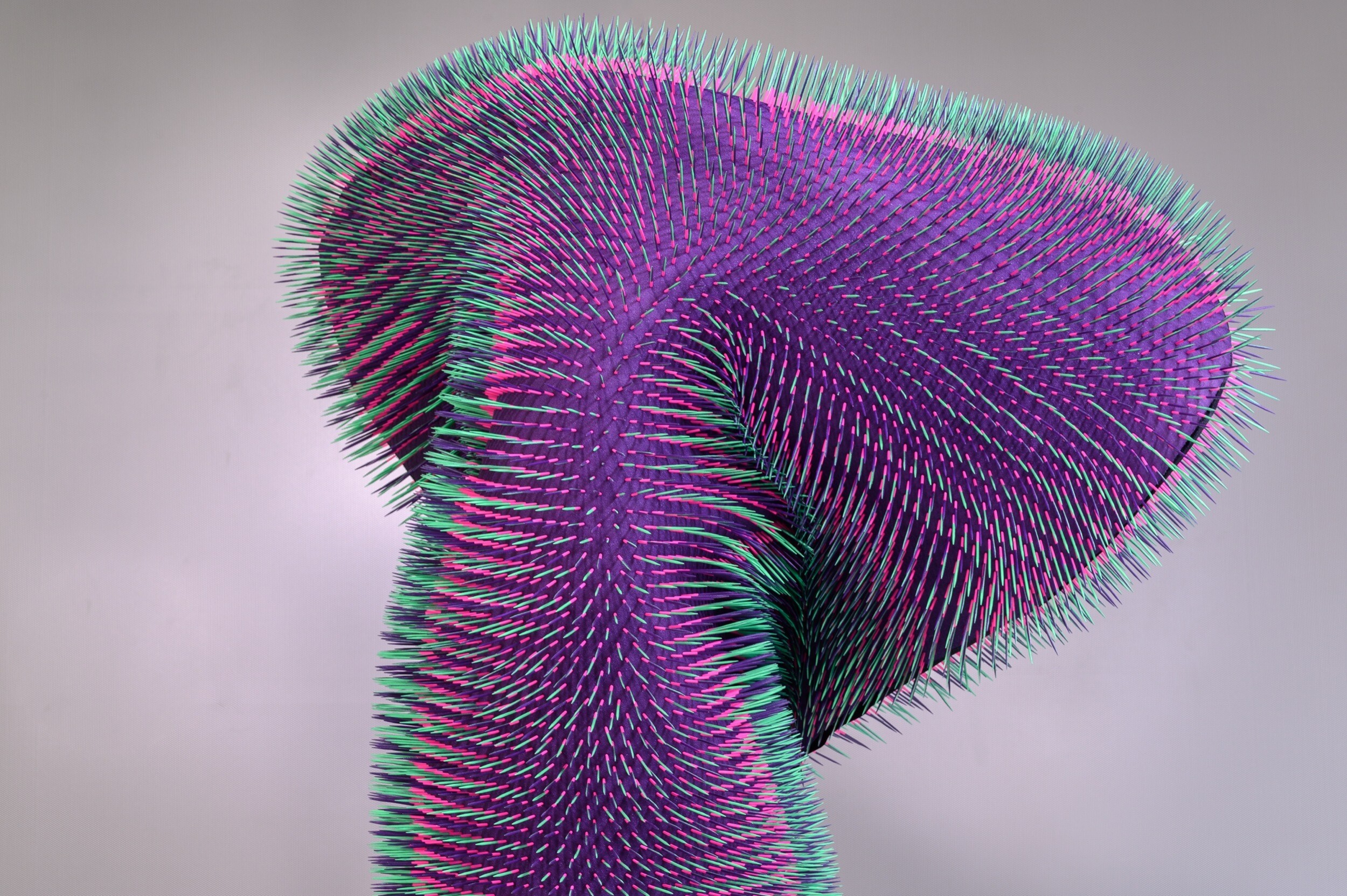
Doing Nothing with AI

Doing Nothing with AI stages the tension between technological optimization and human cognitive limits. Image: Emanuel Gollob

If AI can read signals that you don’t know you’re giving, what does it reveal about how we understand ourselves?

Smart Hans by Max Haarich uses posture recognition and AI to infer human intention through subtle bodily cues. The work echoes the historical case of a horse, “Clever Hans”, once believed to perform arithmetic by reading micro-signals but later understood to be responding to unconscious signals from people around him.

The installation raises questions about how technologies can detect patterns in human behaviour, raising important questions about self-awareness and the role of human judgement in an increasingly data-driven world.

Smart Hans

Smart Hans uses posture recognition and AI to infer human intention through subtle bodily cues. Image: Max Haarich

A mirror shows how you look, but can a machine understand how you feel?

Mirror Ritual by Nina Rajcic examines emotional perception and machine interpretation, generating AI-composed poetry based on a participant’s perceived emotional state. It expands the conversation from observable behaviour to our interior lives, reflecting how digital systems increasingly seek to understand not only what people do, but also how they feel.

Reading the poems displayed on the surface of a mirror, participants can weigh the machine’s interpretation against how they feel.

Mirror Ritual

Mirror Ritual generates AI-composed poetry based on a participant’s perceived emotional state. Image: Nina Rajcic

If environmental change can be experienced in real time, how might it shape your understanding?

Corals by Marco Barotti shifts the focus from individual cognition to planetary systems, translating real-time data on ocean conditions and coral bleaching into a kinetic display. Using AI as a tool for environmental monitoring, it makes visible the fragility of ecosystems that underpin economic stability and long-term prosperity.

While conversations about AI often focus on productivity, jobs and innovation, the installation reminds us that resilience ultimately depends on the health of the natural systems on which societies and economies depend.
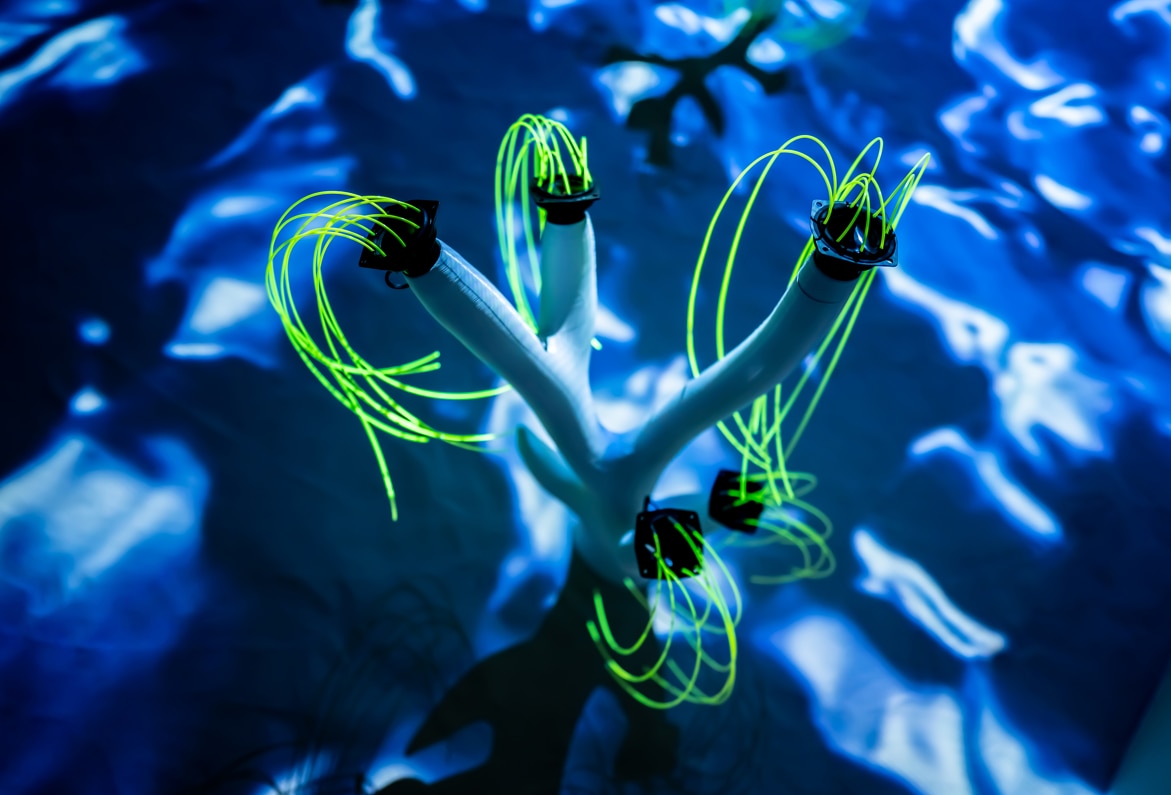
Corals

Corals translates real-time data on ocean conditions and coral bleaching into a kinetic display. Image: Marco Barotti

Taken together, these installations highlight a central reality about the future of competitiveness: it will depend on more than technological capability alone.

“The critical question is not simply what technology can do, but what human capacities we choose to cultivate alongside it now and into the future,” says Ryan Jefferies, Director, Science Gallery at the University of Melbourne.

Technology and the Human System does not offer simple answers. Instead, it frames a broader challenge facing leaders, organizations and societies alike: how to harness technological progress in ways that strengthen rather than erode the human and natural systems on which innovation ultimately depends.

Attention enables creativity. Agency enables judgement. Resilience enables adaptation. In a world increasingly shaped by intelligent machines, the greatest competitive advantage may remain profoundly human.