









Think about the 10 most valuable companies in the world. Seven of them – Nvidia, Apple, Alphabet, Microsoft, Amazon, Meta and Tesla – were once funded by venture capitalists willing to bet on an unproven idea. In the United States alone, companies that received early-stage venture backing before going public now account for 42% of total stock market value and 94% of all R&D spending by public companies founded in the last 50 years.
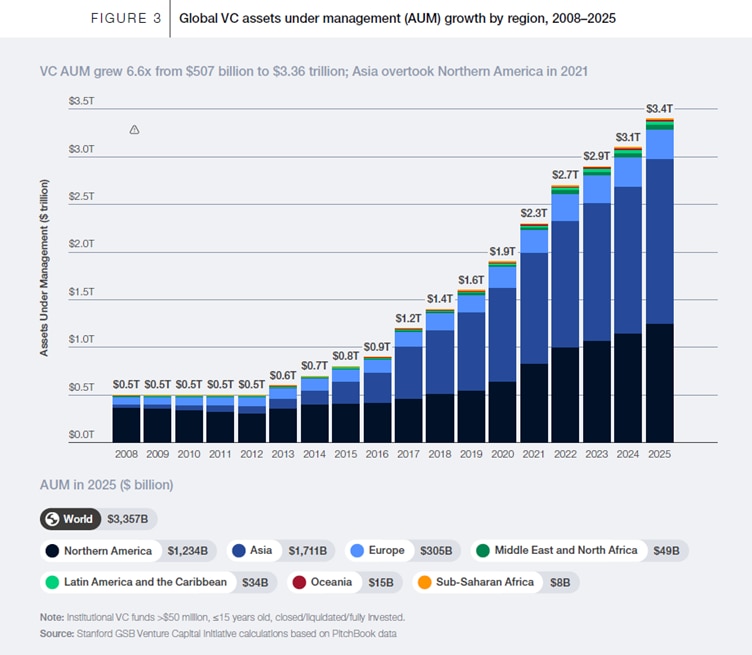
Since 2008, global venture capital assets under management have increased more than sevenfold, from $500 billion to nearly $3.5 trillion. In 2025 alone, global deal value reached an estimated $530 billion across almost 21,000 investments, with more than 250,000 companies having received venture funding worldwide over the past two decades.
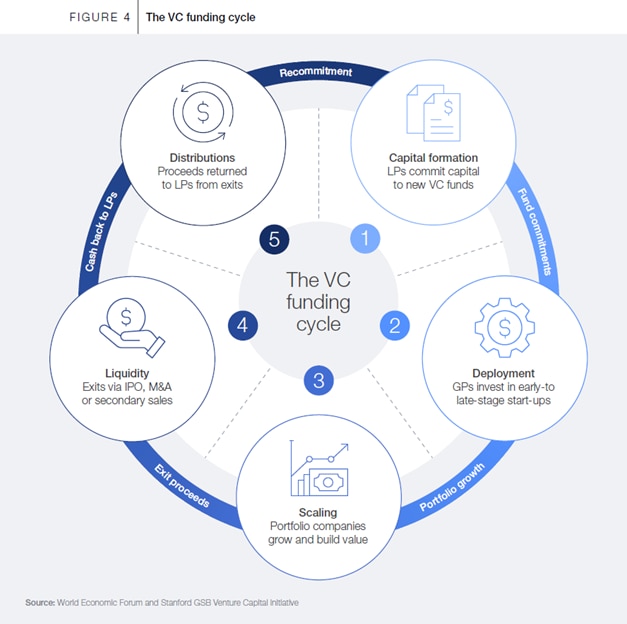
The venture model depends on a continuous cycle: investors back young companies, help them grow, and eventually sell their stakes through a public listing or acquisition.
The proceeds return to the limited partners who funded the original investments, who then recommit that capital to new funds backing the next generation of startups. That cycle is under real strain. Distributions to limited partners have fallen to historic lows, fund timelines have stretched well beyond their original horizons, and the capital that should be recycling into the next generation of startups remains locked up.
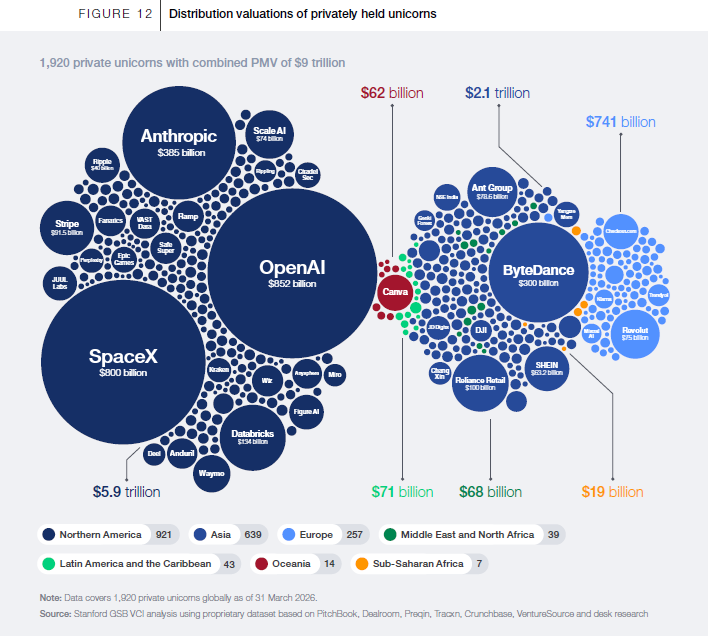
This growth has naturally concentrated where liquidity is deepest. Today, the top 20 most-traded companies account for 86.4% of secondary transaction volume. Whether secondaries can broaden beyond these top names will determine whether they become a true source of liquidity for the asset class as a whole. New regulatory frameworks, including the PISCES initiative in the UK that completed its first trade on the London Stock Exchange in March 2026, and the DEAL Act in the US, are creating the legal foundations for deeper, more accessible private markets.
Funding rounds that once would have been left to public markets are now closing privately. The boundaries between venture capital, growth equity, sovereign wealth and corporate investment are shifting, bringing more capital, more patient capital and more strategically motivated capital into the ecosystem than ever before.
A new report by the World Economic Forum and Stanford Graduate School of Business, The Future of Venture Capital: Unlocking Liquidity and Growth, identifies five priorities for coordinated action by policy-makers and institutional investors to unlock liquidity and growth across the asset class.
Improve secondary market infrastructure. Secondary markets have grown rapidly, but liquidity remains concentrated among a small number of well-known companies. Expanding technology platforms, improving price discovery through better data-sharing and pricing benchmarks, and modernizing regulation can extend liquidity benefits across the wider ecosystem of companies and investors that need them most.
Mobilize institutional capital. Unlocking even a small share of the long-term capital held by institutional investors such as pension funds and insurers would meaningfully expand the venture capital base, and doing so requires modernizing the prudential and regulatory frameworks that currently constrain these allocations across several regions. European pension funds currently allocate a mere 0.12% of their total assets under management to venture capital and growth equity; increasing this allocation to a modest 1-2% would generate transformative capital flows into innovation finance.
Reduce regulatory friction. Cross-border complexity is one of the biggest drags on founders looking to build and scale across markets, and several jurisdictions are now moving to simplify and harmonize their regulatory regimes. The EU-Inc initiative, backed by over 13,000 signatures and now a formal legislative proposal, would allow startups to incorporate once and operate across all 27 EU member states.
Strengthen talent ecosystems. The recycling of talent from successful ventures is one of the most powerful compounding forces in innovation ecosystems. Founders and early employees who exit one company frequently start or back the next, creating a flywheel of capital, expertise and networks. Competitive capital gains treatment, well-designed stock-option taxation and startup visa programmes are essential building blocks for regions seeking to grow and retain their talent base.
Enable strategic government participation. The evidence shows that well-designed public capital, whether deployed through fund-of-funds structures or sovereign vehicles, can meaningfully accelerate ecosystem development when it targets market gaps, reinforces rather than distorts efficient allocation, and is built to evolve as private markets mature. The most effective programmes act as catalysts, multiplying private commitments and stepping back as ecosystems reach self-sustaining scale.
The venture capital industry has shown what is possible when capital, talent and ambition align. But the next decade will be defined less by the industry's ability to deploy capital than by its ability to recycle it, releasing the more than $3 trillion of unrealized value locked in today's portfolios so it can fund the next wave of innovation. The economies that act on this agenda first will define where the next generation of leading companies is built, financed and scaled.
Discover
How the Forum helps leaders understand change in global financial systems
此内容由惯性聚合(RSS阅读器)自动聚合整理,仅供阅读参考。 原文来自 — 版权归原作者所有。