




Retirement planning across much of the world often converges on a similar question: Once I stop working, how much can I withdraw from my savings each year without running out of money?
Over time, this question has frequently been answered with a single number called a safe withdrawal rate. Whether expressed as a fixed percentage of initial savings or as an inflation-adjusted annual withdrawal amount, such rules have become anchors for advisers and retirees alike.
The appeal is understandable. A single rate reduces a complex, multi-decade challenge into something actionable. It offers structure in the face of uncertainty and allows retirement income decisions to be framed with clarity. For many retirees, particularly those with limited technical understanding or appetite for ongoing financial decisions, such rules provide reassurance and a sense of order.
At the same time, it's worth recognising that any withdrawal rate — often expressed as a single percentage — is built on expectations about how returns, inflation and longevity will unfold. This naturally leads to a broader consideration: How well do such rules hold up as conditions change?
To explore this, it is useful to first understand what these rules implicitly assume.
A withdrawal rate is often presented as a percentage that’s typically calculated under a particular set of economic and demographic conditions. When it's treated purely as a number, those underlying conditions can become less visible.
Any fixed withdrawal calculation also rests on expectations about returns, inflation, longevity and the timing of market movements. When actual conditions resemble those expectations, a fixed withdrawal approach can offer stability and reduce the need for frequent financial decision-making. When conditions differ, however – even moderately – outcomes may begin to evolve differently.
Retirement unfolds over several decades. During that time, returns fluctuate, inflation changes and people may live longer than anticipated. A withdrawal rate defined at the outset may not always remain aligned with how these conditions develop and may therefore benefit from periodic reassessment.
In that sense, “safety” depends not only on how conditions have behaved in the past, but also on how they unfold over time.
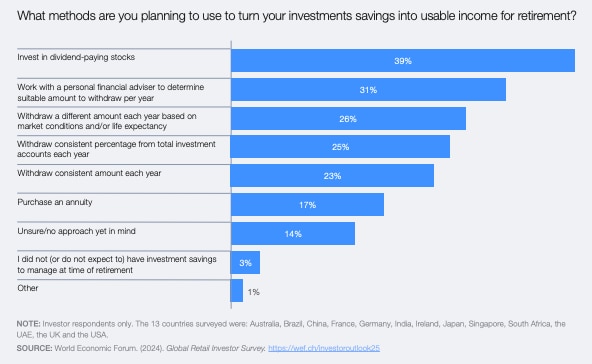
With this new view, several themes about retirement planning begin to surface.
First, sustainability can be sensitive to realised real returns — what retirees actually earn after inflation. Even modest shifts can influence long-horizon outcomes.
Second, the timing of investment returns matters. Early adverse outcomes can affect not only portfolio values, but also the flexibility available later in retirement.
Third, longevity itself can act as an amplifier. As retirement horizons extend, exposure to economic variability accumulates. A strategy that appears stable under one horizon may behave differently as that horizon lengthens.
These observations suggest that the sustainability of a fixed withdrawal rate can depend on how conditions evolve and the assumptions embedded within the withdrawal rule.
This does not diminish the practical value of such approaches. Rather, it highlights the importance of periodically reviewing whether a withdrawal strategy remains sustainable as conditions evolve over time. Choosing a rate that works well at the outset is one part of the task of retirement planning. Ensuring that it remains appropriate as circumstances develop over time is another.
The question therefore shifts from "what is the correct withdrawal rate?" to "how durable is the withdrawal framework when conditions evolve over time?". Focusing on durability retains discipline while acknowledging that fixed rules embed expectations about the future. It also acknowledges that long-horizon sustainability depends on how those expectations interact with evolving realities.
Taken together, these observations suggest that the question of whether a safe withdrawal rate exists may need to be framed differently when planning for retirement.
Over recent decades, the way people build their retirement savings has evolved, with investments spread across different assets, more structured approaches to managing portfolios and strategies that gradually reduce risk as retirement approaches.
But the way income is drawn from those savings has developed more gradually. At the same time, longevity is improving, economic conditions remain uncertain and responsibility for retirement income is increasingly shared with others. As retirement horizons extend, even modest sensitivities to outside events can build up. The durability of withdrawal frameworks becomes an increasingly important consideration.
All of this indicates that the question posed at the outset of this article – "does a safe withdrawal rate really exist?" – may not have a simple yes or no answer. “Safety” is not a fixed number, but a characteristic of how a withdrawal framework behaves over time.
As retirement horizons extend, the challenge is not only to make good retirement planning choices at the beginning, but to revisit them as conditions evolve. The focus of retirement planning, therefore, must shift from identifying a fixed rule to understanding how withdrawal strategies behave over time. Withdrawal strategies need to become more responsive, rather than remaining entirely fixed.
此内容由惯性聚合(RSS阅读器)自动聚合整理,仅供阅读参考。 原文来自 — 版权归原作者所有。