
惯性聚合 高效追踪和阅读你感兴趣的博客、新闻、科技资讯
阅读原文 在惯性聚合中打开

推荐订阅源

Google DeepMind News
S
Security Affairs
阮一峰的网络日志
阮一峰的网络日志
L
LangChain Blog
Microsoft Azure Blog
雷峰网
雷峰网
Recent Announcements
WordPress大学
WordPress大学
The GitHub Blog
The GitHub Blog
博客园_首页
The Cloudflare Blog
M
MIT News - Artificial intelligence
博客园 - 【当耐特】
MyScale Blog
MyScale Blog
S
SegmentFault 最新的问题
P
Proofpoint News Feed
Y
Y Combinator Blog
Jina AI
Jina AI
博客园 - 聂微东
A
About on SuperTechFans
Blog — PlanetScale
Blog — PlanetScale
博客园 - 司徒正美
G
Google Developers Blog
云风的 BLOG
云风的 BLOG
F
Full Disclosure
CTFtime.org: upcoming CTF events
Microsoft Security Blog
爱范儿
爱范儿
T
Tailwind CSS Blog
J
Java Code Geeks
Vercel News
Vercel News
钛媒体:引领未来商业与生活新知
钛媒体:引领未来商业与生活新知
Stack Overflow Blog
Stack Overflow Blog
罗磊的独立博客
小众软件
小众软件
酷 壳 – CoolShell
酷 壳 – CoolShell
T
The Blog of Author Tim Ferriss
cs.AI updates on arXiv.org
博客园 - 三生石上(FineUI控件)
W
WeLiveSecurity
PCI Perspectives
PCI Perspectives
Attack and Defense Labs
Exploit-DB.com RSS Feed
cs.CV updates on arXiv.org
宝玉的分享
宝玉的分享
IT之家
IT之家
Hacker News: Ask HN
Hacker News: Ask HN
The Register - Security
T
The Exploit Database - CXSecurity.com
T
Threat Research - Cisco Blogs

World Economic Forum

What happened at the MC14 WTO meeting in Yaoundé How giving gorillas digital wallets can help finance nature Why is leadership a strategic investment for philanthropy? Counting the many costs of the global mental health burden What we learned from the 2026 World Bank Spring Meetings Crop protection is at risk. How innovation can help Here's a playbook for boards on how to govern agentic AI Why connected data makes AI decision-ready for sustainability 3 ways better data practices are reshaping financial supervision What technology convergence looks like in practice 7 reasons the old order broke — and how it might be repaired How governments can make agentic AI re  ? Current and future uses of RNA, including mRNA vaccines Real-time deepfakes are rewriting the rules of child safety Electrification trend ‘unmistakeable’ – and more energy stories From smallpox to the common cold: A brief history of vaccines Saudi Arabia's new AI-powered sustainability platform could unlock $20 billion by 2030 Here are 6 ways that climate change is affecting sports around the world This crisis could be an opportunity for the energy transition Middle East war: 6 ways countries are responding to the historic energy shock Nature can teach us about leadership and building resilience How did the Strait of Hormuz become so important, and will it stay that way? Yes/Cities: Helping global cities become more resilient, sustainable and prosperous Healthy ageing in APAC: The role of the influenza vaccine Risk management, renewables and a rocky road ahead: Spring Meetings takeaways Japan in a world of rising middle powers EU plans to offset Iran war's energy impact, and other climate and nature news 3 cities leading on green investment for economic growth The coffee industry is making the case for climate insurance The ocean is now a subprime asset, so we need a sustainable blue economy 5 leaders on today’s growth dilemmas and how to navigate them What helps purpose-driven, early-stage start-ups scale? Why trust is key to the EU's Empowering Consumers Directive The $3 trillion maintenance gap is burning money and the planet Surging AI needs and geopolitical supply shocks renew attention on nuclear energy 5 things to know before interacting with digital assets Frontiers Planet Prize: 25 solutions for planetary crises How the Iran war is disrupting India's steel production What's needed for growth in the new economy? Why we need a humanitarian truce is Sudan Freedom of expression under attack: How do we protect the media? Why companies – and nations – should create an AI culture Anthropic’s Mythos moment: how frontier AI is redefining cybersecurity Discover this week's must-read finance stories 'Godfather of AI' Yoshua Bengio on why AI can behave unpredictably (and what needs to change) Everyone talks about critical thinking. Here's how schools should actually teach it The top international trade stories to know this month The big chart: How oil prices have reacted to world events since the 1980s Why AI needs digital public infrastructure to deliver for citizens What AI in education needs next: Lessons from youth leaders across five countries How to scale clean hydrogen to meet energy security needs Meet the Young Global Leaders Class of 2026 Ventures with blue carbon solutions for coastal restoration How peer-led reskilling is helping bridge the skills gap in East Africa China's lessons on the energy sector’s nature-positive transition Here's how Japan's green materials sector is thriving The Strait of Hormuz crisis: Rewriting the future of AI Systemic risk is the hidden tax on growth. Here's how insurance can help build economic resilience Earth Day: What is it, when is it and why is it important? The Rayner plot: What it tells us about the future of jobs This is why we’ll feel the economic effects of this war for a while How energy and finance leaders are approaching climate investment in 2026 How quantum technologies are being tested to strengthen energy systems How to think about ‘safe’ withdrawal rates in a changing global economy Is collective cyber defence the future of port security? Learnings from a Dutch initiative Cyberattacks target US infrastructure, and other cybersecurity news Rethinking workplace energy: Why our assumptions can lead to burnout What could an international panel to tackle inequality achieve? Why climate action matters for healthy longevity Workforce health is the bedrock of global supply chains. Here's how to protect it 5 ways to grow a business mindset in international development How companies can finally cut Scope 3 emissions Here's how to get the $7 trillion AI hardware buildout right Leaders are moving from systems of record to systems of work G7 One Health Summit launches global diagnostics initiative, and other health stories What stopping war-risk insurance in the Strait of Hormuz tells us Why leaders must transform cyber resilience measurement AI can help create comparability and scale impact investing What's in store for the future of multilateralism? Why food waste is a $540 billion opportunity hiding in plain sight What Afghanistan can teach us about strategic foresight This is how we use generative AI on Forum Stories How cities are turning urban complexity into coherent climate plans How non-profits and governments use data to drive real system change How demographics, not AI, will redefine the labour market Three lessons on the energy transition in an age of crisis NFL players: Why financial literacy is a game-changer for student-athletes 3 ways Africa can maximize the value of its critical minerals and finance its future What leaders are saying about the new geopolitics of energy The financial system is rebooting. Stakeholders must adapt Cancer care innovation is reshaping resilience in Japan The hidden struggle of employed youth in Africa How markets and missions are becoming allies for impact What’s changing in frontier tech – from geopolitics to AI and energy Why stablecoins are quickly becoming a geopolitical issue How public-private collaboration can help close the global gender gap It’s time to start treating AI infrastructure as critical infrastructure 5 effective choices to turn workplace well-being into a competitive advantage How to strengthen collaboration to tackle infectious disease Why the AI economy can’t rely on a single digital Suez
Southeast Asia may be a distinct region but its risks affect each country differently
2026-04-13 · via World Economic Forum
  • Economic pressure, geopolitical rivalry and technological disruption are affecting the region unevenly, reflecting big differences in economic structure, fiscal space and demographic trends.
  • Tariffs, supply chain shifts and competing global partnerships are forcing Southeast Asian economies to balance short-term stability with long-term strategic autonomy.
  • While governments and firms are investing in AI infrastructure, uneven adoption, energy constraints and workforce disruption could leave smaller firms and vulnerable workers behind.

Imagine 10 very different houses on the same street – some new, some old, some developing while others are becoming unstable; the same neighbourhood but very different grievances.

That’s very much the narrative for Southeast Asia.

The region spans 10 economies, from Singapore, one of the world's wealthiest, to Myanmar, one of its poorest, with their gross domestic product per capita differing by around $98,000. Yet, in conversations about trade, investment and risk, “Southeast Asia” is often treated as a single place with a single story.

This shortcut misses much about the region and according to the World Economic Forum’s Executive Opinion Survey, capturing how business leaders perceive the risks around them, the divergence is clear.

There is growth but it’s not reaching everyone

Economic growth is a case in point. In the survey, the top three perceived risks in the region are economic downturn, lack of jobs or economic opportunity and inflation, reflecting a shared anxiety about how individuals will experience growth. The signs of stress are already visible.
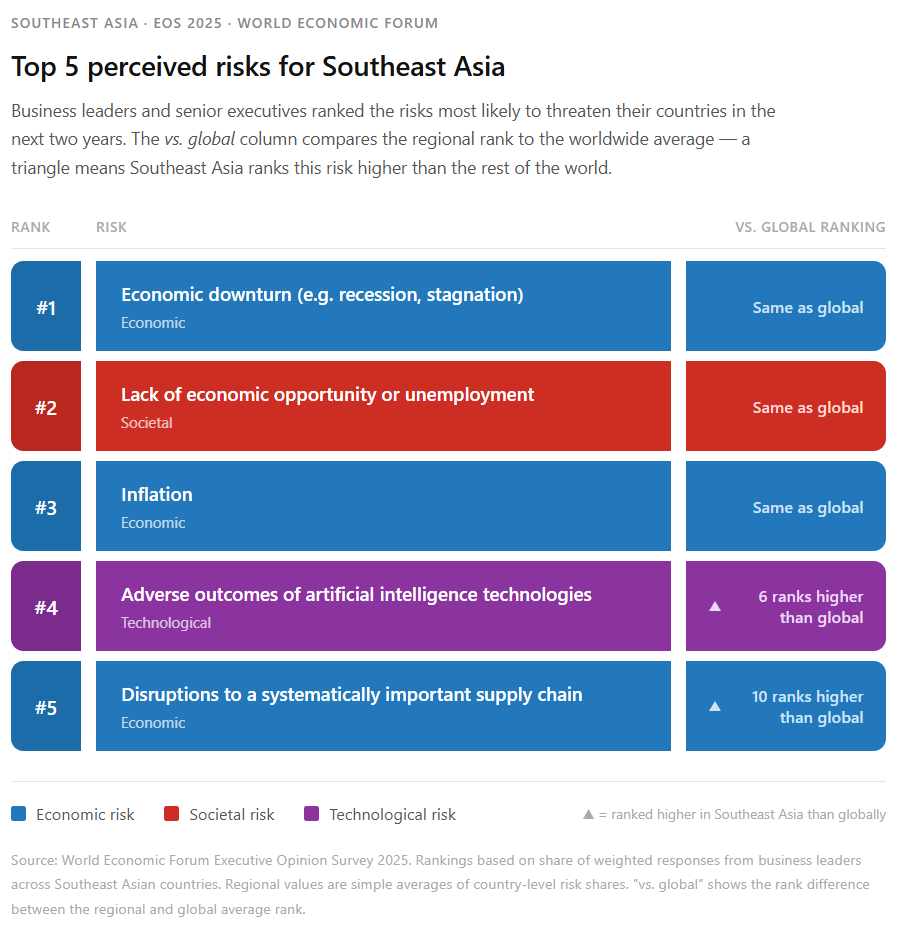
Top 5 perceived risks for Southeast Asia

Image: World Economic Forum

In Thailand, growth forecasts have been revised downward due to trade uncertainty and high household debt. Meanwhile, Brunei is still trying to reduce its reliance on oil and gas, and Lao PDR faces serious debt pressures that limit room to manoeuvre.

Meanwhile, ageing demographics in Malaysia and Viet Nam are outpacing economic development, a challenge requiring different investments in productivity and skills.

Even in Singapore, cost-of-living pressures dominate policy conversations, with households feeling squeezed despite the country’s wealth.

The three top risks reflect something structural: economies are growing on paper but have not yet conquered stable inflation management, good jobs and targeted support for the most vulnerable – factors that turn GDP into genuine security.

Isolating economic downturn, unemployment and inflation as individual policies means missing the connective tissue between them.

When superpowers compete, smaller economies feel squeezed

Southeast Asian economies also find themselves at the sharp end of a more global rivalry. As shown by the survey, respondents ranked geoeconomic confrontation – including tariffs, sanctions and investment restrictions – eighth regionally, compared to 14th globally.

That six-position gap signals that leaders in Southeast Asia perceive their operating environment as significantly more geopolitically exposed.

The numbers demonstrate why.

However, as most Association of Southeast Asian Nations (ASEAN) economies trade more with China than with the United States, cutting ties was a non-starter. To navigate this new conundrum, Malaysia convened a special summit with ASEAN, the Gulf states and China, during which Indonesia secured a lower tariff rate for key commodity exports during the 90-day tariff pause.

Vietnam and the European Union also deepened their economic partnership, an already burgeoning relationship that accelerated during this period.

Overnight, Cambodia, Malaysia and Indonesia, which had already signed bilateral agreements accepting 19% tariffs, found themselves in legal limbo as the US administration moved to reconstitute the tariffs under different legal authority, reintroducing uncertainty.

Beyond a single tariff rate, the deeper issue is that pressured trade arrangements for short-term stability can entail long-term obligations that erode a country’s negotiating leverage.

In addition, supply chain decisions made by multinationals today will need to withstand a geopolitical environment that has already proven capable of reversing direction overnight.

AI boom in the region brings opportunity (and widening fault lines)

Southeast Asian executives rank the risks from artificial intelligence (AI) adversely at fourth regionally, compared to 10th globally. There is also relatively higher concern about online harms and the risks posed by frontier technologies more broadly.

Investment in AI-enabled growth is underway across the region. For example, Microsoft announced major cloud and AI investment programmes in Indonesia and Malaysia.

Qualcomm opened an AI research and development centre in Viet Nam. Singapore’s Green Data Centre Roadmap treats computing capacity as strategic national infrastructure, just as earlier generations treated highways or ports.
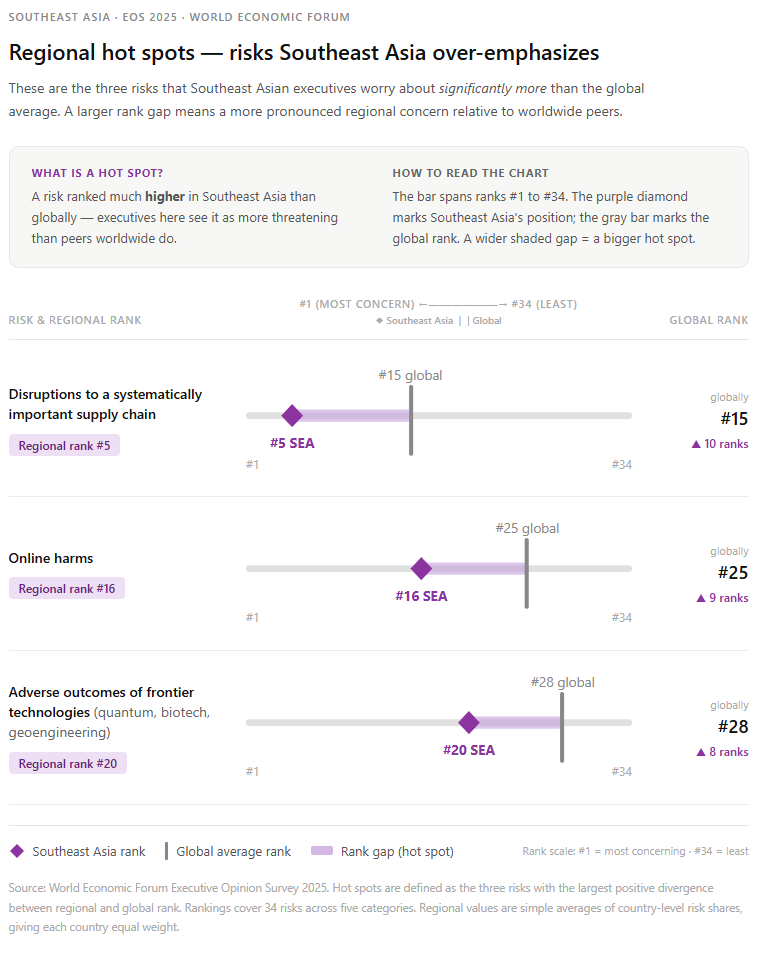
Regional hot spots – risks over-emphasised by Southeast Asia

Image: World Economic Forum

As a result, Malaysia alone could see its data centre emissions rise sevenfold by 2030, while the Philippines faces a potential 14-fold increase and Indonesia a fourfold increase. Malaysian authorities rejected nearly 30% of data centre proposals in early 2025 for failing to demonstrate responsible energy use.

The benefits of AI use are also not evenly spread. Nearly 46% of regional firms have begun scaling AI but among small and medium-sized enterprises (SMEs), which employ the majority of the region’s workers, AI adoption stands at around 15%, even in Singapore, the region's most digitally advanced economy.

If large companies capture most of the productivity gains while workers across the labour market face job losses, AI could increase inequality, especially when unemployment ranks second among perceived risks in the survey.

Around 164 million workers in the region could be affected by AI, with women and younger workers disproportionately impacted. The Philippines’ AI Roadmap 2.0 explicitly frames AI adoption around its large outsourcing and services sector, given the high and visible stakes for employment transitions.

While these are all important steps, they work best in coordination: when energy and digital strategies are addressed as the same policy question and when governance frameworks are built across borders.

The risks are all arriving at once

Southeast Asia’s challenge is not that it faces many risks but that these risks now converge and reinforce one another.

Vijay Eswaran, Executive Chairman, QI Group

None of the mentioned risks is operating in silos.

Geoeconomic competition shapes who can afford to build AI capacity, risking a widening technology gap between the region’s richer and poorer economies.

Supply chain restructuring is accelerating the digitalization of manufacturing, creating new cybersecurity and governance exposures where regulation has yet to reach.

Inflation and unemployment pressures are themselves partly a product of external trade shocks.

“Southeast Asia’s challenge is not that it faces many risks but that these risks now converge and reinforce one another,” said Vijay Eswaran, the executive chairman at QI Group.

“Economic pressure, geoeconomic fragmentation and technological disruption are testing the region’s resilience at the same time. The response must therefore be more integrated, more adaptive and grounded in long-term values rather than short-term reaction.”

The domestic context adds its own pressures as governments manage electoral cycles, leadership transitions and contested policy directions, precisely when the multi-domain risk environment demands the most sustained attention.

In economies where fiscal space is also narrowing, including Thailand, the ability to absorb external shocks without domestic political costs is further reduced.

ASEAN’s consensus-based model of cooperation has historically been well-suited to slow-moving, long-horizon challenges. The current risk environment is neither slow-moving nor neatly contained within single policy domains.

Closing that gap requires deliberate action from multiple actors simultaneously: governments investing in connecting policy and the private sector, particularly multinationals, reshaping the region’s supply chains and digital infrastructure, proactively building shared standards, capacity and platforms.

No single government can build that architecture alone; together, they must act before the risk environment outpaces their ability to act.

Additional insights and contributions by Grace Atkinson, Mark Elsner and Joo-Ok Lee.