


惯性聚合 高效追踪和阅读你感兴趣的博客、新闻、科技资讯
阅读原文 在惯性聚合中打开

推荐订阅源

WordPress大学
WordPress大学
让小产品的独立变现更简单 - ezindie.com
博客园 - 三生石上(FineUI控件)
雷峰网
雷峰网
爱范儿
爱范儿
P
Proofpoint News Feed
Security Archives - TechRepublic
Latest news
Latest news
The Hacker News
The Hacker News
Cyberwarzone
Cyberwarzone
博客园 - 【当耐特】
Project Zero
Project Zero
小众软件
小众软件
T
Tailwind CSS Blog
量子位
博客园 - 聂微东
I
Intezer
美团技术团队
S
SegmentFault 最新的问题
T
Tor Project blog
Spread Privacy
Spread Privacy
V
Vulnerabilities – Threatpost
Exploit-DB.com RSS Feed
Jina AI
Jina AI
罗磊的独立博客
B
Blog RSS Feed
K
KPMG report finds enterprise disconnect between AI and its ROI | CIO
T
Troy Hunt's Blog
有赞技术团队
有赞技术团队
Google DeepMind News
宝玉的分享
宝玉的分享
C
Cisco Blogs
L
LINUX DO - 热门话题
Last Week in AI
Last Week in AI
cs.AI updates on arXiv.org
AI
AI
钛媒体:引领未来商业与生活新知
钛媒体:引领未来商业与生活新知
Microsoft Azure Blog
L
LINUX DO - 最新话题
Know Your Adversary
Know Your Adversary
GbyAI
GbyAI
Engineering at Meta
Engineering at Meta
freeCodeCamp Programming Tutorials: Python, JavaScript, Git & More
Recent Commits to openclaw:main
L
Lohrmann on Cybersecurity
The Register - Security
L
LangChain Blog
博客园 - 叶小钗
T
Tenable Blog
Cyber Security Advisories - MS-ISAC

World Economic Forum

What happened at the MC14 WTO meeting in Yaoundé How giving gorillas digital wallets can help finance nature Why is leadership a strategic investment for philanthropy? Counting the many costs of the global mental health burden What we learned from the 2026 World Bank Spring Meetings Crop protection is at risk. How innovation can help Here's a playbook for boards on how to govern agentic AI Why connected data makes AI decision-ready for sustainability 3 ways better data practices are reshaping financial supervision What technology convergence looks like in practice 7 reasons the old order broke — and how it might be repaired How governments can make agentic AI re  ? Current and future uses of RNA, including mRNA vaccines Real-time deepfakes are rewriting the rules of child safety Electrification trend ‘unmistakeable’ – and more energy stories From smallpox to the common cold: A brief history of vaccines Saudi Arabia's new AI-powered sustainability platform could unlock $20 billion by 2030 Here are 6 ways that climate change is affecting sports around the world This crisis could be an opportunity for the energy transition Middle East war: 6 ways countries are responding to the historic energy shock Nature can teach us about leadership and building resilience How did the Strait of Hormuz become so important, and will it stay that way? Yes/Cities: Helping global cities become more resilient, sustainable and prosperous Healthy ageing in APAC: The role of the influenza vaccine Risk management, renewables and a rocky road ahead: Spring Meetings takeaways Japan in a world of rising middle powers EU plans to offset Iran war's energy impact, and other climate and nature news 3 cities leading on green investment for economic growth The coffee industry is making the case for climate insurance The ocean is now a subprime asset, so we need a sustainable blue economy What helps purpose-driven, early-stage start-ups scale? Why trust is key to the EU's Empowering Consumers Directive The $3 trillion maintenance gap is burning money and the planet Surging AI needs and geopolitical supply shocks renew attention on nuclear energy 5 things to know before interacting with digital assets Frontiers Planet Prize: 25 solutions for planetary crises How the Iran war is disrupting India's steel production What's needed for growth in the new economy? Why we need a humanitarian truce is Sudan Freedom of expression under attack: How do we protect the media? Why companies – and nations – should create an AI culture Anthropic’s Mythos moment: how frontier AI is redefining cybersecurity Discover this week's must-read finance stories 'Godfather of AI' Yoshua Bengio on why AI can behave unpredictably (and what needs to change) Everyone talks about critical thinking. Here's how schools should actually teach it The top international trade stories to know this month The big chart: How oil prices have reacted to world events since the 1980s Why AI needs digital public infrastructure to deliver for citizens What AI in education needs next: Lessons from youth leaders across five countries How to scale clean hydrogen to meet energy security needs Meet the Young Global Leaders Class of 2026 Ventures with blue carbon solutions for coastal restoration How peer-led reskilling is helping bridge the skills gap in East Africa China's lessons on the energy sector’s nature-positive transition Here's how Japan's green materials sector is thriving The Strait of Hormuz crisis: Rewriting the future of AI Systemic risk is the hidden tax on growth. Here's how insurance can help build economic resilience Earth Day: What is it, when is it and why is it important? The Rayner plot: What it tells us about the future of jobs This is why we’ll feel the economic effects of this war for a while How energy and finance leaders are approaching climate investment in 2026 How quantum technologies are being tested to strengthen energy systems How to think about ‘safe’ withdrawal rates in a changing global economy Is collective cyber defence the future of port security? Learnings from a Dutch initiative Cyberattacks target US infrastructure, and other cybersecurity news Rethinking workplace energy: Why our assumptions can lead to burnout What could an international panel to tackle inequality achieve? Why climate action matters for healthy longevity Workforce health is the bedrock of global supply chains. Here's how to protect it Southeast Asia may be a distinct region but its risks affect each country differently 5 ways to grow a business mindset in international development How companies can finally cut Scope 3 emissions Here's how to get the $7 trillion AI hardware buildout right Leaders are moving from systems of record to systems of work G7 One Health Summit launches global diagnostics initiative, and other health stories What stopping war-risk insurance in the Strait of Hormuz tells us Why leaders must transform cyber resilience measurement AI can help create comparability and scale impact investing What's in store for the future of multilateralism? Why food waste is a $540 billion opportunity hiding in plain sight What Afghanistan can teach us about strategic foresight This is how we use generative AI on Forum Stories How cities are turning urban complexity into coherent climate plans How non-profits and governments use data to drive real system change How demographics, not AI, will redefine the labour market Three lessons on the energy transition in an age of crisis NFL players: Why financial literacy is a game-changer for student-athletes 3 ways Africa can maximize the value of its critical minerals and finance its future What leaders are saying about the new geopolitics of energy The financial system is rebooting. Stakeholders must adapt Cancer care innovation is reshaping resilience in Japan The hidden struggle of employed youth in Africa How markets and missions are becoming allies for impact What’s changing in frontier tech – from geopolitics to AI and energy Why stablecoins are quickly becoming a geopolitical issue How public-private collaboration can help close the global gender gap It’s time to start treating AI infrastructure as critical infrastructure 5 effective choices to turn workplace well-being into a competitive advantage How to strengthen collaboration to tackle infectious disease Why the AI economy can’t rely on a single digital Suez
5 leaders on today’s growth dilemmas and how to navigate them
Attilio Di B · 2026-04-22 · via World Economic Forum
  • A convergence of deep structural transformations is shaping the contours of the new economy.
  • The World Economic Forum’s recently published report Growth in the New Economy: Towards a Blueprint presents a set of ‘no-regret’ moves and dilemmas that are shaping growth strategies.
  • We asked five leaders to share how governments and businesses are navigating today’s most pressing growth dilemmas.

The global economic outlook is deteriorating, amid commodity and energy shocks and renewed prospects of sustained geoeconomic fragmentation.

At the same time, a series of long-term transformations, from rapid advances in AI and intensifying geostrategic competition to record debt levels and demographic shifts, are reshaping growth prospects in the new economy. Growing social polarization and the risk of deepening inequalities are further complicating this landscape, alongside shifting social and environmental priorities.

Together, these forces present a new set of interconnected growth dilemmas. Drawing on two years of dialogue and views from over 11,000 business leaders globally, the Forum’s report Growth in the New Economy: Towards a Blueprint distils key dilemmas and “no-regret” moves shaping growth strategies. Leaders must balance short-term resilience with long-term transformation, while ensuring that growth in the new economy creates opportunities for all.
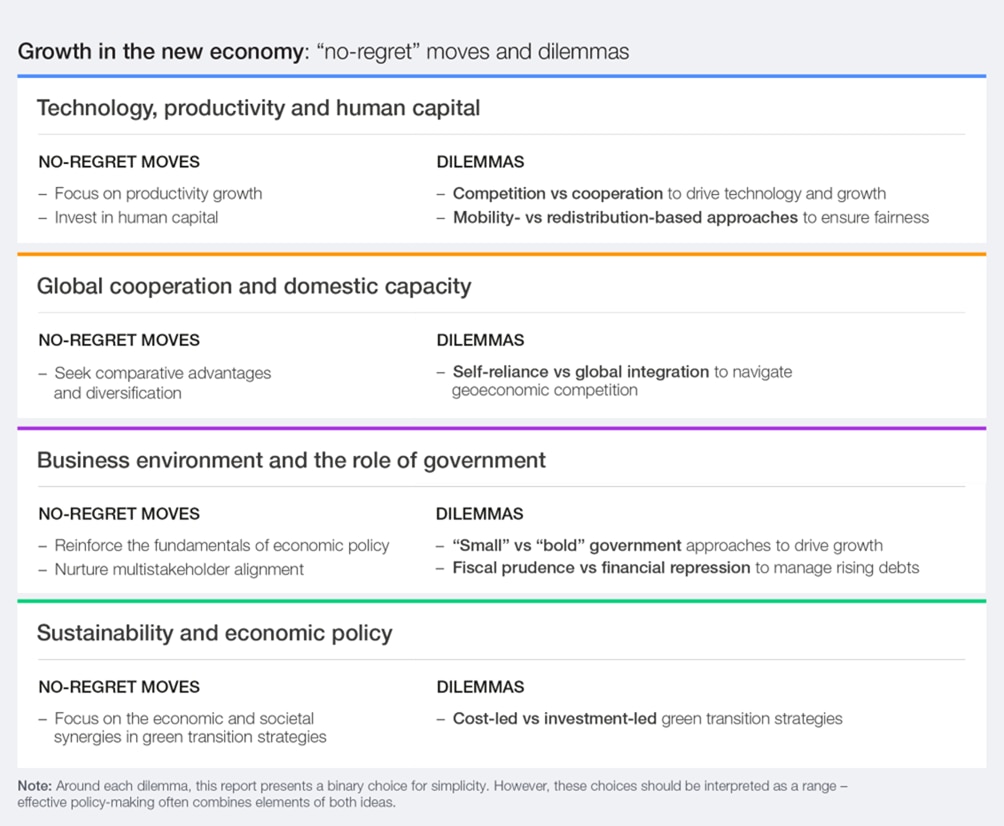
Image: World Economic Forum

We asked a select group of leaders what they see as the most pressing dilemmas today, and how governments and businesses are responding.

Gillian Tett, Provost at Kings College, Cambridge, and columnist and editorial board member at the Financial Times

“There are essentially four interrelated problems: a major tech revolution that is occurring at extraordinary speed with very uncertain consequences, for good and bad; steady climate degradation which is fuelling migration and conflict; soaring global debt without any obvious exit strategy since growth in most mature, debt-laden countries is very weak; and profound geopolitical dislocation as the post-World War Two structures break down but new ones have yet to emerge. To put it bluntly, while (possibly erroneously) quoting the philosopher Antonio Gramsci: “The old world is dying and the new world struggles to be born; now is the time of monsters.”

“So how should business and government leaders respond? Firstly by recognizing that the post-war assumptions that shaped their careers about the value of globalization and capitalism and international collaboration are no longer dominant. Second, we need to recognize that we are in an era of geoeconomics where economic policymaking is increasingly a tool of power politics, not the other way round. Third, middle countries, particularly those of a liberal bent, need to forge alliances with like-minded countries. Fourth, countries and companies need to hedge their bets by building as much resilience as possible into their supply chains and diversifying markets, if they can.

“Fifth, we all need to remember that history moves through pendulum swings (to cite another great thinker, this time Friedrich Hegel), so this current era of geoeconomics will not last forever. Geopolitical monsters are afoot, but tech innovation is equally important now. Let us hope the latter overwhelms the former, for good - not bad.”

Badr Jafar, CEO of Crescent Enterprises

“The central dilemma facing governments and businesses today is maintaining economic growth while building resilience against mounting geopolitical and supply chain risks. The traditional trade-off between openness and security has become acute.

“The UAE has navigated this by pursuing strategic diversification. Rather than fragmentation, we've deepened partnerships with committed allies while expanding alternative pathways. Our 35 Comprehensive Economic Partnership Agreements exemplify this approach – broadening our economic base without compromising core relationships.

“Recent regional tensions tested this model. The UAE maintains strong fundamentals in terms of non-oil GDP and foreign investment flows, and our AA credit rating has held firm. This resilience reflects deliberate infrastructure investments – from alternative trade corridors to expanded maritime capabilities.

“The key insight is moving beyond binary choices. Successful economies aren't choosing between global integration and national security – they're building systems that strengthen through stress rather than weaken through exposure.

“For businesses, this means diversifying partnerships and supply chains strategically, not frantically. For governments, it requires investing in adaptive infrastructure that serves both growth and resilience objectives. The future belongs to economies that can remain open while staying strong.”

Mahmoud Mohieldin, Special Envoy on Financing the 2030 Agenda for Sustainable Development, United Nations

“The central dilemma today is not simply how to generate growth, but how to finance sustainable and inclusive growth under tightening global financial conditions.

For many developing countries, the most binding constraint is debt. Rising interest rates and limited access to affordable finance mean that governments are increasingly forced to choose between servicing debt and investing in development priorities—including climate action, infrastructure, and human capital. This is neither sustainable nor equitable.

A second dilemma is the tension between short-term stabilization and long-term transformation. Policymakers and businesses must respond to immediate shocks, while still investing in green and digital transitions that underpin future competitiveness.

Third, there is a growing mismatch between global ambition and national capacity, particularly as countries are expected to deliver on development and climate goals despite constrained fiscal space.

What is needed now is decisive action. We must implement, without delay, the 11 recommendations of the UN Expert Group on Debt, including faster and fairer restructuring, expanded concessional finance, and debt-for-climate instruments. Equally important is the operationalization of a Borrowers’ Club to strengthen coordination and voice for developing countries.

The priority is clear: restore fiscal space and unlock investment for sustainable growth in the Global South.”

Cláudia Azevedo, CEO of Sonae

“In a context marked by uncertainty and instability, resilience has become the defining condition for sustainable growth. Businesses must remain competitive while navigating rapid technological disruption and geopolitical volatility, while staying prepared to respond quickly to sudden shifts.

“In this environment, resilience is not only built through strategy and technology, but through people. As roles evolve and new capabilities emerge, investing in reskilling and upskilling becomes critical. Future-proofing talent enables organizations to adapt, innovate and respond to uncertainty with confidence.

“Yet this effort cannot be confined to organizations alone. Building resilient economies requires a broader, collective commitment to equipping people with the skills to thrive in a changing world. In Portugal, initiatives such as PRO_MOV and the New Career Network illustrate how cross-sector collaboration can support reskilling, enable career transitions and expand access to opportunities in the new economy.

“This points to a broader reality: long-term sustainable growth will depend on our collective ability to invest in people and create more inclusive pathways to opportunity.

“Ultimately, growth will favour those who build resilience at every level; in their strategies, their energy choices and, above all, their people. Because the greatest risk today is not disruption, it is standing still.”

Simon Freakley, Executive Chair, AlixPartners

“Governments and businesses are wrestling with twin dilemmas: how to deliver growth in an era when disruption has become the norm, and how to do so while political, technological, and energy constraints are increasingly outside their direct control. Geopolitics, fiscal constraints, technological change, and energy resilience are no longer background conditions; they are now the main factors affecting competitiveness, investment, and social cohesion.

“AI presents an additional layer to this challenge. Governments and businesses want productivity, growth, and innovation. Workers fear dislocation and inequality. Balancing rapid AI deployment and productivity gains with thoughtful reskilling, safety nets, and new job creation is now central to maintaining both economic momentum and social license.

“In professional services, disruption is the context of nearly every client conversation. We see the best companies – across sectors – treating disruption as a catalyst to rethink business models, rebalance global footprints, and hard‑wire continuous adaptation into operations, organizational design, and customer relationships. They are accelerating AI adoption while redesigning work, investing in cost efficiencies, and shifting from ‘just in time’ to ‘just in case’ to turn volatility in trade, technology, and policy into a source of enduring competitive advantage.”

Find out more about the World Economic Forum's Future of Growth initiative here.