


惯性聚合 高效追踪和阅读你感兴趣的博客、新闻、科技资讯
阅读原文 在惯性聚合中打开

推荐订阅源

W
WeLiveSecurity
博客园 - 【当耐特】
Microsoft Azure Blog
WordPress大学
WordPress大学
Stack Overflow Blog
Stack Overflow Blog
cs.AI updates on arXiv.org
IT之家
IT之家
Cloudbric
Cloudbric
The Register - Security
小众软件
小众软件
PCI Perspectives
PCI Perspectives
G
Google Developers Blog
AI
AI
OSCHINA 社区最新新闻
OSCHINA 社区最新新闻
Google DeepMind News
宝玉的分享
宝玉的分享
Recent Commits to openclaw:main
量子位
TaoSecurity Blog
TaoSecurity Blog
cs.CV updates on arXiv.org
F
Full Disclosure
N
Netflix TechBlog - Medium
博客园_首页
Last Week in AI
Last Week in AI
A
Arctic Wolf
B
Blog RSS Feed
J
Java Code Geeks
C
Cybersecurity and Infrastructure Security Agency CISA
I
InfoQ
aimingoo的专栏
aimingoo的专栏
云风的 BLOG
云风的 BLOG
NISL@THU
NISL@THU
MyScale Blog
MyScale Blog
H
Hackread – Cybersecurity News, Data Breaches, AI and More
Jina AI
Jina AI
有赞技术团队
有赞技术团队
S
Schneier on Security
L
Lohrmann on Cybersecurity
P
Privacy & Cybersecurity Law Blog
T
Threat Research - Cisco Blogs
P
Palo Alto Networks Blog
S
Security @ Cisco Blogs
Security Archives - TechRepublic
Security Latest
Security Latest
Vercel News
Vercel News
博客园 - 司徒正美
Webroot Blog
Webroot Blog
Hacker News: Ask HN
Hacker News: Ask HN
A
About on SuperTechFans

World Economic Forum

What happened at the MC14 WTO meeting in Yaoundé How giving gorillas digital wallets can help finance nature Why is leadership a strategic investment for philanthropy? Counting the many costs of the global mental health burden What we learned from the 2026 World Bank Spring Meetings Crop protection is at risk. How innovation can help Here's a playbook for boards on how to govern agentic AI Why connected data makes AI decision-ready for sustainability 3 ways better data practices are reshaping financial supervision What technology convergence looks like in practice 7 reasons the old order broke — and how it might be repaired How governments can make agentic AI re  ? Current and future uses of RNA, including mRNA vaccines Real-time deepfakes are rewriting the rules of child safety Electrification trend ‘unmistakeable’ – and more energy stories From smallpox to the common cold: A brief history of vaccines Saudi Arabia's new AI-powered sustainability platform could unlock $20 billion by 2030 Here are 6 ways that climate change is affecting sports around the world This crisis could be an opportunity for the energy transition Middle East war: 6 ways countries are responding to the historic energy shock Nature can teach us about leadership and building resilience How did the Strait of Hormuz become so important, and will it stay that way? Yes/Cities: Helping global cities become more resilient, sustainable and prosperous Healthy ageing in APAC: The role of the influenza vaccine Risk management, renewables and a rocky road ahead: Spring Meetings takeaways Japan in a world of rising middle powers EU plans to offset Iran war's energy impact, and other climate and nature news 3 cities leading on green investment for economic growth The coffee industry is making the case for climate insurance The ocean is now a subprime asset, so we need a sustainable blue economy 5 leaders on today’s growth dilemmas and how to navigate them What helps purpose-driven, early-stage start-ups scale? Why trust is key to the EU's Empowering Consumers Directive The $3 trillion maintenance gap is burning money and the planet Surging AI needs and geopolitical supply shocks renew attention on nuclear energy 5 things to know before interacting with digital assets Frontiers Planet Prize: 25 solutions for planetary crises How the Iran war is disrupting India's steel production What's needed for growth in the new economy? Why we need a humanitarian truce is Sudan Freedom of expression under attack: How do we protect the media? Why companies – and nations – should create an AI culture Anthropic’s Mythos moment: how frontier AI is redefining cybersecurity Discover this week's must-read finance stories 'Godfather of AI' Yoshua Bengio on why AI can behave unpredictably (and what needs to change) Everyone talks about critical thinking. Here's how schools should actually teach it The top international trade stories to know this month The big chart: How oil prices have reacted to world events since the 1980s Why AI needs digital public infrastructure to deliver for citizens What AI in education needs next: Lessons from youth leaders across five countries How to scale clean hydrogen to meet energy security needs Meet the Young Global Leaders Class of 2026 Ventures with blue carbon solutions for coastal restoration How peer-led reskilling is helping bridge the skills gap in East Africa China's lessons on the energy sector’s nature-positive transition Here's how Japan's green materials sector is thriving The Strait of Hormuz crisis: Rewriting the future of AI Systemic risk is the hidden tax on growth. Here's how insurance can help build economic resilience Earth Day: What is it, when is it and why is it important? The Rayner plot: What it tells us about the future of jobs This is why we’ll feel the economic effects of this war for a while How energy and finance leaders are approaching climate investment in 2026 How quantum technologies are being tested to strengthen energy systems How to think about ‘safe’ withdrawal rates in a changing global economy Is collective cyber defence the future of port security? Learnings from a Dutch initiative Cyberattacks target US infrastructure, and other cybersecurity news Rethinking workplace energy: Why our assumptions can lead to burnout What could an international panel to tackle inequality achieve? Why climate action matters for healthy longevity Workforce health is the bedrock of global supply chains. Here's how to protect it Southeast Asia may be a distinct region but its risks affect each country differently 5 ways to grow a business mindset in international development How companies can finally cut Scope 3 emissions Here's how to get the $7 trillion AI hardware buildout right Leaders are moving from systems of record to systems of work G7 One Health Summit launches global diagnostics initiative, and other health stories What stopping war-risk insurance in the Strait of Hormuz tells us Why leaders must transform cyber resilience measurement AI can help create comparability and scale impact investing What's in store for the future of multilateralism? Why food waste is a $540 billion opportunity hiding in plain sight What Afghanistan can teach us about strategic foresight This is how we use generative AI on Forum Stories How cities are turning urban complexity into coherent climate plans How non-profits and governments use data to drive real system change How demographics, not AI, will redefine the labour market Three lessons on the energy transition in an age of crisis NFL players: Why financial literacy is a game-changer for student-athletes 3 ways Africa can maximize the value of its critical minerals and finance its future What leaders are saying about the new geopolitics of energy The financial system is rebooting. Stakeholders must adapt Cancer care innovation is reshaping resilience in Japan The hidden struggle of employed youth in Africa How markets and missions are becoming allies for impact What’s changing in frontier tech – from geopolitics to AI and energy Why stablecoins are quickly becoming a geopolitical issue How public-private collaboration can help close the global gender gap It’s time to start treating AI infrastructure as critical infrastructure How to strengthen collaboration to tackle infectious disease Why the AI economy can’t rely on a single digital Suez
5 effective choices to turn workplace well-being into a competitive advantage
Jacqueline Brassey, Jahanara Rahemtulla · 2026-04-01 · via World Economic Forum
  • Staying competitive depends on both strategy and sustained human performance.
  • Workplace health is emerging as a defining economic variable amid the acceleration of artificial intelligence, demographic shifts and rising burnout, yet it is often not valued as a competitive advantage.
  • Thriving workplaces emerge through deliberate action – leaders can make five strategic choices to turn well-being into a competitive advantage.

Improving employee well-being represents a major untapped economic opportunity, with up to $11.7 trillion in annual economic value at stake. Yet, many organizations struggle to translate well-being into measurable business outcomes.

To understand what distinguishes those who succeed, the World Economic Forum and McKinsey Health Institute interviewed several leaders of high-performing organizations about how they create sustainable, thriving workplaces.

A persistent misconception is that organizations must choose between high performance and employee health. Evidence suggests otherwise. Research from the University of Oxford shows a direct correlation between employee well-being and financial performance.

Leaders can achieve strong performance and healthy people or end up with neither. As Tanuj Kapilashrami, chief strategy and talent officer of Standard Chartered, puts it, “High performance can be unsustainable for your well-being; low performance can come with great well-being. Neither tells the full story.”

The solution is to perform through people. Organizations that consistently outperform recognize that results are delivered through how work is designed, how people are supported and how performance is measured.

When employees thrive, performance improves. When performance improves, investment in well-being strengthens. This virtuous cycle turns well-being into a competitive advantage.

Gretchen Scheidler, leader of McKinsey & Company’s global Colleague Care team notes, “Our teams with the highest levels of satisfaction, purpose, connectivity and well-being are rated most highly by clients.”

5 choices to turn well-being into a competitive advantage

Interviews with selected leaders revealed five choices that help turn well-being into a competitive advantage.

1. Manage well-being like performance

Organizations that deliver results through their people apply the same rigour to well-being metrics as they do to financial and operational performance. “If we’re serious about well-being, we have to measure it, track it and embed it in the expectations we have for organizational leaders,” says Kapilashrami.

Metrics should extend beyond healthcare costs to include business outcomes like attrition, sickness absence, engagement and productivity, enabling focused investment. “I don’t want to sprinkle gold dust everywhere,” Kapilashrami explains. “I want to ensure we take targeted actions on the areas where we can have the greatest impact.”

This doesn’t require new systems. Many organizations already collect relevant data, including contributions to team health and work environment in performance reviews.

“All colleagues can provide feedback on the behaviours of peers and leaders, including whether they create a healthy environment,” Scheidler explains.

2. Make “how we work” healthy

Well-being should not be delivered through standalone programmes. Organizations that succeed incorporate well-being into how work gets done, addressing job design, workflows, and team norms. This requires having a portfolio of interventions grounded in operational reality.

“What we want to build is the discipline of well-being,” says Kapilashrami. Discipline means consistency, prioritization and alignment with constraints, such as work schedules, caregiving, federated teams and workload.

For example, Standard Chartered’s flexible working approach enables colleagues and their managers to agree where, when, and how they work. By embedding flexibility into operating norms, well-being becomes part of performance.

3. Make safety a system for performance

Sustainable performance depends on employees feeling safe, physically and psychologically. On the front line, physical safety begins with minimizing hazards and smart workflow design.

Psychological safety – the ability to speak up, raise concerns, and seek help without fear – is equally critical.

“Leaders don’t create psychological safety by talking about it, they do it by asking genuine questions and listening carefully to responses,” says Harvard researcher Amy Edmondson. “When leaders invite others’ perspectives, they make it harder for them to remain silent than to speak up.”

Organizations that fail to encourage dissent reinforce the status quo. When employees feel unsafe, energy shifts toward self-protection; when they feel safe, performance, learning and speaking up improve.

“We all have private individual struggles,” says Chris Womack, chairman and CEO of Southern Company. “Creating an environment where people feel supported is essential.”

Safety is not a “soft” issue; it is performance infrastructure. “We put in support structures – training, learning and platforms – so people feel able to get help when and how they need it,” says Kapilashrami.

Safety must be designed into the system, not left to chance.

4. Lead by example and reinforce by design

What leaders do matters as much as what they say. “We set clear expectations of the behaviours we expect our leaders to role-model,” says Kapilashrami.

When leaders model healthy behaviours, balancing intensity with recovery, demonstrating vulnerability and using available support, they shape norms across an organization.

Bob Sternfels, global managing partner at McKinsey & Company, points out that leaders are like elite athletes who are at the “pinnacle of their professions.”

Role modelling alone is insufficient. Leaders must reinforce it through intentional design, shaping spaces, workflows and incentives so healthy choices are practical, supported and rewarded, rather than dependent on individual willpower.

5. Position AI as a partner in well-being

As AI reshapes work, leaders must decide whether technology intensifies or alleviates pressure. When deployed thoughtfully, AI can reduce administrative burden, streamline decision-making and free time for more meaningful work, directly supporting well-being.

Leaders must implement AI and communicate its impact, even as its full effects are still emerging. Positioning AI as a partner in improving performance and well-being fosters adoption by making employees feel enabled, not replaced, by technology. As Womack puts it, “AI is not a boogeyman, it’s here to help us be better.”

Aligning AI deployment with drivers of employee health, such as autonomy, workload, and self-efficacy, allows organizations to improve productivity while strengthening well-being. This requires investing in brain capital – the combination of brain health and brain skills – that drive long-term performance.
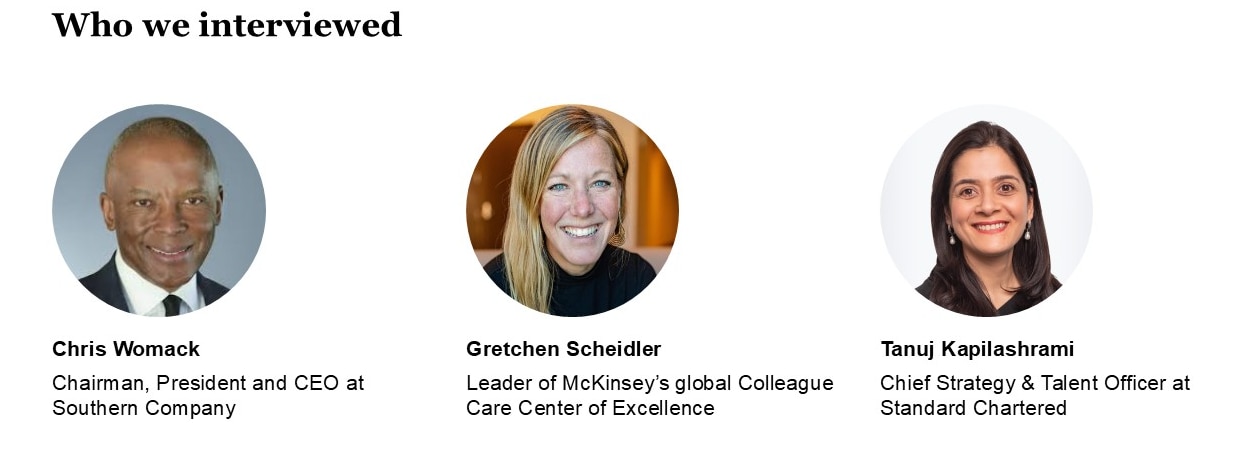
Headshots of Chris Womack, Gretchen Schneidler and Tanuj Kapilashrami Image: McKinsey Health Institute

Well-being comes from a leadership system, not a slogan

Leaders may have differing motives for addressing employee well-being but that should not delay acting. What matters is linking well-being to results and rewards. “Whether leaders are motivated by purpose, results or incentives, linking well-being to performance and rewards is what drives action and accountability,” says Kapilashrami.

“If employees are our number one asset, we have to show it not just in pay and benefits but in the culture we build,” explains Womack.

Thriving workplaces are built by actively making choices around measurement, disciplined work design, safety, role modelling and responsible technology. When well-being is embedded into how performance is defined, delivered and sustained, people and performance thrive together.

The authors wish to thank Alex Vaught, Amy Edmondson, Andy Moose, Barbara Jeffery, Danielle DiStefano, Darshini Mahadevia, Elizabeth Newman, Erica Coe, Lucy Perez and Sophie Merckelbach for their contributions to this article.

The authors also wish to thank Chris Womack, Gretchen Scheidler, and Tanuj Kapilashrami for their contributions to this article.