





Electrification is crucial to clean energy mobility. But as the first-generation of electric vehicles (EVs) approaches retirement, end-of-life (EOL) management for EV batteries has become a critical challenge for the clean mobility transition.
There could be 820,000 tons of retired EV batteries in China by the end of the year, according to 2025 estimates from Chinese research institute EVTank, while the World Resources Institute projects they could reach 20.5 million tons globally by 2040.
It’s not clear that the EV industry is ready to deal with these growing volumes. China holds the largest share of battery recycling infrastructure globally, but an estimated 20-30% of retired batteries are still being handled through unregulated channels. Global readiness is even less clear – in the UK, for instance, capacity limitations have left 90% of used EV batteries unprocessed.
Aside from the obvious waste management gap, these signals uncover a deeper underlying question: Are the systems supporting the clean mobility transition evolving fast enough to match the scale of the transition?
Upstream, limited EOL management capabilities will intensify reliance on virgin raw materials. Dependence on primary extraction amplifies environmental pressure and exposure to global commodity markets, so this reinforces the EV sector’s vulnerability to price volatility, geopolitical risks and other supply disruptions.
Access to the critical minerals used in EV batteries is a strategic concern for automakers, battery manufacturers and governments. And so, material recovery is a key component of resilient EV supply chains. The International Energy Agency (IEA) believes battery recycling could reduce global demand for newly mined lithium and nickel by 25%, and cobalt by 40%, by 2050. As a result, the market value for recycled energy transition minerals could reach $200 billion by the same year.
Downstream, without a coordinated scaling strategy, the likelihood of unregulated disposal or informal handling of spent batteries increases. And when valuable materials remain locked within EOL batteries, it leads to substantial losses in recoverable economic value and reduces the efficiency of circular resource flows.
As a result, recycling is increasingly viewed as a strategic industrial activity rather than a downstream waste-management function. Governments are reinforcing this shift through lifecycle-focused regulations and industrial policies. The EU Battery Booster, launched on 11 June 2026, for example, identifies circularity, material recovery and recycling as key elements of a competitive and resilient battery industry. It also provides a €1.5 billion support package. At the same time, EV manufacturers such as BYD and CATL are already integrating recycling into their operations.
Closing this loop is therefore becoming, not only an environmental concern, but also one of resource security, industrial competitiveness and long-term supply-chain resilience.
EV batteries are generally considered to reach the end of their lives when their charging capacity falls to around 70–80% of their original performance. But while they are no longer suitable for vehicles at this stage, they retain enough energy density for other use cases.
Once removed from vehicles, EV batteries can be redeployed in lower intensity use-cases, such as stationary energy storage or light mobility applications – industrial vehicles, for example. This reduces demand for virgin critical minerals and improves resource efficiency.
Start-ups such as Smartville are deploying residential storage systems based on repurposed EV batteries, while Renault Group is exploring remanufactured components and second-life offerings.
The IEA does note that testing, certification and repackaging costs continue to challenge economic viability, however, while second-life contributions to global storage capacity are expected to remain limited. As a result, this is more of a temporary extension – postponing but not removing the need for recycling infrastructure at scale.
Once EV batteries are fully spent, recovering value requires far more than recycling technology. Spent batteries still contain significant amounts of valuable materials, including lithium, nickel and cobalt. But increased demand for these materials means EOL batteries are still potential resource reservoirs.
Unlike manufacturing scrap, however, retired batteries vary in chemistry and condition, and must be collected, transported and processed. That’s why efforts to close the loop for EV batteries must begin long before batteries reach retirement – during early product design, manufacturing and supply chain planning.
A World Economic Forum white paper, The Art of Scaling Circular Supply Chains, shows how reverse logistics networks, collection systems, material traceability and recovery infrastructure becomes significantly more effective when integrated at an early planning stage, rather than retrofitted once large-scale retirement begins.
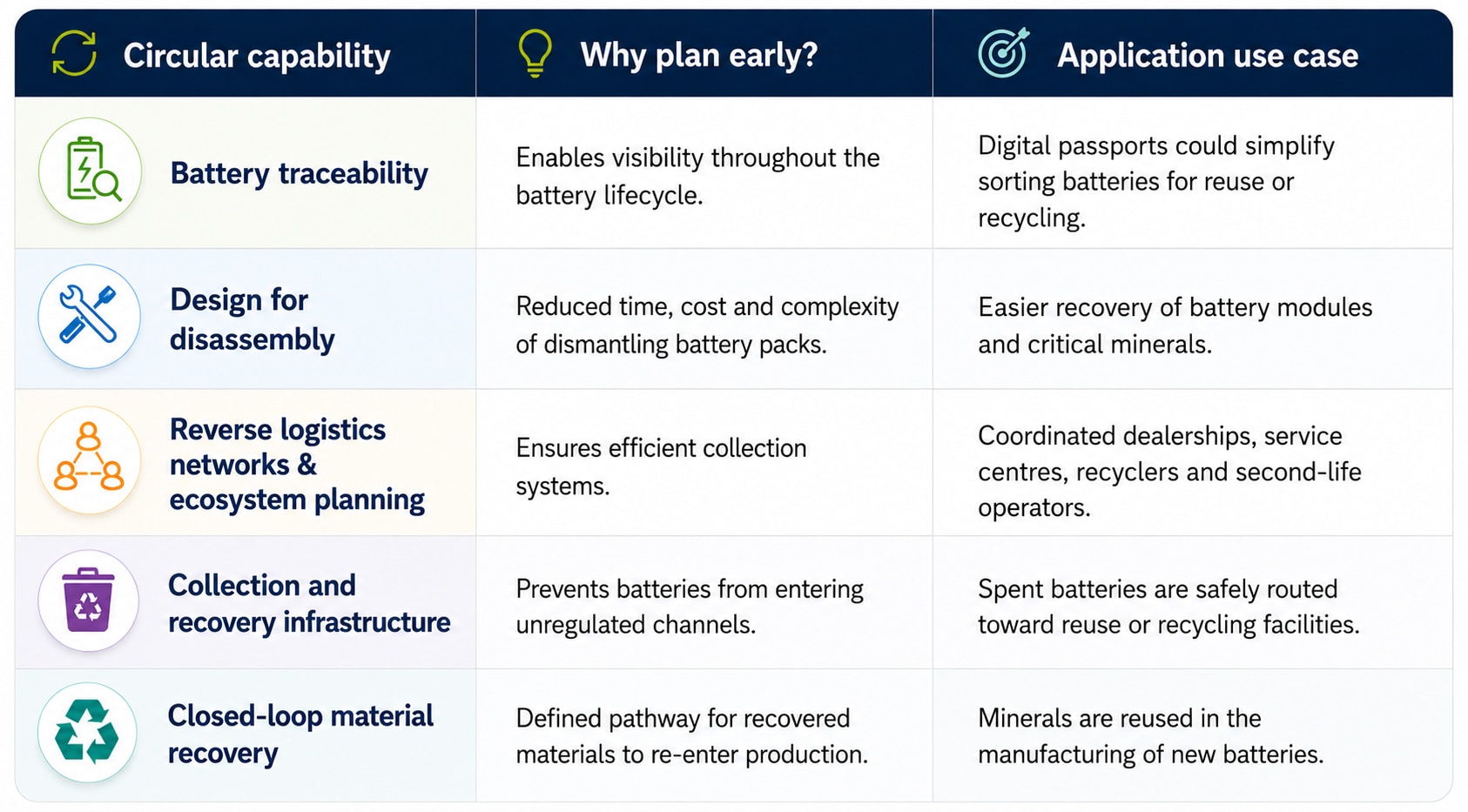
The EV battery recycling market is projected to reach $91.7 billion by 2034. And so the current scaling gap for EOL EV batteries represents a significant industrial opportunity. As supplies of critical minerals tighten and regulatory requirements expand, EOL battery management is evolving from a waste challenge into a strategic industrial capability.
The transition to electric mobility is ultimately not only a question of accelerating adoption, but also of building the systems required to manage the full battery and vehicle lifecycle. As deployment scales, EOL infrastructure will become a defining constraint – or enabler – of the broader clean energy transition.
As a result, companies that embed circularity into product and supply-chain design could gain long-term advantages in resource security, operational resilience, compliance and cost control.
The Forum is spotlighting how innovation moves from breakthrough to scale to impact ahead of 'Summer Davos' in China, 23–25 June 2026. Follow the latest.
此内容由惯性聚合(RSS阅读器)自动聚合整理,仅供阅读参考。 原文来自 — 版权归原作者所有。