


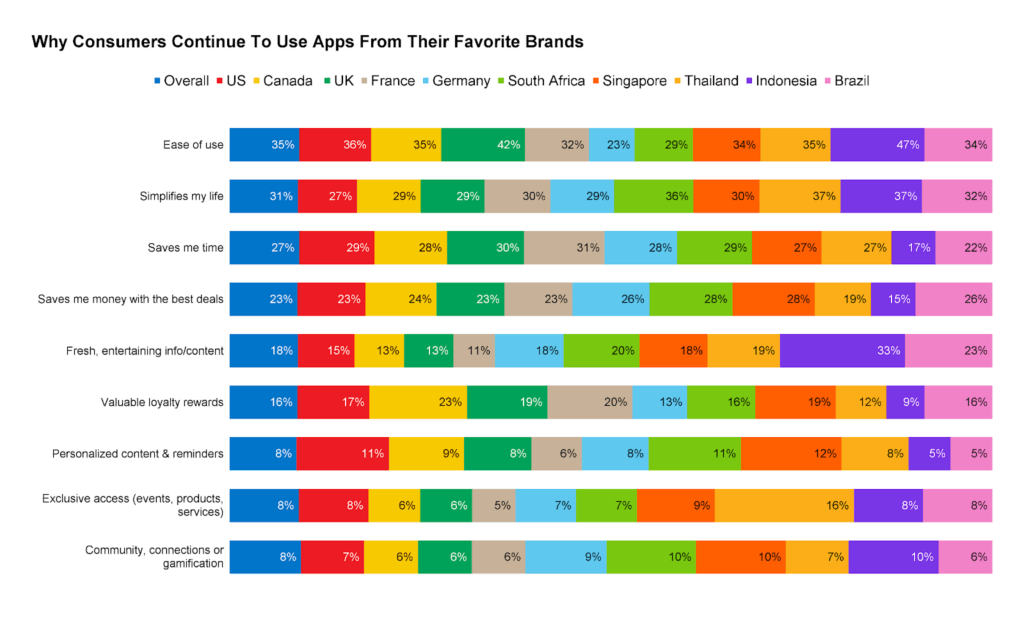
In an era dominated by smartphones and an abundance of mobile applications, understanding what drives consumers to adopt and retain apps is crucial for companies seeking to thrive in the digital landscape. According to new research from Airship, 42% of British consumers say the primary reason for their unwavering commitment to apps lies in their “ease of use”, underscoring the critical role that user-friendly interfaces and seamless navigation play in cultivating long-term engagement and brand loyalty.
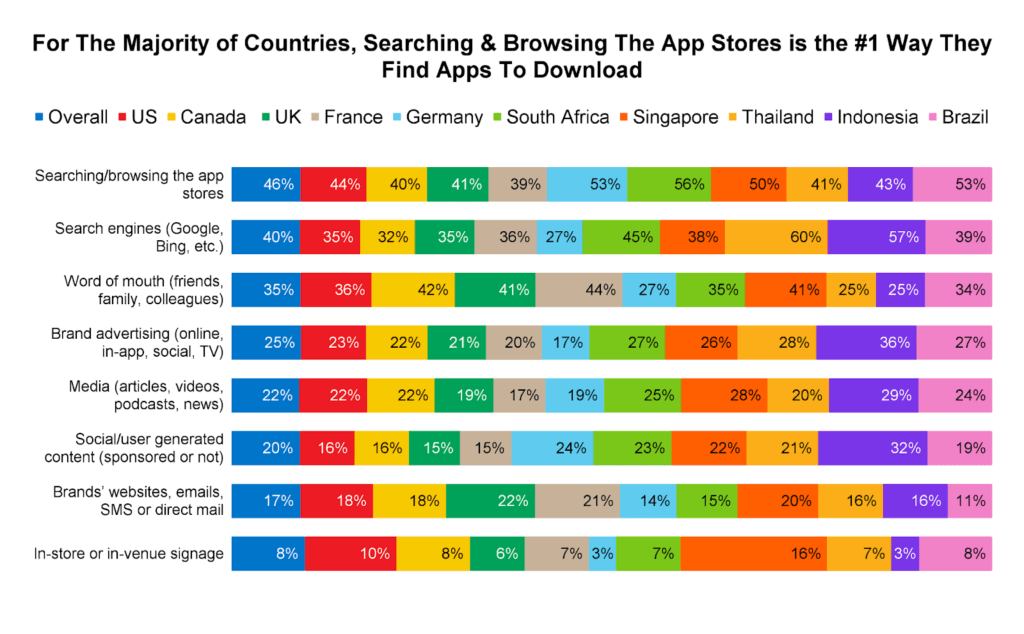
Based on the insight from a global survey of 11,000 respondents, Airship found that both word of mouth and app store browsing emerged as the most popular methods, each accounting for 41% of the respondents’ discoveries.
The top three reasons behind app usage from favourite brands were “ease of use” (35%), “simplifies my life” (31%), and “saves me time” (27%). Even amidst challenging economic times, it is clear that consumers are increasingly drawn to apps for their ability to deliver higher-level benefits—offering ease, speed, and simplicity.
- Advertisement -

The gap between a 65% and 90%+ privacy opt-in rate can mean $525,000 in lost revenue annually for a 100K DAU app — and most teams have no idea where they stand.
This guide breaks down the true cost of consent debt, why the average app sits at just 80% opt-in, and the exact tactics top performers use to consistently hit 90%+: prompt timing, banner design, vendor list optimization, and more.
Deals, rewards, and targeted offers experienced the most significant growth as opt-in motivators for app usage. But that’s not all. The reasons consumers continue to use apps are increasingly about higher-level benefits: ease, speed, and simplicity.
App stores continue to dominate as the preferred avenue for discovering new apps, transcending household income levels, generational gaps, and national boundaries. Whether searching or browsing, users consistently turn to app stores to explore the latest offerings.
How users find apps
Source: Airship
Following closely behind, search engines emerged as the second most popular method for app discovery. However, the power of word of mouth (WOM) should not be underestimated. In the UK, France, and Canada, personal recommendations play a significant role, with consumers relying on WOM as much as, if not more than, app stores to guide their app choices.
Similarly, in the US, Germany, and Singapore, WOM ranks as the second most common method for finding apps. Clearly, in an ever-evolving digital landscape, the discovery of new apps remains influenced by a blend of technological tools and good old-fashioned word-of-mouth recommendations.
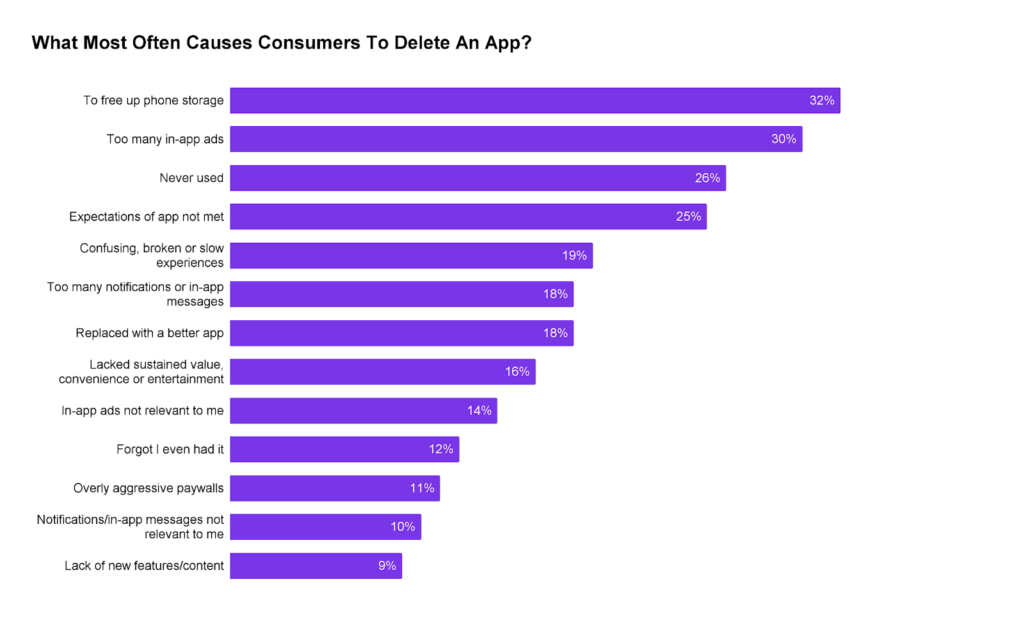
When it comes to deleting apps, two key factors emerged as primary culprits: the need to free up phone storage and an overwhelming number of in-app ads.
Astonishingly, the third most common reason for app deletion globally is simply “never used”, signalling a significant challenge for app developers and brands as it underscores the urgent need for brands to effectively communicate the value of their apps to customers. Improving mobile app onboarding experiences and establishing connections with users beyond the app itself is crucial for optimizing app usage and enhancing retention rates.
Why users delete apps
Source: Airship
Among the reasons for app deletion, the desire to free up phone storage emerges as the leading motive, with 32% of respondents worldwide citing it as their primary driver for removal. As smartphones become increasingly filled with data, users are compelled to declutter their devices, making storage management a critical consideration for app retention.
Moreover, the prevalence of in-app advertisements serves as a major deterrent, with 30% of respondents expressing frustration over excessive ads. This highlights the importance of striking a delicate balance between monetization efforts and user experience, ensuring that ads do not overwhelm or disrupt the app’s functionality.
How long users keep using apps before deletion
Source: Airship
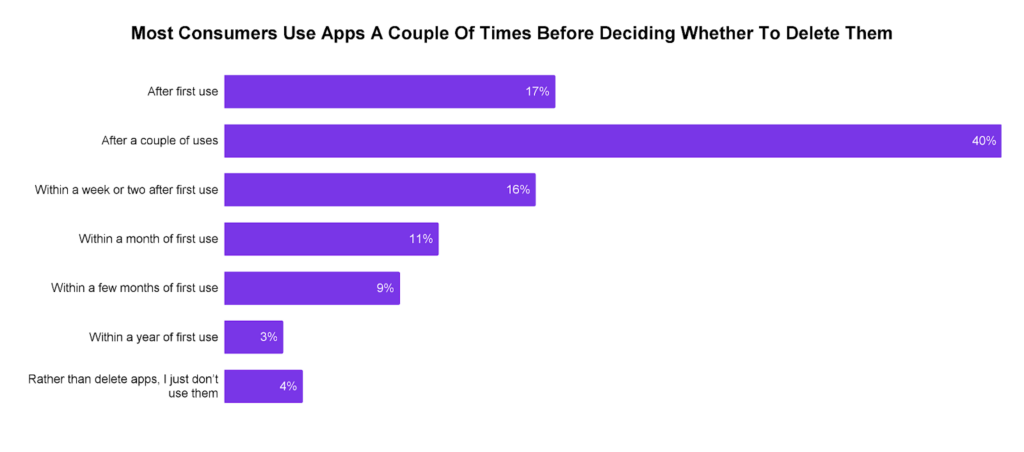
The study also notes that most consumers (57%) only use an app once or twice before deciding whether to delete it or not. And within the first two weeks of downloading a new app, 73% of consumers will decide if they’ll delete it – a behaviour consistent across all countries, household income levels and generations.
此内容由惯性聚合(RSS阅读器)自动聚合整理,仅供阅读参考。 原文来自 — 版权归原作者所有。