
惯性聚合 高效追踪和阅读你感兴趣的博客、新闻、科技资讯
阅读原文 在惯性聚合中打开

推荐订阅源

B
Blog
V
Vulnerabilities – Threatpost
Apple Machine Learning Research
V
V2EX
博客园 - 叶小钗
阮一峰的网络日志
阮一峰的网络日志
人人都是产品经理
人人都是产品经理
Latest news
Latest news
博客园 - 三生石上(FineUI控件)
美团技术团队
aimingoo的专栏
aimingoo的专栏
Google Online Security Blog
Security Archives - TechRepublic
T
Threatpost
Y
Y Combinator Blog
T
Tailwind CSS Blog
CTFtime.org: upcoming CTF events
A
Arctic Wolf
C
Cyber Attacks, Cyber Crime and Cyber Security
小众软件
小众软件
Recent Commits to openclaw:main
T
Tenable Blog
W
WeLiveSecurity
L
LINUX DO - 热门话题
D
Docker
Cyberwarzone
Cyberwarzone
量子位
A
About on SuperTechFans
The Last Watchdog
The Last Watchdog
雷峰网
雷峰网
C
CERT Recently Published Vulnerability Notes
P
Palo Alto Networks Blog
The Hacker News
The Hacker News
Blog — PlanetScale
Blog — PlanetScale
P
Proofpoint News Feed
OSCHINA 社区最新新闻
OSCHINA 社区最新新闻
F
Full Disclosure
The Cloudflare Blog
T
The Blog of Author Tim Ferriss
T
The Exploit Database - CXSecurity.com
Engineering at Meta
Engineering at Meta
O
OpenAI News
Hacker News - Newest:
Hacker News - Newest: "LLM"
Scott Helme
Scott Helme
IT之家
IT之家
S
Secure Thoughts
MongoDB | Blog
MongoDB | Blog
L
Lohrmann on Cybersecurity
博客园 - 司徒正美
Google DeepMind News

Google DeepMind News

Strengthening Singapore’s AI Future: A New National Partnership Simulate real-world places with Project Genie and Street View Introducing Gemini Omni Gemini for Science: AI experiments and tools for a new era of discovery Making it easier to understand how content was created and edited Gemini 3.5: frontier intelligence with action Co-Scientist: A multi-agent AI partner to accelerate research How WeatherNext helped the National Hurricane Center better predict Hurricane Melissa’s historic landfall in Jamaica Fast-tracking genetic leads to reverse cellular aging Finding the molecular switches behind new infectious diseases Opening new paths in aging research Accelerating discovery of liver disease mechanisms Uniting biological toolkits for a new approach to ALS Uncovering repurposed medicines to fight liver fibrosis Google Antigravity We’re launching the Google DeepMind Accelerator program in Asia Pacific to tackle environmental risks. AlphaEvolve: How our Gemini-powered coding agent is scaling impact across fields Enabling a new model for healthcare with AI co-clinician Announcing our partnership with the Republic of Korea Decoupled DiLoCo: A new frontier for resilient, distributed AI training Partnering with industry leaders to accelerate AI transformation Gemini 3.1 Flash TTS: the next generation of expressive AI speech Gemini Robotics-ER 1.6: Powering real-world robotics tasks through enhanced embodied reasoning Protecting people from harmful manipulation From games to biology and beyond: 10 years of AlphaGo’s impact A new way to express yourself: Gemini can now create music Accelerating discovery in India through AI-powered science and education Accelerating Mathematical and Scientific Discovery with Gemini Deep Think D4RT: Teaching AI to see the world in four dimensions Veo 3.1 Ingredients to Video: More consistency, creativity and control Gemma Scope 2: helping the AI safety community deepen understanding of complex language model behavior Google DeepMind supports U.S. Department of Energy on Genesis: a national mission to accelerate innovation and scientific discovery Gemini 3 Flash: frontier intelligence built for speed Improved Gemini audio models for powerful voice interactions Deepening our partnership with the UK AI Security Institute Strengthening our partnership with the UK government to support prosperity and security in the AI era FACTS Benchmark Suite: Systematically evaluating the factuality of large language models Engineering more resilient crops for a warming climate AlphaFold: Five years of impact Revealing a key protein behind heart disease How we’re bringing AI image verification to the Gemini app Build with Nano Banana Pro, our Gemini 3 Pro Image model Introducing Nano Banana Pro We’re expanding our presence in Singapore to advance AI in the Asia-Pacific region Start building with Gemini 3 A new era of intelligence with Gemini 3 Google Antigravity WeatherNext 2: Our most advanced weather forecasting model SIMA 2: An Agent that Plays, Reasons, and Learns With You in Virtual 3D Worlds Teaching AI to see the world more like we do How AI is giving Northern Ireland teachers time back Mapping, modeling, and understanding nature with AI Accelerating discovery with the AI for Math Initiative MedGemma: Our most capable open models for health AI development VaultGemma: The world's most capable differentially private LLM Bringing AI to the next generation of fusion energy Introducing Veo 3.1 and advanced capabilities in Flow Introducing the Gemini 2.5 Computer Use model Introducing CodeMender: an AI agent for code security Gemini Robotics 1.5 brings AI agents into the physical world Strengthening our Frontier Safety Framework Discovering new solutions to century-old problems in fluid dynamics Gemini achieves gold-medal level at the International Collegiate Programming Contest World Finals Using AI to perceive the universe in greater depth Image editing in Gemini just got a major upgrade Introducing Gemma 3 270M: The compact model for hyper-efficient AI How AI is helping advance the science of bioacoustics to save endangered species Genie 3: A new frontier for world models Rethinking how we measure AI intelligence Try Deep Think in the Gemini app AlphaEarth Foundations helps map our planet in unprecedented detail Aeneas transforms how historians connect the past Gemini 2.5 Flash-Lite is now stable and generally available Exploring the context of online images with Backstory Advanced version of Gemini with Deep Think officially achieves gold-medal standard at the International Mathematical Olympiad T5Gemma: A new collection of encoder-decoder Gemma models Introducing Gemma 3n: The developer guide AlphaGenome: AI for better understanding the genome Gemini Robotics On-Device brings AI to local robotic devices We’re expanding our Gemini 2.5 family of models Gemini 2.5: Updates to our family of thinking models Behind “ANCESTRA”: combining Veo with live-action filmmaking How we're supporting better tropical cyclone prediction with AI Advanced audio dialog and generation with Gemini 2.5 Gemini 2.5: Our most intelligent models are getting even better SynthID Detector — a new portal to help identify AI-generated content Our vision for building a universal AI assistant Fuel your creativity with new generative media models and tools Announcing Gemma 3n preview: powerful, efficient, mobile-first AI Gemini 2.5 Pro Preview: even better coding performance Build rich, interactive web apps with an updated Gemini 2.5 Pro Start building with Gemini 2.5 Flash Generate videos in Gemini and Whisk with Veo 2 DolphinGemma: How Google AI is helping decode dolphin communication Gemini 2.5: Our most intelligent AI model Experiment with Gemini 2.0 Flash native image generation Introducing Gemma 3: The most capable model you can run on a single GPU or TPU Start building with Gemini 2.0 Flash and Flash-Lite State-of-the-art video and image generation with Veo 2 and Imagen 3 Introducing Gemini 2.0: our new AI model for the agentic era
Gemini 2.0 is now available to everyone
2025-02-05 · via Google DeepMind News

In December, we kicked off the agentic era by releasing an experimental version of Gemini 2.0 Flash — our highly efficient workhorse model for developers with low latency and enhanced performance. Earlier this year, we updated 2.0 Flash Thinking Experimental in Google AI Studio, which improved its performance by combining Flash’s speed with the ability to reason through more complex problems.

And last week, we made an updated 2.0 Flash available to all users of the Gemini app on desktop and mobile, helping everyone discover new ways to create, interact and collaborate with Gemini.

Today, we’re making the updated Gemini 2.0 Flash generally available via the Gemini API in Google AI Studio and Vertex AI. Developers can now build production applications with 2.0 Flash.

We’re also releasing an experimental version of Gemini 2.0 Pro, our best model yet for coding performance and complex prompts. It is available in Google AI Studio and Vertex AI, and in the Gemini app for Gemini Advanced users.

We’re releasing a new model, Gemini 2.0 Flash-Lite, our most cost-efficient model yet, in public preview in Google AI Studio and Vertex AI.

Finally, 2.0 Flash Thinking Experimental will be available to Gemini app users in the model dropdown on desktop and mobile.

All of these models will feature multimodal input with text output on release, with more modalities ready for general availability in the coming months. More information, including specifics about pricing, can be found in the Google for Developers blog. Looking ahead, we’re working on more updates and improved capabilities for the Gemini 2.0 family of models.

2.0 Flash: a new update for general availability

First introduced at I/O 2024, the Flash series of models is popular with developers as a powerful workhorse model, optimal for high-volume, high-frequency tasks at scale and highly capable of multimodal reasoning across vast amounts of information with a context window of 1 million tokens. We’ve been thrilled to see its reception by the developer community.

2.0 Flash is now generally available to more people across our AI products, alongside improved performance in key benchmarks, with image generation and text-to-speech coming soon.

Try Gemini 2.0 Flash in the Gemini app or the Gemini API in Google AI Studio and Vertex AI. Pricing details can be found in the Google for Developers blog.

2.0 Pro Experimental: our best model yet for coding performance and complex prompts

As we’ve continued to share early, experimental versions of Gemini 2.0 like Gemini-Exp-1206, we’ve gotten excellent feedback from developers about its strengths and best use cases, like coding.

Today, we’re releasing an experimental version of Gemini 2.0 Pro that responds to that feedback. It has the strongest coding performance and ability to handle complex prompts, with better understanding and reasoning of world knowledge, than any model we’ve released so far. It comes with our largest context window at 2 million tokens, which enables it to comprehensively analyze and understand vast amounts of information, as well as the ability to call tools like Google Search and code execution.
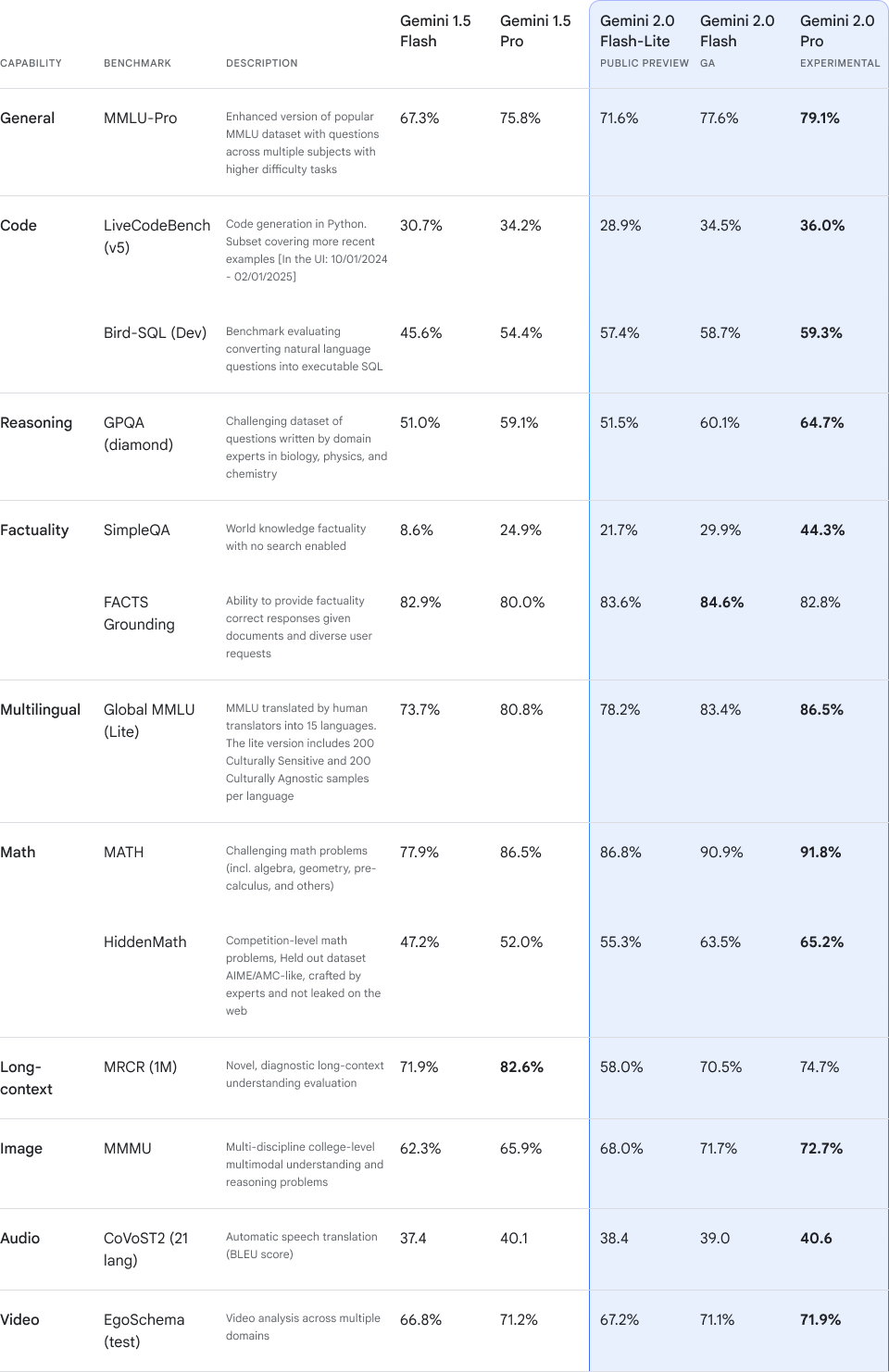
This table compares the capabilities of different versions of Gemini, including 1.5 Flash, 1.5 Pro, 2.0 Flash-Lite, 2.0 Flash, and 2.0 Pro, across various benchmarks. It shows the performance of each version on tasks like general knowledge, code generation, reasoning, factuality, multilingual understanding, math, long-context understanding, image understanding, audio translation, and video analysis.

Gemini 2.0 Pro is available now as an experimental model to developers in Google AI Studio and Vertex AI and to Gemini Advanced users in the model drop-down on desktop and mobile.

2.0 Flash-Lite: our most cost-efficient model yet

We’ve gotten a lot of positive feedback on the price and speed of 1.5 Flash. We wanted to keep improving quality, while still maintaining cost and speed. So today, we’re introducing 2.0 Flash-Lite, a new model that has better quality than 1.5 Flash, at the same speed and cost. It outperforms 1.5 Flash on the majority of benchmarks.

Like 2.0 Flash, it has a 1 million token context window and multimodal input. For example, it can generate a relevant one-line caption for around 40,000 unique photos, costing less than a dollar in Google AI Studio’s paid tier.

Gemini 2.0 Flash-Lite is available in Google AI Studio and Vertex AI in public preview.

Our responsibility and safety work

As the Gemini model family becomes more capable, we’ll continue to invest in robust measures that enable safe and secure use. For example, our Gemini 2.0 lineup was built with new reinforcement learning techniques that use Gemini itself to critique its responses. This resulted in more accurate and targeted feedback and improved the model's ability to handle sensitive prompts, in turn.

We’re also leveraging automated red teaming to assess safety and security risks, including those posed by risks from indirect prompt injection, a type of cybersecurity attack which involves attackers hiding malicious instructions in data that is likely to be retrieved by an AI system.