


(Video length: 1 minute)
Kent is the highest-level official in the Trump administration to resign over the U.S.'s decision to attack Iran. A majority of Americans oppose military action in Iran and don’t like the way Trump is handling the issue, according to the newest PBS News/ NPR/ Marist Poll.
Learn more: Read Joe Kent's full resignation letter here. This News Hour TikTok video was only a minute long. News Hour produced two much longer broadcast segments below. After reading Kent's resignation letter, what are two more important points of information you would have included if you were making this social media post?
Watch PBS News' Who is Joe Kent, the counterterrorism official who resigned over the Iran war?.
Watch PBS News' What Joe Kent's resignation says about U.S. intelligence and counterterrorism efforts.
The News: Then & Now section of the Daily News Lessons allows students to see connections between current and past news events. The activity provides historical context using primary sources from the Library of Congress.
See also PBS News Hour Classroom's Journalism in Action website for interactive examples of how journalists covered key events in U.S. history while honing your primary source, civics and digital news literacy skills.
This News: Then & Now takes a look at the actions by Daniel Ellsberg, a former Defense Department analyst who leaked classified information (known as the Pentagon Papers) about the Vietnam War more than 50 years ago.
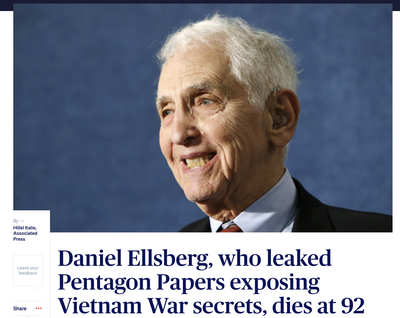
PBS News Hour screenshot: Pentagon Papers whistleblower Daniel Ellsberg participates in a news conference held by the whistleblower group ExposeFacts.org at the National Press Club in Washington April 27, 2015. REUTERS/Jonathan Ernst
Directions: Read the two paragraphs below. Then listen to the WYSO Public Radio interview below with Daniel Ellsberg from 1977 (about 4 minutes). Keep in mind, Ellsberg uses the term counterrevolutionary to describe the U.S. government’s actions in Vietnam after WWII, which went against the general will of the Vietnamese people for independence.
"As much as anyone, Ellsberg embodied the individual of conscience — who answered only to his sense of right and wrong, even if the price was his own freedom," wrote AP reporter Hillel Italie in Ellsberg's 2023 obituary, adding, "As much as anyone, Ellsberg also embodied the fall of American idealism in foreign policy in the 1960s and 1970s and the upending of the post-World War II consensus that Communism, real or suspected, should be opposed worldwide."
What are the Pentagon Papers? From News Hour Classroom's Journalism in Action: The Pentagon Papers was a seven-thousand-page classified report on the history of the Vietnam War that analyst Daniel Ellsberg worked on for the Department of Defense under Secretary of Defense Robert S. McNamara. Ellsberg believed the war was unethical and unwinnable. The Nixon administration brought espionage charges against Ellsberg and his codefendant, Anthony Russo, after they gave secret copies of the Pentagon Papers to the New York Times and the Washington Post. Both men were cleared of the charges.
Caption: Clip of radio interview with Daniel Ellsberg in 1977 with WYSO Public Radio. Courtesy Digital Audio Archives at WYSO Public Radio in Yellow Springs, Ohio. Permission has been granted for educational purposes only, courtesy of WYSO via American Archive of Public Broadcasting (WGBH and Library of Congress).
Next read what Robert McNamara, secretary of defense (1961-1968) during the Vietnam War, said to President Lyndon B. Johnson in 1963, early on in the war.
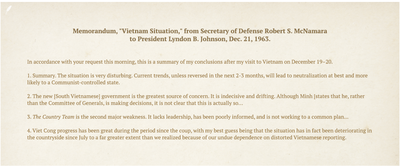
“374. Memorandum From the Secretary of Defense (McNamara) to President Johnson.” Edited for the purpose of this activity. Dec. 21, 1963. Permission has been granted for educational purposes only, courtesy of the Office of the Historian/US State Department
According to a 2021 interview with The Guardian, "Ellsberg [continued] to champion Manning, Assange, Snowden and others charged under the Espionage Act. The climate, he warns, has become more restrictive and punitive than the one he faced 50 years ago."
"The whistleblowers have much less protection now," Ellsberg told the Guardian, "[President Barack] Obama brought eight or nine or even 10 cases, depending on who you count, in two terms, and then Trump brought eight cases in one term. So sources are much more in danger of prosecution than they were before me and even after me for 30 years.”
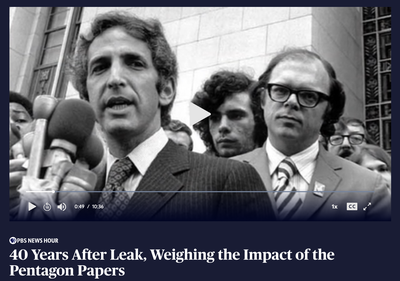
Credit: PBS News Hour screenshot
Discussion questions:
Sign up to receive our weekly newsletter with Daily News Lessons and community events.
To provide feedback on News Hour Classroom's resources, including this lesson, click here.
此内容由惯性聚合(RSS阅读器)自动聚合整理,仅供阅读参考。 原文来自 — 版权归原作者所有。