
惯性聚合 高效追踪和阅读你感兴趣的博客、新闻、科技资讯
阅读原文 在惯性聚合中打开

推荐订阅源

量子位
cs.AI updates on arXiv.org
F
Fortinet All Blogs
博客园 - 聂微东
奇客Solidot–传递最新科技情报
奇客Solidot–传递最新科技情报
Hugging Face - Blog
Hugging Face - Blog
V
Visual Studio Blog
小众软件
小众软件
有赞技术团队
有赞技术团队
雷峰网
雷峰网
钛媒体:引领未来商业与生活新知
钛媒体:引领未来商业与生活新知
AWS News Blog
AWS News Blog
C
Cisco Blogs
美团技术团队
T
Threat Research - Cisco Blogs
C
CERT Recently Published Vulnerability Notes
人人都是产品经理
人人都是产品经理
宝玉的分享
宝玉的分享
Threat Intelligence Blog | Flashpoint
酷 壳 – CoolShell
酷 壳 – CoolShell
Stack Overflow Blog
Stack Overflow Blog
W
WeLiveSecurity
D
DataBreaches.Net
博客园 - 司徒正美
Blog — PlanetScale
Blog — PlanetScale
IT之家
IT之家
云风的 BLOG
云风的 BLOG
Cyber Security Advisories - MS-ISAC
Simon Willison's Weblog
Google DeepMind News
T
The Blog of Author Tim Ferriss
Know Your Adversary
Know Your Adversary
NISL@THU
NISL@THU
OSCHINA 社区最新新闻
OSCHINA 社区最新新闻
The Cloudflare Blog
Vercel News
Vercel News
月光博客
月光博客
T
Tailwind CSS Blog
H
Help Net Security
aimingoo的专栏
aimingoo的专栏
P
Proofpoint News Feed
Application and Cybersecurity Blog
Spread Privacy
Spread Privacy
cs.CL updates on arXiv.org
Cisco Talos Blog
Cisco Talos Blog
Microsoft Security Blog
V
V2EX
WordPress大学
WordPress大学
Cyberwarzone
Cyberwarzone
Recent Announcements

Latest Daily News Lessons | PBS News Hour Classroom

What we know about the cyclosporiasis outbreak linked to produce Dry winter leaves farmers along Colorado River facing greater water shortages Lindsey Graham's career and influence on American politics Trump fires election commission members in latest attempt to control voting process A look at the new regulations and incentives in the housing bill set to become law Some Medicare beneficiaries eligible for weight loss drug discounts Immigration judge says Trump administration's firings and policies are 'disheartening' How hospitals are using the arts to help patients recover Recovery efforts underway in Venezuela following earthquakes The growing dangers of record heat waves like the one engulfing July 4th celebrations How climate change and rising seas endanger historic sites like Jamestown, Virginia America 250: A student series on a nation in progress Supreme Court transforms campaign finance rules, lifting limits on party spending How the birthright citizenship decision impacts Trump's immigration agenda Walter Isaacson on what he calls 'The Greatest Sentence Ever Written' What the Supreme Court rulings mean for presidential power Anti-ICE protesters sentenced to decades in prison in latest crackdown on dissent Why more school districts are limiting screen time for students Black Opera Project celebrates resilience and richness of the Black American experience New book explores America's history of celebrating freedom while excluding millions Monitoring the Midterms: Progressive victories signal mood of some Democratic voters The scientist and his family tracking melting glaciers for nearly half a century Bruce Springsteen on 'critical patriotism' and the power of protest music Anthropic disables new AI model after White House security directive Plagued by algae and peeling paint, reflecting pool set to undergo more repairs How the Obama Presidential Center offers a new vision for presidential legacies Shorts: Today's advice for America's founding fathers Derrick Adams celebrates the joy of the Black American experience through art U.S. officials reveal key terms of agreement to end Iran war Survey reveals political and cultural factions shaping the midterms How the loss of USAID has weakened the fight against Ebola America's 250th anniversary revives questions about religion and the founders New book spotlights grandparents raising children Millions lose SNAP benefits as One Big Beautiful Bill's stricter requirements kick in Why 'teen takeovers' are taking off This chef will teach you how to make healthy $5 family dinners College graduates begin their job search in a world being transformed by AI President Trump's mass deportation campaign takes toll on college campuses Department of Justice appears to drop 'anti-weaponization' fund What's next for mission to moon after Blue Origin rocket explosion? New museum spotlights Thaddeus Stevens' abolitionist legacy Monitoring the Midterms: Texas primaries lead to high-profile Senate clash Shorts: 2026 graduates boo commencement speeches on AI Memorial Day: How one community honors the graves of Revolutionary War veterans Student Reporting Labs: Finding Warmth in the Wicked Cold Massachusetts Weather How Denmark's wind and solar investments shield it from global energy turmoil San Diego mosque attack heightens fears as anti-Islam rhetoric rises in U.S. Trump administration rolls back limits on chemicals in drinking water Doctors share latest concerns about Ebola virus Monitoring the Midterms: How reality TV stars seeking office are changing politics Student Reporting Labs: Buckle up! The Road Trip podcast across America Monitoring the Midterms: Louisiana’s redistricting rush ignites debate over race and representation Virginia's Supreme Court tosses voter-approved redistricting plan Cyberattack on Canvas platform highlights vulnerabilities and risks for schools Monitoring the Midterms: Tennessee’s new congressional map sparks protest Examining details of a potential peace between the U.S. and Iran Why the Trump administration is paying billions to abandon wind farms How the collapse of Spirit Airlines is impacting travelers and the wider aviation industry The local communities hoping America's 250th birthday will help bridge divides Supreme Court decision weakens the Voting Rights Act Who is likely to see tariff refunds? Shorts: Shooter charged after Trump evacuated from White House Correspondents' Dinner What is the future of America's national parks? Trump extends ceasefire as talks with Iran stall Monitoring the Midterms: Virginians vote on redistricting How Trump's recent actions are affecting his support among young voters Trump's DOJ targets Jan. 6 convictions Study finds Trump administration cut legal immigration far more than illegal crossings Why Viktor Orbán's defeat in Hungary has global impact How does a decline in birth rate impact the future of the U.S.? Powerful new AI model raises concerns about being a tool for hackers Artemis II mission prepares for return to Earth Israel strikes Lebanon without warning, hours after Iran ceasefire announced Farmers warn of food price spike as war drives up fuel and fertilizer costs Hershey's quietly changes recipes after facing backlash Supreme Court hears arguments about birthright citizenship Artemis II launch sends 4 astronauts on mission around the moon Communities rebrand César Chavez Day as abuse allegations taint his legacy Can nuclear power help meet growing energy needs? Germany considers banning social media for most children A look back at the three No Kings protests: Millions turn out nationwide once again Jury finds Meta and YouTube liable in landmark youth addiction case How experts view efforts to end Iran war through diplomacy How climate change and overdevelopment are threatening cities Shorts: Afroman prevails in defamation lawsuit brought by police Why are manufacturing jobs in the U.S. declining? Americans divided on nation's history as 250th anniversary nears Trump threatens action against a deteriorating Cuba Trump’s top counterterrorism official resigns over Iran
Monitoring the Midterms: Supreme Court hears mail-in ballot case that could impact the midterms
2026-03-25 · via Latest Daily News Lessons | PBS News Hour Classroom

SUMMARY

The Supreme Court heard a case that could reshape how millions of mail-in ballots are counted in this fall's elections. Some states count mail-in ballots that arrive after Election Day as long as they are postmarked by Election Day. The Republican National Committee is challenging that procedure. Ali Rogin discussed the case with Nate Persily, an election law scholar at Stanford University.

View the transcript of the story.

NOTE: If you are short on time, watch the video and complete this See, Think, Wonder activity: What did you notice? What did the story make you think? What would you want to learn more about?

News alternative: Check out recent segments from the NewsHour, and choose the story you’re most interested in watching. You can make a Google doc copy of discussion questions that work for any of the stories here.

WARM-UP QUESTIONS

  1. Who is the plaintiff (the side who brought the case) in the case before the Supreme Court?
  2. Why did the plaintiff sue? What are their core arguments?
  3. What are the different arguments Justice Samuel Alito and Justice Ketanji Brown Jackson make regarding the meaning of Election Day?
  4. When is the Supreme Court expected to decide on the case?
  5. How would the Supreme Court's ruling affect the 2026 midterms, according to Nate Persily?

ESSENTIAL QUESTIONS

  • How do you think the Supreme Court should rule in this case?
  • Why has the issue of mail-in voting become divided along political party lines?

Media literacy: Nate Persily is a Stanford University election law scholar. What additional experts would you like to hear from? How could you find out where the electorate stands on the issue of mail-in ballots?

WHAT STUDENTS CAN DO

Take a look at the map below. Does your state accept mail-in ballots after Election Day?

Activity: Learn more about what is going on in your state by reading a 1-2 stories about mail-in ballots. Start by looking up one of your state capital's main newspapers. You can find of newspapers on Wikipedia here. Scroll down to the section "United States newspapers by state and territory." Click on your state and find your state capital newspaper. If you are not sure what is one of the main daily newspapers for your state's capital, conduct some online research.
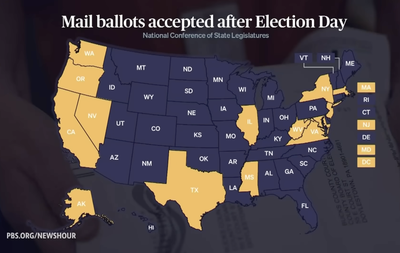
Credit: PBS News Hour screenshot from Supreme Court hears mail-in ballot case that could impact the midterms segment

What did you learn about mail ballots in your state? Did anything surprise you? Did anything you read make you want to write to your elected officials?

NEWS: THEN & NOW

The News: Then & Now section of the Daily News Lessons allows students to see connections between current and past news events. The activity provides historical context using primary sources from the Library of Congress.

See PBS News Hour Classroom's Journalism in Action website for interactive examples of how journalists covered key events in U.S. history while honing your primary source, civics and digital news literacy skills.

THEN

Though mail-in voting has become an increasingly common way to cast a ballot in recent years, especially during the COVID-19 pandemic, absentee voting and mail-in ballots are not new. In fact, they trace their roots far back throughout our nation’s history.

The Civil War marked the beginning of widespread absentee voting, allowing military service members to participate in elections while away from their polling precincts. As seen in the illustration by William Waud for Harper's Weekly in October 1864, some states, like Pennsylvania, established satellite polling stations in the field, while others allowed soldiers to mail in their ballots. Further primary-source evidence of mail-in voting during the Civil War is the Poll Book below, which certified the judges and clerks for the 1864 presidential election held at a camp in Strasburg, Virginia, for the 139th Pennsylvania Infantry Regiment.
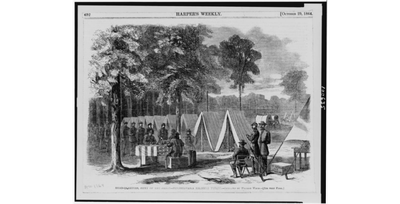
Pennsylvania soldiers voting, Army of the James. Courtesy of the Library of Congress
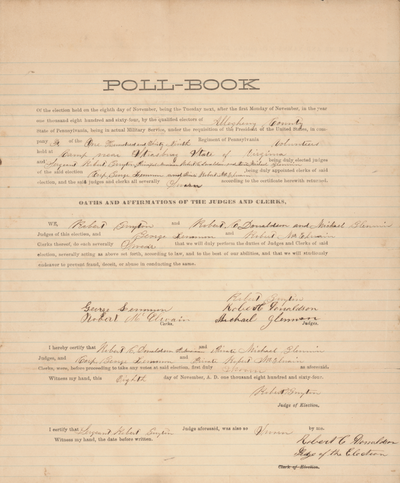
Poll-book naming judges and clerks for the 1864 presidential election held at the camp of Co. F, 139th Pennsylvania Infantry Regiment, near Strasburg Virginia. Courtesy of the Library of Congress

While absentee ballots gained widespread use among soldiers in the Civil War, the opportunity to vote by mail has also long been extended to civilians. However, the laws varied by state. The September 29, 1920, issue of the Evening Star reports on the National Women’s Party's efforts to educate female voters about their absentee-voting options based on the state they live in, coming just one month after women won the right to vote.

For more: Voting by Mail: It’s Nothing New | Teaching with the Library

History 1861-2022 | National Postal Museum

NOW

On Monday, March 23, 2026, the Supreme Court heard arguments in a case that could dramatically change the way mail-in ballots are counted. While 14 states and the District of Columbia allow ballots to be received after Election Day, as long as they are postmarked by Election Day, the Republican National Committee is challenging that procedure, arguing that it undermines trust in elections. As Nate Persily, an election law scholar at Stanford University, explains in the News Hour segment above, the RNC is arguing that the federal law sets the date for the election as a particular day and thus takes precedence over any state laws that allow for ballots to be received after that day. While the law at issue in this particular case is a Mississippi law, the decision will have wide-ranging implications for how ballots are counted across the country.

The decision, expected in June, is likely to affect the midterm elections this November. If the court sides with the RNC, states would be unable to count any ballot received after Election Day.

Discussion questions:

  • How has the practice of mail-in voting changed from its inception during the Civil War to today, particularly as a result of the COVID-19 pandemic? How has trust in mail-in voting changed?
  • Do you agree or disagree with the arguments proposed by the RNC? Does the history of mail-in ballot usage justify its continuance?

Sign up to receive our weekly newsletter with Daily News Lessons and community events.

To provide feedback on News Hour Classroom's resources, including this lesson, click here.