





Large Language Models (LLMs) (opens new window) like GPT (opens new window) can generate text, answer questions, and assist with many tasks. However, they are reactive, meaning they only respond to the input they receive based on patterns they've learned. LLMs can't make their own decisions; other than that, they can't plan or adapt to changing situations.
Agentic AI (opens new window) comes into play to resolve this issue. Unlike **generative AI (opens new window)** LLMs, agentic AI can take initiative, set goals, and learn from its experiences. It is proactive, able to adjust its actions over time, and can handle more complex tasks that require ongoing problem-solving and decision-making. This shift from reactive to proactive AI opens up new possibilities for technology across many industries.
In this blog series, we will break down the differences between Agentic AI and Generative AI, looking at how each affects industries and the future of technology. In this first post, we'll start by exploring what sets these two types of AI apart.
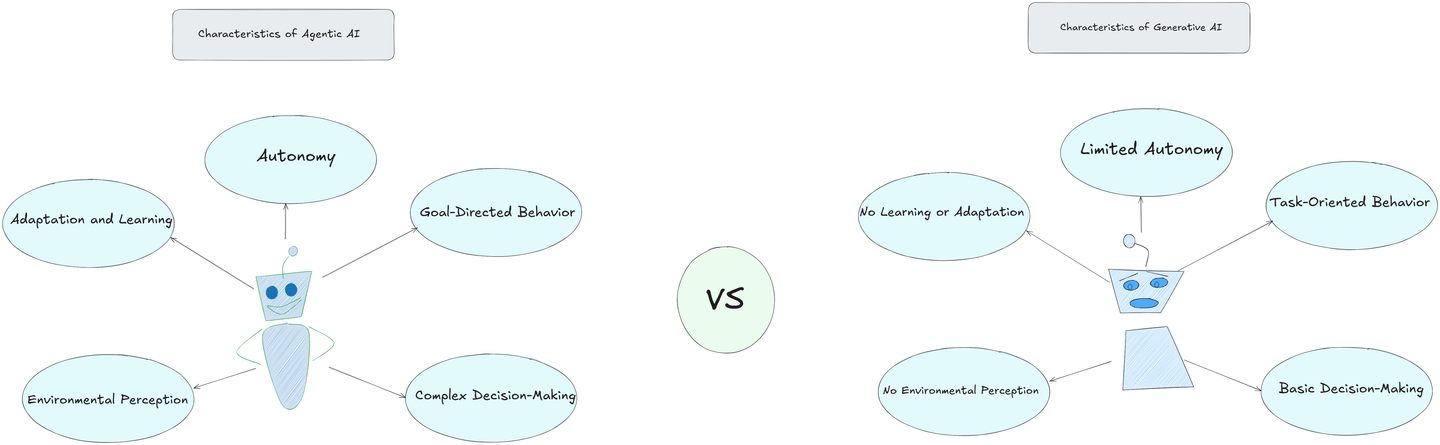
Agentic AI refers to AI systems that can make decisions and take actions autonomously to accomplish specific goals. Instead of simply generating content, these AI models can interact with their surroundings, respond to changes, and complete tasks with minimal human guidance. For example, a virtual assistant with agentic capabilities might not only provide information but also schedule appointments, manage reminders, or perform other actions to help the user achieve their goals. Similarly, self-driving cars exemplify agentic AI, as they make real-time decisions to safely navigate roads and reach destinations independently.
Generative AI is a type of artificial intelligence focused on creating new content, such as text, images, music, or even video. It works by learning from vast amounts of data to understand patterns, styles, or structures, and then generates original content based on what it has learned. For instance, a generative AI like ChatGPT can produce unique text responses to questions, while image-generating models like DALL-E can create images from text descriptions. Essentially, generative AI is like a digital artist or writer, producing creative work based on what it has learned.
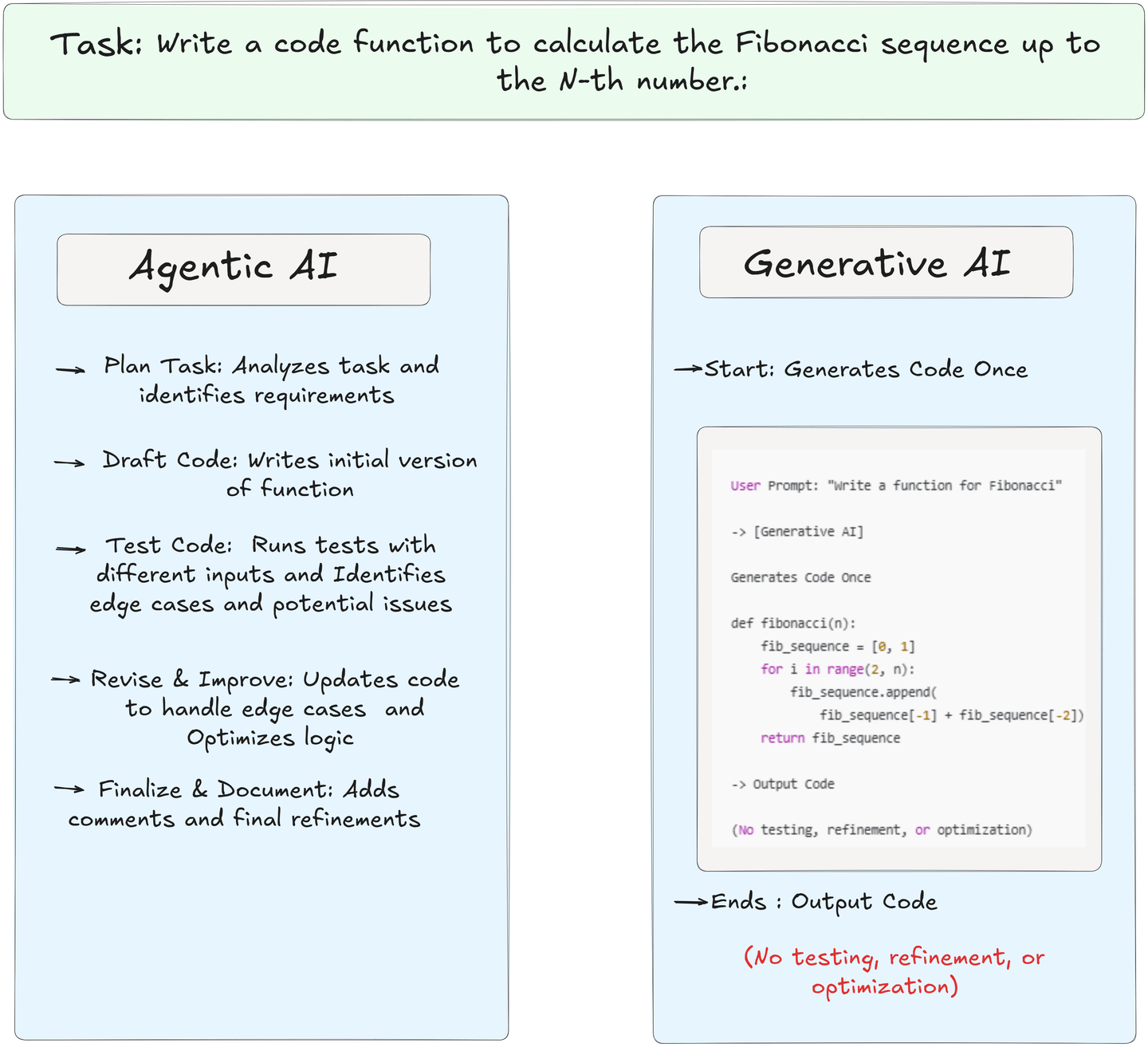
The illustration above highlights how Agentic AI works through an iterative, cyclical workflow that includes stages of "Thinking/Research" and "Revision." This adaptive process involves continuous self-assessment and improvement, enabling Agentic AI to produce a higher-quality, optimized output. By taking multiple steps to test and refine its work, Agentic AI can operate independently, learn from each stage, and tackle tasks that demand ongoing evaluation and adjustment.
In the illustration above, you can see how Generative AI follows a straightforward, single-step workflow: it moves directly from "Start" to "Finish" in one go. This means the AI provides an immediate response without revisiting or refining its output. The process is linear, producing a basic result that meets the initial prompt but doesn’t account for edge cases or iterative testing. This illustrates the limitations of Generative AI in handling more complex or adaptive tasks.
This section explores Agentic AI and GenAI's unique characteristics, highlighting their distinct approaches to intelligence, autonomy, and decision-making.
While the theoretical distinctions between Generative AI and Agentic AI are clear, seeing these concepts in action is where the true potential of Agentic AI becomes evident. To demonstrate its practical value, let's explore a case study that showcases how Agentic AI outperforms traditional LLM methods in real-world scenarios.
Andrew Ng shared a case study to highlight the power of the Agentic Workflow in coding tasks. His team tested two methods using the HumanEval coding benchmark. The task was: “Given a list of integers, return the sum of all even-positioned elements.” In the first method, zero-shot prompting (opens new window), the AI was simply asked to solve the problem directly without any extra steps. For example, GPT-3.5 scored 48% accuracy, and GPT-4 did better with 67%. These results were good, but not exceptional.
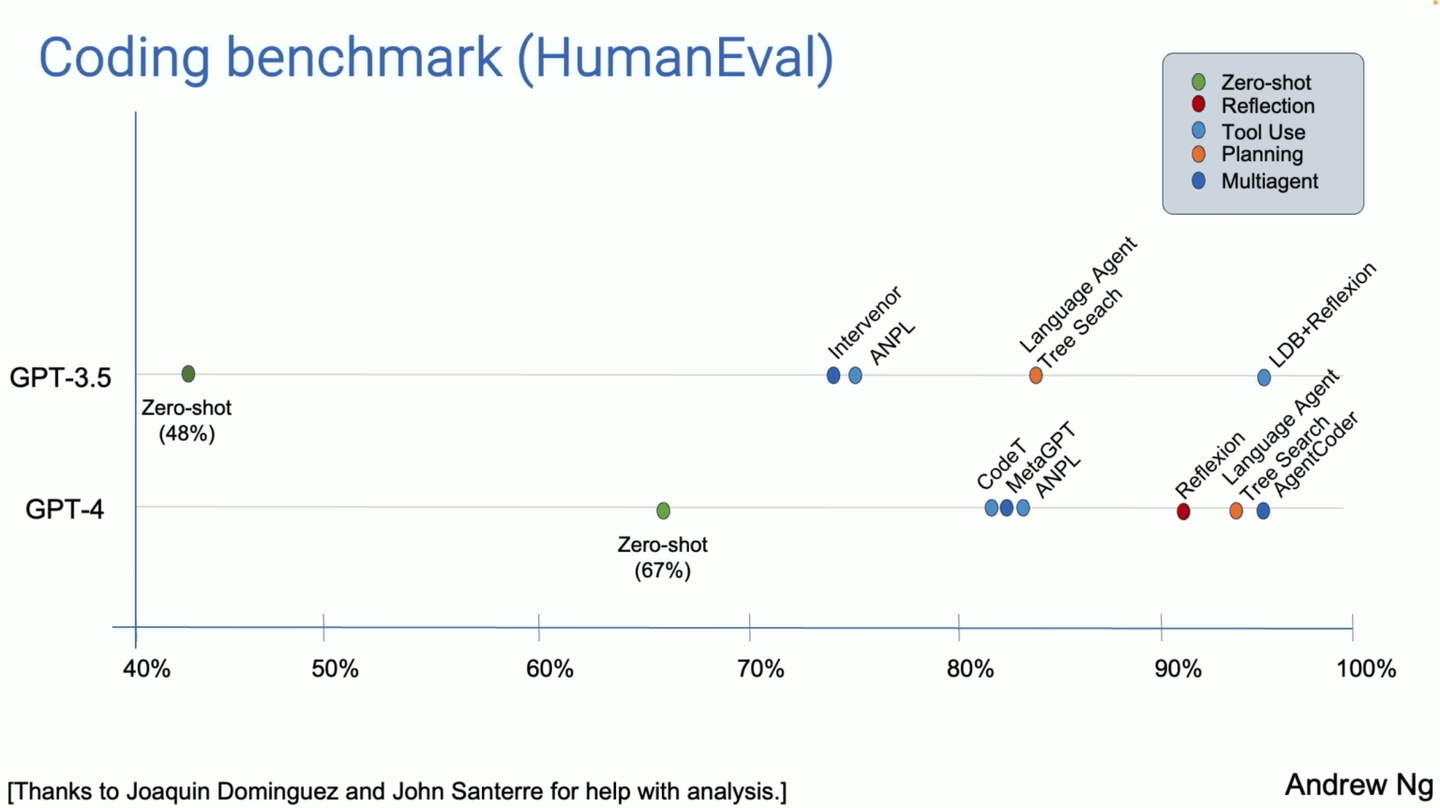
However, when the team applied the Agentic Workflow, which breaks the task into smaller steps like understanding the problem, writing the code in parts, testing, and fixing errors, GPT-3.5 performed even better than GPT-4. Ng pointed out that GPT-4 also showed stronger results when using the Agentic Workflow. This shows that by taking a step-by-step approach, AI models—especially older ones—can outperform more advanced models using traditional methods like zero-shot prompting.
As AI becomes a bigger part of our lives and workplaces, it’s very important to understand the differences between Agentic AI and Generative AI. Generative AI has been very helpful in tasks like text generation, responding to prompts by generating text or images. But it’s limited to following instructions without real autonomy. Agentic AI, on the other hand, is a step forward—it can set goals, make decisions, and adapt to changing situations on its own, taking on complex tasks without constant human guidance.
By using methods like the Agentic Workflow, AI systems can become more effective, improving performance through iterative steps and learning from each phase. This shift opens up opportunities for advanced applications and allows even older models to keep evolving and stay relevant. In the next parts of this series, we’ll explore how Agentic AI works in practice and its potential to reshape industries and drive new innovations.
此内容由惯性聚合(RSS阅读器)自动聚合整理,仅供阅读参考。 原文来自 — 版权归原作者所有。