








Imagine walking into a massive library in search of a specific book, but without an organized catalog. You’d have to browse through every shelf, which could take hours or even days. However, if the library is equipped with a well-organized catalog, you can simply refer to a systematic list of titles, authors, or subjects, and quickly locate the book you need. This structured approach makes finding the book much faster and more efficient
Similarly, in a database, indexing serves as that organized catalog. It improves query performance (opens new window) by creating a system that allows the database to swiftly locate and retrieve records (opens new window). Just like a catalog helps you find a book quickly, an index helps the database find the data you need much faster. To achieve this, databases use different indexing algorithms (opens new window). For example, hash indexing is effective for exact-match queries (opens new window), quickly finding specific data. Another method, B-Tree indexing, organizes data in a structured way that speeds up searches.
Additionally, graph indexing optimizes searches for data with complex connections, such as relationships in social networks. An index acts as a roadmap in a database, offering quick access to relevant information (opens new window) without scanning every record. This is essential for managing large datasets where both speed and accuracy are critical.
In database management, the B-Tree indexing algorithm is crucial for optimizing search, insert, and delete operations. Its design and properties make it particularly effective for managing large datasets efficiently.
The B-Tree maintains balance by allowing nodes to have multiple children, unlike binary search trees (opens new window), which typically have only two child nodes. This design enables each node to store multiple keys and pointers to its child nodes, ensuring that all leaf nodes remain at the same depth and providing efficient access to data.
These features contribute to the key properties of B-Tree indexing. With its balanced structure, a B-Tree guarantees O(log n) time complexity for search, insertion, and deletion operations. Each node can hold between t-1 and 2t-1 keys and between t and 2t children, offering flexible storage. This balance ensures that the tree’s height remains logarithmic relative to the number of keys, which supports efficient operations even with large datasets. Additionally, the sorted keys within the nodes facilitate efficient range queries and ordered traversals, further enhancing the tree's performance.
Let’s understand it with the help of an example.
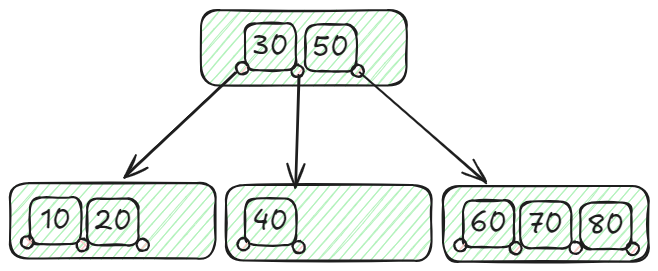
Consider a student database where we need to efficiently search for student records by their IDs. Suppose we have the following student IDs to index: 10, 20, 30, 40, 50, 60, 70, and 80. We construct a B-tree with a minimum degree (t) of 2.
Within this B-tree, the primary node holds two keys (30 and 50), leading to three offspring nodes: the left node preserving IDs below 30 (10, 20), the center node accommodating IDs ranging from 30 to 50 (40), and the right node storing IDs exceeding 50 (60, 70, 80). This organization enables effective handling and retrieval of student IDs using the B-tree data structure. As an example, to locate ID 40, you would begin at the root and observe that 40 falls between 50 and 30. Therefore, you proceed to the middle child node containing 40. This well-balanced organization guarantees efficient search, insert, and delete functions with a time complexity (opens new window) of O(log n).
B-Tree indexing is highly valued for its flexibility and efficiency in managing ordered data. Key advantages include:
Despite its strengths, B-Tree indexing may not always be the best choice in every scenario. Consider the following limitations:
Database administrators often choose between B-Trees and hash-based indexing based on their needs. B-Trees excel in relational databases, efficiently managing sorted data and range queries in low-dimensional spaces, and maintaining order for traditional operations.
However, in vector databases that handle high-dimensional data (such as those used in AI and machine learning), B-Trees struggle due to the curse of dimensionality. As dimensions increase, B-Trees become less effective because data spreads more uniformly, making partitioning difficult. In such cases, hash-based indexing offers a compelling alternative, which we will discuss next, and may provide better performance for high-dimensional datasets.
Hash indexing is a technique designed to enhance search efficiency, especially in high-dimensional contexts like vector databases. It operates differently from B-Trees and is particularly useful for managing large and complex datasets.
Hash indexing uses a hash function (opens new window) to map keys to specific locations in a hash table, allowing for efficient data retrieval (opens new window). Unlike B-Trees, which maintain a balanced structure, hash indexes provide constant time complexity, O(1), for search, insertion, and deletion operations, making them ideal for exact match queries. The hash function converts a key into a hash code to determine its index in the hash table, while buckets store entries at each index. Collision handling techniques, such as chaining (linked lists) or open addressing (probing), manage cases where multiple keys hash to the same index.
In vector databases, hash indexing is adapted for high-dimensional data. Multiple hash functions distribute vectors into various hash buckets. During a nearest neighbor search, vectors from relevant buckets are retrieved and compared to the query vector. The method's effectiveness relies on the quality of the hash functions and how well they spread vectors across buckets. Hash indexing enhances search efficiency for exact matches but is less suited for range queries or ordered data retrieval.
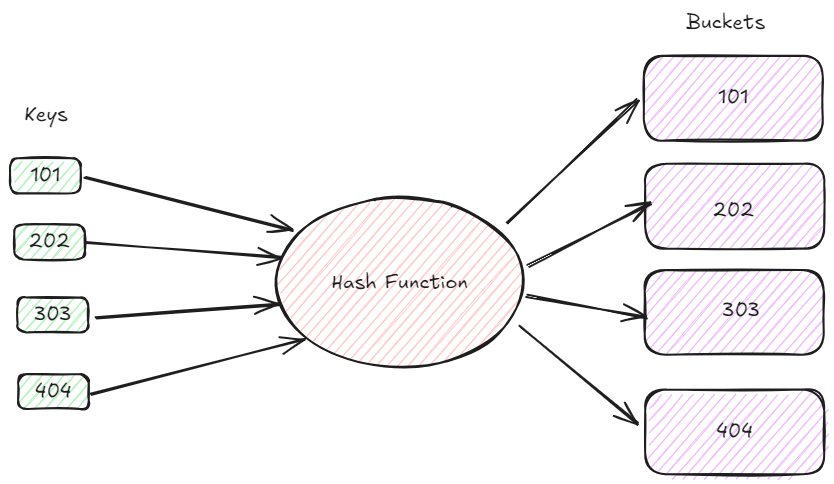
Now to enhance understanding let take a example of a library database where we need to efficiently search for book records by their unique IDs. Suppose we have the following book IDs to index: 101, 202, 303, and 404.
This diagram shows the fundamental idea of hash indexing. We begin with a collection of book IDs, which serve as our keys. The keys go through a hash function that changes them into numerical values. These hash values, labeled as such, decide the container where the related book data will be placed. Ideally, the hash function evenly distributes the keys among the buckets to reduce collisions. In this instance, every book ID is linked to a distinct bucket, showcasing flawless hash distribution. In actual situations, collisions are frequent and need additional methods such as chaining or open addressing to manage them successfully.
While hash indexing is great for fast exact match queries, it can struggle with high-dimensional data. For efficient approximate nearest neighbor (ANN) searches, graph indexing using the HNSW (Hierarchical Navigable Small World) algorithm provides a powerful alternative, adeptly managing complex, high-dimensional vectors.
Boost Your AI App Efficiency now
Sign up for free to benefit from 150+ QPS with 5,000,000 vectors
Graph indexing (opens new window) is very useful for handling complex data networks or relationships, like social connections or recommendation systems. Graph indexing, in contrast to linear data structures such as B-Trees or hash tables, is specifically designed to effectively handle and retrieve graph data, where the connections between entities hold equal significance to the entities themselves.
In modern vector databases, graph-based indexing (opens new window) methods like HNSW (Hierarchical Navigable Small World) (opens new window) are widely used for approximate nearest neighbor (ANN) (opens new window) searches, especially in high-dimensional spaces. These advanced techniques are designed to navigate through large and complex datasets efficiently.
Graph indexing involves creating structures that help quickly locate nodes (vertices) and edges (connections) based on specific queries. The indexing process might focus on different aspects of the graph, such as node labels, edge types, or the shortest paths between nodes. Several graph indexing methods have been developed to optimize different types of queries:
HNSW is an algorithm based on graphs that is specifically created to efficiently find nearest neighbors in high-dimensional vector spaces. The main concept of HNSW involves building multiple hierarchical layers, with each layer being a graph that links nodes (data points) based on their closeness. The upper layers give a general summary, whereas the lower layers present more intricate information.
In practice, when you perform a search using HNSW, the algorithm starts at the top layer and navigates through the graph, gradually descending to lower layers where the search becomes more precise. This hierarchical approach significantly reduces the search space, making it possible to retrieve nearest neighbors quickly, even in very large datasets.
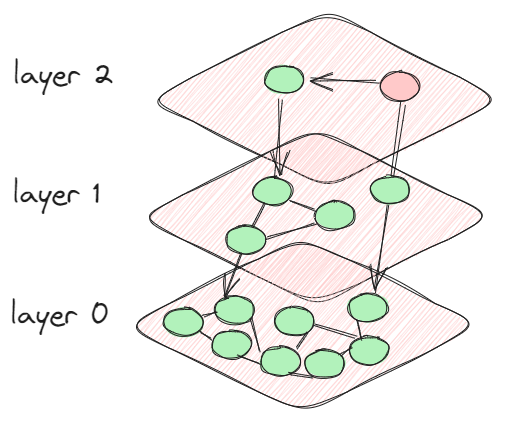
Imagine you're searching for similar images in a large database of visual data. Each image is represented by a high-dimensional vector (e.g., extracted features from a neural network). HNSW allows you to quickly find images that are closest to a given query image by traversing the hierarchical graph, starting from a broad search in the upper layers and gradually zooming in on the closest matches in the lower layers. Graph indexing algorithms like HNSW are designed to minimize the computational cost associated with such traversals, especially in large graphs where millions of nodes and edges may exist. The indexing process significantly improves query performance by focusing on relevant parts of the graph.
While B-Trees and hash indexing work well for certain types of queries, they struggle with complex or high-dimensional data. Graph indexing methods like HNSW handle these challenges by efficiently navigating complex connections. The Multi-Scale Tree Graph (MSTG) from MyScale (opens new window) takes this a step further by combining the best of SQL and graph-based techniques. MSTG uses a mix of hierarchical tree structures and graph traversal to quickly and accurately search through large, complex datasets. This blend makes it a powerful tool for handling today’s vast and intricate data.
The Multi-Scale Tree Graph (MSTG) algorithm, developed by MyScale (opens new window), is an advanced indexing technique designed to overcome the limitations of traditional vector search algorithms like HNSW (Hierarchical Navigable Small World) (opens new window) and IVF (Inverted File Indexing) (opens new window). MSTG is particularly well-suited for handling large-scale, high-dimensional vector data, offering superior performance for both standard and filtered searches.
MSTG combines the strengths of hierarchical tree clustering and graph traversal to create a robust and efficient search mechanism. Here’s how it works:
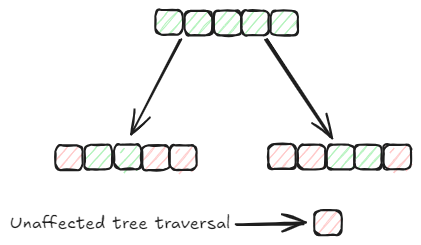
MSTG addresses several key limitations of existing vector search algorithms:
MyScale (opens new window) optimizes the filter vector search (opens new window) with the unique MSTG algorithm that provides a significant leap in performance for vector search tasks, particularly in scenarios involving large and complex datasets. Its hybrid approach and resource-efficient design make it a powerful tool for modern vector databases, ensuring fast, accurate, and scalable search capabilities.
Join Our Newsletter
The selection of an indexing algorithm should be tailored to your specific requirements, taking into account the data type, query frequency, and performance needs of your database. For instance, if your database frequently performs range queries or necessitates efficient sorting capabilities, a B-Tree index might be more appropriate due to its optimized structure for such operations. On the other hand, if your primary focus is on exact-match queries and rapid lookups, a Hash index could offer superior performance in those scenarios.
In summary, understanding the distinctive characteristics of each indexing algorithm is essential in making an informed decision that optimizes query performance based on your database's unique requirements.
此内容由惯性聚合(RSS阅读器)自动聚合整理,仅供阅读参考。 原文来自 — 版权归原作者所有。