



惯性聚合 高效追踪和阅读你感兴趣的博客、新闻、科技资讯
阅读原文 在惯性聚合中打开

推荐订阅源

A
About on SuperTechFans
博客园 - 聂微东
让小产品的独立变现更简单 - ezindie.com
奇客Solidot–传递最新科技情报
奇客Solidot–传递最新科技情报
博客园 - 司徒正美
宝玉的分享
宝玉的分享
美团技术团队
量子位
The Cloudflare Blog
freeCodeCamp Programming Tutorials: Python, JavaScript, Git & More
IT之家
IT之家
爱范儿
爱范儿
J
Java Code Geeks
博客园 - Franky
Last Week in AI
Last Week in AI
B
Blog
H
Hackread – Cybersecurity News, Data Breaches, AI and More
I
InfoQ
GbyAI
GbyAI
Recent Announcements
小众软件
小众软件
H
Help Net Security
Microsoft Azure Blog
MyScale Blog
MyScale Blog

Tech - South China Morning Post

Multinational pharmaceutical companies to benefit from new China guidelines: analysts Hong Kong lawmaker swipes at US lack of ‘clarity’ as city eyes crypto lead China’s Hesai adds colour to lidar to help EVs level up in self-driving ‘State-of-the-art’ models can struggle with basic office work, says AI executive Opinion | As AI evolves, school syllabuses must evolve with it Winner of second Beijing robot half-marathon smashes human world record by 6 minutes Asia’s supply chains could give it edge over US in AI race: Granite Asia’s Foo Chinese software firms defy ‘SaaSpocalypse’ with strategic AI partnerships Huawei retains lead in China smartphones, Apple shipments surge in first quarter China’s drug makers are speeding up – will AI be their secret weapon? Hong Kong seen leading Asia in push to scale stablecoins, HSBC says ByteDance, Tencent step up AI talent battle amid reports of DeepSeek loss White House and Anthropic CEO discuss working together amid Mythos AI fears Chinese LED chipmaker’s purchase of Dutch firm collapses after US opposition How Amazon uses closer China supply ties to counter tariffs, Shein and Temu ‘Horrible’ for US if DeepSeek AI models run on Huawei chips: Nvidia CEO Chinese platforms fined 3.6b yuan over ‘ghost’ takeaways amid cutthroat rivalry Manycore, one of Hangzhou’s ‘Six Little Dragons’, surges on Hong Kong IPO debut How the rise of AI agents could finally make China’s open-source models pay ‘Buy what they can, steal what they can’t’: US lawmakers slam China’s AI tactics China’s lithium giant Ganfeng sees profit jump as EV, ESS battery demand soars Chinese tech giants, AI ‘godmother’ Li Fei-Fei race into world models Black market workarounds scale up for Claude as Anthropic tightens ID checks TSMC targets over 30% revenue surge in 2026, ramps up capex amid AI boom BrainCo’s brain-computer interface wows at HSBC summit with mind-controlled hand Chinese investors cheer Tesla’s AI chip progress, boosting shares of suppliers ASML boosts 2026 sales forecast despite shrinking China sales China’s EV battery giant CATL to set up mining arm to secure supply chain From ‘probing minds’ to verified account: how Musk’s stance on TikTok shifted Amazon bets on Shenzhen smart warehouse to cut merchant storage costs by 45%
Huawei chips refine DeepSeek model in leap for China’s AI...
Coco Feng · 2026-06-05 · via Tech - South China Morning Post

A research team that includes Huawei Technologies says it has successfully used the firm’s Ascend 910C chips to complete post-training for the DeepSeek-V4-Pro model, marking a major step forward as China’s semiconductor industry tries to leap from supporting basic AI inference to more complex model training amid tightening US sanctions.

While Chinese chipmakers have found success in supporting AI inference – the relatively simple process of running an already-finished model to answer user prompts – they have struggled with training, the far more complex process of building or refining a model’s brain.

If initial “pre-training” teaches a model how to speak by absorbing massive amounts of data, post-training teaches it how to work by following human instructions, safety rules and specific tasks.
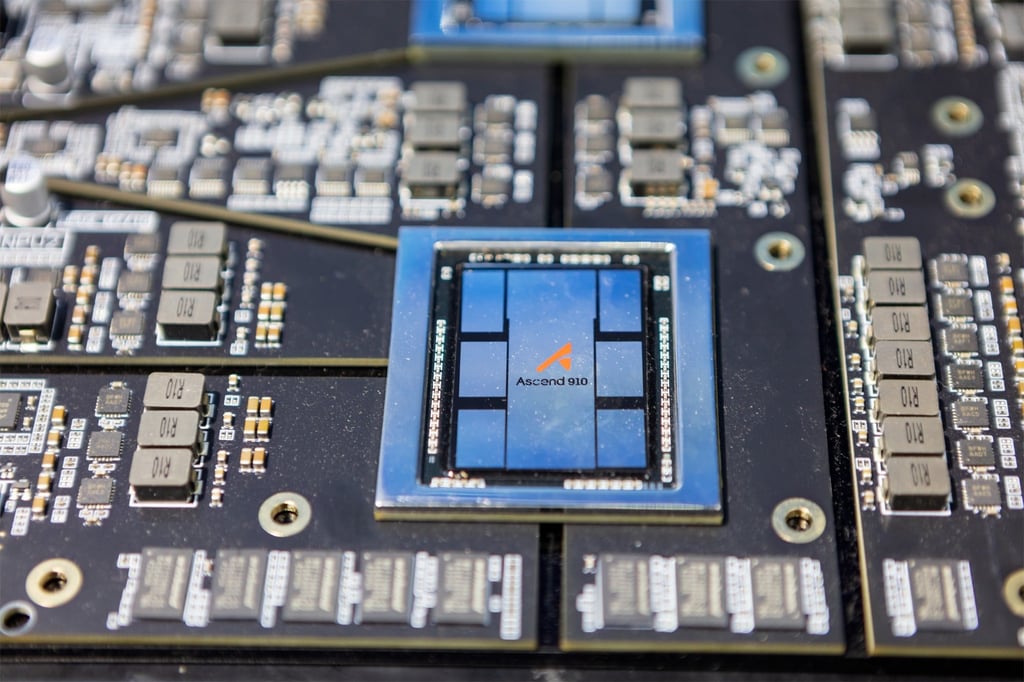
A Huawei Ascend 910 processor is displayed during PT Expo China in 2023. Photo: Shutterstock Images

A Huawei Ascend 910 processor is displayed during PT Expo China in 2023. Photo: Shutterstock Images

To achieve this, the researchers ran DeepSeek’s largest model to date – boasting 1.6 trillion parameters – on a computing cluster powered by at least 1,000 Huawei chips, according to a social media post from the Shenzhen government on Friday.

The team successfully conducted “full-parameter” post-training, meaning the model’s entire architecture was updated and refined without cutting corners, the post said.

Previously, domestic computing power was primarily used for inference, “much like building a one-way road for the model: input a question, output an answer”, the post explained. The project, however, allowed a model to self-reflect and adjust.

This added “complex flyovers and loops to that one-way road, instantly multiplying the computational and communication demands by several times”, it added.

The exploration – jointly conducted by Huawei, the Shenzhen Loop Area Institute, the Shenzhen campus of Harbin Institute of Technology and Shenzhen Research Institute of Big Data – “will help enhance the self-reliance of China’s AI industry chain”, the post said.