


惯性聚合 高效追踪和阅读你感兴趣的博客、新闻、科技资讯
阅读原文 在惯性聚合中打开

推荐订阅源

博客园 - 三生石上(FineUI控件)
N
Netflix TechBlog - Medium
F
Full Disclosure
I
InfoQ
Jina AI
Jina AI
GbyAI
GbyAI
P
Proofpoint News Feed
Cyber Security Advisories - MS-ISAC
V
V2EX
腾讯CDC
博客园 - 司徒正美
让小产品的独立变现更简单 - ezindie.com
Last Week in AI
Last Week in AI
宝玉的分享
宝玉的分享
人人都是产品经理
人人都是产品经理
OSCHINA 社区最新新闻
OSCHINA 社区最新新闻
Apple Machine Learning Research
F
Fortinet All Blogs
B
Blog
A
About on SuperTechFans
博客园 - Franky
酷 壳 – CoolShell
酷 壳 – CoolShell
Engineering at Meta
Engineering at Meta
C
Check Point Blog
J
Java Code Geeks
L
LangChain Blog
WordPress大学
WordPress大学
Stack Overflow Blog
Stack Overflow Blog
Martin Fowler
Martin Fowler
爱范儿
爱范儿
Recorded Future
Recorded Future
小众软件
小众软件
Microsoft Security Blog
Blog — PlanetScale
Blog — PlanetScale
The Register - Security
IT之家
IT之家
博客园 - 聂微东
量子位
G
Google Developers Blog
Vercel News
Vercel News
B
Blog RSS Feed
阮一峰的网络日志
阮一峰的网络日志
D
Docker
钛媒体:引领未来商业与生活新知
钛媒体:引领未来商业与生活新知
Google DeepMind News
MyScale Blog
MyScale Blog
罗磊的独立博客
Y
Y Combinator Blog
The GitHub Blog
The GitHub Blog
H
Hackread – Cybersecurity News, Data Breaches, AI and More

Tech - South China Morning Post

Multinational pharmaceutical companies to benefit from new China guidelines: analysts Hong Kong lawmaker swipes at US lack of ‘clarity’ as city eyes crypto lead China’s Hesai adds colour to lidar to help EVs level up in self-driving ‘State-of-the-art’ models can struggle with basic office work, says AI executive Opinion | As AI evolves, school syllabuses must evolve with it Winner of second Beijing robot half-marathon smashes human world record by 6 minutes Asia’s supply chains could give it edge over US in AI race: Granite Asia’s Foo Chinese software firms defy ‘SaaSpocalypse’ with strategic AI partnerships Huawei retains lead in China smartphones, Apple shipments surge in first quarter China’s drug makers are speeding up – will AI be their secret weapon? Hong Kong seen leading Asia in push to scale stablecoins, HSBC says ByteDance, Tencent step up AI talent battle amid reports of DeepSeek loss White House and Anthropic CEO discuss working together amid Mythos AI fears Chinese LED chipmaker’s purchase of Dutch firm collapses after US opposition How Amazon uses closer China supply ties to counter tariffs, Shein and Temu ‘Horrible’ for US if DeepSeek AI models run on Huawei chips: Nvidia CEO Chinese platforms fined 3.6b yuan over ‘ghost’ takeaways amid cutthroat rivalry Manycore, one of Hangzhou’s ‘Six Little Dragons’, surges on Hong Kong IPO debut How the rise of AI agents could finally make China’s open-source models pay ‘Buy what they can, steal what they can’t’: US lawmakers slam China’s AI tactics China’s lithium giant Ganfeng sees profit jump as EV, ESS battery demand soars Chinese tech giants, AI ‘godmother’ Li Fei-Fei race into world models Black market workarounds scale up for Claude as Anthropic tightens ID checks TSMC targets over 30% revenue surge in 2026, ramps up capex amid AI boom BrainCo’s brain-computer interface wows at HSBC summit with mind-controlled hand Chinese investors cheer Tesla’s AI chip progress, boosting shares of suppliers ASML boosts 2026 sales forecast despite shrinking China sales China’s EV battery giant CATL to set up mining arm to secure supply chain From ‘probing minds’ to verified account: how Musk’s stance on TikTok shifted Amazon bets on Shenzhen smart warehouse to cut merchant storage costs by 45% Lightelligence on track with IPO plans as China’s AI photonics race gathers pace Opinion | US controls chips in the AI race, but China controls the scoreboard How PayMe’s 3.3 million users and Hong Kong firms could start using stablecoins Chinese robotics firms focus on quadrupeds as major revenue drivers Why Sigenergy’s IPO ignited market frenzy with oversubscription of 1,000 times Shanghai Gigafactory has potential to build humanoid robots: Tesla China head China’s AI world model edge: abundant data and faster deployment, executive says China’s Dishan Technology nears 2nm AI chip breakthrough, reports say How AI technology supports conservation of endangered species China profits from US AI boom despite Washington’s tech curbs, research says How prolonged Iran war could disrupt Asia tech from chipmaking to data centres Victory Giant joins IPO push by China’s circuit-board makers amid AI frenzy ‘Common ignorance’: how China took the lead in global efforts to govern AI China curbs live stream tipping with new rules to protect minors South China Morning Post China launches national plan to boost AI education Colleague Skill: AI tool said to harvest abilities goes viral in China China’s energy bosses push for tighter rules as overcapacity bites DeepSeek ramps up hiring ahead of V4 launch as chip strategy questions swirl What does China’s tightening grip on red-chip structures mean for IPOs? Samsung weighs China overhaul as local rivals pile on the pressure Can Hong Kong’s listing reform 2.0 win over innovative firms? China’s Li Qiang hosts Moonshot AI chief, urges faster industrial AI roll-out China telecoms face US exit risk as FCC deepens crackdown on data centres Tencent moves to rein in AI content flood on WeChat with stricter rules Alibaba takes on Seedance as AI rivalry offers glimpse into race for top talent HSBC, StanChart-led group among first to get stablecoin licences in Hong Kong Outside In | My love-hate relationship with Apple as an Android user OKX Ventures, HashKey Capital back Vietnam crypto platform’s pilot scheme bid Alibaba’s Qwen family captures over 50% of global open-source downloads: report Unitree to debut cheapest humanoid robot globally via Alibaba: sources Alibaba cloud growth forecast to climb with AI push, higher charges: analysts Hangzhou ‘Six Little Dragons’ member Manycore seeks US$130m from Hong Kong IPO AI fuels global trade growth as China-US flows shift, McKinsey finds ByteDance valuation exceeds US$600 billion after proposed equity sale: sources Alibaba sets up top tech committee led by CEO to sharpen AI push China’s Zhipu AI open-sources GLM-5.1, raises prices to trim gap with US rivals Proposed US chip curbs on China risk deeper supply chain disruption China’s DeepSeek adds expert chatbot mode ahead of much-awaited V4 release As AI race with US intensifies, Alibaba launches 10,000-card computing cluster China taps offshore wind, subsea data centres to ease AI computing bottleneck Chinese memory giants seen grabbing market share on lower prices, more capacity Chinese AI glasses maker Rokid planning Hong Kong IPO: sources Stricter Chinese scrutiny of offshore vehicles a blow for tech IPO candidates Chinese AI rivals clash over Anthropic’s OpenClaw exit amid global token crunch Chip, AI talent race heats up as Taiwan tightens crackdown on alleged poaching Meter running: CaoCao backs heavy-asset play to scale robotaxis China’s rigid corporate culture slows AI adoption, ex-OpenAI executive says Who is Xu Rui, the ex-ByteDance executive tapped by Meta to lead AI hardware? Competition or ‘co-opetition’: how is convergence shaping Sino-US AI race? Beijing mandates internal ethics committees for all Chinese AI companies Tencent expands OpenClaw suite with enterprise tool amid China’s ‘lobster’ craze Memory crunch bites: Xiaomi lifts handset prices amid supply chain squeeze China moves to cut AI computing costs for SMEs as cloud prices surge Tesla outraces China’s BYD in pure electric car sales to regain world’s top spot Chinese AI giants pivot toward proprietary models to drive revenue, performance Anthropic’s AI code leak ignites frenzy among Chinese developers OpenClaw deepens China footprint through native Tencent, ByteDance integrations Countdown starts for Chinese rocket maker CAS Space’s Shanghai listing Premier Li Qiang pushes AI-powered, next-gen energy system amid global shocks What Zhipu and MiniMax’s first post-IPO earnings say about the 2 AI start-ups UBTech powers up as humanoid robot sales jump 23-fold China’s No 3 foundry Nexchip files for Hong Kong listing to scale output Baidu’s robotaxi breakdown in Wuhan strands riders, raises safety concerns Ganfeng Lithium sees surge in battery demand amid China-US energy rivalry Hong Kong’s anticipated stablecoin licence by end-March does not materialise Huawei’s profit rises 8.6% in 2025 as overall performance remains steady Shenzhen activates China’s first 10,000-card AI cluster with Huawei’s chips Zhipu AI revenue jumps 132% in first post-IPO report, missing estimates Apple’s accidental AI feature release in China risks regulatory backlash: expert
How AI integration into real-world tasks enhances healthcare and education
Randy Mulyanto · 2026-06-23 · via Tech - South China Morning Post

The growing use of artificial intelligence (AI) in our daily lives has become a constant topic of worldwide conversation. Its most proclaimed everyday benefits of the technology include boosting efficiency, productivity and decision-making, but developing and deploying it is a much more complicated matter.

The next phase of its adoption will be defined not by access to the technology, but by the ability to translate AI capabilities into real-world outcomes. In education and healthcare, institutions are looking at ways to embed AI into their core academic, clinical and administrative functions.

Early on, many organisations typically focused on introducing AI through pilot projects or siloed applications – standalone software programs that operate independently. These initiatives showed what AI could do, but also exposed a broader industry issue: technical capability does not automatically become an institutional capability. Real transformation depends on it being embedded into everyday workflows, decision-making processes and broader operational systems.

For Huawei Technologies, a global provider of information and communication technology and smart devices, the next step in its development demands translating raw AI technologies into institutional capabilities that support long-term, sustainable transformation. Two of its recent initiatives – the AI Practice Lab (AIPL) in higher education and the Hospital AI Platform (HAIP) in healthcare – have shown how this systematic approach is being applied to help solve real-world challenges.

Moving from ‘learning AI’ to ‘Discipline + AI’

AI’s impact on higher education extends far beyond computer science and technology-related disciplines. As industries are increasingly embracing its use, universities are having to respond by preparing students who can understand and apply AI within their own professional fields – including engineering, business, law, education or manufacturing.

Traditionally, universities have provided valuable exposure to AI technologies through dedicated courses or standalone laboratory environments, but these initiatives are often disconnected from the needs of different disciplines. Now, some universities are looking to integrate AI into their core teaching, practical training, scientific research and innovation activities.

AIPL, which was developed to support this transition, reflects the company’s commitment to systematic innovation in the education industry. Its value lies not only in the construction of an AI laboratory, but in helping universities integrate the new technology’s capabilities into core teaching and learning processes through a “Discipline + AI” educational model.

It offers a framework that ensures students acquire foundational AI skills while learning to be applied within discipline-specific teaching, research and practical scenarios, so they are able to learn, use and innovate with AI in the context of their own professional fields.

Rather than simply introducing AI tools to campuses, AIPL enables universities to embed AI into their academic workflows by integrating technology, teaching scenarios and disciplinary needs to transform technical potential into practical educational capability, while supporting the transition from “learning AI” to a “Discipline + AI” educational model.

AIPL was implemented at China’s Beijing Institute of Technology last March, for example, when the university and Huawei jointly launched the world’s first AI Practice Lab showcase. It provides a framework that seamlessly integrates theory, practice and application innovation and has already begun supporting diverse disciplines, including chemistry and chemical engineering, law, economics and management, and education.

The project shows how AI can be integrated into teaching, practical training and research across multiple disciplines, so students can work on real-world problems using data and tools directly relevant to their fields of study.

Similarly, Hefei College of Economics and Applied Sciences, in China’s Anhui province, has also adopted the AIPL model, combining the platform with the university’s academic strengths and real, local-based industry needs, with focal points such as “audit + AI” and “manufacturing + AI” used to create practical, industry-oriented training courses.

Beijing Institute of Technology’s use of AIPL shows its implementation capability across multiple disciplines, while Hefei College of Economics and Applied Sciences highlights the model’s ability to be replicated and adapted to different universities, disciplines and regional industry needs.

Shift towards smart, hospital-wide integration

Healthcare organisations have been experiencing a different, but equally significant stage of AI transformation in recent years, with hospitals adopting AI into areas such as medical imaging, pathology, medical record quality control, scientific research and patient services. These applications have shown clear value in specific scenarios, but also created new challenges as AI expands across departments and workflows.

Many hospitals now face issues such as data fragmentation, independent computing power silos, repeated model development and difficulties in integrating AI processes into clinical and operational workflows. While individual AI applications can address specific problems, they often operate independently, making it difficult to manage and scale capabilities using the new technology across the entire organisation.

As a result, the focus of hospital AI development is shifting from individual applications to platform-based construction, with the challenge of building a unified foundation that supports the planning, management and operation of the technology across the hospital.

HAIP was developed as an innovative solution for hospital-wide AI. By integrating data, computing power, models and applications, the platform supports the transition from fragmented AI pilots to hospital-wide collaboration and continuous operation. More broadly, HAIP combines information and communication technology infrastructure, AI engineering capabilities and ecosystem collaboration to address real-world implementation challenges.

This approach aims to support four areas: centralised computing resources; reusable data assets; shared model capabilities; and applications integrated into diagnosis, treatment, research, teaching and patient services.

HAIP’s implementation at Nanfang Hospital of Southern Medical University, in Guangdong province, shows how this approach can be applied in practice.

Working with Huawei and its ecosystem partners, the hospital has explored or deployed AI-enabled applications across scenarios, including chronic kidney disease management, perioperative anaesthesia management, pathology-assisted diagnosis, medical record quality control and electronic medical record support. It has also established a smart AI centre to support intelligent agent development.

These initiatives, which span clinical diagnosis and treatment, patient services, scientific research and hospital management, show how a unified AI foundation can support multiple operational functions.

The West China Hospital of Sichuan University is also working with Huawei to adopt the platform, highlighting its potential for replication across leading healthcare institutions.

Through AIPL and HAIP, Huawei is showing a consistent vision: AI creates greater value when it is embedded into institutional systems, professional workflows and real-world decision-making processes. By combining ICT infrastructure, AI engineering capabilities, ecosystem collaboration and real-world industry scenarios, the company is helping institutions transform technical potential into practical educational and healthcare capacities.

In doing so, the company is supporting a vital transition by moving organisations away from isolated AI experiments towards the implementation of the technology involving a systematic, organisation-wide capability, where it is integrated across core institutional functions.
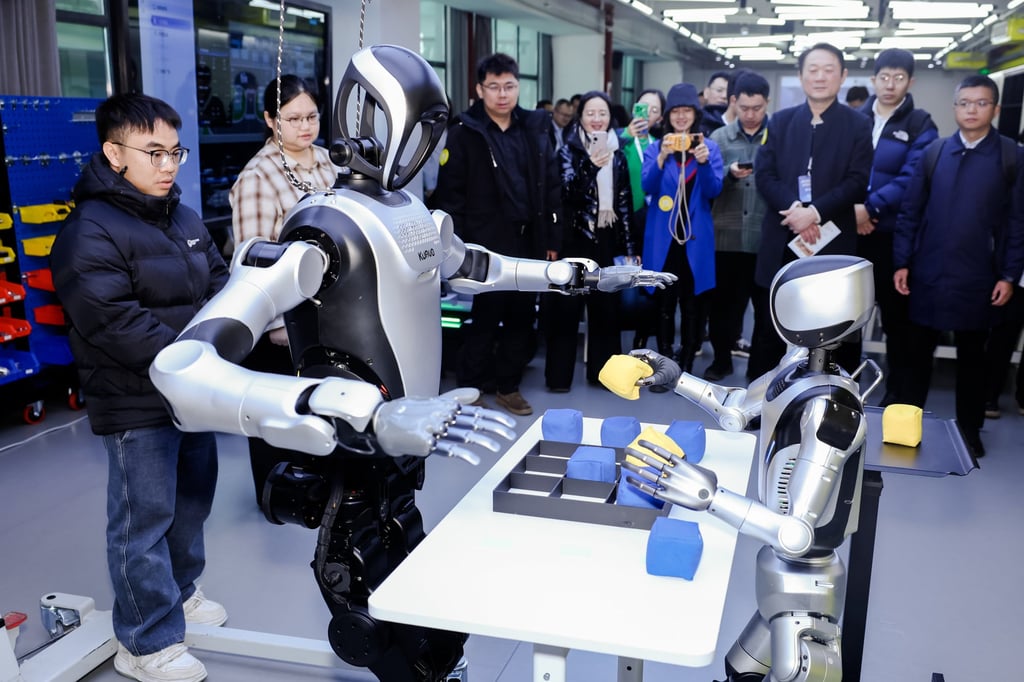
Visitors explore AI and robotics applications at last March’s launch event for Huawei’s AIPL at Beijing Institute of Technology, reflecting broader efforts to integrate AI into higher education and practical training.

Visitors explore AI and robotics applications at last March’s launch event for Huawei’s AIPL at Beijing Institute of Technology, reflecting broader efforts to integrate AI into higher education and practical training.