

惯性聚合 高效追踪和阅读你感兴趣的博客、新闻、科技资讯
阅读原文 在惯性聚合中打开

推荐订阅源

IT之家
IT之家
aimingoo的专栏
aimingoo的专栏
H
Help Net Security
L
LangChain Blog
M
MIT News - Artificial intelligence
The GitHub Blog
The GitHub Blog
H
Hackread – Cybersecurity News, Data Breaches, AI and More
C
Check Point Blog
P
Proofpoint News Feed
J
Java Code Geeks
大猫的无限游戏
大猫的无限游戏
博客园_首页
Blog — PlanetScale
Blog — PlanetScale
U
Unit 42
I
InfoQ
月光博客
月光博客
爱范儿
爱范儿
Stack Overflow Blog
Stack Overflow Blog
V
Visual Studio Blog
Y
Y Combinator Blog
Microsoft Security Blog
博客园 - Franky
D
Docker
B
Blog

Tech - South China Morning Post

Multinational pharmaceutical companies to benefit from new China guidelines: analysts Hong Kong lawmaker swipes at US lack of ‘clarity’ as city eyes crypto lead China’s Hesai adds colour to lidar to help EVs level up in self-driving ‘State-of-the-art’ models can struggle with basic office work, says AI executive Opinion | As AI evolves, school syllabuses must evolve with it Winner of second Beijing robot half-marathon smashes human world record by 6 minutes Asia’s supply chains could give it edge over US in AI race: Granite Asia’s Foo Chinese software firms defy ‘SaaSpocalypse’ with strategic AI partnerships Huawei retains lead in China smartphones, Apple shipments surge in first quarter China’s drug makers are speeding up – will AI be their secret weapon? Hong Kong seen leading Asia in push to scale stablecoins, HSBC says ByteDance, Tencent step up AI talent battle amid reports of DeepSeek loss White House and Anthropic CEO discuss working together amid Mythos AI fears Chinese LED chipmaker’s purchase of Dutch firm collapses after US opposition How Amazon uses closer China supply ties to counter tariffs, Shein and Temu ‘Horrible’ for US if DeepSeek AI models run on Huawei chips: Nvidia CEO Chinese platforms fined 3.6b yuan over ‘ghost’ takeaways amid cutthroat rivalry Manycore, one of Hangzhou’s ‘Six Little Dragons’, surges on Hong Kong IPO debut How the rise of AI agents could finally make China’s open-source models pay ‘Buy what they can, steal what they can’t’: US lawmakers slam China’s AI tactics China’s lithium giant Ganfeng sees profit jump as EV, ESS battery demand soars Chinese tech giants, AI ‘godmother’ Li Fei-Fei race into world models Black market workarounds scale up for Claude as Anthropic tightens ID checks TSMC targets over 30% revenue surge in 2026, ramps up capex amid AI boom BrainCo’s brain-computer interface wows at HSBC summit with mind-controlled hand Chinese investors cheer Tesla’s AI chip progress, boosting shares of suppliers ASML boosts 2026 sales forecast despite shrinking China sales China’s EV battery giant CATL to set up mining arm to secure supply chain From ‘probing minds’ to verified account: how Musk’s stance on TikTok shifted Amazon bets on Shenzhen smart warehouse to cut merchant storage costs by 45%
Chinese start-up tackles fusion energy software bottlenec...
Wency Chen · 2026-06-21 · via Tech - South China Morning Post

For decades, fusion energy has sat at the edge of humanity’s clean-energy imagination – a promise of virtually limitless power that always seems just out of reach. But for Xie Huasheng, a fusion theorist and plasma simulation scientist, the industry finally has a tangible way to shorten its costly trial-and-error cycle: better software.

“Fusion simulation software has long faced an ‘impossible triangle’,” Xie said. Existing tools, he argued, tend to be either accurate but computationally expensive, fast but unreliable, or simple in principle but too crude to allow accurate extrapolation and guide next-generation reactor design.

“We are now at a turning point,” Xie said, noting that the performance of more than a dozen physics design and analysis models had improved sharply, driven by refined mathematical structures and advances in artificial intelligence that improved research efficiency.

In April, Xie founded VeloAlpha, a Beijing-based start-up building “FusionAlpha” – a simulator designed to help developers test reactor designs on computers before committing to expensive physical experiments.

He likened it to electronic design automation (EDA) software in the semiconductor industry, where chipmakers test and optimise designs long before they go to the wafer foundry.
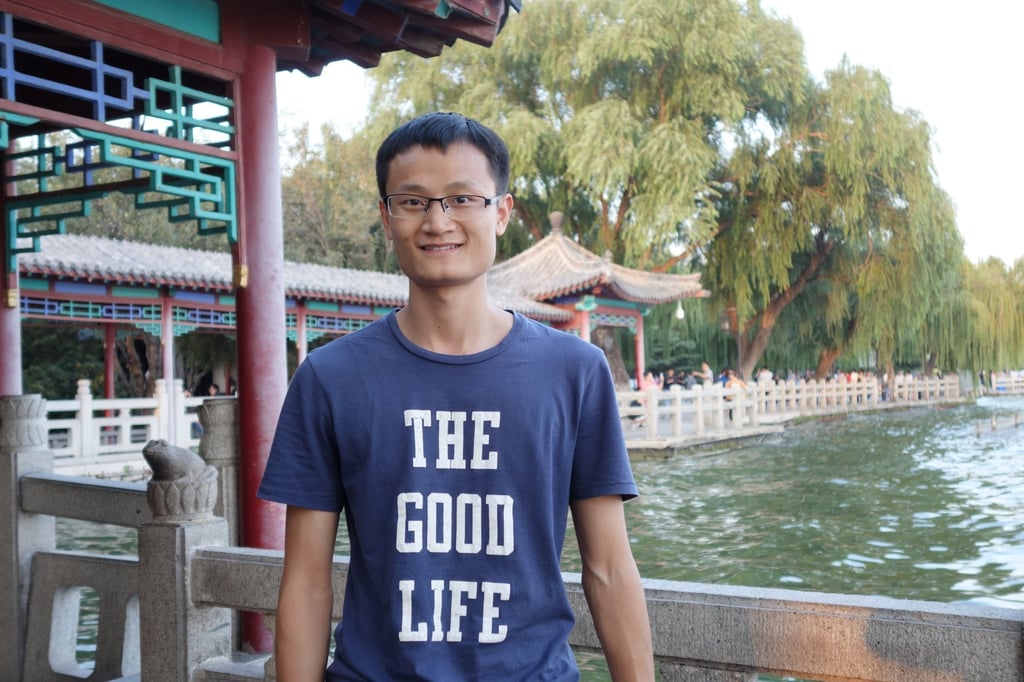
VeloAlpha founder Xie Huasheng has spent much of his career developing mathematical and software tools for modelling fusion plasma. Photo: Handout

VeloAlpha founder Xie Huasheng has spent much of his career developing mathematical and software tools for modelling fusion plasma. Photo: Handout

Fusion is the reaction that powers the sun, releasing massive amounts of energy when nuclei of light atoms are forced to collide and merge. To recreate this cosmic process on Earth, scientists have to heat fuel until it becomes an extremely hot, electrically charged gas called plasma, and hold it stable long enough for the reaction to keep going.