

惯性聚合 高效追踪和阅读你感兴趣的博客、新闻、科技资讯
阅读原文 在惯性聚合中打开

推荐订阅源

Martin Fowler
Martin Fowler
Microsoft Security Blog
freeCodeCamp Programming Tutorials: Python, JavaScript, Git & More
Vercel News
Vercel News
Y
Y Combinator Blog
D
DataBreaches.Net
IT之家
IT之家
Cyber Security Advisories - MS-ISAC
博客园_首页
钛媒体:引领未来商业与生活新知
钛媒体:引领未来商业与生活新知
H
Hackread – Cybersecurity News, Data Breaches, AI and More
WordPress大学
WordPress大学
H
Help Net Security
GbyAI
GbyAI
C
Check Point Blog
L
LangChain Blog
小众软件
小众软件
T
The Blog of Author Tim Ferriss
MyScale Blog
MyScale Blog
G
Google Developers Blog
月光博客
月光博客
V
V2EX
M
MIT News - Artificial intelligence
博客园 - 叶小钗

Tech - South China Morning Post

Multinational pharmaceutical companies to benefit from new China guidelines: analysts Hong Kong lawmaker swipes at US lack of ‘clarity’ as city eyes crypto lead China’s Hesai adds colour to lidar to help EVs level up in self-driving ‘State-of-the-art’ models can struggle with basic office work, says AI executive Opinion | As AI evolves, school syllabuses must evolve with it Winner of second Beijing robot half-marathon smashes human world record by 6 minutes Asia’s supply chains could give it edge over US in AI race: Granite Asia’s Foo Chinese software firms defy ‘SaaSpocalypse’ with strategic AI partnerships Huawei retains lead in China smartphones, Apple shipments surge in first quarter China’s drug makers are speeding up – will AI be their secret weapon? Hong Kong seen leading Asia in push to scale stablecoins, HSBC says ByteDance, Tencent step up AI talent battle amid reports of DeepSeek loss White House and Anthropic CEO discuss working together amid Mythos AI fears Chinese LED chipmaker’s purchase of Dutch firm collapses after US opposition How Amazon uses closer China supply ties to counter tariffs, Shein and Temu ‘Horrible’ for US if DeepSeek AI models run on Huawei chips: Nvidia CEO Chinese platforms fined 3.6b yuan over ‘ghost’ takeaways amid cutthroat rivalry Manycore, one of Hangzhou’s ‘Six Little Dragons’, surges on Hong Kong IPO debut How the rise of AI agents could finally make China’s open-source models pay ‘Buy what they can, steal what they can’t’: US lawmakers slam China’s AI tactics China’s lithium giant Ganfeng sees profit jump as EV, ESS battery demand soars Chinese tech giants, AI ‘godmother’ Li Fei-Fei race into world models Black market workarounds scale up for Claude as Anthropic tightens ID checks TSMC targets over 30% revenue surge in 2026, ramps up capex amid AI boom BrainCo’s brain-computer interface wows at HSBC summit with mind-controlled hand Chinese investors cheer Tesla’s AI chip progress, boosting shares of suppliers ASML boosts 2026 sales forecast despite shrinking China sales China’s EV battery giant CATL to set up mining arm to secure supply chain From ‘probing minds’ to verified account: how Musk’s stance on TikTok shifted Amazon bets on Shenzhen smart warehouse to cut merchant storage costs by 45%
Opinion | China-UK cooperation vital in ensuring the AI e...
Shaoshan Liu · 2026-06-11 · via Tech - South China Morning Post

During a recent discussion in Shenzhen with British Foreign Secretary Yvette Cooper, I was reminded that the development of artificial intelligence (AI) is no longer only a technological race. It is a test of whether major economies can build the institutions, standards and economic systems needed to integrate intelligent machines into human society.

Britain has every reason to enter this new era with confidence. It has contributed to much of the modern world’s foundations. In 1687, Isaac Newton published Philosophiae Naturalis Principia Mathematica, helping establish the scientific world view that made modern engineering and the Industrial Revolution possible. In 1776, Adam Smith published The Wealth of Nations, giving the industrial age one of its most influential economic models: division of labour, specialisation, markets, trade and capital accumulation.

In the 20th century, Alan Turing laid the intellectual foundation for computation and machine intelligence. His work helped define what computation is, and later opened one of the most profound questions of the modern age: whether machines can think.

This history matters. The AI era needs both technological confidence and viable economic systems. Britain has helped provide both. It should not see the AI age only as a challenge from larger markets or faster-moving competitors. It should see it as another moment when its strengths in science, political economy, law, education and governance can help shape the rules of a new era.

China, meanwhile, has developed at extraordinary speed over the past few decades. In particular, it has built the world’s strongest manufacturing and robotics capabilities, along with supply-chain resilience and large-scale application ecosystems. There is little doubt that China will be one of the global powerhouses of the AI age. From smart manufacturing and AI deployment, there is no question that China’s scale and engineering capacity matter.

Clearly, both countries have a role to play. The real question is whether Britain or China can cooperate on problems that neither country can solve alone.
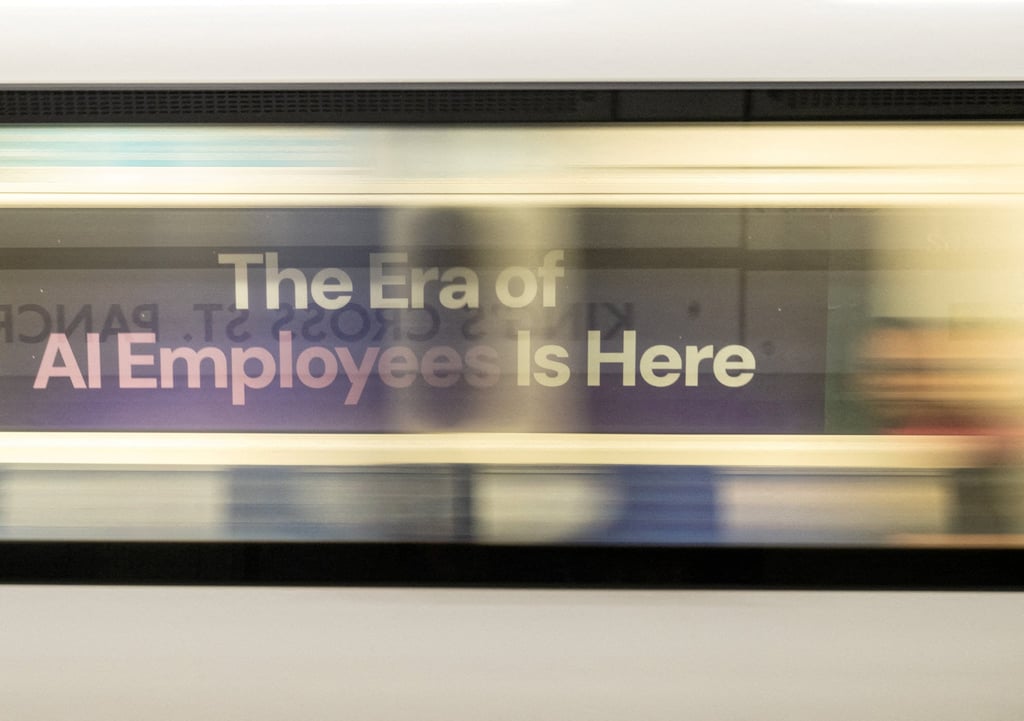
A London Underground train passes an advertisement for a company promoting AI in London in 2025. Photo: Reuters

A London Underground train passes an advertisement for a company promoting AI in London in 2025. Photo: Reuters