


惯性聚合 高效追踪和阅读你感兴趣的博客、新闻、科技资讯
阅读原文 在惯性聚合中打开

推荐订阅源

Hugging Face - Blog
Hugging Face - Blog
Vercel News
Vercel News
C
Check Point Blog
G
Google Developers Blog
博客园 - 司徒正美
量子位
Engineering at Meta
Engineering at Meta
S
SegmentFault 最新的问题
Google DeepMind News
F
Fortinet All Blogs
A
About on SuperTechFans
美团技术团队
D
DataBreaches.Net
Stack Overflow Blog
Stack Overflow Blog
Jina AI
Jina AI
Y
Y Combinator Blog
奇客Solidot–传递最新科技情报
奇客Solidot–传递最新科技情报
Apple Machine Learning Research
J
Java Code Geeks
MongoDB | Blog
MongoDB | Blog
人人都是产品经理
人人都是产品经理
H
Hackread – Cybersecurity News, Data Breaches, AI and More
The Cloudflare Blog
U
Unit 42

Tech - South China Morning Post

Multinational pharmaceutical companies to benefit from new China guidelines: analysts Hong Kong lawmaker swipes at US lack of ‘clarity’ as city eyes crypto lead China’s Hesai adds colour to lidar to help EVs level up in self-driving ‘State-of-the-art’ models can struggle with basic office work, says AI executive Opinion | As AI evolves, school syllabuses must evolve with it Winner of second Beijing robot half-marathon smashes human world record by 6 minutes Asia’s supply chains could give it edge over US in AI race: Granite Asia’s Foo Chinese software firms defy ‘SaaSpocalypse’ with strategic AI partnerships Huawei retains lead in China smartphones, Apple shipments surge in first quarter China’s drug makers are speeding up – will AI be their secret weapon? Hong Kong seen leading Asia in push to scale stablecoins, HSBC says ByteDance, Tencent step up AI talent battle amid reports of DeepSeek loss White House and Anthropic CEO discuss working together amid Mythos AI fears Chinese LED chipmaker’s purchase of Dutch firm collapses after US opposition How Amazon uses closer China supply ties to counter tariffs, Shein and Temu ‘Horrible’ for US if DeepSeek AI models run on Huawei chips: Nvidia CEO Chinese platforms fined 3.6b yuan over ‘ghost’ takeaways amid cutthroat rivalry Manycore, one of Hangzhou’s ‘Six Little Dragons’, surges on Hong Kong IPO debut How the rise of AI agents could finally make China’s open-source models pay ‘Buy what they can, steal what they can’t’: US lawmakers slam China’s AI tactics China’s lithium giant Ganfeng sees profit jump as EV, ESS battery demand soars Chinese tech giants, AI ‘godmother’ Li Fei-Fei race into world models Black market workarounds scale up for Claude as Anthropic tightens ID checks TSMC targets over 30% revenue surge in 2026, ramps up capex amid AI boom BrainCo’s brain-computer interface wows at HSBC summit with mind-controlled hand Chinese investors cheer Tesla’s AI chip progress, boosting shares of suppliers ASML boosts 2026 sales forecast despite shrinking China sales China’s EV battery giant CATL to set up mining arm to secure supply chain From ‘probing minds’ to verified account: how Musk’s stance on TikTok shifted Amazon bets on Shenzhen smart warehouse to cut merchant storage costs by 45%
Opinion | Beyond subsidies: what’s really driving China’s...
Zongshuai Fa · 2026-05-03 · via Tech - South China Morning Post

Zongshuai Fan is a senior policy analyst at Cambridge Industrial Innovation Policy, University of Cambridge, whose expertise spans manufacturing and intellectual property.

Driven by intensifying competition in advanced manufacturing, the world is waking up to “China shock 2.0”. The first “shock”, associated with China’s accession to the World Trade Organization in 2001, focused on low-tech manufacturing.

Of course, this latest “shock” isn’t framed as such by Chinese policymakers. They present it as an upgrade in export strength, often described as a shift from the “old three” of textiles, furniture and home appliances to the “new three” of electric vehicles, batteries and solar panels.

What many abroad call “China shock 2.0” is a marker of industrial upgrading and a reflection of long-standing national strategies.

Beijing is also not waiting for the world to fully digest this latest wave. As of late 2025, official messaging has begun promoting artificial intelligence (AI), industrial robots and innovative medicines as the “newer three”, pointing to their rising presence in global markets. This is not just domestic cheerleading. These sectors are also drawing growing attention internationally.

It may be too early to place the “newer three” on the same footing as the previous trios, given their relatively combined smaller export base and the likelihood that the composition will change. Still, the trajectory is striking. It took roughly two decades for China to climb from the “old three” to the “new three”. Just years after the “new three” entered the spotlight, Beijing is already signalling what’s next.

Industrial subsidies are the explanation many reach for. Public funding is indeed part of the story, especially in frontier sectors such as AI. Compared with the United States, China has relied more heavily on state-backed channels than private capital. Government funds invested an estimated US$184 billion in AI firms between 2000 and 2023.
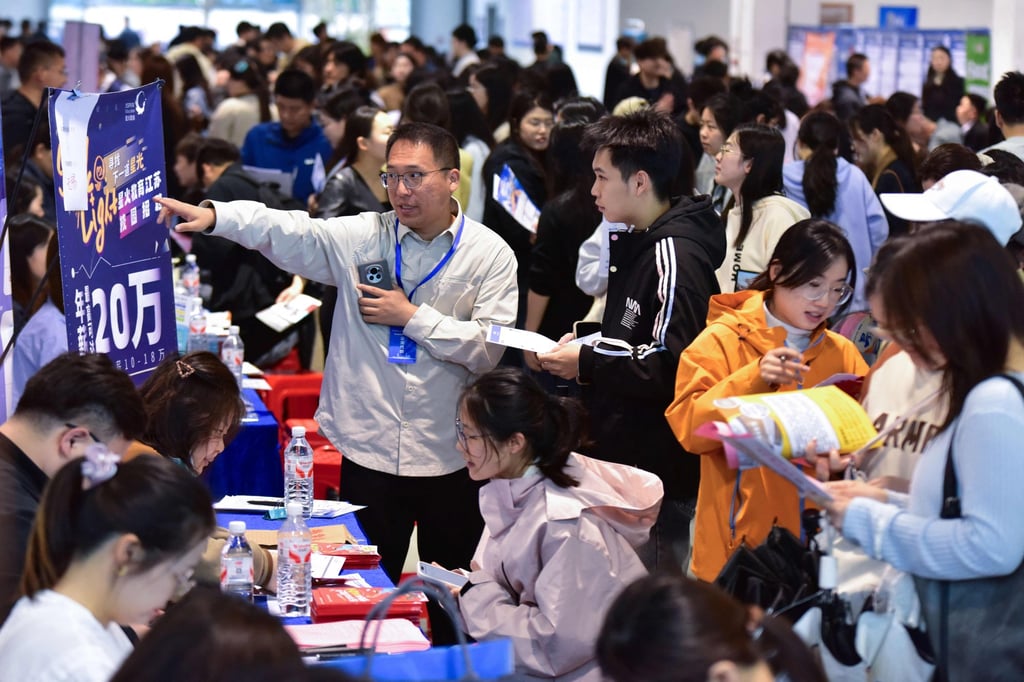
University students attend a job fair in Fuyang, Anhui province, on April 28. Photo: CN-STR / AFP

University students attend a job fair in Fuyang, Anhui province, on April 28. Photo: CN-STR / AFP