




惯性聚合 高效追踪和阅读你感兴趣的博客、新闻、科技资讯
阅读原文 在惯性聚合中打开

推荐订阅源

S
SegmentFault 最新的问题
爱范儿
爱范儿
博客园 - Franky
OSCHINA 社区最新新闻
OSCHINA 社区最新新闻
WordPress大学
WordPress大学
宝玉的分享
宝玉的分享
雷峰网
雷峰网
酷 壳 – CoolShell
酷 壳 – CoolShell
IT之家
IT之家
有赞技术团队
有赞技术团队
美团技术团队
Last Week in AI
Last Week in AI
奇客Solidot–传递最新科技情报
奇客Solidot–传递最新科技情报
大猫的无限游戏
大猫的无限游戏
The Cloudflare Blog
Jina AI
Jina AI
钛媒体:引领未来商业与生活新知
钛媒体:引领未来商业与生活新知
Engineering at Meta
Engineering at Meta
T
Tailwind CSS Blog
J
Java Code Geeks
Martin Fowler
Martin Fowler
I
InfoQ
小众软件
小众软件
MongoDB | Blog
MongoDB | Blog

Robotics - South China Morning Post

From cars to humanoids: Xpeng boss takes over robotics unit in ‘strategic pivot’ New Chinese police tech uses AI to scan suspects’ health and mental states From dance to factory floor: China moves to fast track humanoids into industry China’s EV giants challenge Tesla in race to commercialise humanoid robots Indonesian police in the market for hi-tech Chinese equipment Chinese researchers tackle AI training bottleneck for household robots US public cheers dancing Unitree robots while Congress looks to ban them China just beat Nvidia on a global robotics ranking. Is a new tech war brewing? Opinion | How foreign investors should view China’s ‘little giants’ scheme Unitree clears Shanghai IPO hurdle as China’s humanoid robot wave gathers pace World of humanoid robots set for new blueprint as Nvidia teams with Asian firms ‘Arms race’: why investors can’t let go of robotic hand developers in China Alibaba, Tencent lead pivot from chatbots to embodied AI for robotics Unitree’s IPO progress spurs stock buying of firms with exposure to robot maker As China’s humanoid-robot hype cools, Unitree sees profit plunge ‘Sharif speed’ meets Qwen AI: how Alibaba sealed a sweeping deal with Pakistan Every humanoid robot in China set to receive personal identification number Ancient Chinese texts show ‘immortal mirror’ linking to early notion of robots Inside the Chinese auto-glass maker whose chairman sat beside Elon Musk Why Singapore wants to become the world’s ‘living lab’ for physical AI China unveils first humanoid robot for household chores, ready as early as 2027 Chinese firm Xpeng builds driverless cabs, challenging Tesla’s FSD software Editorial | China’s AI-enabled robots set to transform global playing field Unitree debuts US$574,000 ‘mecha’ robot that ‘transforms’ from 2 legs to 4 Robots to the rescue? South Korea looks for solutions to falling army numbers China robotics to drive next chapter of manufacturing dominance: Morgan Stanley Baggage bots: Chinese humanoids clock on at Japanese airports amid labour crunch Hype or real: China’s robot boom faces reality check as commercialisation lags China’s robots step into real-world roles, from cleaning to directing traffic Exiting China market a ‘self-inflicted wound’ for US tech, think tank warns
Xiaomi deepens push into chips and AI as peers race to de...
Mia Nurmamat · 2026-02-25 · via Robotics - South China Morning Post

Xiaomi is doubling down on its five-year plan for core technologies including chips, artificial intelligence and operating systems, aiming to position itself as a deep-tech player amid China’s self-reliance push, while peers such as Li Auto and Xpeng accelerate moves into humanoid robotics.

Lei Jun, founder, chairman and CEO of the Beijing-based smartphone and electric vehicle giant, on Tuesday said private technology firms must deepen investment in core technologies and speed up the commercialisation of innovation.

“Private enterprises’ biggest advantage is their proximity to the market and users,” Lei said in an interview with state-run China News Service. “They can respond quickly and rapidly apply new technologies to real-world scenarios, forming scalable products and solutions.”

Xiaomi had invested more than 100 billion yuan (US$14.5 billion) in research and development over the past five years, achieving breakthroughs in self-developed chips and other core technologies, according to the report.

Lei’s remarks echoed comments he made at a company awards ceremony last month, where he said Xiaomi expected to integrate its in-house chip, operating system and self-developed large AI model in a single device this year. At that event, Lei pledged 200 billion yuan over the next five years in core technology research, targeting breakthroughs in foundational areas such as chips, operating systems and AI, while also advancing innovation in robotics.
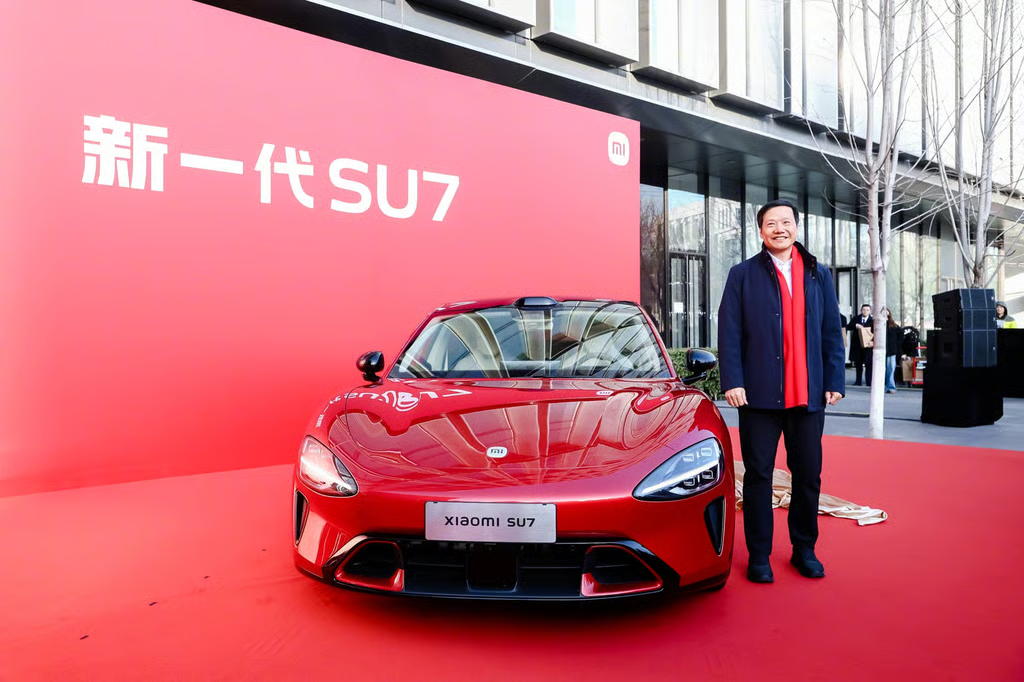
Xiaomi CEO Lei Jun says the biggest advantage of private enterprises is their proximity to the market and users. Photo: Handout

Xiaomi CEO Lei Jun says the biggest advantage of private enterprises is their proximity to the market and users. Photo: Handout

Lei’s interview came about a year after President Xi Jinping met leading private technology entrepreneurs, part of Beijing’s broader effort to bolster private-sector confidence and reinforce resilience in its tech rivalry with the US.