
惯性聚合 高效追踪和阅读你感兴趣的博客、新闻、科技资讯
阅读原文 在惯性聚合中打开

推荐订阅源

Hugging Face - Blog
Hugging Face - Blog
GbyAI
GbyAI
Engineering at Meta
Engineering at Meta
有赞技术团队
有赞技术团队
博客园 - 【当耐特】
H
Hackread – Cybersecurity News, Data Breaches, AI and More
WordPress大学
WordPress大学
博客园_首页
美团技术团队
H
Help Net Security
MongoDB | Blog
MongoDB | Blog
宝玉的分享
宝玉的分享
大猫的无限游戏
大猫的无限游戏
小众软件
小众软件
J
Java Code Geeks
A
About on SuperTechFans
让小产品的独立变现更简单 - ezindie.com
IT之家
IT之家
T
The Blog of Author Tim Ferriss
Microsoft Azure Blog
OSCHINA 社区最新新闻
OSCHINA 社区最新新闻
B
Blog
雷峰网
雷峰网
爱范儿
爱范儿

Coco Feng - South China Morning Post

Shein clears Hong Kong IPO hurdle as valuation halves to below US$50b: sources Chinese state-owned firms set up chip funds for long-term innovation Breaking | Shein receives approval for Hong Kong IPO from Chinese regulators Game-changer? Why China is finally letting its AI firms buy the Nvidia H200 Why Alibaba shares just scored their strongest gains in Hong Kong this year China records most new unicorn start-ups in 5 years as AI and robotics boom Final insurance frontier: Hong Kong sees opening in mainland China’s space boom How a Chinese physical AI start-up’s new paradigm bypasses US road maps Dishing the dirt: official media alleges smear tactics in delivery battle Zhipu AI market cap tops HK$1 trillion after GLM-5.2 release Chinese AI improves forecasts as Hong Kong braces for super typhoons Alibaba and JD.com targeted in smear campaign ahead of shopping festival Who pays when rockets explode? China rushes to insure SpaceX’s rivals Microsoft cuts hundreds of mainland cloud jobs, as China, US tighten data laws Part boat, part plane, part sci-fi: China debuts consumer watercraft China just beat Nvidia on a global robotics ranking. Is a new tech war brewing? Want to save the planet? Stop being so polite to AI chatbots Alibaba elevates tech chief Wu Zeming to elite committee amid AI push Mainland Chinese locked out of Computex Taipei amid cross-strait tensions ‘Arms race’: why investors can’t let go of robotic hand developers in China Kuaishou beats estimates as Kling AI video tool’s revenue jumps 300% Huawei’s workaround for US chip curbs faces hurdles on road to self-reliance China told the solar industry to cut capacity. Firms built new factories anyway China unveils first humanoid robot for household chores, ready as early as 2027 China’s Moonshot AI moves to unwind offshore structure in IPO pursuit: sources Trump, Xi weigh AI ‘guard rails’ as Nvidia chip exports hang in the balance Alibaba shares surge 7% in Hong Kong as firm accelerates pivot to AI Why are Chinese stock markets hitting record highs ahead of Trump’s visit? Nvidia’s Jensen Huang joins Trump’s trip to China at last minute ByteDance raises 2026 capex by at least 25% amid AI boom, sources say
Huawei chips refine DeepSeek model in leap for China’s AI...
Coco Feng · 2026-06-05 · via Coco Feng - South China Morning Post

A research team that includes Huawei Technologies says it has successfully used the firm’s Ascend 910C chips to complete post-training for the DeepSeek-V4-Pro model, marking a major step forward as China’s semiconductor industry tries to leap from supporting basic AI inference to more complex model training amid tightening US sanctions.

While Chinese chipmakers have found success in supporting AI inference – the relatively simple process of running an already-finished model to answer user prompts – they have struggled with training, the far more complex process of building or refining a model’s brain.

If initial “pre-training” teaches a model how to speak by absorbing massive amounts of data, post-training teaches it how to work by following human instructions, safety rules and specific tasks.
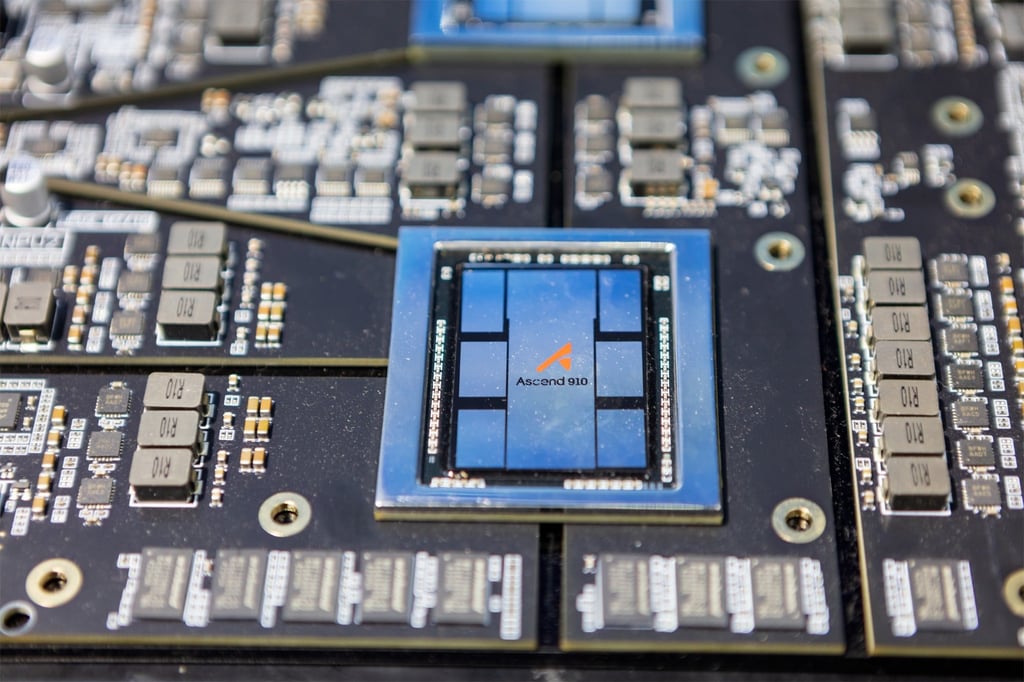
A Huawei Ascend 910 processor is displayed during PT Expo China in 2023. Photo: Shutterstock Images

A Huawei Ascend 910 processor is displayed during PT Expo China in 2023. Photo: Shutterstock Images

To achieve this, the researchers ran DeepSeek’s largest model to date – boasting 1.6 trillion parameters – on a computing cluster powered by at least 1,000 Huawei chips, according to a social media post from the Shenzhen government on Friday.

The team successfully conducted “full-parameter” post-training, meaning the model’s entire architecture was updated and refined without cutting corners, the post said.

Previously, domestic computing power was primarily used for inference, “much like building a one-way road for the model: input a question, output an answer”, the post explained. The project, however, allowed a model to self-reflect and adjust.

This added “complex flyovers and loops to that one-way road, instantly multiplying the computational and communication demands by several times”, it added.

The exploration – jointly conducted by Huawei, the Shenzhen Loop Area Institute, the Shenzhen campus of Harbin Institute of Technology and Shenzhen Research Institute of Big Data – “will help enhance the self-reliance of China’s AI industry chain”, the post said.