





Getty
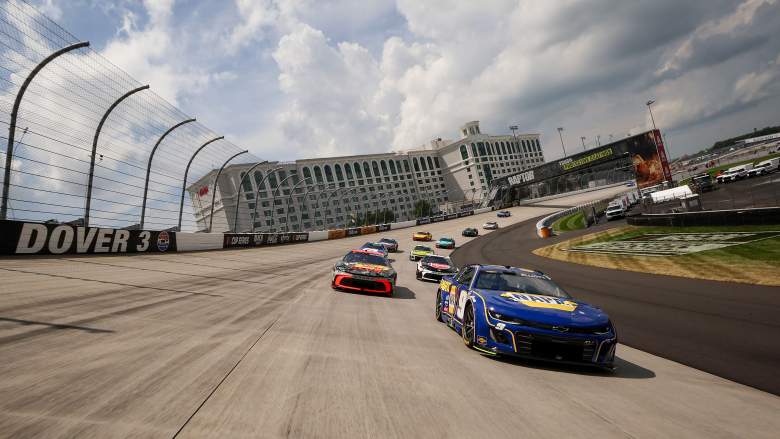
Chase Elliott and Chase Briscoe lead the field during a NASCAR Cup Series race at Dover Motor Speedway. Warmer temperatures are expected to create changing track conditions during NASCAR All-Star Weekend.
NASCAR heads to Dover Motor Speedway this weekend for the All-Star Race with weather expected to stay dry throughout all three days — but that does not mean conditions will be easy on drivers.
In fact, the weekend forecast could quietly become one of the bigger competitive storylines entering the exhibition event.
Current forecasts call for temperatures climbing steadily throughout the weekend, beginning with Friday highs in the upper 60s before jumping into the 80s Saturday and approaching 90 degrees by Sunday afternoon. While rain is not currently expected to play a significant role, the warmer temperatures could dramatically change how Dover’s concrete surface behaves over the course of the weekend.
That especially matters at a track like Dover.
Known as “The Monster Mile,” Dover’s steep banking and concrete racing surface already create some of the most physically demanding conditions on the NASCAR schedule. As temperatures rise, teams could be forced to manage changing grip levels, tire wear and long-run balance throughout All-Star weekend.
Sunday’s forecast currently calls for partly cloudy skies with temperatures approaching 90 degrees during the afternoon.
That type of heat can significantly impact track temperature, particularly on Dover’s concrete surface, which tends to evolve differently compared to traditional asphalt tracks.
As track temperatures rise, drivers often describe Dover becoming “slick,” with cars losing rear grip on corner exit and fighting balance over longer runs.
The issue becomes even more important during an All-Star event, where shorter race segments and aggressive driving styles often place extra emphasis on handling and track position.
Unlike longer points races where teams can sometimes recover through pit strategy, exhibition-style racing typically rewards drivers who unload with speed immediately and adapt quickly to changing track conditions.
Dover has long been considered one of the most unique tracks in NASCAR because of its concrete surface and high banking.
The one-mile oval routinely produces heavy tire falloff, long green-flag runs and physically demanding racing conditions for drivers. As temperatures climb into the weekend, maintaining rear grip over extended runs could become increasingly difficult.
Friday’s cooler temperatures may also create a noticeable transition into the hotter conditions expected later in the weekend.
Teams that find speed during practice under cooler conditions could discover their setups behaving very differently once temperatures rise Saturday and Sunday.
That creates another variable entering NASCAR’s All-Star weekend, especially with limited track time available to dial in handling changes.
While heat may affect track conditions, the overall forecast currently appears favorable for NASCAR to complete the weekend without major weather disruptions.
Friday’s forecast calls for partly cloudy skies and highs around 69 degrees. Saturday is expected to be mostly sunny with temperatures reaching the low 80s before Sunday becomes the warmest day of the weekend.
At this point, rain chances remain minimal across all three days.
That should allow NASCAR to avoid the scheduling uncertainty that often becomes a major storyline during spring race weekends.
Still, with temperatures expected to climb steadily throughout the weekend, teams may find themselves dealing with an entirely different kind of challenge once the green flag drops at Dover.
Maggie MacKenzie Maggie MacKenzie covers NASCAR for Heavy.com. She previously worked for NASCAR.com, where she reported, wrote, and edited race-weekend coverage and traveled to key events throughout the season. She has more than ten years of experience in sports media and is based in Boston, Massachusetts. More about Maggie MacKenzie
此内容由惯性聚合(RSS阅读器)自动聚合整理,仅供阅读参考。 原文来自 — 版权归原作者所有。