惯性聚合 高效追踪和阅读你感兴趣的博客、新闻、科技资讯
阅读原文 在惯性聚合中打开

推荐订阅源

N
News and Events Feed by Topic
Malwarebytes
Malwarebytes
Threat Intelligence Blog | Flashpoint
C
Cybersecurity and Infrastructure Security Agency CISA
F
Future of Privacy Forum
C
Cisco Blogs
T
The Exploit Database - CXSecurity.com
A
Arctic Wolf
S
Securelist
K
Kaspersky official blog
S
Schneier on Security
T
ThreatConnect
T
Tenable Blog
Spread Privacy
Spread Privacy
T
True Tiger Recordings
AWS News Blog
AWS News Blog
F
Fox-IT International blog
量子位
T
Threatpost
V
Vulnerabilities – Threatpost
C
CERT Recently Published Vulnerability Notes
Cisco Talos Blog
Cisco Talos Blog
GbyAI
GbyAI
宝玉的分享
宝玉的分享
腾讯CDC
G
Google Developers Blog
aimingoo的专栏
aimingoo的专栏
Cyberwarzone
Cyberwarzone
有赞技术团队
有赞技术团队
S
SegmentFault 最新的问题
OSCHINA 社区最新新闻
OSCHINA 社区最新新闻
V
Visual Studio Blog
U
Unit 42
雷峰网
雷峰网
cs.CV updates on arXiv.org
Simon Willison's Weblog
O
OpenAI News
freeCodeCamp Programming Tutorials: Python, JavaScript, Git & More
The GitHub Blog
The GitHub Blog
The Register - Security
MyScale Blog
MyScale Blog
小众软件
小众软件
A
About on SuperTechFans
Last Week in AI
Last Week in AI
Y
Y Combinator Blog
博客园 - 三生石上(FineUI控件)
美团技术团队
Google Online Security Blog
P
Proofpoint News Feed
MongoDB | Blog
MongoDB | Blog

Freshly Pressed - WordPress.com

Beedle-dee beedle-dee dee Tu Hi Re…. These Gray Hairs Emotional Connection Guest Post from my Daughter- 5/10/26 Lost in LA: Silver Lake Something to Think About Some of us hated having to go to school. Ah well, somehow we all learnt something along the way. Tiny Hearts, Big Inspiration Planning Without a Helmet: Lessons from Motorcycles, War, and Life Of State Of Self-Sufficiency Through Blood, I Am Yours #Writerproblems: Publishing Trends Antisocial media. Can You Do It? Stressed First, Do No Harm Better with Age SoCS — Life Hacks Little League Legend Quietly Exiting from the Noise & Nonsense - Sereneluna Talking with Pregnant Mothers Living Authentically: Key Lessons from ‘Just Who Will You Be?’ God’s other book: Dandelions believers (a Sermon) Why Southampton Wore Yellow: From 1976 Glory to 2026 Tribute To You, 229 years ago Lagos – Lost & Found Three dozen baseballs How I said hello and goodbye to my friend Stephen Tell my story- the silence of the good people…. Survival Isn’t Earth’s Problem. It’s Ours. Book Chat: The Joy of Signed Books a man decides to go for a walk. The Me I Become When I Travel To Prank or Not to Prank Gloria Has an Egg Hunt. The Road by Francisco Bravo Cabrera and Gabriela Marie Milton – A Poem – The Courage to Stop Beach peace The Space They Took From You (And How to Take It Back) John Ripley, the Marine Who Blew Up the Dong Ha Bridge, to Receive the Medal of Honor Peacock Robinia in Machine Translation I Fell Down Serenity in Shades of Gray The Philosophy of a Hobby Missing teeth A Mosquito in the Ear: One Family’s Honest Adoption Story through a Graphic Novel Why Opening Day is My Favorite Day of the Year Writing, and Reading
We Can See What Stars Are Made of
thomasstigwi · 2026-05-25 · via Freshly Pressed - WordPress.com

Super fact 101: We can see what stars are made of and calculate their speed and distance compared to us just by looking at their light.
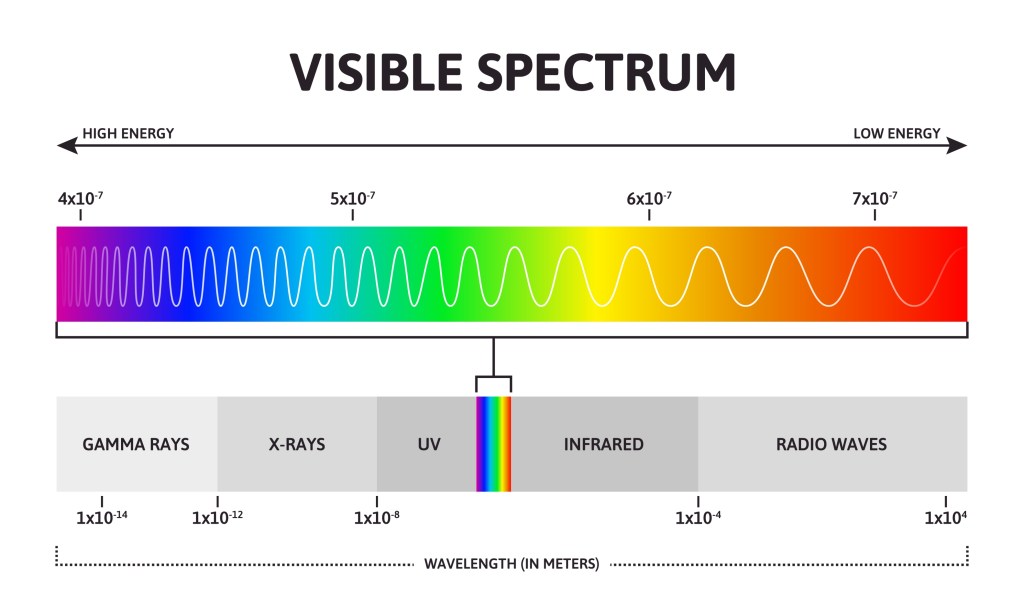
The picture shows the spectrum visible to humans as a horizontal bar at the top. This spectrum is superimposed on a wider spectrum below as a thin rainbow colored strip. The wider spectrum is also placed horizontally and goes from gamma rays to radio waves. | We Can See What Stars Are Made of
The visible color spectrum. Sunlight wavelength and increasing frequency vector infographic illustration. Visible spectrum color range. Rainbow electromagnetic waves. Educational physics line. Shutterstock Asset id: 1933622132 by Shutterstock Asset id: 1933622132 WinWin artlab.

Electromagnetic radiation, including visible light, features a lot of different frequencies, which for light correspond to different colors. Red has a lower frequency, and blue has a higher frequency. For more information about the electromagnetic spectrum and light see Human Vision Only Detects a Sliver of the EM Spectrum.

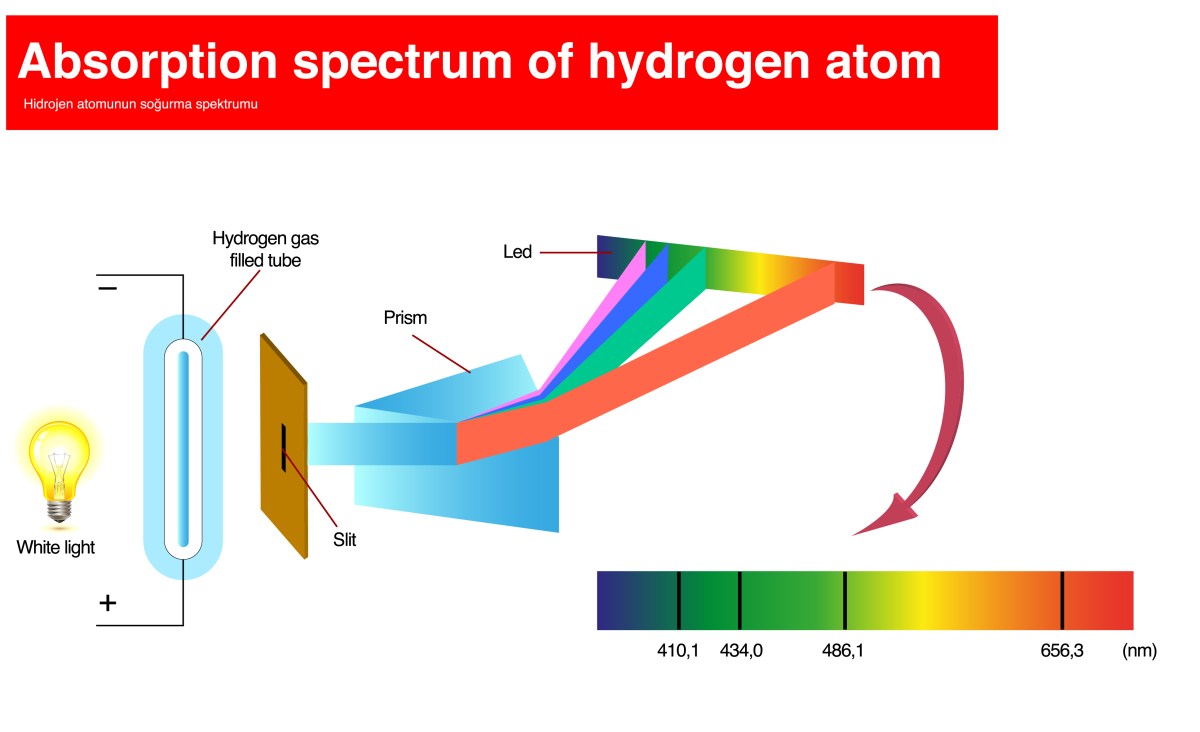
If you place a light bulb (white light includes a spectrum of colors) in front of a container filled with hydrogen and then you let the light pass through a prism, it will split into the different colors (red, yellow, blue, etc.) forming a rainbow, as prisms do. You see this every time you see a rainbow in nature. However, if you measure carefully, as in the experimental setup below, you will  notice that some frequencies are missing. That’s because the hydrogen gas will absorb certain frequencies.

This is true, not just for hydrogen, but for all elements/atoms and molecules. Atoms and molecules have light absorption patterns that are unique to the atom/element in question. The dark lines in the spectra are referred to as Frauenhofer lines. In a sense, all elements have a thumb print resulting from their so called absorption spectra. This makes it possible to identify the elements in a star and their proportions.
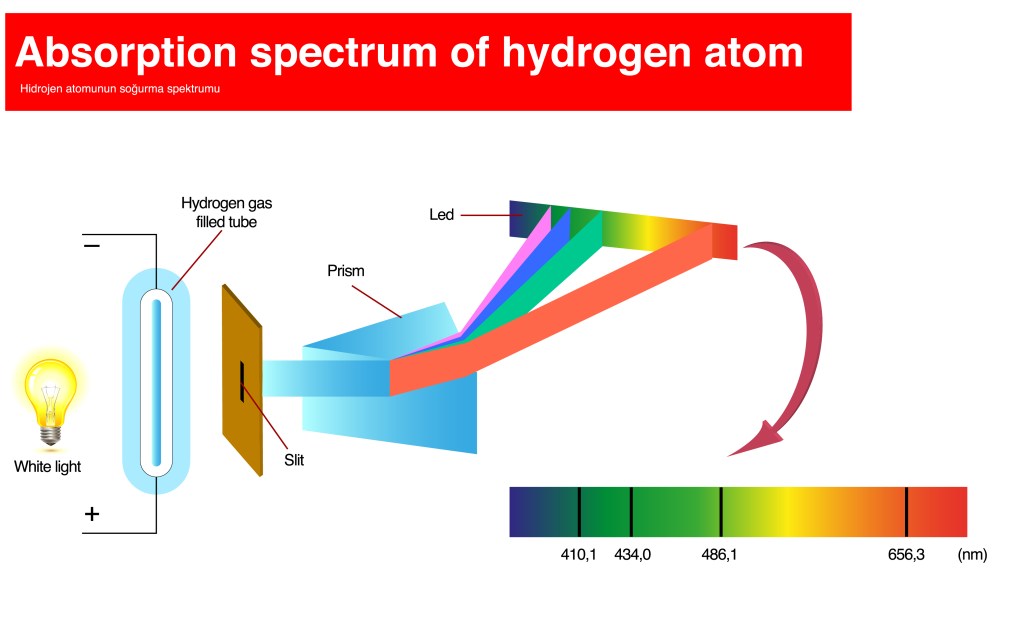
On the left a light bulb generating white light, which is split into a rainbow by a prism. On the wall behind the prism you’ll see all the colors, except a few frequencies indicated by black lines, will be missing.
Absorption spectrum / Frauenhofer lines of the hydrogen atom. Shutterstock asset id: 1305568666 by Emir Kaan

Before the discovery of absorption spectra, it was sometimes believed that humanity would never know the chemical elements of stars. Even today many people are surprised to hear that we can indeed know what stars are composed of just by looking at their light. In addition to identifying elements in the upper layers / atmosphere of stars you can use the same absorption spectra to determine the relative velocity of stars compared to us and sometimes the distance to the stars.  This is an old discovery that is surprising and important to our understanding of the world and therefore a super fact in my opinion.

Examples of Absorption Spectra

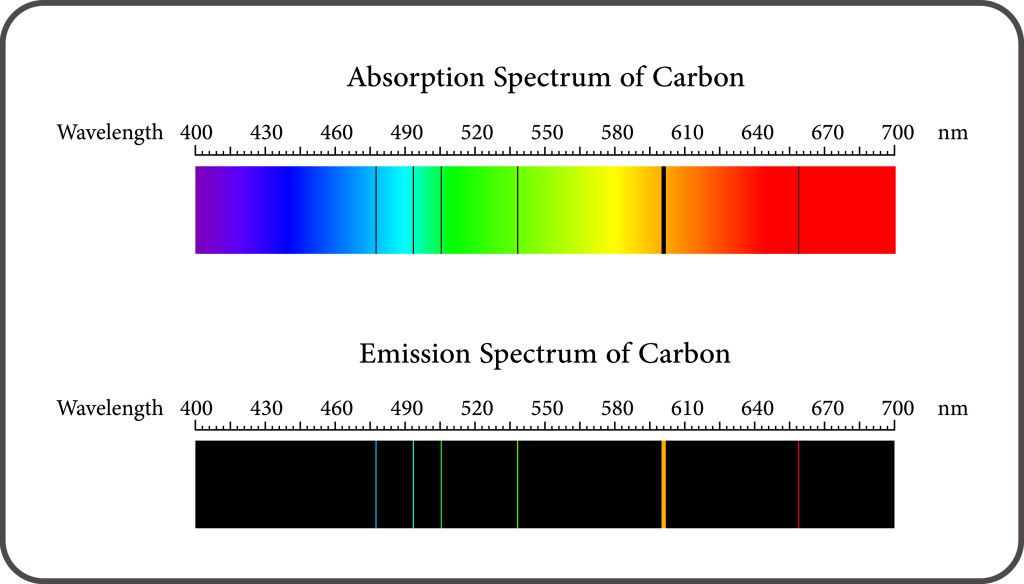
An interesting, related fact is that Helium was discovered in the Sun before it was found on Earth, with the help of emission spectra (August 18, 1868). Emission spectra are the opposite of absorption spectra. It should be noted that while emission spectra are commonly used for identifying the composition of interstellar gas, absorption spectra are commonly used for identifying the composition of stars.
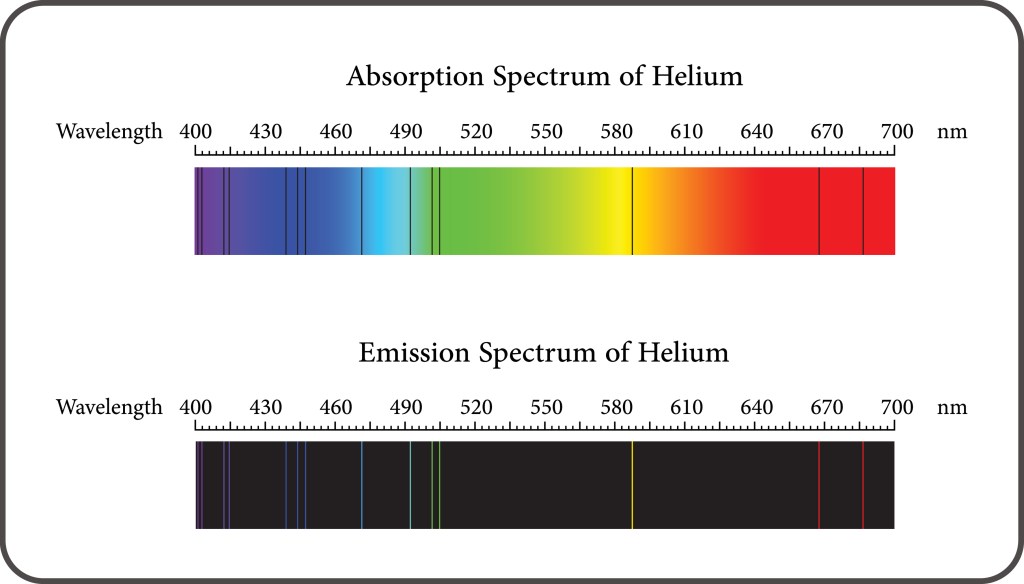
Absorption spectra showing the colors of visible light with black lines characteristic for Helium.
Absorption and Emission Spectrum of Helium Shutterstock asset id: 1724296909 by MoFarouk
Absorption spectra showing the colors of visible light with black lines characteristic for Carbon.
Absorption and Emission Spectrum of Carbon Shutterstock asset id: 1725934867 by MoFarouk
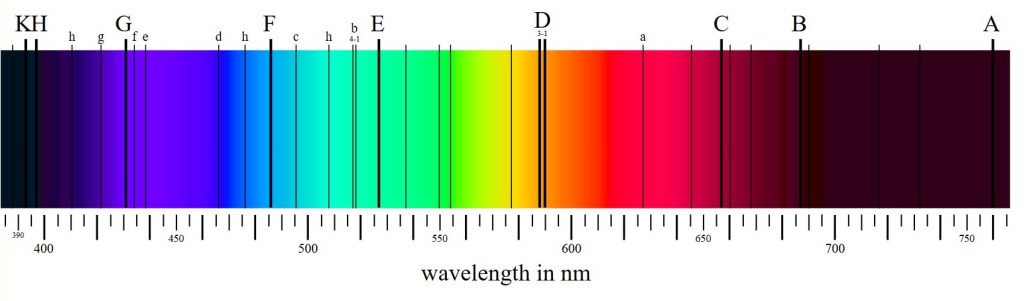
Absorption spectra showing the colors of visible light with black lines characteristic for the sun. | We Can See What Stars Are Made of
Solar spectrum with Fraunhofer lines as it appears visually. The solar spectrum is a combination of spectra from multiple elements: nl:Gebruiker:MaureenVSpectrum-sRGB.svg: Phrood~commonswikiFraunhofer_lines_DE.svg: *Fraunhofer_lines.jpg: Saperaud 19:26, 5. Jul. 2005derivative work: Cepheiden (talk)derivative work: Cepheiden, Public domain, via Wikimedia Commons.

Using Redshift to Determine how fast Stars are Moving Compared to us

A star or galaxy that is moving towards us will have a blue shifted spectrum. A star or galaxy that is moving away from us will have a red shifted spectrum. Red shifted means that the absorption lines have moved towards red because the frequency of the light has been shifted due to the motion.

This is called the doppler effect. You can notice this phenomenon for the case of sound when an ambulance is coming towards you and then speeding by you. The sound changes. The astronomer Hubble was using redshift to the determine that the further away a galaxy was from us the faster it was moving away from us. Measuring the redshift of a faraway galaxy or star, not only tells us its speed compared to us but can indirectly help us determine the distance to the galaxy or star.
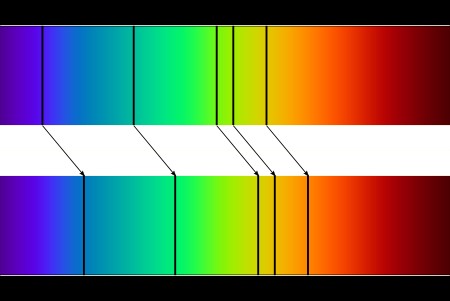
The top shows a colorful spectrum from blue to red with absorption lines in black. The bottom portion of the picture shows the same thing expect the black absorption lines have moved a bit to the right. | We Can See What Stars Are Made of
Visualization of redshifted absorption lines are redshifted due to velocity away from observer. Top lines are for an object at rest and in the bottom picture the object is moving away. Maxmath12, CC0, via Wikimedia Commons. This file is made available under the Creative Commons CC0 1.0 Universal Public Domain Dedication.

There are other things you can tell from the light from stars and from their electromagnetic spectrum such as the type of star, the size of the star, and the age of the star, but that is for another post. This post is long enough.


To see the other Super Facts click here

Unknown's avatar

My name is Thomas Wikman. I am a software/robotics engineer with a background in physics. I am currently retired. I took early retirement. I am a dog lover, and especially a Leonberger lover, a home brewer, craft beer enthusiast, I’m learning French, and I am an avid reader. I live in Dallas, Texas, but I am originally from Sweden. I am married to Claudia, and we have three children. I have two blogs. The first feature the crazy adventures of our Leonberger Le Bronco von der Löwenhöhle as well as information on Leonbergers. The second blog, superfactful, feature information and facts I think are very interesting. With this blog I would like to create a list of facts that are accepted as true among the experts of the field and yet disputed amongst the public or highly surprising. These facts are special and in lieu of a better word I call them super-facts.