







In today’s digital era, protecting personal information is paramount. The privacy policy URL serves as a critical tool in this endeavor, ensuring transparency and building user trust.
This guide aims to provide comprehensive insights into the process of crafting and effectively showcasing one.
🔎 Let’s delve deeper into navigating the world of Privacy Policy URLs:
- What is a Privacy Policy
- What is a Privacy Policy URL
- Creating Privacy Policy URL
- Privacy Policy URL Placement
- FAQs
What is a Privacy Policy?
A Privacy Policy is a legal document that details how a business collects, uses, shares, and manages personal data. It’s mandated by global privacy laws and is unique to each business’s data practices.
What is a Privacy Policy URL?
It serves as the direct link to where your Privacy Policy is made available online. It is essential to meet legislation requirements by making your Privacy Policy accessible, and one effective method to achieve this is by offering a URL link to your policy that can be easily found and accessed at any moment.
This necessity extends to app developers seeking to collaborate with major platforms like Facebook and Apple, who are frequently asked to submit the link during the app registration process.
Typically, the preferred approach is to host your Privacy Policy yourself, facilitating updates and maintaining control.
This can be accomplished in a couple of key ways:
- By incorporating the URL in the footer of your website
- By integrating the URL within your mobile app’s navigational menu or its app store description
Creating Privacy Policy URL
The journey to a robust privacy policy begins with understanding the types of personal data you collect, from email addresses to browsing habits. Options range from using a free privacy policy generator for basic needs to consulting legal experts for more complex scenarios.
The key lies in making this policy easily accessible, typically through a link in your website’s footer, ensuring compliance and user convenience.
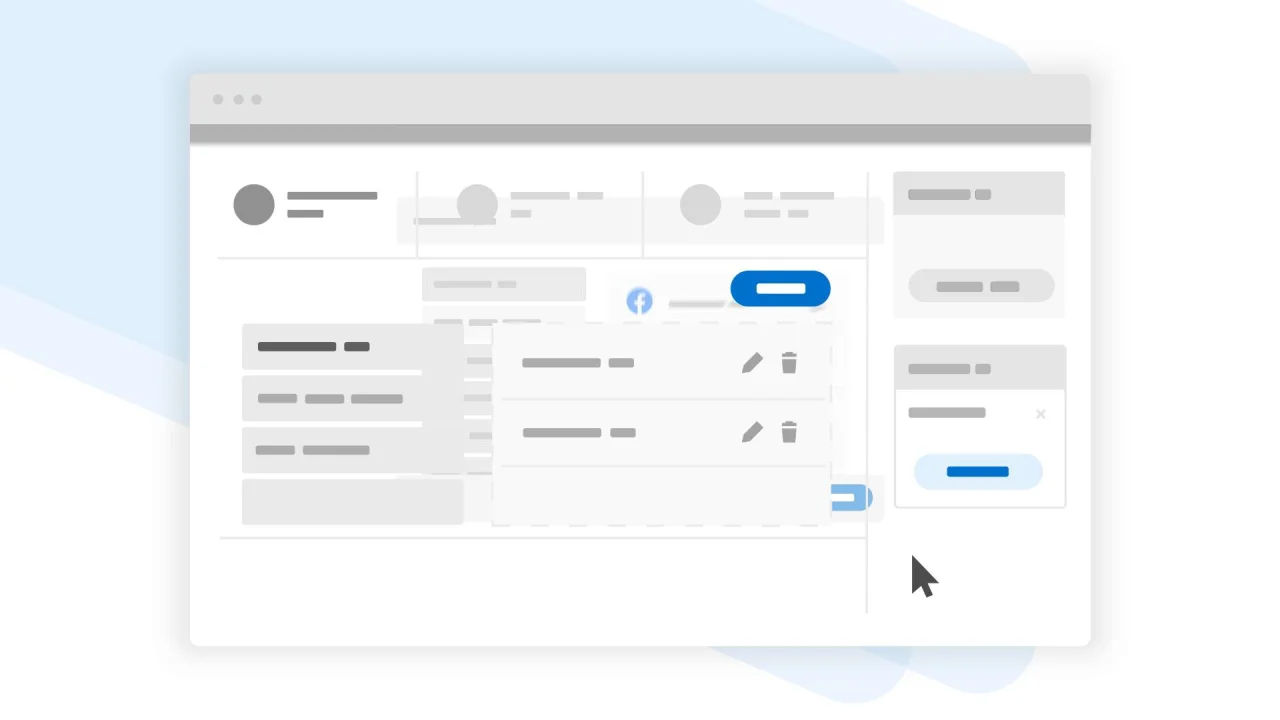
FREE PRIVACY POLICY GENERATOR
Generate your fully customizable Privacy Policy in minutes
Generate a free Privacy Policy for your website that is customizable, professional, and drafted by an international legal team. A simple way to handle compliance.
0:37
0:22
See it in action (0:37)
Privacy Policy URL Placement
Displaying your Privacy Policy URL prominently on your website is key to complying with privacy laws (like the GDPR or the CCPA/CPRA) and making the policy accessible to the public. A common and effective placement is within the website’s footer, a location users are accustomed to checking for such links, ensuring its visible on every page for easy access.
An exemplary implementation of this can be seen on our website, where the link is featured in our site’s footer alongside other crucial links.
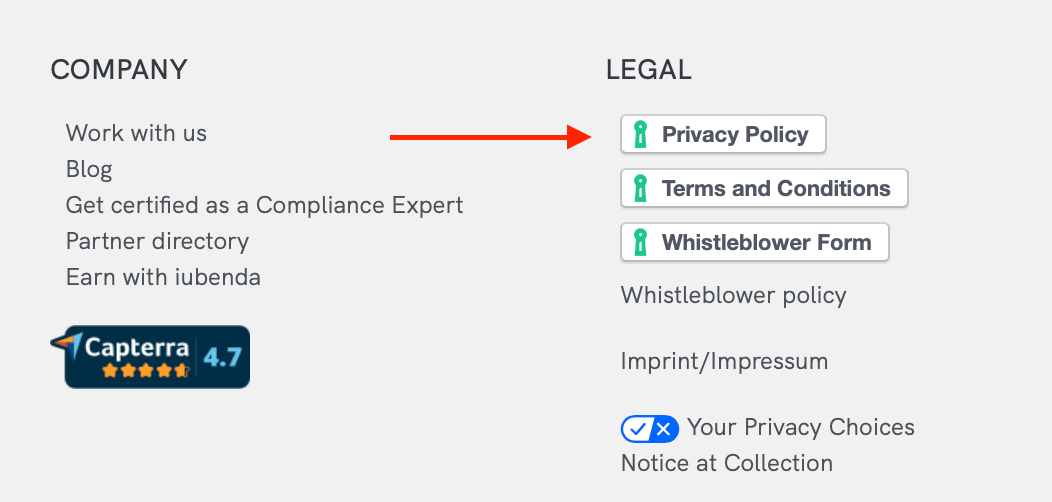
This is not only meets legal requirements but also reinforces your commitment to user privacy. As a data controller, it’s your responsibility to ensure that your privacy policy is clear, accessible, and reflects your current data practices.
FAQs
1. Where do I find my privacy policy URL?
- Answer: The privacy policy URL for your website or application is typically located in the footer or within the settings or legal section. If you’re looking for the privacy policy of a service you’re using, it’s often found at the bottom of the homepage or under a menu labeled ‘Legal’, ‘Privacy’, or ‘Terms & Conditions’. For personal websites or apps, if you have created a privacy policy, the URL is the web address where this policy is published.
2. What is a privacy notice URL?
- Answer: A privacy notice URL is a direct link (URL) to a sites Privacy Policy. This includes information about what personal data is collected, how it’s used, stored, and shared, as well as users’ rights regarding their data.
3. How do I get a privacy policy URL on Facebook Developer?
- Answer: To get one for your app on Facebook Developer, first, you need to create a privacy policy for your app. Once you have the policy, host it on a public website. Then, log in to your Facebook Developer account, go to ‘My Apps’, select your app, and navigate to ‘Settings’ > ‘Basic’. Here, you will find a field to enter the URL of your privacy policy. Ensure that the URL is publicly accessible so that Facebook can review it.
4. Where is the privacy policy on a website?
- Answer: On most websites, the privacy policy can be found at the bottom of the webpage, often in the footer. It may be labeled as ‘Privacy Policy’, ‘Privacy Notice’, or something similar. Alternatively, it can also be found in the website’s menu, usually under sections like ‘About’, ‘Legal’, ‘Terms & Conditions’, or ‘Settings’. For a comprehensive understanding, it’s advisable to read through the entire policy, especially on websites where you provide personal information.