






Update on Data Privacy in the EU: IAB Europe Advocates for Public Consultation on ‘Consent or Pay’ Model
Brussels, Belgium, 19 March 2024 – A coalition of digital associations, including IAB Europe, Alliance Digitale, IAB Italia, and IAB Spain, has officially addressed the European Data Protection Board (EDPB). In a joint letter, they articulate crucial points for consideration regarding the EDPB’s forthcoming Opinion and Guidelines on the ‘Consent or Pay’ model. The group calls for a public consultation, stressing the necessity for the EDPB’s stance to reflect current EU and EEA case law and guidelines, and advocating for cooperation with competition and consumer protection bodies to define “reasonable” pricing standards.
The associations underscore public sentiment favoring the choice between paid services and ad-supported content, defending the model against critiques that it equates to “paying” for data protection rights. They assert that compliance with the GDPR is paramount, regardless of the payment or consent given by users.
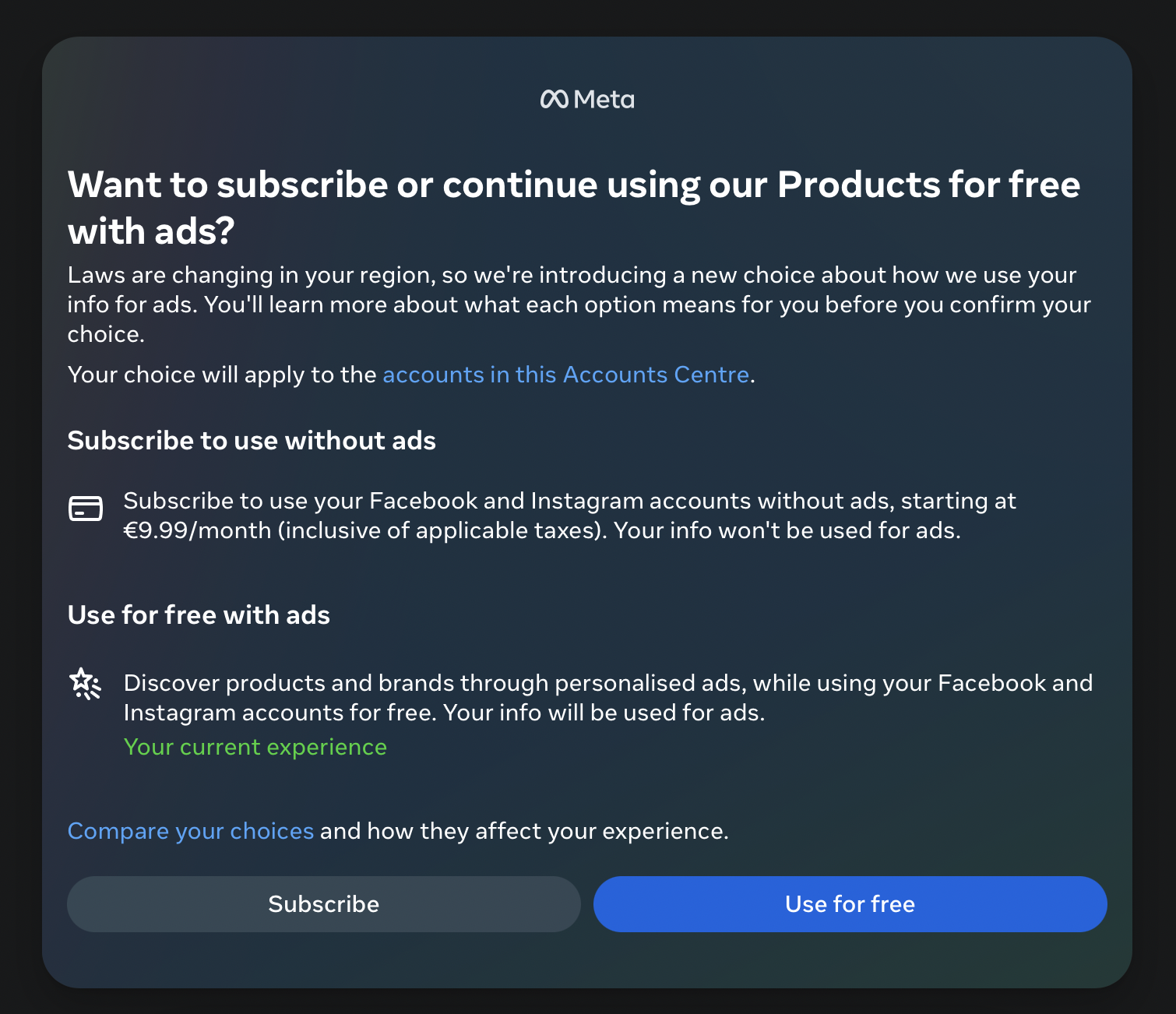
You might have seen by now: Meta has launched a paid subscription option across its platforms, Facebook and Instagram. This Facebook subscription allows end users to subscribe for a fully ad-free experience. According to Meta, this paywall is a way of complying with European regulations.
Meta’s “Pay or OK” Model Under Scrutiny in Europe
Meta’s “Pay or OK” subscription model, allowing users to opt for an ad-free experience on platforms like Facebook and Instagram in exchange for a fee, has attracted significant attention and concern across Europe. Members of the European Parliament, Paul Tang and Kim Van Sparrentak, have sought clarity from the European Commission on the legality of this model, questioning its compliance with data protection regulations.
European consumer organizations from eight countries, including Czechia, Denmark, Greece, France, Norway, Slovakia, Slovenia, and Spain, have filed complaints against Meta’s subscription model. These complaints, coordinated by the pan-European consumer group BEUC, argue that Meta’s data collection practices through this model violate the EU’s General Data Protection Regulation (GDPR). BEUC’s Deputy Director General, Ursula Pachl, emphasized the need for data protection authorities to address Meta’s “unfair data processing” and its infringement on fundamental rights.
The European Data Protection Board (EDPB) is expected to make a decision regarding the “Pay or OK” model, which could influence global data collection standards. This decision is particularly relevant as it could affect the ongoing reform of Australia’s Privacy Act, highlighting concerns that such models support “surveillance-based business models.”
Moreover, the European Commission has formally requested information from Meta under the Digital Services Act, focusing on the company’s advertising practices, recommendation systems, and risk assessments related to its subscription model. This request indicates the Commission’s proactive stance in ensuring digital services operate within legal frameworks.
In the UK, the Information Commissioner’s Office (ICO) has initiated a “call for views” to explore how “Pay or OK” models can comply with regulations concerning third-party cookies. This move reflects the ICO’s commitment to updating cookie compliance guidelines while considering the practical implications for businesses and digital advertising stakeholders.
As regulatory bodies and consumer organizations continue to scrutinize Meta’s subscription model, the outcome of these inquiries and complaints could have significant implications for privacy standards and digital advertising practices worldwide.
Update: European Commission’s Preliminary Findings on Meta’s Compliance with the Digital Markets Act
The European Commission has issued its preliminary findings regarding Meta’s “Pay or Consent” model, determining it to be in breach of the Digital Markets Act (DMA). According to the Commission, Meta’s advertising model does not comply with the DMA requirements, as it forces users into a binary choice: either consent to the combination of their personal data or lose access to certain services, without offering a less personalized but equivalent version of Meta’s social networks.
Under Article 5(2) of the DMA, gatekeepers like Meta are required to seek users’ consent for combining their personal data across designated core platform services and other services. If a user refuses to give such consent, they must still be provided access to a less personalized but equivalent alternative. The law prohibits gatekeepers from making access to the service or specific functionalities conditional upon the user’s consent.
The Commission’s preliminary view highlights the necessity for Meta to adjust its advertising model to comply with these regulations, ensuring that users have a genuine choice regarding their personal data.
Update
NOYB files a complaint against Meta with the Austrian Data Protection Authority. European users face a controversial choice on Instagram and Facebook: consent to data tracking for personalized ads or pay a substantial annual fee of up to €251.88 for their data privacy. This practice, seen as a “privacy fee,” is criticized for its high cost. Industry statistics reveal a mere 3% of users favor tracking, with over 99% avoiding payment when confronted with such fees. The precedent set by Meta could lead to wider implications – if unchallenged, similar strategies by other companies could mean privacy costs soaring to about €8,815 yearly for an average smartphone user with 35 apps.
Following the complaint by noyb, the European Consumer Organization (BEUC), along with 18 of its member organizations, lodged a formal grievance with the European Commission on November 30, targeting Meta’s controversial “pay-or-consent” model as a violation of EU consumer law. This move by BEUC marks a distinct approach from that of noyb; instead of addressing a national data protection authority, BEUC brought its case directly to the European Commission, framing its accusations primarily as infringements of EU consumer legislation rather than EU data protection statutes.
What is a Facebook subscription?
On October 30, 2023, Meta announced a new subscription model for Facebook and Instagram. Users in the EU, European Economic Area and Switzerland can now choose whether to continue to use Meta platforms for free, with personalized ads, or pay a fee to stop seeing ads.
The price of the Meta subscription varies depending on the device used:
- €9.99/month on the web;
- €12.99/month on iOS and Android.
Meta’s decision is a way of responding to complaints regarding its data processing activities and complying with European regulations. Earlier this year, the European Data Protection Board (EDPB) had declared that Meta’s method of bypassing user consent was unlawful. The Court of Justice of the European Union (CJEU) also backed this view, confirming that Meta’s data usage practices were illegal in the EU from 2018 to 2023.
Are paywalls allowed in the EU?
According to the GDPR, consent should always be freely given. That’s why EU Data Protection Authorities are generally against the use of a paywall. However, in the last year, more and more EU DPAs have declared that the paywall system would be acceptable if users are properly informed about what they are consenting to and the paywall system actually provides an equal alternative to consent.
The discussion around this topic is still quite heated. However, Meta isn’t the first company to implement a paywall on its platforms. Many others – mostly publishers – have already introduced a paid option as a way of respecting users’ privacy rights while preserving their ability to be profitable.
Lawful ways to recover consent
If you’re a publisher or a business that monetizes content, then you should know that there are a few effective ways for consent recovery, that can help you optimize your earnings while respecting users’ privacy rights.
For example, iubenda has meticulously crafted several features that bridge the gap for optimal consent rates and a satisfying user journey, to help you boost your revenue:
- Our Consent Recovery feature allows you to display a custom message instead of the pre-blocked scripts and iframes, maximizing your opportunities to obtain users’ consent.
- Our flexible Cookie Paywall strategically limits access to content based on user consent preferences.
- Our Reverse Proxy guarantees uninterrupted cookie consent collection, by navigating around ad-blockers.
iubenda makes it really easy for you to set up and choose the consent recovery method that’s best for you!
About us

Attorney-level solutions to make your websites and apps compliant with the law across multiple countries and legislations.