




惯性聚合 高效追踪和阅读你感兴趣的博客、新闻、科技资讯
阅读原文 在惯性聚合中打开

推荐订阅源

Know Your Adversary
Know Your Adversary
小众软件
小众软件
L
LangChain Blog
月光博客
月光博客
博客园 - Franky
Microsoft Azure Blog
Y
Y Combinator Blog
有赞技术团队
有赞技术团队
奇客Solidot–传递最新科技情报
奇客Solidot–传递最新科技情报
MongoDB | Blog
MongoDB | Blog
Recorded Future
Recorded Future
V
Visual Studio Blog
TaoSecurity Blog
TaoSecurity Blog
S
Schneier on Security
C
Cybersecurity and Infrastructure Security Agency CISA
P
Privacy & Cybersecurity Law Blog
T
Threat Research - Cisco Blogs
D
DataBreaches.Net
L
LINUX DO - 热门话题
C
Check Point Blog
F
Fortinet All Blogs
Hugging Face - Blog
Hugging Face - Blog
The Hacker News
The Hacker News
钛媒体:引领未来商业与生活新知
钛媒体:引领未来商业与生活新知
Microsoft Security Blog
酷 壳 – CoolShell
酷 壳 – CoolShell
V
V2EX
让小产品的独立变现更简单 - ezindie.com
The GitHub Blog
The GitHub Blog
P
Proofpoint News Feed
L
Lohrmann on Cybersecurity
博客园 - 司徒正美
T
Threatpost
P
Palo Alto Networks Blog
A
About on SuperTechFans
Spread Privacy
Spread Privacy
Engineering at Meta
Engineering at Meta
N
News | PayPal Newsroom
T
Tailwind CSS Blog
The Last Watchdog
The Last Watchdog
Blog — PlanetScale
Blog — PlanetScale
A
Arctic Wolf
量子位
Exploit-DB.com RSS Feed
博客园 - 聂微东
Google Online Security Blog
Google DeepMind News
www.infosecurity-magazine.com
V
Vulnerabilities – Threatpost
H
Hacker News: Front Page

Compliance Solutions for Websites, Apps and Organizations | iubenda

AI can build your website. It can't manage your consent. | iubenda Browser signals and machine-readable consent: what they are and what the EU’s Digital Omnibus could change California Consumer Privacy Act (CCPA): Complete Guide How to increase your cookie banner opt-in rates: 5 mistakes to fix today | iubenda DPO Newsletter: Global Data Protection & Privacy News (issue #153) Why your consent management setup is a marketing performance question Everything you need to know about GDPR The redesigned cookie banner and configurator What nobody tells you about handing over the company you built European marketers are betting on retention. Privacy could be the edge they’re not using yet. The 5 best alternatives to Didomi in 2026: Pros, cons, pricing, and comparison Looking back on 15 years: what iubenda's founder would tell his 2011 self | iubenda The best cookie policy generator in 2026 DPO Newsletter: Global Data Protection & Privacy News (issue #152) | iubenda What publishers should expect from the EU’s Digital Omnibus proposal Uncertainty is the biggest blocker to AI adoption in marketing | iubenda Everything AI app builders need to know about vibecoding and privacy compliance | iubenda Introducing 1-Click Embedding for Google Tag Manager The Essential Small Business Terms and Conditions Template: What You Need to Know Terms of Use Template | iubenda IAB Europe Raises Concerns Over GDPR Procedural Regulation Draft Report | iubenda Learn from HelloFresh's Costly Mistake: Ensure Compliance with iubenda | iubenda Understanding the Spanish DPA Guide on Audience Measurement Cookies | iubenda The Austrian Data Protection Authority's FAQs on Cookies and Privacy | iubenda DPO Newsletter: Global Data Protection & Privacy News (issue #127) | iubenda Microsoft Ensuring European Data Stays Within the EU Cloud Boundary | iubenda Businesses Beware: ICO’s Record £14.3m in Fines for Data Misuse in 2023 Understanding the Risks and Responsibilities of Model-as-a-Service Companies in AI Development Facebook's New “Link History” Feature: A Blend of Convenience and Surveillance? | iubenda OpenAI’s Strategic Move in the EU: Aligning with Data Privacy Regulations TikTok Faces Lawsuit Over Tracking Non-Users What’s the Digital Markets Act (DMA) and how will it affect you? | iubenda Simplifying Cookie Consent: The European Commission's Approach | iubenda Google Settles Landmark Privacy Lawsuit for $5 Billion | iubenda Navigate GDPR Compliance with Confidence: Lessons from Recent Fines in Italy Simplifying the Commission's New Reporting Template for Digital Market Gatekeepers | iubenda Understanding the GDPR Complaint Against X (Twitter) for Illegal MicroTargeting | iubenda Spanish Media Giants Take On Meta in a Groundbreaking $600 Million Lawsuit | iubenda DPO Newsletter: Data Protection & Privacy News (issue #126) | iubenda Belgian DPA Mandates Cookie Banner Changes for Major Media Websites | iubenda UK's Top Websites Warned by ICO to Revise Cookie Practices | iubenda Understanding the European Union's Data Act | iubenda Google Announces Consent Mode v2 – here’s what it means for your business and advertising Noyb Challenges EU Commission Over Controversial Ad Campaign | iubenda OECD Updates AI Definition: A Step Forward in Shaping EU’s AI Law Firefox To Introduce Simplified Global Privacy Control Berlin Court Cracks Down on LinkedIn’s Privacy Violations The YouTube Ad Blocker Controversy: A Test of the ePrivacy Directive? | iubenda DPO Newsletter: Data Protection & Privacy News (issue #125) Facebook and Instagram Subscription: Meta adds a paywall | iubenda GDPR Violation: Lack of Transparency in Data Processing via Google Fonts Amazon Introduces AWS European Sovereign Cloud to Address EU Regulations | iubenda Texas New Data Privacy Law TDPSA: Everything you need to know How to Make Money with a Website Without Selling Anything Oregon Consumer Privacy Act: Overview | iubenda Google’s Move to Disable Third-Party Cookies: What Advertisers Need to Know IMY Fines H&M for GDPR Violations: A Closer Look EU Commission Requests Information from X Under Digital Services Act: What You Need to Know | iubenda Understanding California’s “Delete Act” and Data Broker Regulations TCF v 2.2 Initial Layer (Banner) Requirements | iubenda Grindr Faces €5.8 Million Fine: A Reminder on the Importance of GDPR Compliance | iubenda Newly Enacted Iowa Consumer Data Protection Act (ICDPA) | iubenda The Witch’s Brew of Privacy: A Halloween Tale of Compliance and Consequences IAB TCF 2.2 – What you need to do DPO Newsletter: Data Protection & Privacy News (issue #124) Blog Ideas That Make Money: How To Make Money From Your Blog + Examples | iubenda Maximize your Growth with Online Presence Management | iubenda Meta's New Pivot in Europe: To Pay or Not to Pay for an Ad-Free Experience? | iubenda Consumer Reports Launches Free ‘Permission Slip’ App to Protect Your Data | iubenda DAZN’s Access Request Saga Personal Brand Logo: How to Stand Out in a Crowded Marketplace UK-US Data Bridge: A New Era for Secure Data Transfers 7 Ways How to Promote Affiliate Links Effectively (And Boost Commissions) | iubenda Mastering LinkedIn Personal Branding: A Guide to More Opportunities Meta's New Approach: Pay for Your Privacy? | iubenda No Return, No Refund Policy Template & Guide GDPR in the US: a GDPR Checklist for US Companies Crafting a Niche with Branding and Identity Design | iubenda The Online Safety Bill: A Leap Towards a Safer Digital United Kingdom Understanding Google's $93m Settlement over Consumer Location Data Accusations | iubenda CCPA vs CPRA: Key Differences You Need to Know | iubenda How To Use Ecommerce Retargeting to Grow Your Business | iubenda PECR: Everything you need to know | iubenda How Mobile Apps Illegally Share Your Personal Data: A Deep Dive | iubenda Legal Spotlight: Privacy Concerns Surrounding OpenAI’s ChatGPT and Microsoft’s Involvement Legal Scrutiny Looms Over Transatlantic Data Deal: French MEP Takes Action Understanding the Digital Markets Act: A Comprehensive Guide Block AI Crawlers: Here’s How To Stop Your Site From Being Used for AI Training (OpenAI and Google Bard Irish Regulator Slaps $368M Fine on TikTok DPO Newsletter: Data Protection & Privacy News (issue #123) | iubenda The Privacy Pitfalls of Vehicle Data Collection: What You Need to Know | iubenda Twitter customer’s data on the menu for xAI models Update: Revised Swiss Privacy Law Takes Effect Fitbit and the GDPR Hurdle: What You Need to Know About Your Data Privacy | iubenda Terms of Service Template for your site | iubenda Senators Urge FTC to Investigate YouTube and Google for Violating Children's Privacy: What You Need to Google AdSense Requirements: Here's What You Need to Know | iubenda Users can’t opt out from marketing emails: FTC fines Experian $650,000 | iubenda DPO Newsletter: Data Protection & Privacy News (issue #122) | iubenda 7 Ways Business Process Automation Can Increase Your Profits
All Sales Are Final Policy: What You Need to Know | iubenda
Juan Ruiz · 2023-03-22 · via Compliance Solutions for Websites, Apps and Organizations | iubenda

As a business owner, understanding and having the proper sales policies in place is crucial to avoiding legal issues and protecting your business. One of the most commonly used sales policies, specifically in online shops, is the “all sales are final” policy, which can be both beneficial and risky for your business, so you need to be careful.

In this article, we will provide you with a comprehensive guide to help you better understand the “all sales are final” policy and see what the laws in different countries say about it and how it can impact your business.

At a glance ⬇️

  • What is an “All Sales Are Final” Policy?
  • Are “All Sales Are Final” Policies Legal?
  • Tips for Writing Your “All Sales Are Final” Policy
  • How to Create an All Sales Are Final Policy
  • Where to Put Your Final Sale Policy
  • All Sales Are Final Examples
All Sales Are Final

What is an “All Sales Are Final” Policy?

An “all sales are final” policy is a type of sales policy that states that once a customer has purchased a product or service, they are not allowed to return it for a refund or exchange except in limited circumstances or when required by law. It is often used by businesses when selling products on sale or customized products.

What does “Final Sale” Mean?

Final Sale and All Sales Are Final mean that the items bought can’t be returned, exchanged or refunded. A final sale usually happens with clearance or end-of-season items, which are sold at a lower price.

The short answer is yes, they are legal, and it’s important to understand the implications. Here are a few key things you need to know:

🇺🇸 United States

Under federal and state laws, business owners are allowed to have “All Sales Final” policies as long as they clearly communicate them in writing. This means they don’t have to provide refunds or accept returns, except when a product is defective.

  • It’s important to note that California has stricter consumer protection laws than other states. In California, businesses with an “All Sales are Final” policy must display in a conspicuous place, along with any other return or refund limitations. Failure to do so will result in the requirement to honor all return, exchange, and refund requests.

🇪🇺 European Union (EU)

In the European Union (EU), the Consumer Rights Directive provides certain protections for consumers, including the right to cancel a purchase within 14 days of receiving the item. This means that even if you have an “All Sales Are Final” policy, customers in the EU may still have the entitlement to a refund within this timeframe. However, it is important to note that this right of withdrawal does not apply in all situations, so caution must be exercised. Some exceptions apply for:

  • event and travel tickets and rental car reservations;
  • any contract relating to leisure activities, if it provides for a specific date or period of performance;
  • the recipient unseals sealed and stamped multimedia items, such as CDs;
  • consumer-downloaded digital content;
  • custom-made or personalized items;
  • and in some additional conditions, any contract for the provision of a service, etc.

So, “all sales are final” can probably apply in the cases described above.

Also, consider, if the business does not provide information on the consumer’s right to cancel, the return period can be extended to up to one year.

💡 Remember

It’s important to note that these are just a few examples of regulations in the EU and US and that regulations can vary slightly depending on your based country. 👉 More details on legal requirements here.

💡 Tips for Writing Your “All Sales Are Final” Policy

If you’re wondering about how to implement an “All Sales Are Final” policy for your business, it’s important to create a clear and concise policy that protects both you and your customers.

Here are some tips for writing your policy:

  • Be upfront and transparent: Make sure your customers know that all sales are final by including a clear statement on your website, receipts, and/or notice.
  • Specify any exceptions: Consider specifying certain situations in which you may be willing to offer a refund or exchange. This can help prevent misunderstandings and manage customer expectations.
  • Consider the use of a software generator to add your “All Sales Are Final” policy: This can save you time and effort, while also providing you with the peace of mind that comes with knowing that your policy is legally sound and complies with all relevant regulations and laws.
  • Make it easy for customers to contact you: If customers have questions or concerns about your policy, make sure it’s easy for them to get in touch with you. Remember that one of the requirements of privacy policies and terms and conditions is to add all the details of the data controller.

🔎 How to Create an All Sales Are Final Policy

If you choose not to offer refunds and apply a final sale policy, you may do so. Just make sure you include all the important information and display your policy properly in a Terms and Conditions document, where your users can easily find it.

This is where relying on the right tools or proper people is crucial, and here you have two options:

  • Relying on a lawyer, who will help you check the applicable law to your case. This option has the disadvantage of having to recur every time you want to modify or update with new rules and regulations.
  • Or use a generator that helps you not only to add a customized All Sales are Final clause, but also to generate a full Terms and Conditions document that is professional and drafted by an international legal team and up to date with the main international legislations.

Where to Put Your Final Sale Policy

Since every consumer should be aware of your policy before making a purchase, there are a few key spots where you can add a link to your Final Sale policy.

  • On the product pages of the items that are subject to this policy.
  • On the checkout page.
  • In the footer of your website.
  • On the FAQ page of your site.
  • Within your Terms and Conditions document.

All Sales Are Final Examples

Now let’s go over some All Sales Are Final Examples to have a clearer idea of how this policy is implemented.

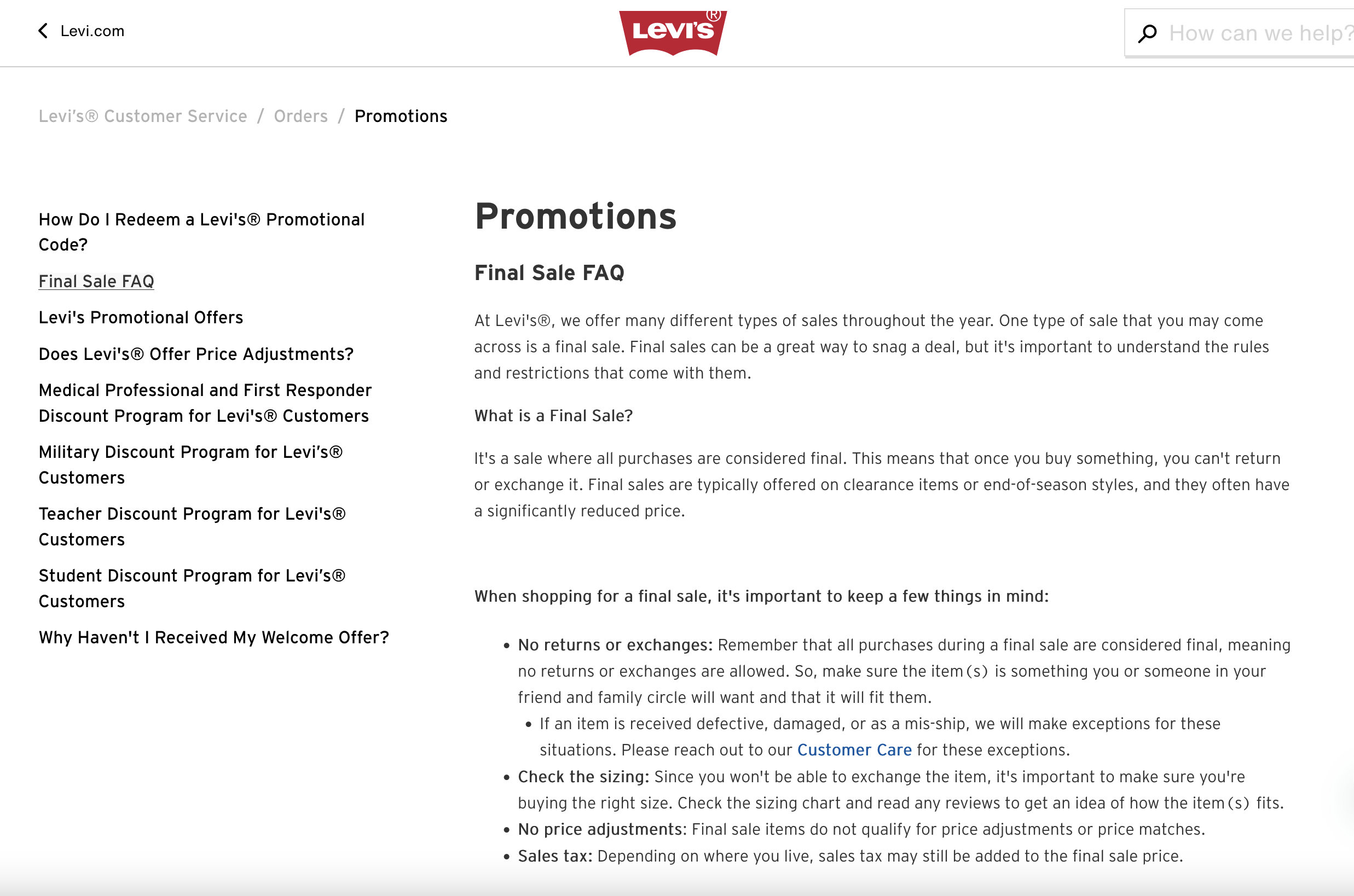
Levi’s added a Final Sale FAQ to explain what a Final Sale is and all relevant details that apply in this case. They also explain that exceptions apply for damaged items or when the wrong item is sent.
all sales are final example

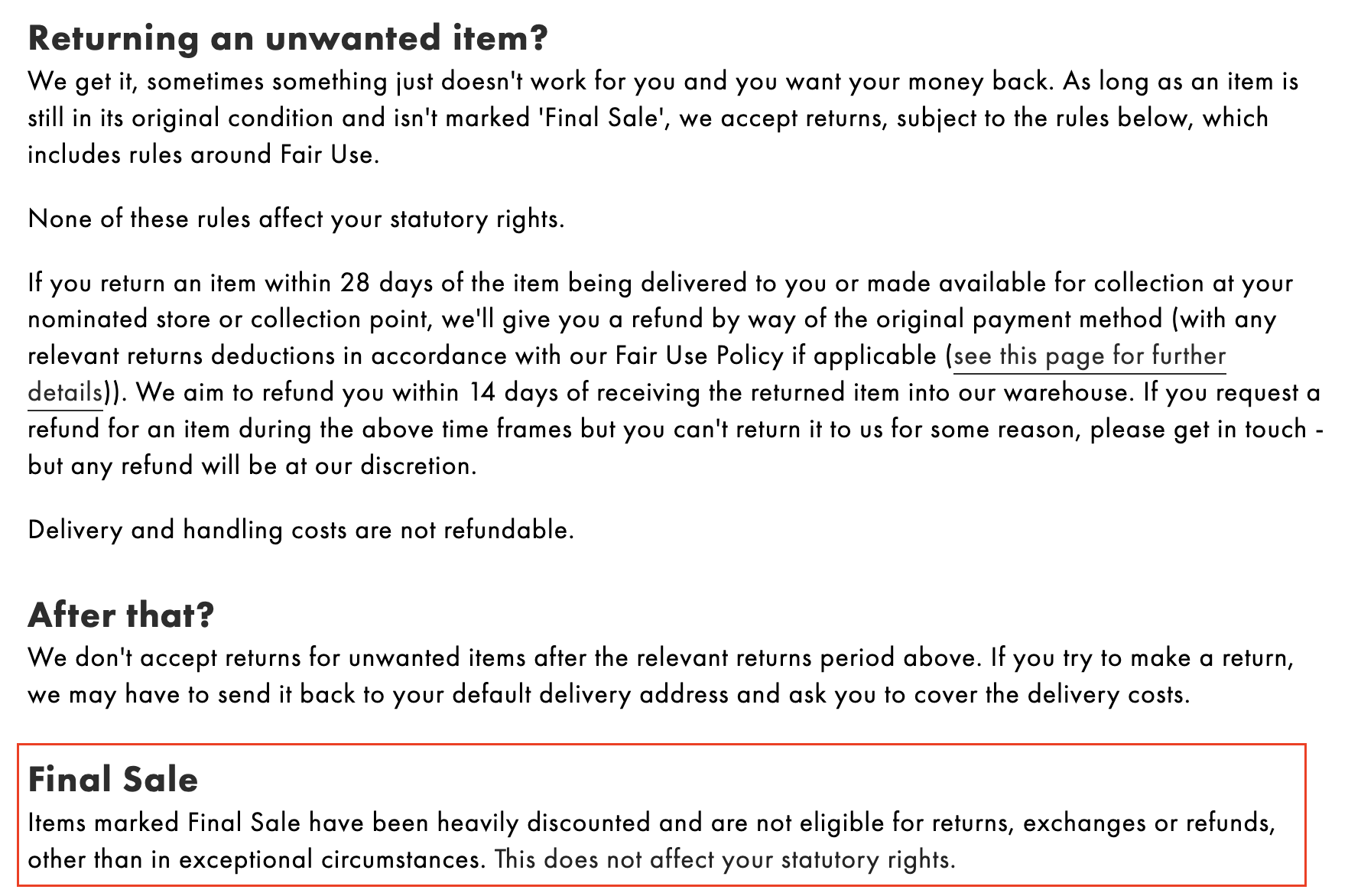
ASOS, too, makes clear in its Return and Refund Policy that items that are marked as “Final Sale” can’t be returned or refunded.
👋 Need to create an All Sales Are Final Policy?

When it comes to creating an “All sales are final” policy, it is important, and even mandatory, that you have a visible statement that “all sales are final” on your product pages and near the shopping portals.

It is also a best practice, and even one of the most convenient, to support this information in your legal documents such as terms and conditions; a document that also helps to protect you and your business, allowing you to set out applicable laws and limit your liability.

Our Terms and Conditions Generator helps you to create a Terms and Conditions document in just a few minutes.

  • 🚀 Select disclosures specific to your business among 100+ pre-drafted clauses, including refunds and more;
  • 🚀 Follow the instructions to easily install the document on your website!